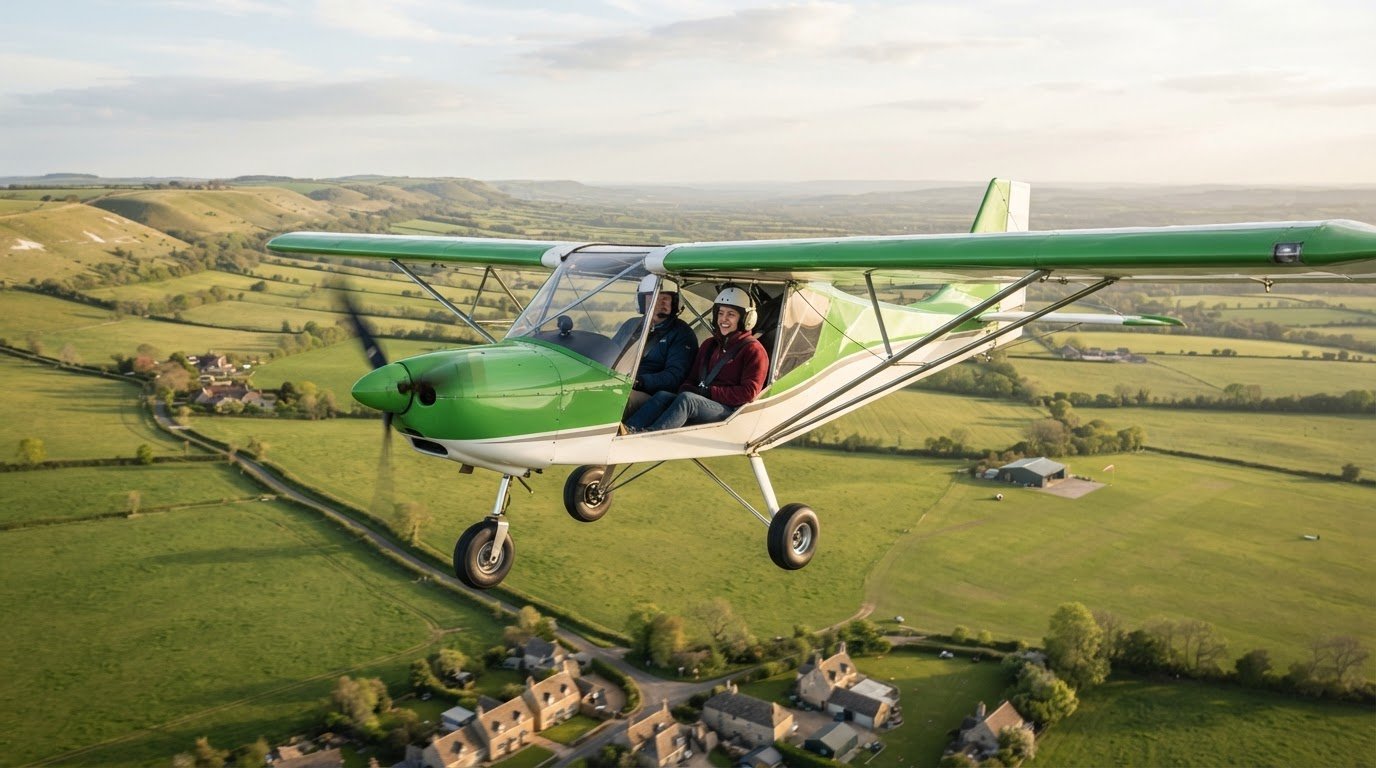
What if your first step towards flying a ulm plane didn’t involve buying one? If you’ve come across “ULM” in European aviation, you may be wondering what it means and whether it’s different from a microlight. In the UK, microlight is the term you’ll hear most often. You don’t need to own an aircraft to experience flying one.
This guide explains the term in plain English and shows you what to consider before choosing an introductory flight or training. A supervised experience can let you take the controls and discover how flying feels. If the view from above sparks a bigger ambition, structured microlight tuition and ground school can help you explore what comes next. We’ll also introduce a local starting point at Fun Flying Aviation Ltd in Yatesbury. You can begin with a first experience, not a plane of your own.
Key Takeaways
- Understand why “ULM plane” is used in some countries, while “microlight” is the familiar term in UK flying.
- Learn how to make sense of aircraft descriptions without getting bogged down in specifications you don’t yet need.
- Compare a trial flight, ongoing tuition and aircraft research to decide which first step suits your goals.
- Explore how supervised flying and structured lessons at Yatesbury can help you discover whether microlight flying is for you.
What Is a ULM Plane? A Clear Starting Point for UK Readers
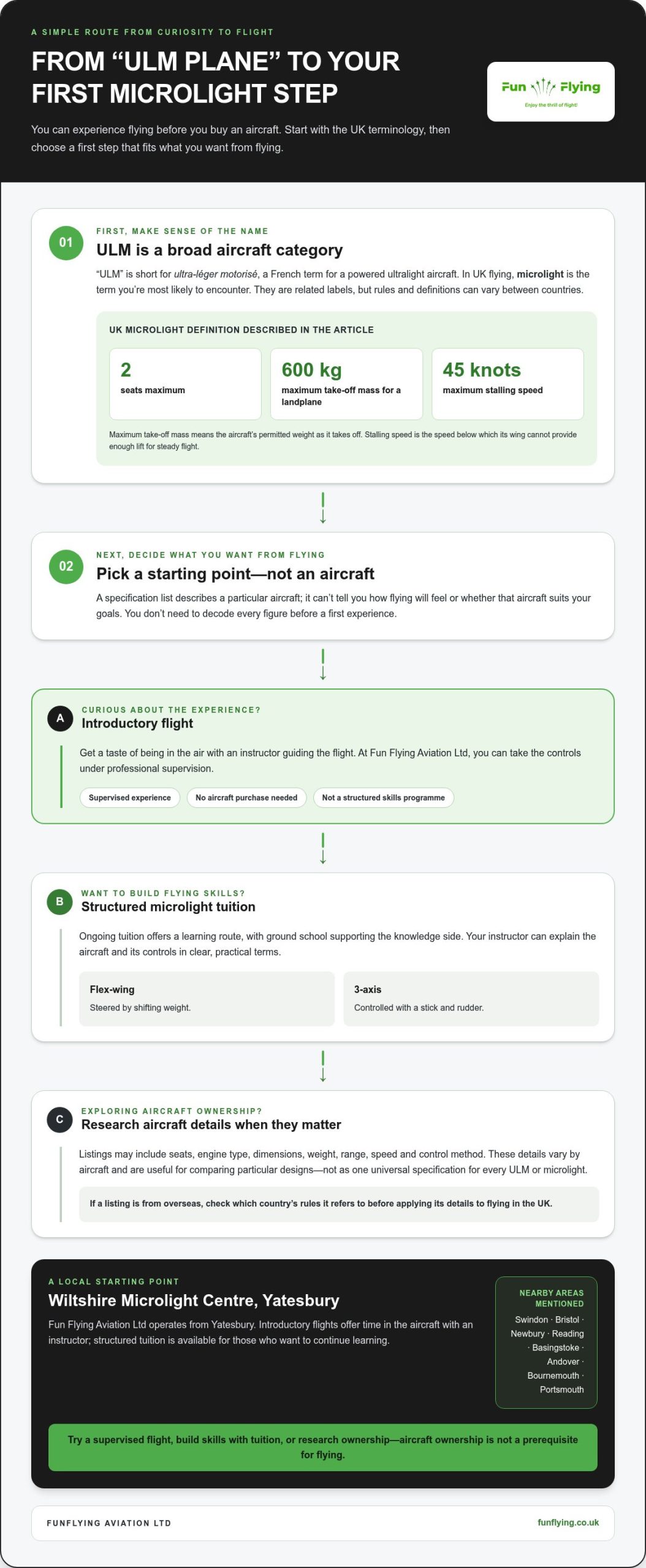
ULM is short for ultra-léger motorisé, a French term for a powered ultralight aircraft. The label is used in parts of Europe, but aircraft terminology and rules vary between countries. In the UK, the Civil Aviation Authority (CAA) uses microlight as the practical term for this category. Its current definition includes aircraft with no more than two seats, a maximum take-off mass of up to 600kg for a landplane, and a stalling speed of no more than 45 knots. Maximum take-off mass means the aircraft’s total permitted weight as it takes off. Stalling speed is the speed below which its wing can no longer provide enough lift for steady flight.
A ULM plane is a broad category of lightweight powered aircraft, not the name of one particular aircraft model or brand. This distinction helps make sense of online listings. A listing may use “ULM” to describe a category, while the aircraft itself has its own make and model. For wider context on how the terminology is used internationally, see this Ultralight aviation (microlight) definition.
Does ULM Mean the Same Thing as Microlight?
Not always. Countries use different terms and apply their own rules. “ULM” is common in some European contexts, whilst “microlight” is the term you’re most likely to encounter in UK flying. Treat the words as related labels, not proof that aircraft definitions or requirements are identical across borders. If you’re reading an overseas listing, check which country’s rules it refers to before applying its details to flying in the UK.
Why ULM Plane Listings Can Feel Technical
Aircraft listings often include details such as seating, engine type and other specifications to help readers compare particular aircraft. These details describe individual designs; they aren’t a beginner’s checklist for deciding whether to try flying. You don’t need to decode every figure before booking a first experience flight. Start by understanding the broad category, then explore aircraft-specific questions when they’re relevant to your plans.
How ULM Planes Are Described, and What Beginners Actually Need to Know
Aircraft listings can look like a wall of unfamiliar terms. You may see fields for seats, engine details, dimensions, weight, range or speed, alongside descriptions of how the aircraft is controlled. These details help you compare particular aircraft, but they aren’t a universal specification that applies to every ULM plane.
Which Aircraft Details Matter Before a First Flight?
Start with what you want to do. For an introductory flight, focus on the experience rather than comparing technical figures. If you’re considering lessons, the control layout may be useful to understand: a flex-wing aircraft is steered by shifting weight, while a 3-axis aircraft is controlled with a stick and rudder. Your instructor can explain the aircraft used for your flight or tuition in clear, practical terms.
If you’re researching ownership, aircraft details matter more, but their relevance depends on the aircraft and how you intend to use it. A specification list alone can’t tell you what a beginner’s flying experience will feel like, or whether a particular aircraft suits your goals. Appropriate instruction and hands-on experience are a more useful starting point than comparing figures in isolation.
Why a ULM Plane Does Not Have One Universal Specification
Aircraft directories use different filters because they cover different designs and record different kinds of information. One listing might foreground the number of seats or engine type; another may include dimensions, weight, range or speed. Those fields describe a specific aircraft, but they don’t mean every aircraft shares the same layout or capabilities. Avoid treating one figure as a rule for the whole category.
Curious to move from browsing to learning? Explore how to learn to fly and consider which first step fits you: an introductory experience or structured tuition.
Do you need to own a microlight to try flying one?
No. You can experience microlight flying without buying an aircraft or committing to a course. A supervised introductory flight lets you experience being in the air, with an instructor guiding the flight. At Fun Flying Aviation Ltd, you can also take the controls under professional supervision.
A supervised experience flight gives you a taste of flying; aircraft ownership is a separate decision, not a prerequisite. Independent aircraft research is useful if you’re exploring ownership, but it’s different from getting airborne. You can discover whether flying appeals to you first, then decide whether you want to learn more.
Trial Flight or Pilot Training: Which Is the Better First Step?
Choose a trial flight if you’re curious about the feeling of flight and want to see how it suits you. It’s an introduction, rather than a structured programme for building skills. If you already know you want to develop as a pilot, ongoing microlight tuition offers a learning route, with ground school supporting the knowledge side. You don’t have to decide on aircraft ownership before taking either step.
A Local First Flight at Yatesbury
Fun Flying Aviation Ltd operates from the Wiltshire Microlight Centre in Yatesbury, a local starting point for people in Swindon and the surrounding area. It also serves as a practical option for people travelling from Bristol, Newbury, Reading, Basingstoke, Andover, Bournemouth and Portsmouth. An introductory flight gives you time in the aircraft with an instructor, while structured tuition is there for those who want to continue learning. The right starting point depends on your aim: enjoy a first flight, or begin building skills.
Ready to explore your next step? Explore microlight flying lessons.
From ULM Plane Curiosity to Your First Microlight Lesson
Once the term makes sense, the next step is about what you want from flying, not choosing an aircraft. Your interest in a ulm plane might lead to a one-off experience or the start of learning to fly. Either is a practical place to begin, and you can decide at your own pace.
- Want to experience flying? Choose an introductory flight to discover what being in the air is like.
- Ready to build skills? Explore structured microlight tuition, with ground school to support your learning on the ground.
At Fun Flying Aviation Ltd, lessons combine practical instruction with a hands-on approach, and scheduling can be flexible. Your pace and next steps are individual, so there’s no need to map out the whole journey before you start.
What Happens After an Introductory Flight?
If the experience leaves you wanting to learn more, you can consider moving on to structured microlight tuition. Ground school forms part of that learning pathway, building the knowledge that sits alongside practical flying. An introductory flight can help you decide whether you’d like to explore this further; it doesn’t commit you to training or guarantee a particular outcome.
Explore Microlight Training in Wiltshire
The Wiltshire Microlight Centre in Yatesbury is Fun Flying Aviation Ltd’s base for introductory flights and microlight training. It offers a local starting point for either option: experience a flight first, or look into a more structured learning route. Instructors guide the practical side, while tuition and ground school support those who want to develop their skills over time.
Ready to take your next step? Explore microlight flight training.
Let Your Curiosity Take Flight
Curiosity can be the beginning of something exciting. Before choosing your next step, think about what draws you to flying: the feeling of being in the air, the chance to learn a hands-on skill, or seeing the landscape from a new perspective. Your answer can help you choose an experience that feels right, without needing to decide how far you’ll take your interest.
If reading about a ulm plane has sparked a wish to do more than browse, let that interest lead to a practical next step. Explore what learning to fly involves and see which option fits your ambitions. There’s no need to have every detail figured out before you begin. A little curiosity is a fine place to start.
Your first step could open up a whole new view. Enjoy finding out where it takes you.
Frequently Asked Questions
What does ULM mean in aviation?
ULM stands for ultra-léger motorisé, French for a powered ultralight aircraft. It’s a term you may encounter in European aircraft articles or listings, where it identifies the broad type of flying being discussed. If you’re reading about flying in Britain, look for the word “microlight” too, as that’s the term commonly used in the UK.
Is a ULM plane the same as a microlight in the UK?
They’re closely related terms, but don’t assume they mean an identical regulatory category in every country. “ULM” is used in some European contexts; UK aviation uses “microlight” for the relevant aircraft category. If a ULM plane listing catches your eye, use “microlight” when looking for UK flying experiences or tuition, and read overseas descriptions in their own national context.
Can I fly a ULM plane without owning one?
Yes. You can book an introductory experience flight without buying an aircraft. A professional instructor supervises the flight, and at Fun Flying Aviation Ltd you can take the controls under that supervision. If you’re curious about handling an aircraft but aren’t ready to commit to lessons, an experience flight lets you try that aspect before deciding whether you’d like to pursue training.
Do I need a licence to fly a microlight in the UK?
Yes, to fly a microlight as a pilot in the UK, you need a National Private Pilot’s Licence (NPPL) with a Microlight Class Rating. This rating is the part of the licence that authorises you to fly microlight aircraft. That’s different from taking the controls during an instructor-supervised experience flight. Ground school, or classroom-based study, supports practical training.
Where can I try flying a microlight near Swindon?
Fun Flying Aviation Ltd offers introductory flights from the Wiltshire Microlight Centre in Yatesbury, a local option for people travelling from Swindon. The centre is also a local starting point for people coming from Bristol, Newbury, Reading, Basingstoke, Andover, Bournemouth and Portsmouth. On an introductory flight, you can experience microlight flying with an instructor and get a feel for whether you’d like to learn more.