
Have you ever looked up at a summer sky and wondered what it feels like to actually hold the controls yourself? Many people assume that pilot life is reserved for the ultra-wealthy or those with a PhD in physics. It’s easy to feel overwhelmed by the thought of complex regulations or the worry that you’ll be out of your depth. But here is the truth. Microlight flying for beginners is the most accessible, pure, and exhilarating way to join the aviation community. Whether you’re in Swindon, Bristol, or anywhere near our Yatesbury hub, the dream of flight is much closer than you think.
We know that the first step can feel like the hardest. You might worry about safety or wonder if you have what it takes to land. This guide is designed to replace that anxiety with a clear, simple roadmap to earning your National Private Pilot’s Licence. We will explore the sheer joy of your first trial flight, break down the training process into easy steps, and show you how to find a welcoming local community. By the time you finish reading, you’ll see exactly how to transition from a curious observer to a confident pilot in command.
Key Takeaways
- Discover why microlight flying for beginners is the most accessible way to experience the sky, offering a sense of freedom that heavy aircraft simply cannot match.
- Learn how you can take the controls from your very first lesson, moving beyond observation to active flying with professional, friendly guidance.
- Understand the clear roadmap to earning your National Private Pilot’s Licence (NPPL), combining hands-on flight hours with flexible ground school.
- Uncover the modern engineering and safety protocols that make microlighting incredibly reliable, ensuring you feel confident and secure from take-off to landing.
What is Microlight Flying and Why is it the Ultimate Hobby?
Forget the sterile, pressurised cabins of commercial travel. Microlighting is different. It is the purest way to experience the sky, offering a visceral connection to the elements that larger aircraft simply cannot match. For those looking into microlight flying for beginners, it represents the ultimate gateway to the clouds. It’s about feeling the lift, hearing the wind, and seeing the world unfold beneath your wings without a layer of thick glass in the way. This is aviation stripped back to its most joyful essence.
This branch of ultralight aviation is built on the idea that flying should be for everyone. You don’t need a massive bank balance or an engineering degree to get started. It is an incredibly accessible hobby that prioritises fun and freedom over complex jargon. At centres like Yatesbury, near Swindon and Bristol, the focus is on making the cockpit a welcoming space. It’s a vibrant, friendly community where shared passion replaces the “elite” barriers often associated with traditional pilot training.
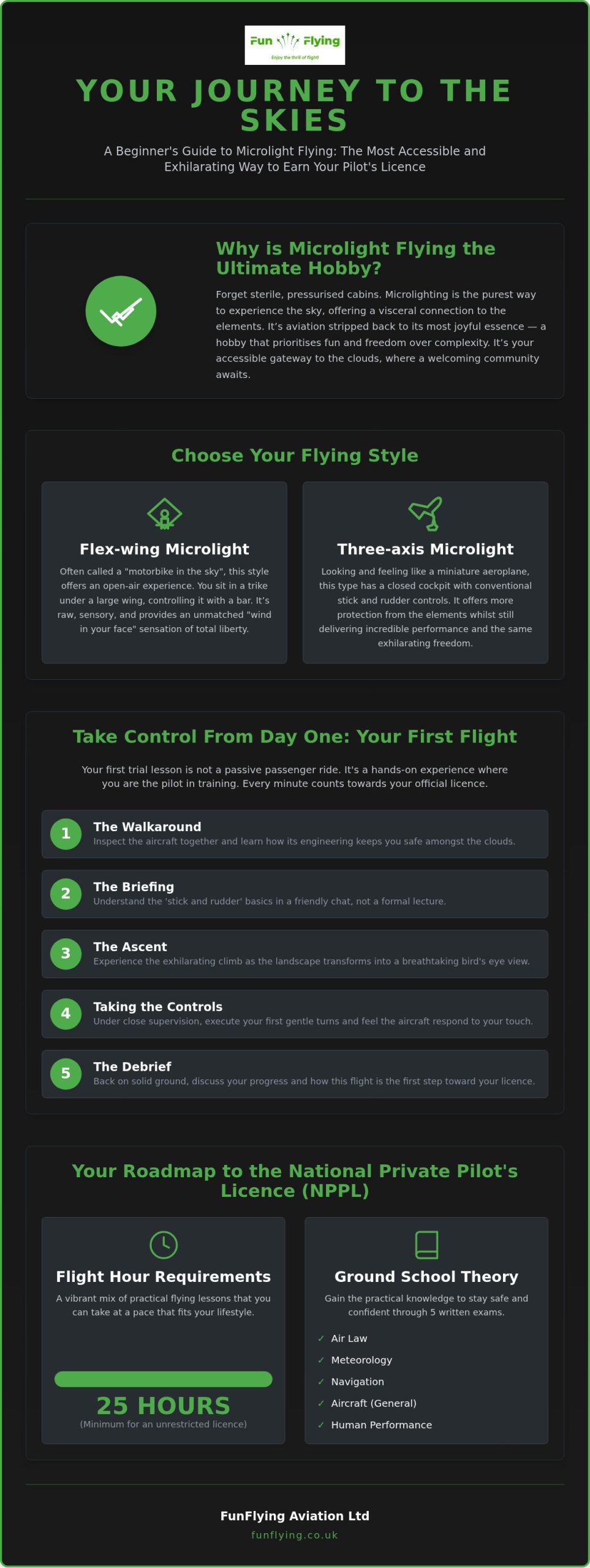
Flex-wing vs Three-axis: Choosing Your Flying Style
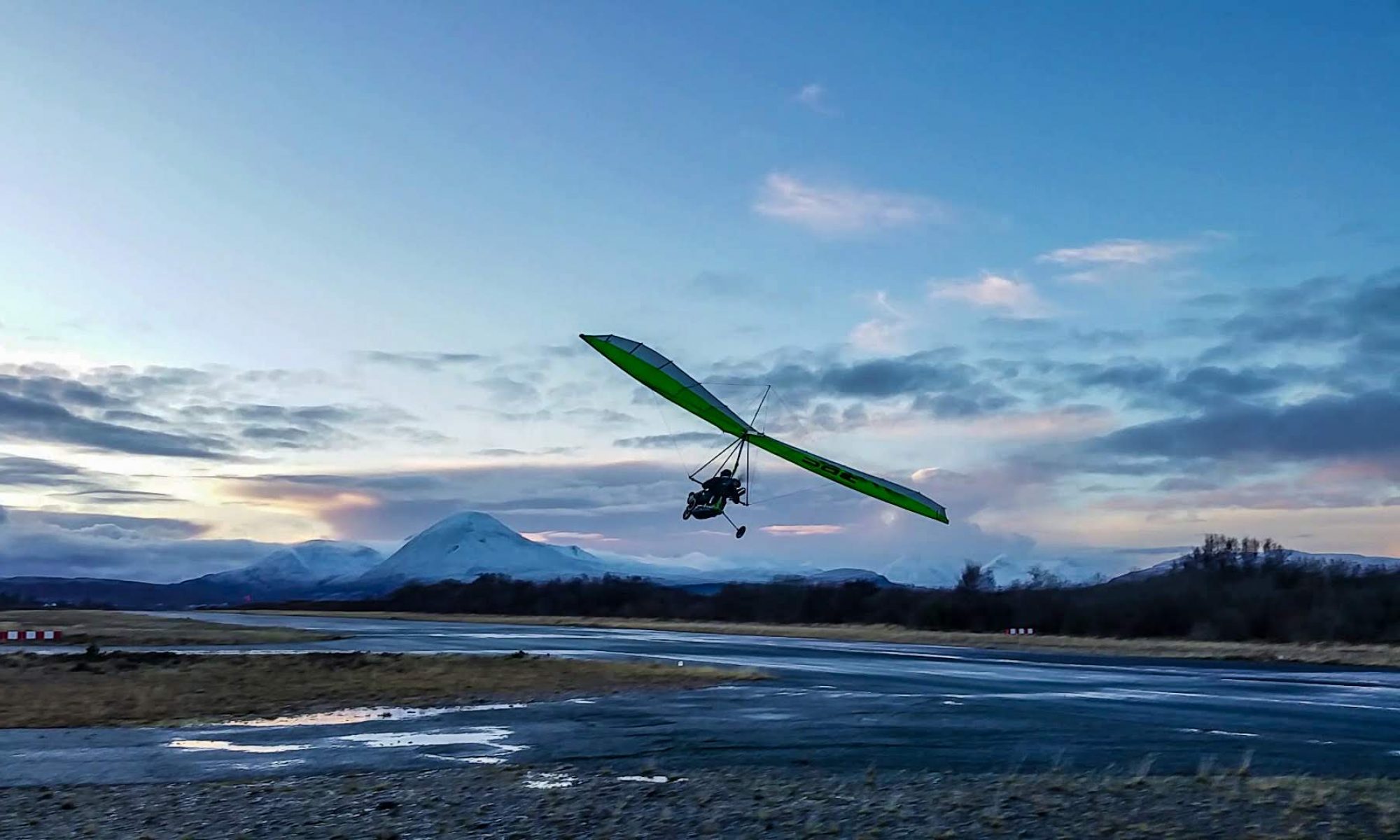
Imagine yourself in a flex-wing microlight. Many pilots describe it as a “motorbike in the sky” because you are sitting in an open trike suspended below a large wing. You control the aircraft by moving your weight with a control bar. It is raw, sensory, and provides an unmatched view of the Wiltshire countryside. It’s the perfect choice if you crave that “wind in your face” sensation of total liberty.
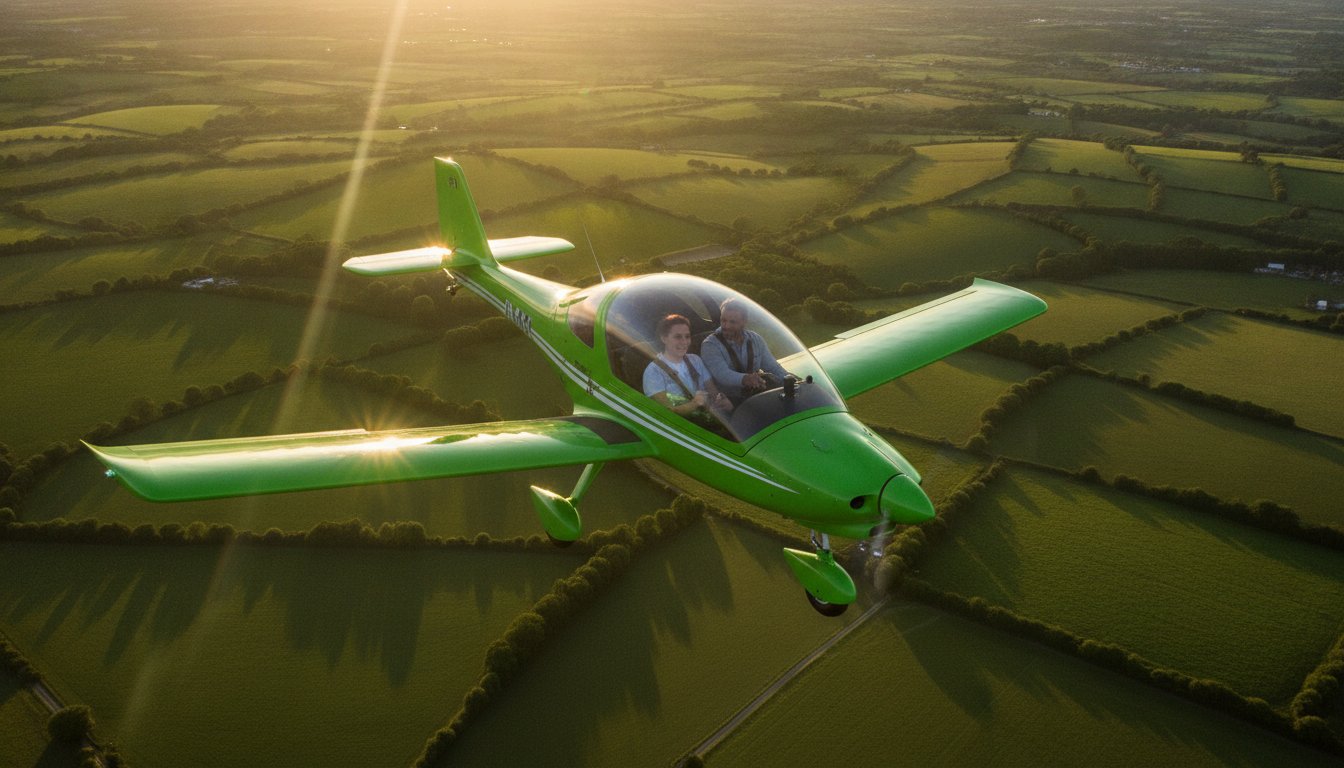
Alternatively, you might prefer three-axis microlight training. These aircraft look and feel like miniature traditional aeroplanes, featuring a closed cockpit and conventional stick and rudder controls. They offer a bit more protection from the elements whilst still delivering incredible performance. Both paths lead to the same destination: the sheer exhilaration of flight. To better understand the full range of options available to you, explore our comprehensive guide to microlight aircraft types UK pilots can choose from. At Fun Flying Aviation Ltd, we specialise in microlight flying for beginners and help you learn to fly in the style that resonates most with your personal dream of being a pilot.
Your First Trial Lesson: Taking Control from Day One
Walking onto the airfield for the first time is a moment you’ll never forget. At Fun Flying Aviation Ltd, our philosophy is simple: we want you to actually fly. Forget being a passive passenger; from day one, you are the pilot in training. Your journey into microlight flying for beginners starts with a warm welcome at Yatesbury, where the focus is on hands-on experience rather than just observation.
Before you even leave the ground, we sit down for a thorough pre-flight briefing. We’ll chat through the basic controls and safety protocols in a way that feels like a conversation with a friend, not a lecture. Once you’re strapped in, the sensation of taking off from the Wiltshire Microlight Centre is pure magic. As the wheels leave the grass, the landscape opens up and you’ll feel that incredible lift. Don’t worry about the technicalities yet. Your instructor is right there, guiding every movement and ensuring you feel completely secure.
The 5-Step Experience of Your First Flight
- The Walkaround: We’ll inspect the aircraft together, explaining how it stays amongst the clouds and how the engineering keeps you safe.
- The Briefing: You’ll learn the ‘stick and rudder’ basics, understanding how small movements of the controls translate into flight.
- The Ascent: Experience the exhilarating climb as Wiltshire transforms into a bird’s eye view of rolling hills and ancient landmarks.
- Taking the Controls: This is the big one. Under close supervision, you’ll execute your first gentle turns whilst feeling the aircraft respond to your touch.
- The Debrief: Back on solid ground, we’ll discuss your progress. Every minute of this trial flight counts towards your official pilot’s licence, proving that microlight flying for beginners is a practical path to the cockpit.
The Journey to Your Pilot’s Licence: Training and Ground School
The National Private Pilot’s Licence (NPPL) is your official passport to the skies. It is the ultimate goal that turns a curious hobbyist into a fully qualified pilot. We believe that microlight flying for beginners should be an adventure from start to finish. That’s why our training is designed to be a vibrant mix of practical flying and essential theory. You can learn to fly at a pace that fits your lifestyle; whether you want to fast-track your progress or take it slow on the weekends. Every single hour you spend in the air brings you closer to that feeling of ultimate freedom.
Mastering the Theory in Ground School
Don’t let the term “school” put you off. This isn’t about sitting in a dusty classroom memorising dry facts. It’s about gaining the practical knowledge you need to stay safe and confident. You’ll explore fascinating subjects across five written exams, covering topics like navigation, meteorology, and air law in a way that actually makes sense. Learning how to read the clouds or plot a course across the countryside is incredibly rewarding. For a deeper look at what to expect, check out our microlight ground school UK guide.
Meeting the Flight Hour Requirements
To earn an unrestricted licence, you’ll need a minimum of 25 flight hours. However, it’s vital to remember that everyone learns at their own pace. Consistency is the secret ingredient here. Flying regularly helps build the “muscle memory” that makes handling the aircraft feel like second nature. As you explore microlight flying for beginners, try not to view these hours as a tick-box exercise. See each one as a fresh adventure. Every take-off is a chance to sharpen your skills whilst enjoying the incredible views over Wiltshire. Your instructor will be there to celebrate every milestone with you.
Safety, Requirements, and Starting at Yatesbury
Safety is the top priority for anyone exploring microlight flying for beginners. You might wonder about the risks, but modern aviation technology has made these aircraft exceptionally reliable. We are frequently asked, is microlight flying safe?; the answer is a resounding yes. Today’s machines are engineering triumphs. Many are even equipped with ballistic recovery systems, which act as a parachute for the whole aircraft, providing an extra layer of reassurance for every student.
The Safety Standards of Modern Microlights
Every Fun Flying Aviation Ltd lesson is built on a foundation of professional care. Our aircraft undergo rigorous maintenance, and our instructors are highly qualified experts who live and breathe aviation. Microlights are inherently stable. They are designed for recreational joy and possess forgiving handling that makes them perfect for newcomers. You can feel confident knowing that your safety is managed with absolute precision whilst you focus on the exhilaration of being in the air.
Why Yatesbury is the Perfect Place to Start
Location matters when you are learning a new skill. Yatesbury is an ideal hub for students from Bristol, Swindon, and Newbury. The Wiltshire countryside offers a peaceful training ground free from the stress of heavy commercial airspace. This allows you to focus entirely on the controls whilst soaking in the historic views. The Wiltshire Microlight Centre at Yatesbury is a friendly, welcoming community where the kettle is always on.
It is also a wonderfully inclusive hobby. If you check the microlight flying age requirements, you’ll find that students can start training at 14 and fly solo by 16. There’s no upper age limit either; as long as you are fit to drive, you are generally fit to fly. Come and visit us at the airfield, meet the team, and experience the atmosphere for yourself before booking your first flight.
Your Skyward Adventure Starts Now
You have discovered that microlighting is the most accessible and exhilarating way to experience the clouds. From the sensory thrill of your first trial flight to the methodical journey of earning your licence, every step is designed for joy. It is about stripping away the complexity of traditional aviation and returning to the pure, open-air excitement of flight. This is your chance to join a community that values freedom and adventure above all else.
Microlight flying for beginners isn’t just about learning a new skill; it’s about claiming a level of autonomy that most people only dream of. Our expert instructors at the stunning Yatesbury airfield are ready to help you take the controls from your very first lesson. With flexible training programmes that fit around your busy lifestyle, the path to becoming a qualified pilot has never been clearer or more welcoming.
It’s time to stop looking up and start looking down. The horizon is calling, and we can’t wait to see you in the cockpit for your first real taste of freedom. Your journey to the skies begins the moment you decide to take that first step.
Frequently Asked Questions
Do I need any previous experience to start microlight flying for beginners?
You don’t need any prior aviation experience to begin your journey. Microlight flying for beginners is designed to take you from a complete novice to a confident pilot through a structured, hands-on approach. At our Yatesbury base, we welcome students from all walks of life. Our professional instructors will guide you through every step, ensuring you feel comfortable and in control from your very first trial flight.
What is the difference between a flex-wing and a three-axis microlight?
A flex-wing microlight features an open trike suspended below a large wing, controlled by shifting your weight with a bar. It offers a raw, sensory experience. In contrast, a three-axis aircraft looks like a traditional aeroplane with a closed cockpit and conventional stick controls. Both paths are excellent for microlight flying for beginners, so your choice depends on whether you prefer the open-air thrill or a more protected flying environment. Our guide to microlight aircraft types UK aviators can fly covers both options in greater detail to help you decide.
How long does it take to get a microlight pilot’s licence in the UK?
To earn your National Private Pilot’s Licence (NPPL), you must complete a minimum of 25 hours of flight training. Most students find that training takes longer as they work to master specific skills and pass their ground school exams. Because we offer flexible schedules six days a week, you can progress at a pace that suits your personal life, whether you are visiting us from Swindon, Bristol, or further afield.
Are there any specific medical requirements or fitness levels needed to fly?
Are there any specific medical requirements or fitness levels needed to fly?
You don’t need a rigorous commercial pilot medical to fly a microlight. Instead, most pilots simply complete a Pilot Medical Declaration (PMD). This is a self-certification process where you confirm you meet the health standards required to drive a car. It makes the hobby incredibly inclusive for everyone. To stay in peak physical condition for the focus and stamina required in the cockpit, you might visit Gym n Go Forest Hill for professional fitness support. If you have any specific health concerns, it’s always best to have a quick chat with our friendly team before your first lesson.
Dress in comfortable, warm layers for your flight at Yatesbury. Even on a sunny day in Wiltshire, it can be significantly cooler once you’re up amongst the clouds. If you’re training in a flex-wing aircraft, a windproof jacket is essential to keep you cosy. We recommend wearing sturdy, flat shoes like trainers or boots. We’ll provide any specialised gear like helmets and headsets to ensure you are safe and connected throughout.