Learn to fly in the UK without a medical: eligibility and training time

Learn to fly in the UK without a medical: eligibility and training time

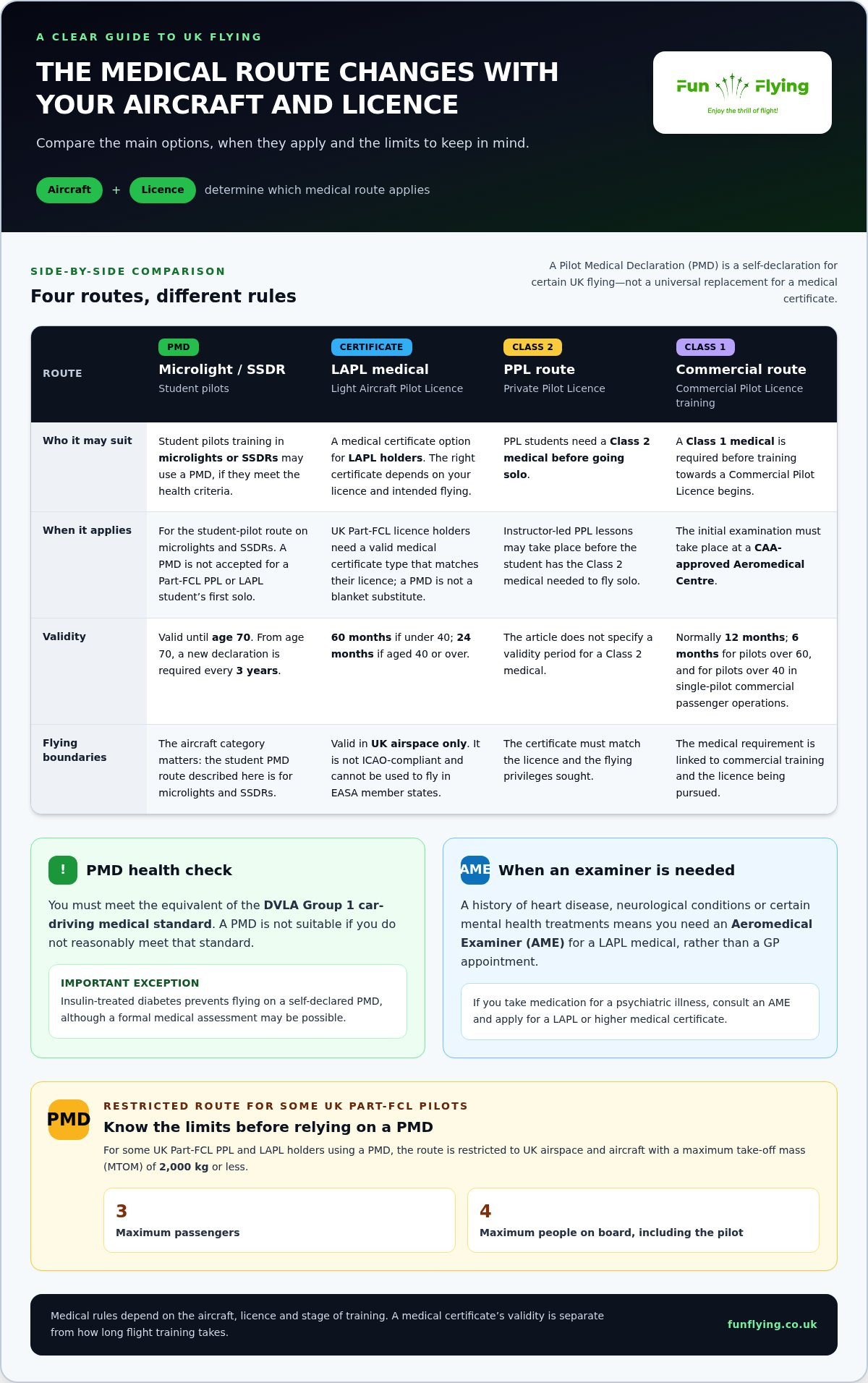
You can learn to fly in the UK without a medical certificate on a microlight route: student pilots may use a Pilot Medical Declaration (PMD) for microlights and SSDRs. A PMD remains valid until age 70, then a new declaration is required every three years. You still need to meet the relevant health criteria, including the equivalent of the DVLA driving standard.

It’s understandable to wonder whether you need a Class 1 or Class 2 medical before taking to the skies. The answer depends on the type of flying and licence you’re working towards: microlight training has a different route from private or commercial pilot training.

This guide explains which declaration or certificate may apply, how long each remains valid, and what that means when you learn to fly in the UK without a medical certificate. It also covers how lesson frequency can shape your training progress.

Key Takeaways

  • A Pilot Medical Declaration may allow eligible student pilots to train in microlights, but the rules depend on the aircraft and licence.
  • Match your medical to your licence: UK Part-FCL PPL and LAPL holders need the certificate type that applies to their licence.
  • Your training timeline depends partly on how regularly you can fly, so lesson frequency is worth considering when planning your progress.
  • A Trial Flight or Experience Flight can help you explore microlight flying as you consider your next step.

Pilot Medical Declaration eligibility

A Pilot Medical Declaration (PMD) is a self-declaration of medical fitness for certain UK flying. It is not a universal substitute for a medical certificate: whether it applies depends on your aircraft, licence and stage of training.

Medical requirements before a first solo

A student pilot must meet the medical rules for their licence before flying solo. For Part-FCL PPL or LAPL training, a PMD isn’t accepted for that first solo: you need an actual medical certificate. PPL students need a Class 2 medical before going solo, but may take instructor-led lessons beforehand. Student pilots can use a PMD only for microlights and SSDRs. This distinction helps you plan training without assuming the same declaration covers every aircraft.

For general UK learn-to-fly training, the aircraft and licence route determine which requirement applies.

Accepted declarations for UK LAPL and PPL

For a UK Part-FCL LAPL or PPL, the medical route depends on the licence; a PMD is not a blanket substitute for a medical certificate. A UK pilot using a PMD with a Part-FCL PPL or LAPL is limited to UK airspace and aircraft of no more than 2,000 kg MTOM. MTOM means the aircraft’s maximum take-off mass.

For balloon and sailplane pilots, a PMD is generally sufficient under UK Part-BFCL and Part-SFCL rules. Commercial passenger ballooning with more than 4 people on board requires at least a Class 2 medical certificate. A passenger airline certificate is separate: airlines may request one for travel after 28 weeks of pregnancy.

Conditions and medication affecting self-declaration

A PMD requires you to meet the equivalent of the DVLA Group 1 car-driving medical standard. You can’t self-declare if you don’t reasonably meet it. Insulin-treated diabetes also prevents flying on a self-declared PMD, although a formal medical assessment may be possible.

A history of heart disease, neurological conditions or certain mental health treatments means you need an Aeromedical Examiner (AME) for a LAPL medical rather than a GP appointment. If you take medication for a psychiatric illness, you must consult an AME and apply for a LAPL or higher medical certificate. For commercial pilot training, a Class 1 medical is required before training towards a Commercial Pilot Licence begins; the initial examination must take place at a CAA-approved Aeromedical Centre.

LAPL as an alternative for people with medical limitations

A Light Aircraft Pilot Licence (LAPL) is a private flying licence with its own medical certificate route. It may be worth exploring if a medical condition makes another certificate difficult, but it does not remove the need to meet fitness requirements. The right route depends on your health and the flying privileges you want.

According to the UK Civil Aviation Authority, UK Part-FCL licence holders, including LAPL and PPL pilots, need a valid Class 1, Class 2 or LAPL medical certificate, depending on their licence. A doctor may be able to sign a LAPL medical if you have no serious pre-existing conditions. A history of heart disease, neurological conditions or certain mental health treatments requires assessment by an Aeromedical Examiner for a LAPL medical.

A UK LAPL medical is valid for 60 months if you’re under 40, and 24 months if you’re aged 40 or over. It applies to LAPL holders and is valid in UK airspace only. It isn’t ICAO-compliant, so it can’t be used to fly in EASA member states. That matters if you’re planning to take your flying beyond the UK.

There’s also a restricted PMD route for some UK Part-FCL PPL and LAPL holders. Under that route, you’re limited to UK airspace and aircraft with a maximum take-off mass of 2,000 kg. You can carry no more than 3 passengers, with no more than 4 people on board. Those limits shape where you can fly and who can come along.

A medical certificate choice should match both your pilot licence and your intended flying. If medical limitations are affecting your plans, understanding the available microlight training options can help you explore a different route into flying.

Training duration and lesson frequency

Training time depends partly on how often you fly and how consistently you practise. UK PPL training can take around eight months to a year or longer, and students are ideally advised to take one or two flying lessons each week. Regular lessons give you time to build skills, revisit earlier learning and progress through the course. Your schedule matters as much as your ambition.

Consider your usual weekly commitments before you plan your training. If work or family makes regular lessons difficult, longer gaps may extend the time it takes to progress. Consistent sessions help you carry skills from one flight to the next; after a break, you may need time to refresh what you learned. That is a planning consideration, not a measure of your potential as a pilot. Developing strong cognitive resilience and mental focus is just as valuable when absorbing complex technical skills, and resources such as Neurotransformation by Tanja highlight how mindset and neurotransformation coaching can support individuals through demanding personal learning journeys.

A shorter course may suit students who can commit the time and money to train intensively, with an estimate of around three to six months. This is a faster pace, not a promise of completion by a set date. Lesson frequency, progress through each training stage and time for study all affect your pace. If you are considering microlight training, discuss the course structure and a suitable lesson rhythm as part of your plan.

Keep medical certificates on a separate timeline from flying lessons. A certificate’s validity doesn’t tell you how long training will take, and a fitness-to-fly assessment serves a different purpose from learning to handle an aircraft. For example, a UK Class 1 medical is normally valid for 12 months, but for pilots over 60 it is valid for 6 months. The shorter period also applies to pilots over 40 in single-pilot commercial operations carrying passengers. If your goal is an airline career, account for medical requirements as well as training time. For recreational flying, focus first on the licence route, lesson schedule and medical rules that apply to it.
Learn to fly in the UK without a medical: eligibility and training time

Can you train for a UK NPPL without a medical?

Yes. Some UK NPPL student pilots can train without a medical certificate by making a Pilot Medical Declaration (PMD). The student-pilot exception applies to microlights and SSDRs, so the aircraft category matters. A PMD is a self-declaration, not an exemption from medical fitness criteria.

For an NPPL route, a PMD can apply to NPPL or local UK PPL flying, within its restrictions. The declaration is for UK airspace and aircraft under 2,000 kg maximum take-off weight. It remains valid until age 70; after that, a new declaration is required every three years. That helps you understand the medical route, but it doesn’t make every licence or aircraft eligible.

Before self-declaring, you must reasonably meet the DVLA Group 1 car-driving medical standard. A history of heart disease, neurological conditions or certain mental health treatments means you need an Aeromedical Examiner for a LAPL medical rather than a GP. Insulin-treated diabetes also prevents flying under a self-declared PMD, although formal medical assessment may be possible. These criteria matter before you plan training around a declaration.

Keep the difference between training and later privileges clear. A PMD may support eligible microlight student training, but it doesn’t automatically cover another aircraft category or every NPPL privilege. Your intended aircraft and licence determine whether the declaration fits. If your goal is commercial pilot training, this route isn’t a substitute for the required Class 1 medical before Commercial Pilot Licence training begins.

A delayed Class 1 medical can affect a commercial course: the start date may be pushed back if the certificate is still missing up to four weeks before the course begins. That’s a separate issue from an NPPL microlight route, but it shows why choosing your licence goal early matters.

Explore UK microlight training

Fun Flying Aviation Ltd: Experience Flights

Fun Flying Aviation Ltd offers Experience Flights for people curious about flying from the pilot’s seat. If you are weighing up medical rules and training routes, an experience flight lets you discover what flying feels like before deciding on your next step.

Ready to work towards a licence? Fun Flying Aviation Ltd provides microlight licence training and Ground School to build your flying skills and aviation knowledge. Trial Flights offer another introduction to flying. Your training route depends on the licence and aircraft you are aiming for, so keep the relevant medical requirements in mind as you plan.

For a friendly starting point, contact Fun Flying Aviation Ltd or visit funflying.co.uk.

Take your next step towards flying

Your next step can be simple: decide whether you want to experience flying first or start working towards a licence. If you are considering whether you can learn to fly in the UK without a medical certificate, focus on your intended aircraft and flying goals. A clear goal makes it easier to plan around your ambitions and available time.

Fun Flying Aviation Ltd offers Experience Flights and Trial Flights for a taste of flying, as well as microlight licence training when you are ready to build your skills. Choose the step that suits you, then progress at your own pace.

Explore your flying options

Your aviation journey can start with one exciting step. The sky is waiting.

Frequently Asked Questions

Aviation medicals in the UK: Do you need a Class 1 or Class 2 to start flight training?

The certificate depends on your intended licence: a UK PPL uses a Class 2 medical, while commercial training towards a Commercial Pilot Licence requires a Class 1 before that training begins. “Part-FCL” is the UK licensing framework covering licences such as the PPL and LAPL. Decide whether your goal is private or commercial flying first, as that choice shapes the medical route.

Can I fly with a heart condition?

A heart condition does not by itself determine whether you can fly. Your medical history and its effect on safe flying matter. An Aeromedical Examiner (AME) is a doctor qualified to assess pilots’ medical fitness. Having your NHS medical notes available for an appointment can help explain your diagnosis, treatment and current health.

Can you learn to fly in the UK without a medical certificate?

Yes. Some student pilots can train without a medical certificate on eligible microlight or SSDR routes. SSDR means a single-seat, deregulated microlight. Before planning your training, identify the aircraft category and licence you intend to pursue: a declaration for one route does not automatically cover another.

What medical requirements apply to UK trial flying lessons?

A supervised Trial Flight is an introductory experience, not a solo flight or a licence assessment. Fun Flying Aviation Ltd lets participants take the controls under professional supervision. Taking the controls during an introductory flight does not give you permission to fly independently. If you are considering ongoing training, use the trial to experience flying before choosing a licence route.

What are the UK CAA rules for self-declared pilot medical fitness?

A Pilot Medical Declaration is your own declaration that you meet the applicable medical standard for the flying route. The DVLA Group 1 standard is the medical fitness standard used for ordinary car drivers. Consider your health and medication in relation to safe flying before making a declaration; it isn’t simply a form to complete regardless of your circumstances.

Can you fly solo in the UK before obtaining a pilot medical?

For a UK PPL student, you cannot fly solo before holding the required medical certificate. A different exception applies to student pilots flying microlights and SSDRs under an eligible declaration. In practice, the aircraft category matters as much as your training stage. SSDR means a single-seat, deregulated microlight, not a general exemption for every aircraft.
Marce Colucci

Article by

Marce Colucci

Love to fly, and more importantly, love teaching others to fly.

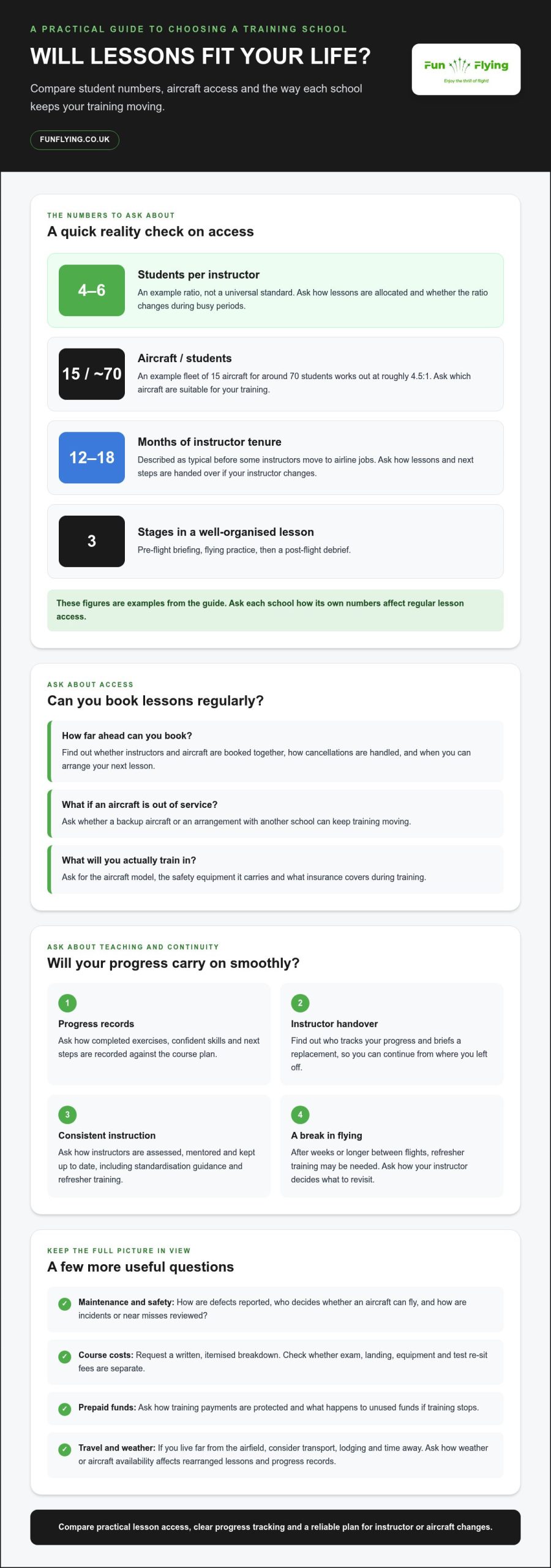
Questions to Ask a Flight Instructor About Training Quality

Questions to Ask a Flight Instructor About Training Quality

The most useful questions to ask a flight instructor cover who owns or leases the aircraft, how instructors are mentored, and how the school keeps training consistent. Ask how many students share each instructor and how far ahead you can schedule lessons. These answers help you understand what your training could look like in practice.

It’s natural to focus on the aircraft: you want to know what you’ll fly and whether it will be available when you’re ready to learn. But a good training experience also depends on clear progress tracking, consistent instruction and lesson times that fit your life.

This guide gives you practical questions to raise about aircraft ownership, instructor support, training consistency, student ratios and scheduling. You’ll be better prepared to compare how each school organises training and choose a path towards the freedom of flying with confidence.

Key Takeaways

  • Ask who owns or leases the aircraft and what happens to lesson plans if your instructor changes.
  • Find out how instructors are mentored, assessed and supported in keeping their knowledge current.
  • Compare student-to-instructor and student-to-aircraft ratios, then ask how these affect access to lessons.
  • Look for a clear training structure and ask how course costs, extra fees and lesson gaps are managed.

Instructor evaluation, mentoring and recurrent training

An independent instructor teaches on their own, while a flying school organises training through its instructors and course plan. Ask who tracks your progress and shares your plan if your instructor changes. A clear handover helps you continue from where you left off instead of repeating lessons.

For UK microlight training, medical requirements depend on the licence route and aircraft. Ask which medical standard applies to the licence you’re pursuing, and which licence the course prepares you to earn.

  • Ask how instructors are assessed, mentored and kept up to date. Find out what standardisation training they receive, meaning guidance that helps instructors teach using consistent methods. Ask about recurrent training too: regular refresher sessions that help instructors maintain and update their teaching knowledge.
  • Ask how long instructors tend to stay and how handovers work. Instructor tenure of 12 to 18 months is described as typical before some move to airline jobs. Ask how the school records lessons, skills and next steps, and who briefs a replacement instructor.
  • Ask for outcomes and realistic timelines for your chosen course. Request the first-time pass rate for relevant UK skill tests, practical assessments of flying ability, and ask how it’s calculated. Ask for the average completion time rather than relying on the best-case estimate. If you hope to advance a flying career, ask which qualifications the course supports.
  • Ask how instructors’ experience fits your goals. Explain where you hope to be in 5 years, then ask how their teaching experience relates to that ambition. Their answer can show whether they understand your priorities, whether you’re learning for recreation or a career.
  • Ask for a written breakdown before discussing finance. Separate course charges from any exam, landing, equipment or test re-sit costs, then compare loan interest, repayment dates and total repayment. Ask how prepaid training funds are protected, and read the terms before paying.

These questions help you judge teaching quality, continuity and course fit. For a closer look at the training pathway, explore learning to fly in a microlight.

Student-to-aircraft and student-to-instructor ratios

Ask how many students each instructor teaches and how many training aircraft are available. This helps you understand how lessons are scheduled and whether you can book regularly.

  • Ask for the current student-to-instructor ratio. Around 4-6 students per instructor is an example, not a universal standard. Ask how the school allocates lessons and whether the ratio changes during busy periods.
  • Ask how many aircraft are available to active students. A useful illustration is 15 aircraft for around 70 students, a ratio of roughly 4.5:1. Ask which aircraft are suitable for your training, rather than relying on the fleet total alone.
  • Ask how far ahead you can book and how availability is managed. Find out whether instructors and aircraft are booked together, and how cancellations affect your next lesson. A booking process can matter as much as the headline fleet size.
  • Ask what happens if an aircraft is out of service for an extended period. Ask whether a backup aircraft or an arrangement with another school can keep training moving. A clear plan helps you understand how maintenance downtime could affect lesson continuity.
  • Ask which aircraft you’ll train in, what safety equipment it carries, and what insurance covers during training. Get the aircraft model and the relevant equipment and cover explained in plain language, so you know what applies to your lessons.
  • Ask how maintenance and safety are monitored. Find out how defects are reported, who decides whether an aircraft can fly, and how incidents or near misses are reviewed. Those steps show how safety information informs day-to-day decisions.

Use the answers to compare practical access, not just fleet size. If you’re exploring microlight training, the learn-to-fly information can help you understand the training pathway.

How Is Training Consistently Maintained?

A well-organised flight lesson has three stages: a pre-flight briefing, flying practice and a post-flight debrief. Ask how your instructor records progress against the course plan, identifies what to practise next and adapts the next lesson if you need more time.

  • Request a complete, itemised course breakdown. Ask which charges cover instruction and aircraft use, and whether exam fees, landing fees, equipment or test re-sits are separate. A written list makes it easier to plan the full commitment and compare like with like.
  • Ask how prepaid training funds are protected. Find out whether payments are held in a separate client account, meaning an account kept apart from the school’s everyday business funds, or covered by an insurance policy. Ask what happens to unused funds if training stops. Clear terms help you understand the arrangement before paying.
  • Ask how the school measures progress. A standard syllabus is a shared course plan that sets out the ground and flight skills students work through. Written records can show which exercises you’ve completed, where you’re confident, and what needs more practice. Ask how often your instructor reviews these records with you, rather than relying on memory between lessons.
  • Ask what happens after a break in flying. Students who go weeks or longer between training flights often need refresher training, which can increase training cost and completion time. Ask how the instructor decides what to revisit before you resume new exercises.

If you live far from the airfield, travel and accommodation may also affect your training plan. Ask whether lessons can be arranged to suit your travel, then factor in transport, lodging and time away from home. These costs depend on your circumstances, so include them in your own budget rather than considering flight fees alone.

Ask how weather changes or aircraft availability affect lesson continuity. A clear process for rearranging a session, updating your progress record and agreeing on the next practice goal helps you return with a plan.

Questions to Ask a Flight Instructor About Training Quality

Student-to-instructor ratios and lesson scheduling

A ratio gives useful context, but your timetable shows whether instruction is accessible in practice. Around 4-6 students per instructor is an example to discuss, not a rule. Ask how many students are actively flying, how teaching time is divided, and whether the figure changes during busy periods.

Map out a typical booking cycle. Ask how far ahead you can reserve a lesson, how bookings are made and how often suitable slots are available. If you can fly only around work shifts or an airline roster, explain those limits and ask how scheduling works. Understanding the process from the start makes regular lessons easier to plan.

For lesson length, cancellations, weather and rescheduling, ask what a standard session includes, how much notice you need to give to cancel, and whether weather-related changes follow a different process. Find out who contacts you, how a replacement slot is arranged and whether any cancellation charge applies. Get clear answers before you commit to a booking.

  • Ask how many students each instructor currently teaches. This helps you understand whether your preferred lesson times compete with other students’ bookings.
  • Ask how lessons are distributed across the instructor’s timetable. A clear process shows how regular training fits around other commitments.
  • Ask how open slots are shared when plans change. Knowing whether you can rebook with the same instructor helps you plan around work, study or family responsibilities.
  • Ask how the school handles weather decisions. Find out when you’ll hear whether a lesson can proceed and how you’ll arrange another session if conditions prevent flying.
  • Ask how progress is managed if scheduling causes a long gap. Agree what to review at your next lesson, so you can return with a useful focus.

Clear answers help you compare how instruction is organised, rather than relying on a headline student-to-instructor ratio. A workable schedule can make it easier to keep progressing towards your flying goals.

Explore microlight flight training

Fun Flying Aviation: Experience Flights

Fun Flying Aviation Ltd offers experience flights for anyone who wants to discover microlight flying before choosing a training path. It’s a practical first step if you’re curious about flying but not ready to commit to lessons.

If you’re ready to build towards a licence, microlight licence training and Ground School provide a route into both flying and the knowledge behind it. The school’s hands-on approach means students take control of the aircraft from their first lesson. Trial Flights are another way to explore the experience and decide whether you’d like to advance further.

You now have practical points to discuss, from instructor support to lesson availability. Contact Fun Flying Aviation Ltd to talk about training or book an experience flight, or visit FunFlying.co.uk.

Take your next step towards the cockpit

Use your first conversation to see whether you feel listened to and comfortable asking follow-up questions. The best questions to ask a flight instructor help you picture what learning with them would be like, not simply compare answers on a page. Notice whether explanations make sense and whether you feel able to speak up.

Before you book, write down what you hope to gain from flying and what might make training difficult to fit around your life. Bring those priorities into the conversation. A clear picture of your goals can help you decide whether to start training or explore flying at your own pace.

Explore microlight flight training

Your flying journey can start with a conversation. Stay curious, choose a next step that feels right, and discover what’s possible.

Frequently Asked Questions

Are your airplanes owned or leased?

A flying school may own or lease its aircraft, and either arrangement can support training. Ask which aircraft you’ll use and what arrangements are in place if it becomes unavailable. Ownership alone doesn’t tell you whether an aircraft suits your training. The model, its role in your course and the school’s plans for maintaining lesson continuity matter too.

Do you require payment for the entire cost of training upfront?

Payment arrangements vary between flying schools. Ask whether you can pay as training progresses or need to pay for a block in advance, and get the schedule in writing. Check what happens to payment for lessons you haven’t used if you pause training. Read the terms, including how unused funds are handled, before paying.

How proficient is your flight instructor?

Notice how the instructor explains tasks, responds to your questions and adapts their teaching when something isn’t clear. Ask about their experience teaching the type of aircraft you’ll fly and how they keep their aviation knowledge current. A clear explanation of what you’ll practise, why it matters and how you’ll know you’re ready to move on can help you assess their approach.

What if I decide to quit during my training, how much will I get back?

Refunds depend on the payment terms and training already completed, so ask for the method to be explained in writing before you commit. Find out how unused prepaid lessons, non-refundable charges and previous cancellations are handled. Ask for a sample calculation based on your proposed payment plan to understand the financial implications of stopping part-way through.

What questions should you ask a flight instructor before your first lesson?

Ask what to bring, what the session involves and how to prepare. You might ask, “What will I be expected to do in the aircraft?” and “How should I tell you if I’m unsure?” Discuss what you hope to learn, too. These questions to ask a flight instructor help set expectations and make it easier to take part confidently.

What qualifications and ratings should a UK flight instructor hold?

For UK microlight training, ask to see the instructor’s current qualification and privileges for teaching on the aircraft you’ll use. Ask which training or skill-test stages they’re authorised to teach and whether their experience matches your course. The school should explain their qualification in plain English, so you understand who will teach you and what their role covers.

Marce Colucci

Article by

Marce Colucci

Love to fly, and more importantly, love teaching others to fly.

Wiltshire Microlight Centre: Flying at Yatesbury Guide

Wiltshire Microlight Centre: Flying at Yatesbury Guide

What if you could swap your usual weekend routine for a sunrise flight over the ancient stones of Avebury, feeling the rush of pure freedom in a machine that’s as simple to fly as it is exhilarating? Many people assume that taking to the skies is an elite club reserved for the few, but the Wiltshire Microlight Centre is here to prove that the dream of flight is closer than you think. You’ve likely felt that pull towards the clouds whilst watching a plane overhead, only to be put off by confusing technical terms or the fear that pilot training is just too complicated for a busy schedule.

It’s a feeling we understand perfectly, and that’s why we’ve put together this guide to your new favourite hobby. You’ll discover everything you need to know about starting your journey, from the thrill of your very first trial flight to the rewarding process of earning your NPPL (National Private Pilot’s Licence). We’re going to walk you through the different types of microlights, explain the hands-on training approach, and show you how this historic airfield at Yatesbury has become a vibrant, welcoming hub for aspiring pilots across the region.

Key Takeaways

  • Discover why flying over the North Wessex Downs and the ancient stones of Avebury makes this one of the most stunning locations for aviation in the UK.
  • Learn how the Wiltshire Microlight Centre simplifies the path from your first trial flight to holding a full pilot’s licence.
  • Understand the modern safety standards and professional engineering that make microlighting a secure and accessible way to experience the skies.
  • Get a clear breakdown of the NPPL requirements and how you can tailor your training to fit around a busy working week.
  • Explore the welcoming community at Yatesbury, where you can transition from a curious visitor to a confident member of the local flying scene.

Discovering the Wiltshire Microlight Centre at Yatesbury

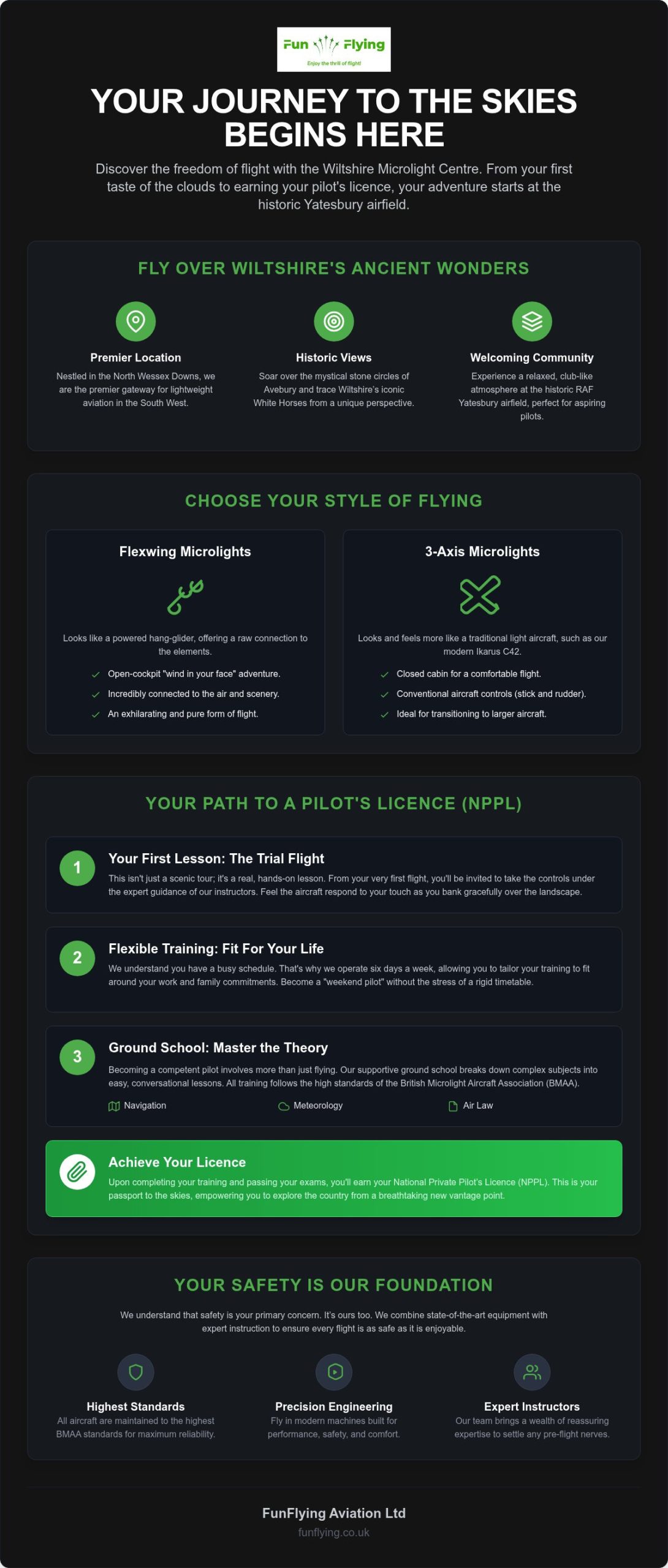
Imagine lifting off from a runway steeped in stories. The Wiltshire Microlight Centre isn’t just another flight school; it’s the premier gateway for lightweight aviation in the South West. Nestled within the rolling greenery of the North Wessex Downs, this centre offers a perspective of England you simply can’t get from the ground. You aren’t just flying; you’re soaring over the ancient, mystical stone circles of Avebury and tracing the chalk outlines of Wiltshire’s iconic White Horses. It’s a sensory explosion of vibrant greens and deep blues that stays with you long after you’ve touched down.

The airfield itself sits on the site of historic RAF Yatesbury, a location that played a vital role in training pilots during both World Wars. Today, that legacy of excellence continues, but with a much more relaxed, community-focused heart. We’ve traded the rigid military drills for a spirit of freedom and adventure. It’s a place where the adrenaline of a new hobby meets the genuine warmth of a weekend club, making every visit feel like coming home to a group of friends who happen to share a love for the clouds.

Where is the Wiltshire Microlight Centre Located?

Getting here is remarkably simple. We’re perfectly positioned for residents of Swindon, Bristol, and Reading, making it an easy escape for a Saturday morning flight. If you’re based closer to the market town, you’ll find that microlight flying near Devizes is equally straightforward, with Yatesbury just a short drive away across the beautiful Wiltshire countryside. The environment at Yatesbury is unique; it manages to feel professional and high-standard whilst remaining completely unpretentious. It’s a vast, open landscape where the sky feels bigger, providing the perfect canvas for your first aviation milestones without the stress of busy commercial airspace.

The Fun Flying Aviation Ltd Philosophy: Aviation for Everyone

We believe that the sky shouldn’t be a spectator sport. Our philosophy at Fun Flying Aviation Ltd is built on a “hands-on” approach that gets you involved immediately. On your very first lesson, you won’t just be sitting there as a passenger; you’ll be the one learning to fly the aircraft under the expert guidance of our instructors. We’re “Expert Enthusiasts” who live for that moment a student feels the controls respond for the first time. It’s about stripping away the elitism often associated with flying and replacing it with pure, accessible joy for anyone with a dream of taking flight.

Experience Flights and Pilot Training: What’s on Offer?

Ever wondered what it actually feels like to leave the ground behind? At the Wiltshire Microlight Centre, we offer a range of experience flights that turn that curiosity into reality. Whether you’re treating yourself or looking for the ultimate gift for a loved one, these sessions are designed to be unforgettable. Our operations run six days a week. This flexibility is perfect for the “weekend pilot” who needs to fit training into a busy lifestyle without the stress of a rigid schedule.

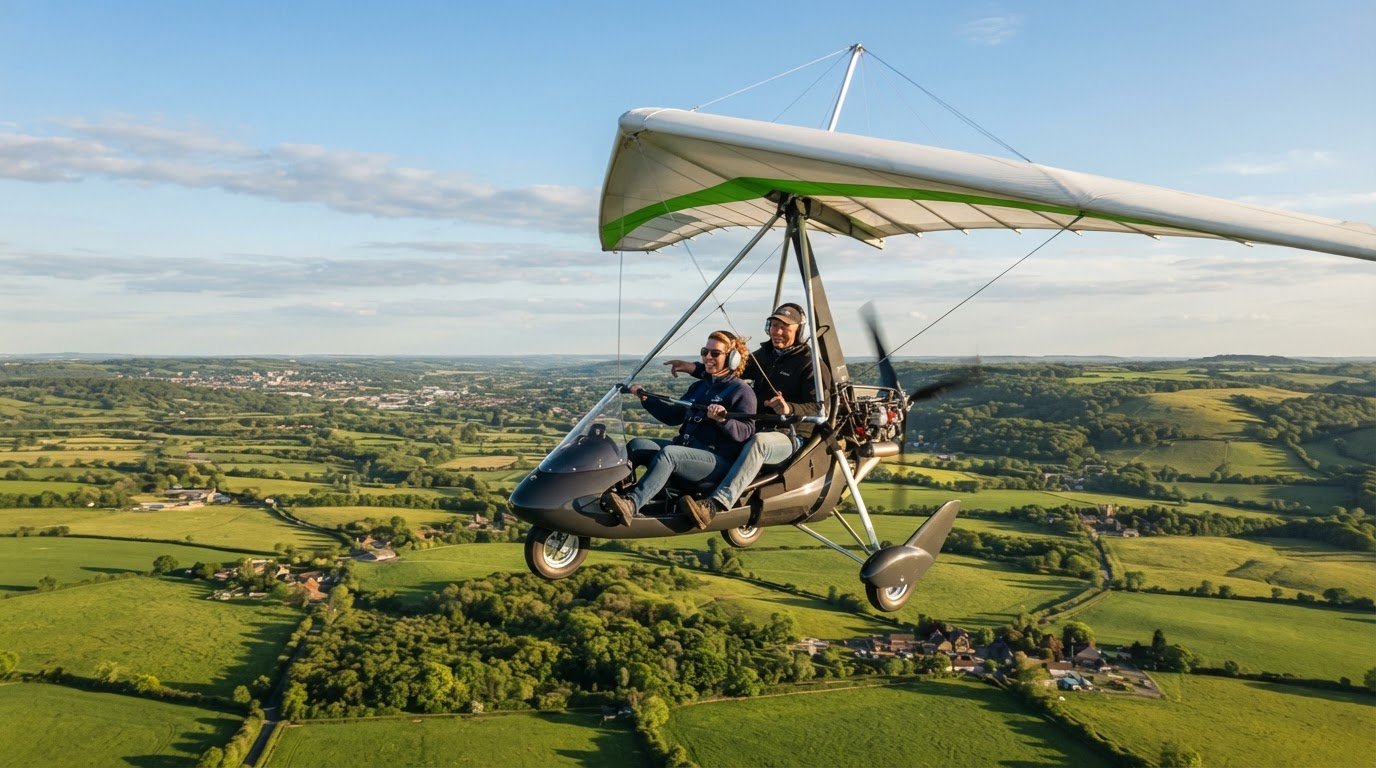
You can choose between two distinct styles of flying. Flexwing microlights look a bit like a powered hang-glider, offering an open-cockpit, “wind in your face” adventure that feels incredibly connected to the elements. Three-axis microlights, such as the modern Ikarus C42, look and feel more like a traditional light aircraft with a closed cabin and conventional controls. Both are fantastic ways to start your journey toward a National Private Pilot’s Licence (NPPL) at the Wiltshire Microlight Centre.

Your First Lesson: Taking the Controls

Your trial flight at Yatesbury isn’t just a sightseeing tour. It’s a real, hands-on lesson. You’ll feel the subtle vibration of the engine as you taxi out and the sudden, smooth lift as the wings take over. Once at a safe altitude, your instructor will invite you to take the stick. It’s surprisingly responsive; a tiny movement of your hand sends you banking gracefully over the landscape. If you’re ready to start your journey, you can book an introductory microlight lesson UK and see exactly what to expect from your very first time in the cockpit.

Ground School and Theory: Mastering the Sky

Earning your licence involves more than just time in the air. You’ll also dive into the fascinating world of navigation, meteorology, and air law. Fun Flying Aviation Ltd provides a supportive ground school environment where complex subjects are broken down into easy, conversational lessons. All our training follows the high standards set by the British Microlight Aircraft Association (BMAA), ensuring you become a safe, competent pilot. For a deeper dive into the academic side, check out our guide on Mastering the Sky: The Ultimate Guide to Microlight Ground School UK.

Facilities, Safety, and Preparing for Your Visit

The question we hear more than any other is simple: “Is it safe?” It’s a natural thought when you’re about to leave solid ground for the first time. At the Wiltshire Microlight Centre, safety isn’t just a checklist; it’s the foundation of everything we do. You’re flying in machines built with precision engineering and maintained to the highest standards. Our instructors bring a wealth of reassuring expertise to every flight, helping to settle those pre-flight butterflies so you can focus on the incredible views. They’ve seen every level of nerves and know exactly how to guide you through your first moments in the air with calm, professional confidence; for those who feel they need more specialised support to manage their anxiety, 1 to 1 Fearless Flying provides tailored therapy to help you overcome your fears and fully enjoy the experience.

Safety Standards at Yatesbury

Our aircraft undergo rigorous, scheduled maintenance that meets strict national requirements. The Civil Aviation Authority (CAA) oversees all microlight aviation in the UK, ensuring that every school operates within a tightly regulated framework. Modern microlights possess a safety record that compares very favourably with traditional light aircraft, thanks to their lightweight design and robust modern engines.

Planning Your Journey to the Centre

Finding us is a breeze, whether you’re driving up from Bournemouth or coming across from Basingstoke and Andover. Most visitors find that the A303 and A361 provide the most direct routes into the heart of the Wiltshire countryside, though if you are visiting from London for a special occasion, you might prefer the premium ground transport provided by JAF Executive Travels to handle the journey. Once you arrive, there’s ample free parking right near the hangars. We suggest arriving about fifteen minutes before your scheduled slot. This gives you time to soak in the atmosphere and meet your instructor without feeling rushed.

Wiltshire Microlight Centre: Flying at Yatesbury Guide

How to Join the Yatesbury Aviation Community

Becoming a pilot is about more than just mastering a machine; it’s about joining a group of people who refuse to stay grounded. At the Wiltshire Microlight Centre, the social side of flying is just as rewarding as the time spent in the cockpit. You’ll find yourself sharing stories over a coffee after a morning flight, swapping tips with fellow pilots, and feeling part of a vibrant, supportive club. For those who already have wings, Fun Flying Aviation Ltd offers conversion training and licence revalidations to keep you current and confident in the air. It’s a place where the barrier between dreamer and aviator disappears the moment you step onto the airfield.

Booking Your First Flight

Ready to take the leap? Our booking system is built to be as flexible as possible, working around your life rather than forcing you into a rigid timetable. If you’re looking to inspire someone else, our microlight gift vouchers are a fantastic way to introduce a friend or family member to the skies. They’re easy to purchase and even easier to redeem. To understand why so many people are making the switch to this hobby, take a look at The Rise of the Weekend Pilot: Why Microlighting is the UK’s Favourite New Hobby.

The Path to Your Licence

Earning your National Private Pilot’s Licence (NPPL) is a structured, achievable journey that transforms your perspective on the world. Whilst it requires dedication to master the flying hours and ground school exams, the team at Fun Flying Aviation Ltd is here to support you every step of the way. The sky isn’t a limit; it’s your new playground, and we can’t wait to see you up there.

Start your aviation journey at the Wiltshire Microlight Centre today!

Your Journey to the Skies Starts Here

The dream of flight is no longer out of reach. We’ve explored how the Wiltshire Microlight Centre combines a historic airfield with modern, accessible aviation. You’ve seen that whether you want a one-off thrill or a structured path to your own pilot’s licence, the process is straightforward and incredibly rewarding. It’s about more than just mechanics; it’s about the pure joy of the experience.

With our professional CAA-qualified instructors guiding you, those initial nerves quickly turn into the exhilaration of seeing the White Horses and Avebury stones from a perspective few ever experience. You’ll find a friendly, inclusive atmosphere where pilots of all ages and backgrounds come together to celebrate the freedom of the air. Visitors from across the county, including those exploring microlight flying near Devizes and the Vale of Pewsey, regularly make Yatesbury their home airfield. The clouds are calling, and the controls are ready for your touch.

Stop watching from the ground and start your adventure. We can’t wait to welcome you to the airfield and help you discover the magic of microlighting for yourself.

Frequently Asked Questions

How do I find the Wiltshire Microlight Centre at Yatesbury?

You’ll find us at the historic Yatesbury Airfield, which is conveniently situated just off the A361 and easily reached from the A303. If you are driving from Swindon, Bristol, or Reading, simply follow the signs toward the ancient village of Avebury. Once you arrive at the airfield, there is plenty of free parking available right next to the hangars. It’s a scenic drive that perfectly prepares you for the incredible views you’re about to experience from the cockpit.

Do I need any previous experience to take a trial flight?

No previous experience is necessary to enjoy a trial flight with us. Our introductory sessions are designed specifically for beginners who have never been in a small aircraft before. Your professional instructor will handle the more complex parts of the journey, such as take-off and landing, whilst giving you the opportunity to take the controls once you’re at a safe altitude. It’s all about making the thrill of aviation accessible to everyone from day one.

What is the difference between a trial flight and a flying lesson?

There is actually no difference between a trial flight and your first flying lesson at the Wiltshire Microlight Centre. Every experience flight we offer is conducted as a formal lesson by a qualified instructor, which means the time you spend in the air can be officially logged toward your pilot’s licence. Whether you’re treating it as a one-off adventure or the start of your training, you’ll receive the same expert guidance and hands-on involvement throughout your time in the sky.

Are there any age or weight restrictions for flying microlights in Wiltshire?

Microlight aircraft do have specific weight limits for safety, which typically fall between 100kg and 110kg depending on the specific plane being used. Whilst there is no upper age limit for enjoying an experience flight, students must be at least 14 years old to start logging their flight hours toward a National Private Pilot’s Licence. We always encourage you to get in touch if you have any questions about physical requirements or mobility so we can ensure your visit is comfortable.

Can I buy a microlight experience flight as a gift voucher?

You can certainly purchase our experience flights as gift vouchers, providing a truly unique surprise for a friend or loved one. These vouchers are a popular choice for birthdays and anniversaries, offering the recipient the flexibility to book their session at a time that suits them. It’s a fantastic way to share the magic of the Wiltshire Microlight Centre and give someone the chance to tick a major adventure off their bucket list in a supportive, professional environment.

What happens if the weather is bad on the day of my flight?

If the weather conditions aren’t suitable for a safe and enjoyable flight, we will simply reschedule your session for another day. Safety is our absolute priority, and we monitor wind speeds and visibility constantly to ensure every trip meets our high standards. You won’t lose your booking; instead, we’ll work with you to find the next available slot when the Wiltshire skies are clear. This ensures that when you do finally take off, the experience is everything you dreamed it would be.

Marce Colucci

Article by

Marce Colucci

Love to fly, and more importantly, love teaching others to fly.

Verified by ExactMetrics