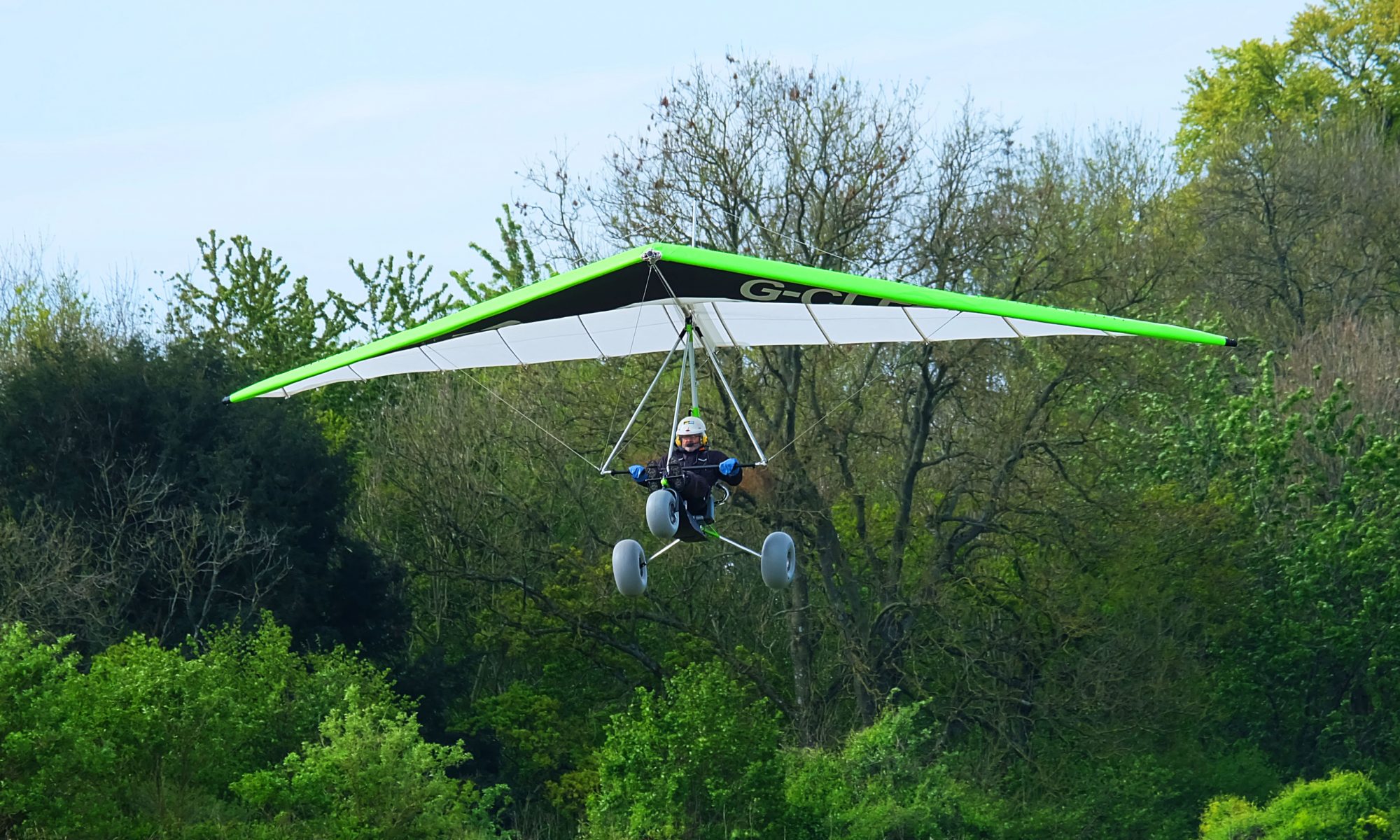

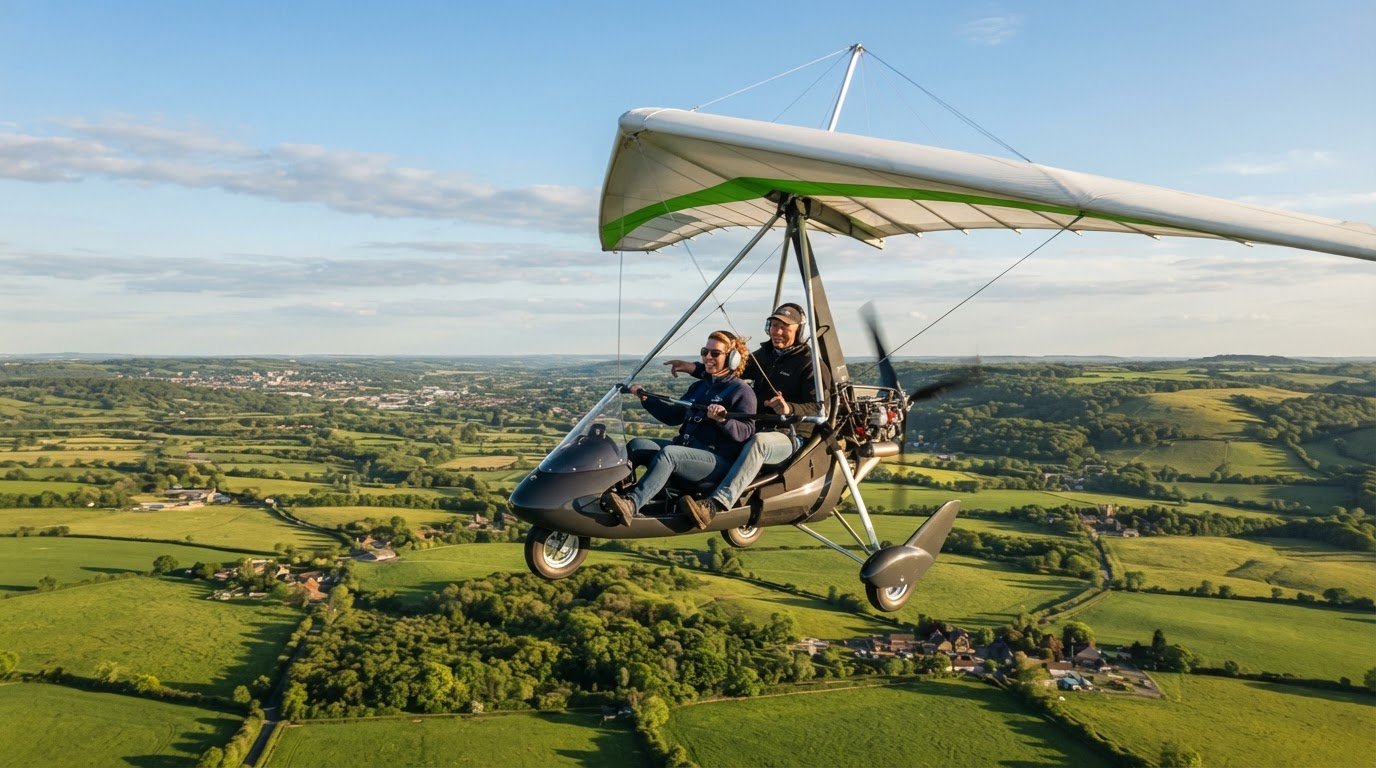
You can learn to fly in the UK without a medical certificate on a microlight route: student pilots may use a Pilot Medical Declaration (PMD) for microlights and SSDRs. A PMD remains valid until age 70, then a new declaration is required every three years. You still need to meet the relevant health criteria, including the equivalent of the DVLA driving standard.
It’s understandable to wonder whether you need a Class 1 or Class 2 medical before taking to the skies. The answer depends on the type of flying and licence you’re working towards: microlight training has a different route from private or commercial pilot training.
This guide explains which declaration or certificate may apply, how long each remains valid, and what that means when you learn to fly in the UK without a medical certificate. It also covers how lesson frequency can shape your training progress.
Key Takeaways
- A Pilot Medical Declaration may allow eligible student pilots to train in microlights, but the rules depend on the aircraft and licence.
- Match your medical to your licence: UK Part-FCL PPL and LAPL holders need the certificate type that applies to their licence.
- Your training timeline depends partly on how regularly you can fly, so lesson frequency is worth considering when planning your progress.
- A Trial Flight or Experience Flight can help you explore microlight flying as you consider your next step.
Pilot Medical Declaration eligibility
A Pilot Medical Declaration (PMD) is a self-declaration of medical fitness for certain UK flying. It is not a universal substitute for a medical certificate: whether it applies depends on your aircraft, licence and stage of training.
Medical requirements before a first solo
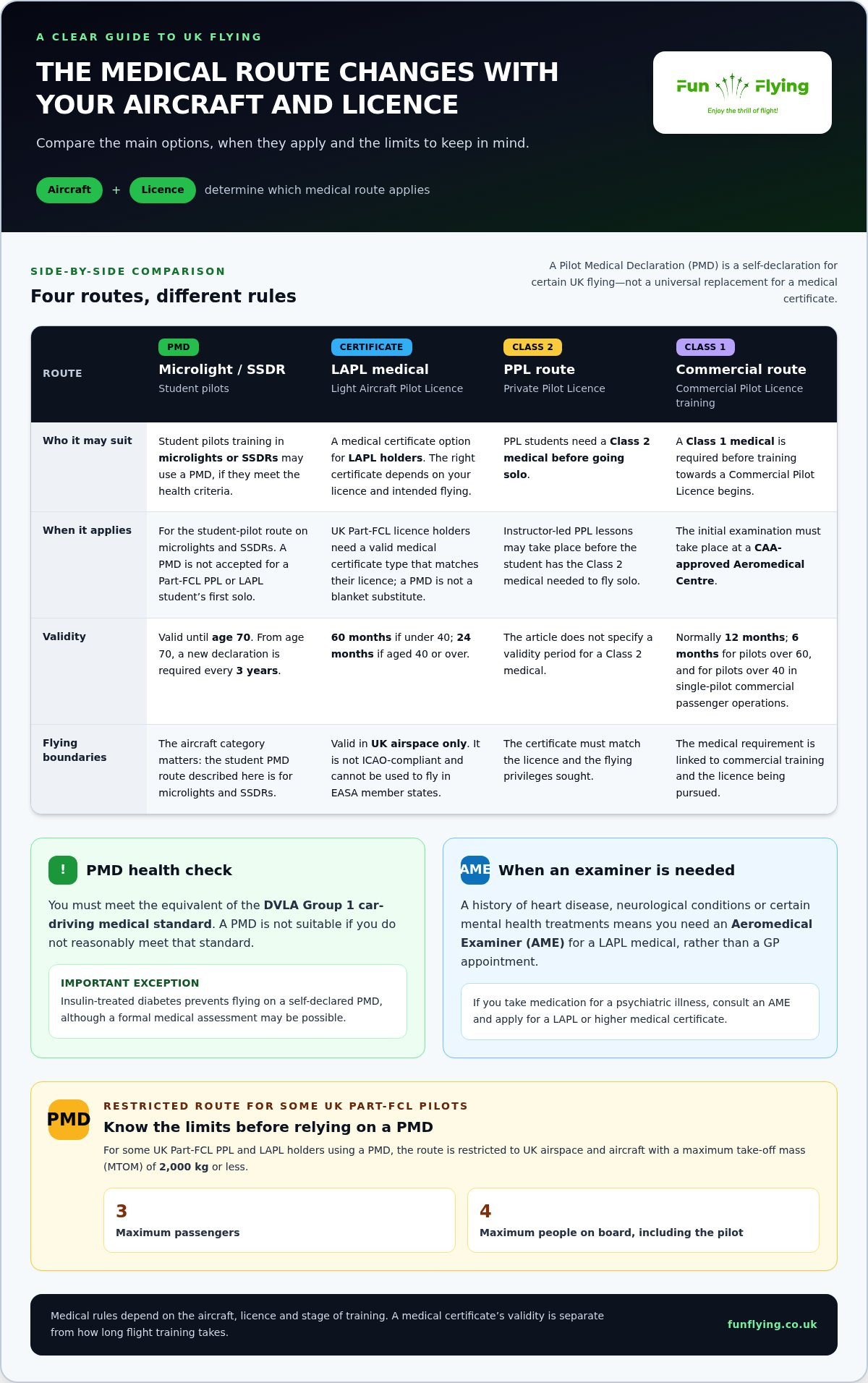
A student pilot must meet the medical rules for their licence before flying solo. For Part-FCL PPL or LAPL training, a PMD isn’t accepted for that first solo: you need an actual medical certificate. PPL students need a Class 2 medical before going solo, but may take instructor-led lessons beforehand. Student pilots can use a PMD only for microlights and SSDRs. This distinction helps you plan training without assuming the same declaration covers every aircraft.
For general UK learn-to-fly training, the aircraft and licence route determine which requirement applies.
Accepted declarations for UK LAPL and PPL
For a UK Part-FCL LAPL or PPL, the medical route depends on the licence; a PMD is not a blanket substitute for a medical certificate. A UK pilot using a PMD with a Part-FCL PPL or LAPL is limited to UK airspace and aircraft of no more than 2,000 kg MTOM. MTOM means the aircraft’s maximum take-off mass.
For balloon and sailplane pilots, a PMD is generally sufficient under UK Part-BFCL and Part-SFCL rules. Commercial passenger ballooning with more than 4 people on board requires at least a Class 2 medical certificate. A passenger airline certificate is separate: airlines may request one for travel after 28 weeks of pregnancy.
Conditions and medication affecting self-declaration
A PMD requires you to meet the equivalent of the DVLA Group 1 car-driving medical standard. You can’t self-declare if you don’t reasonably meet it. Insulin-treated diabetes also prevents flying on a self-declared PMD, although a formal medical assessment may be possible.
A history of heart disease, neurological conditions or certain mental health treatments means you need an Aeromedical Examiner (AME) for a LAPL medical rather than a GP appointment. If you take medication for a psychiatric illness, you must consult an AME and apply for a LAPL or higher medical certificate. For commercial pilot training, a Class 1 medical is required before training towards a Commercial Pilot Licence begins; the initial examination must take place at a CAA-approved Aeromedical Centre.
LAPL as an alternative for people with medical limitations
A Light Aircraft Pilot Licence (LAPL) is a private flying licence with its own medical certificate route. It may be worth exploring if a medical condition makes another certificate difficult, but it does not remove the need to meet fitness requirements. The right route depends on your health and the flying privileges you want.
According to the UK Civil Aviation Authority, UK Part-FCL licence holders, including LAPL and PPL pilots, need a valid Class 1, Class 2 or LAPL medical certificate, depending on their licence. A doctor may be able to sign a LAPL medical if you have no serious pre-existing conditions. A history of heart disease, neurological conditions or certain mental health treatments requires assessment by an Aeromedical Examiner for a LAPL medical.
A UK LAPL medical is valid for 60 months if you’re under 40, and 24 months if you’re aged 40 or over. It applies to LAPL holders and is valid in UK airspace only. It isn’t ICAO-compliant, so it can’t be used to fly in EASA member states. That matters if you’re planning to take your flying beyond the UK.
There’s also a restricted PMD route for some UK Part-FCL PPL and LAPL holders. Under that route, you’re limited to UK airspace and aircraft with a maximum take-off mass of 2,000 kg. You can carry no more than 3 passengers, with no more than 4 people on board. Those limits shape where you can fly and who can come along.
A medical certificate choice should match both your pilot licence and your intended flying. If medical limitations are affecting your plans, understanding the available microlight training options can help you explore a different route into flying.
Training duration and lesson frequency
Training time depends partly on how often you fly and how consistently you practise. UK PPL training can take around eight months to a year or longer, and students are ideally advised to take one or two flying lessons each week. Regular lessons give you time to build skills, revisit earlier learning and progress through the course. Your schedule matters as much as your ambition.
Consider your usual weekly commitments before you plan your training. If work or family makes regular lessons difficult, longer gaps may extend the time it takes to progress. Consistent sessions help you carry skills from one flight to the next; after a break, you may need time to refresh what you learned. That is a planning consideration, not a measure of your potential as a pilot. Developing strong cognitive resilience and mental focus is just as valuable when absorbing complex technical skills, and resources such as Neurotransformation by Tanja highlight how mindset and neurotransformation coaching can support individuals through demanding personal learning journeys.
A shorter course may suit students who can commit the time and money to train intensively, with an estimate of around three to six months. This is a faster pace, not a promise of completion by a set date. Lesson frequency, progress through each training stage and time for study all affect your pace. If you are considering microlight training, discuss the course structure and a suitable lesson rhythm as part of your plan.
Keep medical certificates on a separate timeline from flying lessons. A certificate’s validity doesn’t tell you how long training will take, and a fitness-to-fly assessment serves a different purpose from learning to handle an aircraft. For example, a UK Class 1 medical is normally valid for 12 months, but for pilots over 60 it is valid for 6 months. The shorter period also applies to pilots over 40 in single-pilot commercial operations carrying passengers. If your goal is an airline career, account for medical requirements as well as training time. For recreational flying, focus first on the licence route, lesson schedule and medical rules that apply to it.
Can you train for a UK NPPL without a medical?
Yes. Some UK NPPL student pilots can train without a medical certificate by making a Pilot Medical Declaration (PMD). The student-pilot exception applies to microlights and SSDRs, so the aircraft category matters. A PMD is a self-declaration, not an exemption from medical fitness criteria.
For an NPPL route, a PMD can apply to NPPL or local UK PPL flying, within its restrictions. The declaration is for UK airspace and aircraft under 2,000 kg maximum take-off weight. It remains valid until age 70; after that, a new declaration is required every three years. That helps you understand the medical route, but it doesn’t make every licence or aircraft eligible.
Before self-declaring, you must reasonably meet the DVLA Group 1 car-driving medical standard. A history of heart disease, neurological conditions or certain mental health treatments means you need an Aeromedical Examiner for a LAPL medical rather than a GP. Insulin-treated diabetes also prevents flying under a self-declared PMD, although formal medical assessment may be possible. These criteria matter before you plan training around a declaration.
Keep the difference between training and later privileges clear. A PMD may support eligible microlight student training, but it doesn’t automatically cover another aircraft category or every NPPL privilege. Your intended aircraft and licence determine whether the declaration fits. If your goal is commercial pilot training, this route isn’t a substitute for the required Class 1 medical before Commercial Pilot Licence training begins.
A delayed Class 1 medical can affect a commercial course: the start date may be pushed back if the certificate is still missing up to four weeks before the course begins. That’s a separate issue from an NPPL microlight route, but it shows why choosing your licence goal early matters.
Fun Flying Aviation Ltd: Experience Flights
Fun Flying Aviation Ltd offers Experience Flights for people curious about flying from the pilot’s seat. If you are weighing up medical rules and training routes, an experience flight lets you discover what flying feels like before deciding on your next step.
Ready to work towards a licence? Fun Flying Aviation Ltd provides microlight licence training and Ground School to build your flying skills and aviation knowledge. Trial Flights offer another introduction to flying. Your training route depends on the licence and aircraft you are aiming for, so keep the relevant medical requirements in mind as you plan.
For a friendly starting point, contact Fun Flying Aviation Ltd or visit funflying.co.uk.
Take your next step towards flying
Your next step can be simple: decide whether you want to experience flying first or start working towards a licence. If you are considering whether you can learn to fly in the UK without a medical certificate, focus on your intended aircraft and flying goals. A clear goal makes it easier to plan around your ambitions and available time.
Fun Flying Aviation Ltd offers Experience Flights and Trial Flights for a taste of flying, as well as microlight licence training when you are ready to build your skills. Choose the step that suits you, then progress at your own pace.
Your aviation journey can start with one exciting step. The sky is waiting.
Frequently Asked Questions
Aviation medicals in the UK: Do you need a Class 1 or Class 2 to start flight training?
The certificate depends on your intended licence: a UK PPL uses a Class 2 medical, while commercial training towards a Commercial Pilot Licence requires a Class 1 before that training begins. “Part-FCL” is the UK licensing framework covering licences such as the PPL and LAPL. Decide whether your goal is private or commercial flying first, as that choice shapes the medical route.
Can I fly with a heart condition?
A heart condition does not by itself determine whether you can fly. Your medical history and its effect on safe flying matter. An Aeromedical Examiner (AME) is a doctor qualified to assess pilots’ medical fitness. Having your NHS medical notes available for an appointment can help explain your diagnosis, treatment and current health.
Can you learn to fly in the UK without a medical certificate?
Yes. Some student pilots can train without a medical certificate on eligible microlight or SSDR routes. SSDR means a single-seat, deregulated microlight. Before planning your training, identify the aircraft category and licence you intend to pursue: a declaration for one route does not automatically cover another.
What medical requirements apply to UK trial flying lessons?
A supervised Trial Flight is an introductory experience, not a solo flight or a licence assessment. Fun Flying Aviation Ltd lets participants take the controls under professional supervision. Taking the controls during an introductory flight does not give you permission to fly independently. If you are considering ongoing training, use the trial to experience flying before choosing a licence route.
What are the UK CAA rules for self-declared pilot medical fitness?
A Pilot Medical Declaration is your own declaration that you meet the applicable medical standard for the flying route. The DVLA Group 1 standard is the medical fitness standard used for ordinary car drivers. Consider your health and medication in relation to safe flying before making a declaration; it isn’t simply a form to complete regardless of your circumstances.
Can you fly solo in the UK before obtaining a pilot medical?
For a UK PPL student, you cannot fly solo before holding the required medical certificate. A different exception applies to student pilots flying microlights and SSDRs under an eligible declaration. In practice, the aircraft category matters as much as your training stage. SSDR means a single-seat, deregulated microlight, not a general exemption for every aircraft.