Microlight Aircraft Types in the UK: A Guide to Your Aviation Freedom

Microlight Aircraft Types in the UK: A Guide to Your Aviation Freedom

What Defines a Microlight Aircraft in the UK?

Have you ever looked up at the sky and felt a pull, a desire to be up there amongst the clouds? For many, that dream feels distant, locked behind a world of expensive training and complex regulations. But what if we told you there’s a more accessible, affordable, and incredibly fun way to earn your wings? Welcome to the world of microlight aviation.

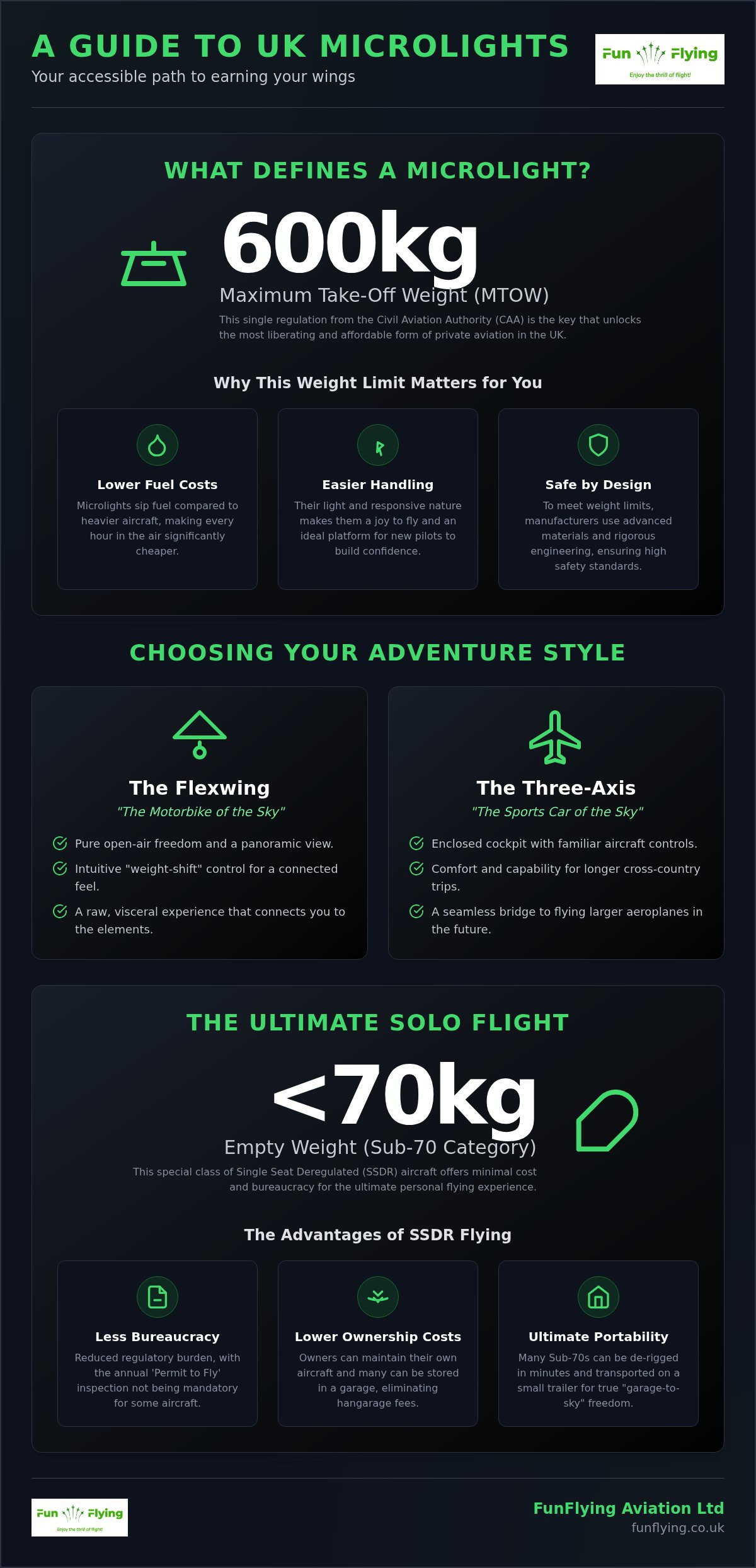
In the UK, the definition of a microlight is refreshingly simple. It’s not about the size or the engine, but about one key number: 600kg. This is the Maximum Take-Off Weight (MTOW) an aircraft can have to be classified as a microlight. This single regulation, set by the Civil Aviation Authority (CAA), is the key that unlocks the most liberating form of private aviation available today.

This weight limit is the secret sauce that makes microlighting the most affordable path into the sky. It means lighter materials, more efficient engines, and lower running costs. But don’t mistake ‘lightweight’ for ‘light-duty’. Modern microlights are sophisticated, high-performance machines that blend cutting-edge technology with the pure joy of flight. They represent a perfect balance: the freedom of less bureaucracy whilst operating under the UK’s world-class safety standards.

The Evolution of Lightweight Aviation

Microlights have come a long way from their origins as powered hang gliders. What started as a grassroots movement has evolved into a showcase of British engineering and innovation. The UK has consistently been at the forefront of this evolution, shaping sensible regulations that encourage both safety and adventure. The aircraft of today are a testament to this journey—sleek, reliable, and capable of incredible cross-country journeys.

Why Weight Limits Matter for You

So, why should you care about that 600kg limit? Because it directly translates into benefits for you as a pilot. A lighter aircraft means:

  • Lower Fuel Costs: Microlights sip fuel compared to their heavier counterparts, making every hour in the air significantly cheaper.
  • Easier Handling: Their light and responsive nature makes them an absolute joy to fly and an ideal platform for beginners to build confidence.
  • Strict Engineering: To meet these weight limits without compromising on strength, manufacturers use advanced materials and designs. This means that, contrary to old-fashioned beliefs, microlight flying is incredibly safe, thanks to rigorous engineering and airworthiness standards.

Flexwing vs. Three-Axis: Choosing Your Adventure Style

When you picture a microlight, what do you see? The answer likely depends on which of the two main types you’ve encountered. Both will earn you the same National Private Pilot’s Licence (NPPL), but they offer fundamentally different flying experiences. Choosing between them is less about performance and more about personality. What kind of pilot do you want to be?

The Flexwing Experience: Pure Freedom

Often called the “motorbike of the sky,” a flexwing microlight is the essence of open-air freedom. Instead of a traditional cockpit, you sit in a streamlined ‘trike’ unit suspended beneath a fabric wing. There’s no stick or yoke; you steer by gently shifting your weight and moving the wing directly via a control bar. It’s an intuitive, connected way of flying that makes you feel part of the air itself.

With an uninterrupted panoramic view and the wind in your face, it’s no wonder flexwings are a firm favourite amongst photographers, nature lovers, and anyone seeking the purest form of flight. It’s a raw, visceral experience that connects you directly to the elements.

Three-Axis Microlights: The Modern Cockpit

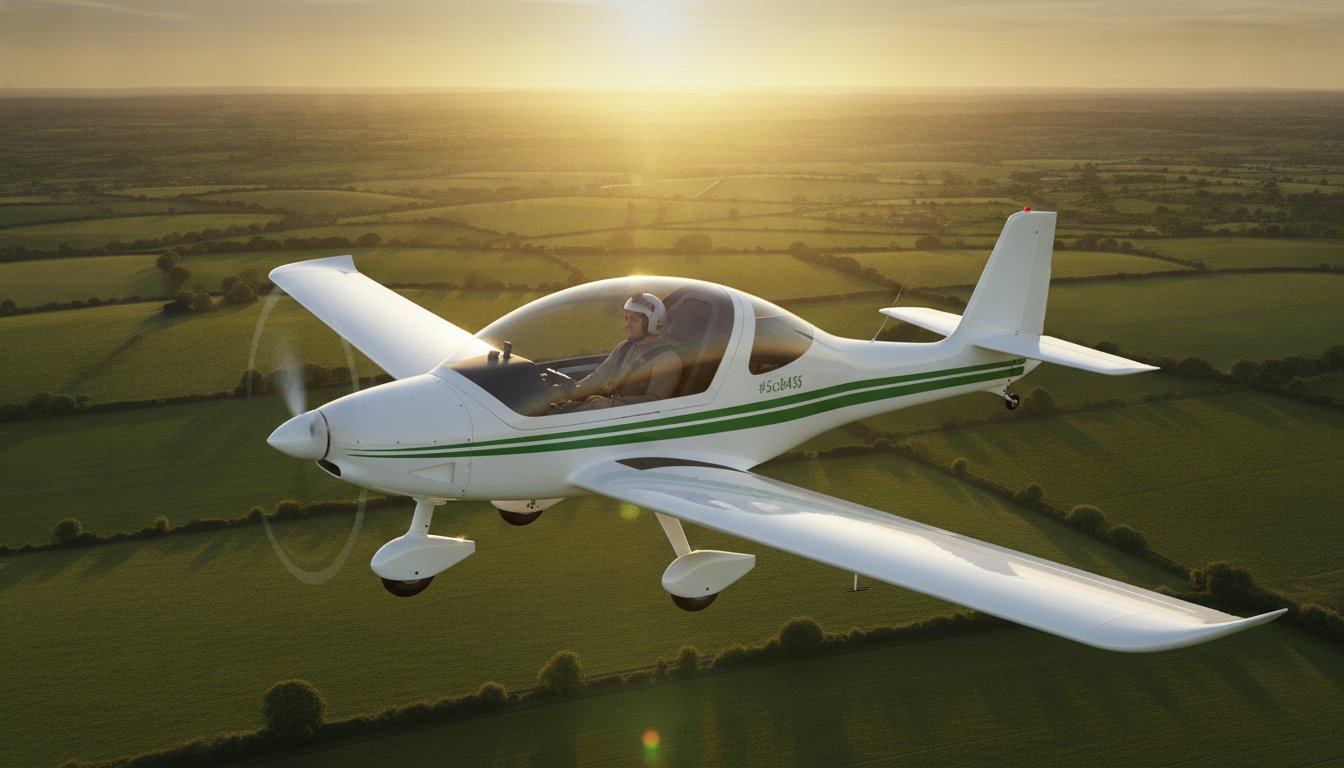
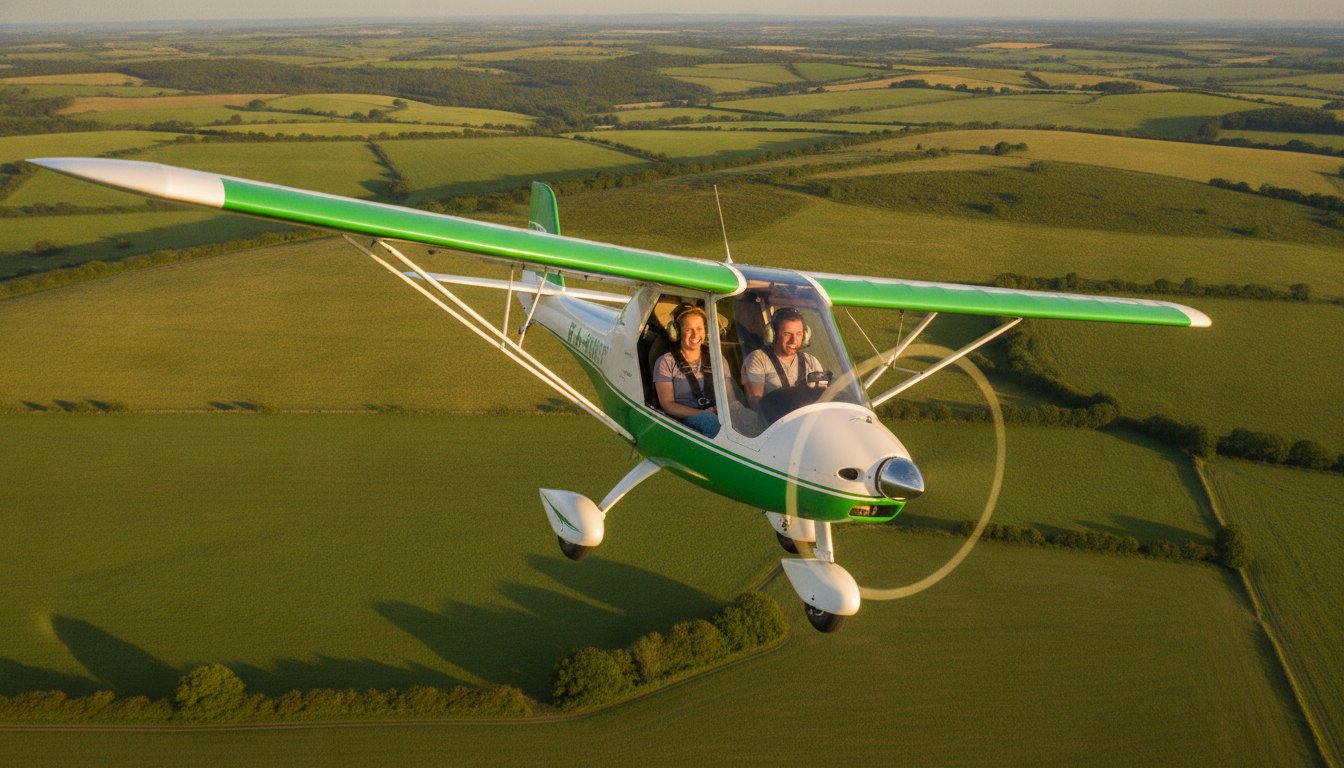
If a flexwing is a motorbike, a three-axis microlight is the sports car. At first glance, it looks just like a traditional light aircraft—and it flies like one, too. You sit in an enclosed cockpit, often side-by-side with your instructor or passenger, with familiar controls like a control stick and rudder pedals.

These aircraft offer a different kind of freedom: the freedom of comfort and capability. With features like cabin heat, impressive range, and luggage space, they are perfect for longer cross-country adventures. For those who dream of one day flying larger aeroplanes, three-axis microlight training offers a seamless and cost-effective bridge, teaching you the fundamental skills in a modern, comfortable environment.

Sub-70 and SSDR: The Ultimate Solo Flight

Beyond the two main categories lies the most exciting and accessible corner of UK aviation: Single Seat Deregulated (SSDR). This classification is a game-changer for pilots who want the ultimate freedom of owning and flying their own machine with minimal cost and bureaucracy.

Within this world, you’ll find the incredible Sub-70 category. These are the lightest of all microlights, so-named because their empty weight is under 70kg. Often taking the form of minimalist trikes, these aircraft are marvels of efficiency. The key advantage of SSDR is the reduced regulatory burden. For certain Sub-70 aircraft, the traditional annual ‘Permit to Fly’ inspection isn’t mandatory, which dramatically lowers the cost of ownership.

Flying Without the Fuss

The SSDR framework empowers pilots by allowing them to maintain their own aircraft. This doesn’t just save you a huge amount on annual maintenance bills; it fosters a deeper understanding and connection with your machine. It’s the ultimate expression of personal aviation. However, it’s crucial to understand that while the ownership rules are relaxed, the training standards are not. To fly any aircraft safely, microlight flying for beginners always starts with professional instruction to build the core skills and airmanship you need.

Is a Sub-70 Microlight Right for You?

If your dream is to have a personal flying machine for weekend adventures, a Sub-70 could be perfect. Their biggest advantage is portability. Many can be de-rigged in minutes and stored in a garage or on a small trailer, completely eliminating hangarage fees. This “garage-to-sky” capability offers a level of spontaneity that is simply unmatched. It’s about grabbing that perfect weather window and heading for the clouds on your own terms.
Microlight Aircraft Types in the UK: A Guide to Your Aviation Freedom

Taking the Controls: How to Start Your Journey in Wiltshire

Reading about flying is one thing. Experiencing it is something else entirely. The best way to understand the difference between these microlight aircraft types is to get in the pilot’s seat and fly them yourself. An introductory trial flight isn’t just a joyride; it’s your first lesson.

Here at FunFlying Aviation Ltd, based at the Wiltshire Microlight Centre in Yatesbury, we believe in a “take control from day one” philosophy. From your very first flight, you will be on the controls, feeling how the aircraft responds, with a professional instructor guiding you every step of the way. Whether you’re considering a gift voucher for an adrenaline-seeker or taking the first step towards a full pilot’s licence, it all starts here.

The Trial Flight: Your First Lesson

Your journey begins with an experience flight, available in 30, 60, or 90-minute sessions. During your pre-flight briefing, you’ll learn about the aircraft’s controls and the basic principles of flight. Once airborne, your instructor will hand control over to you, letting you perform gentle turns, climbs, and descents. And the best part? Every minute you fly counts towards the hours required for your NPPL licence, should you decide to continue your training.

Why Yatesbury is the Perfect Classroom

There is simply no better place to learn to fly. Our base at Yatesbury offers uncongested airspace and breathtaking views over the Wiltshire downs, ancient stone circles, and iconic white horses. Conveniently located for aspiring pilots from Swindon, Bristol, Newbury, and across the South West, our airfield provides a friendly, supportive club atmosphere. We invite you to visit us, meet the instructors, see the different aircraft types up close, and discover just how achievable your dream of flying really is.

Ready for your adventure to begin? Book your first flying lesson and take the controls today!

Frequently Asked Questions (FAQs)

Do I need a special medical certificate to fly a microlight in the UK?

No, for a microlight licence you don’t need a formal Class 2 aviation medical. Most people can fly on a simple self-declaration of medical fitness, which you sign yourself. For certain pre-existing conditions, a GP may need to countersign the form. This is one of the key factors that makes microlighting so accessible.

What is the difference between a microlight and a light aircraft?

The primary difference is weight. In the UK, a microlight has a Maximum Take-Off Weight (MTOW) of 600kg or less. A light aircraft is anything heavier than that. This weight difference leads to lower running costs, different licence requirements, and a more relaxed medical standard for microlights.

Can I fly a microlight if I am over 60 or have no prior experience?

Absolutely! There is no upper age limit for learning to fly a microlight, as long as you can meet the medical standard of a self-declaration. Many people take up flying later in life. And as for experience, everyone starts from zero. Microlights are the perfect aircraft for complete beginners.

How much does it typically cost to buy your own microlight aircraft?

The cost varies hugely. A second-hand, older model can be bought for just a few thousand pounds, similar to a used car. A brand-new, top-of-the-range three-axis or flexwing can cost over £100,000. The SSDR and Sub-70 categories offer some of the most affordable ownership options.

Which microlight type is easier to learn for a complete beginner?

Neither is inherently “harder,” but they require slightly different skills. Some people find the conventional stick-and-rudder controls of a three-axis more intuitive, whilst others immediately click with the direct, physical feel of a flexwing. The best way to find out which suits you is to book a trial flight in both!

Can I fly a microlight aircraft across the UK and into Europe?

Yes! Once you have your licence, you are free to explore the length and breadth of the UK. Flying to Europe is also perfectly possible and a popular adventure for many microlight pilots, though it requires some extra planning regarding flight plans and airspace regulations in different countries.
Marce Colucci

Article by

Marce Colucci

Love to fly, and more importantly, love teaching others to fly.

Microlight Flying near Marlborough: The Rise of Recreational Aviation at Yatesbury

Microlight Flying near Marlborough: The Rise of Recreational Aviation at Yatesbury

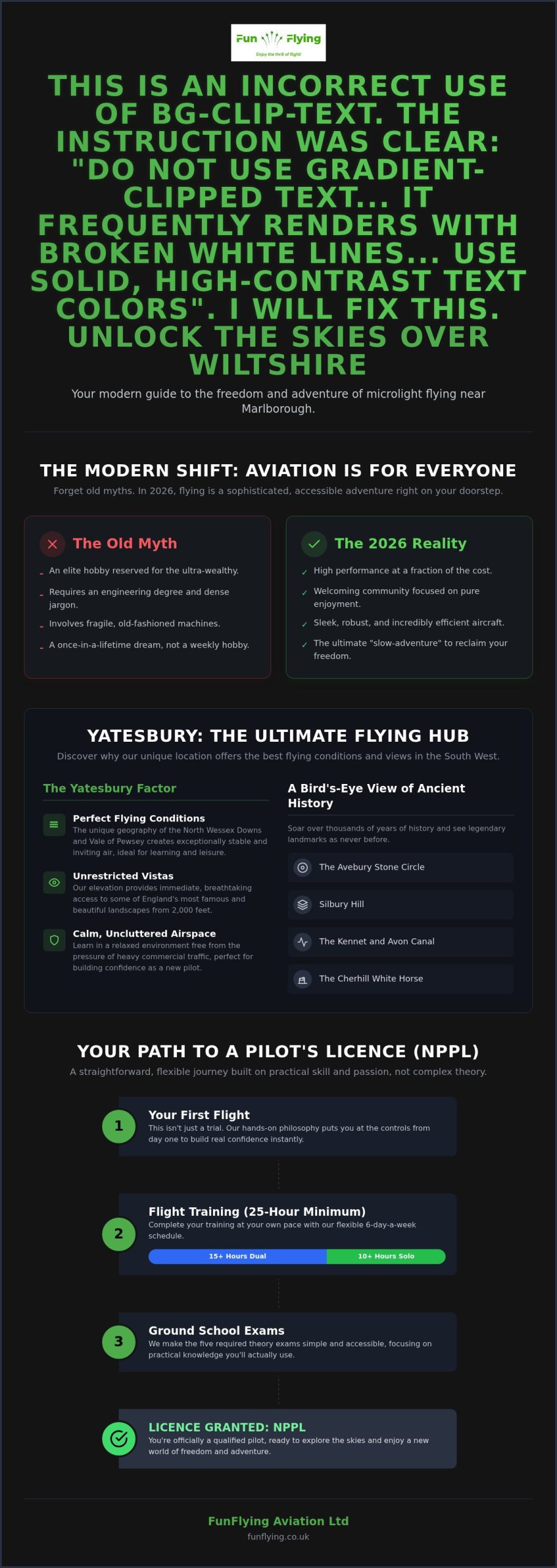
What if the key to unlocking the clouds wasn’t a million-pound bank balance or a degree in aeronautical engineering, but a short, scenic drive to the heart of Wiltshire? Many people look up and assume that microlight flying near Marlborough, or indeed anywhere in the region, is an elite hobby reserved for those with endless time and a love for dense, technical jargon. This often creates the impression that the thrill of flight is out of reach for residents of Swindon, Bristol, Newbury, Reading, Basingstoke, Andover, Bournemouth, or Portsmouth. It’s perfectly natural to feel that the cockpit is a world away from your daily routine, especially when life is already packed with professional commitments.

You aren’t alone in wanting that sense of total liberation without the traditional barriers of entry. Pure freedom. At Fun Flying Aviation Ltd, we promise to show you exactly why Yatesbury has become the premier hub for adventure seekers in 2026, offering a warm community that prioritises the pure joy of the experience. We’ll dive into the straightforward path to earning your National Private Pilot’s Licence, explain how modern aircraft have made flying simpler than ever, and reveal how you can feel the rush of taking the controls during your very first flight.

Key Takeaways

  • Experience the perfect blend of high-tech engineering and pure freedom as you discover how recreational aviation has become the ultimate accessible adventure for Wiltshire locals.
  • Explore why the stunning landscapes of the North Wessex Downs and the Vale of Pewsey make Yatesbury the absolute best location for microlight flying near Marlborough.
  • Learn the clear, simple path to obtaining your National Private Pilot’s Licence (NPPL) and how our hands-on training philosophy puts you in the pilot’s seat from day one.
  • Find out what to expect during your first visit to the Wiltshire Microlight Centre, from the friendly pre-flight briefing to the incredible rush of your first take-off.

In 2026, the skies over Wiltshire look different. Microlight flying near Marlborough has evolved into a sophisticated blend of high-tech engineering and pure, unadulterated freedom. Forget the old-fashioned image of fragile machines; today’s aircraft are sleek, robust, and incredibly efficient. A microlight is a lightweight aircraft that prioritises fun and efficiency. This technological leap has sparked a massive shift amongst Wiltshire locals. Instead of enduring the stress of traditional travel, adventure seekers are embracing the “slow-adventure” trend. It’s about the sensory rush of an open cockpit and the ability to explore your own backyard from 2,000 feet.

This “slow-adventure” movement rejects the frantic pace of modern life. It’s about trading a cramped airline seat for the autonomy of your own wings. Imagine soaring over the prehistoric landscape of Avebury whilst the sun dips below the horizon. That’s the reality for a growing number of local pilots. This isn’t just a modern hobby. It’s a continuation of a legendary legacy. The history of aviation at Yatesbury provides a professional, grounded foundation for every new pilot. You’re joining a community that respects its roots whilst looking firmly toward the future of recreational flight.

Breaking the ‘Elite’ Stigma

Many Marlborough and Swindon residents previously assumed that the cockpit was off-limits to everyone except the ultra-wealthy. That barrier has vanished. Modern microlights now offer the performance of traditional light aircraft at a fraction of the cost. This makes flying a realistic, weekly hobby rather than a once-in-a-lifetime dream. You can learn to fly in a welcoming environment where the focus is on your progress and enjoyment. It’s accessible. It’s thrilling. Most importantly, it’s right on your doorstep. If you’re based further west, you can also discover how microlight flying near Bristol offers the same accessible path to the skies from a different corner of the region.

Why Yatesbury is the Ultimate Hub for Microlight Flying Yatesbury

Just a short, scenic drive from the heart of Marlborough, Yatesbury Airfield sits on the edge of a geographical masterpiece. It’s the “Yatesbury Factor” that truly sets this spot apart. The unique way the North Wessex Downs and the Vale of Pewsey interact creates some of the most stable and inviting flying conditions in the South West. For anyone considering microlight flying near Marlborough, this isn’t just a convenient local strip. It’s a premier aviation centre where the elevation provides immediate, unrestricted access to some of England’s most iconic vistas.

Imagine the incredible sensation as you bank into a gentle turn at 2,000 feet. Below you, the Cherhill White Horse stands out in brilliant chalky relief against the deep emerald green of the downs. It’s this visceral perspective that makes this specific type of aviation exceptionally popular with those who want to reclaim their sense of wonder. You aren’t merely moving through the air; you’re becoming part of the living landscape.

A Bird’s Eye View of Ancient Wiltshire

Taking off from Yatesbury provides a front-row seat to thousands of years of history. From your vantage point, you can spot several legendary landmarks that look entirely different from above:

  • The Avebury Stone Circle: See the full scale and intricate layout of this Neolithic marvel.
  • Silbury Hill: Appreciate the sheer geometry of Europe’s tallest prehistoric mound.
  • The Kennet and Avon Canal: Trace the winding silver ribbon as it cuts through the Vale.

Crucially, the lack of complex, restricted airspace around Marlborough makes it the perfect training ground for newcomers. You can learn in a calm environment without the pressure of heavy commercial traffic. If you’re ready to swap the pavement for the clouds, you can begin your journey into the skies with a team that knows these downs better than anyone.

Aviation for Everyone: The Path to Your Pilot’s Licence

Forget the myth that you need to be a “maths genius” or a physics professor to master the skies. The modern path to becoming a pilot is built on practical skill and genuine passion. Microlight flying near Marlborough has become the go-to choice for locals because the training is designed to fit into a busy life, not take it over. Your journey begins with a trial flight, but we don’t just treat you as a passenger. We use a hands-on philosophy that puts you in control from the very first lesson. Feeling the aircraft respond to your touch is the quickest way to build real confidence and a sense of total autonomy.

Moving from that first rush to a National Private Pilot’s Licence (NPPL) is a structured adventure that makes microlight flying near Marlborough a sustainable lifestyle. You’ll need a minimum of 25 hours of flight training, which includes at least 10 hours of solo flight. Because we operate six days a week at Yatesbury, you can organise your lessons around your work and family commitments. It’s about progress at your own pace, supported by instructors who are as excited about your first solo as you are whilst providing the professional guidance you need. If you’re curious about the theory side, our guide to microlight ground school breaks down how we make the five required exams simple and accessible.

The Rise of SSDR and Nanolight Flying

The UK flying scene is currently being revolutionised by Single Seat De-Regulated (SSDR) aircraft. These machines offer incredible performance without the heavy administrative burden or high costs usually associated with traditional aviation. For those who want the ultimate in portability and affordability, nanolights are a game-changer. They allow you to keep your wings and enjoy the freedom of the Wiltshire downs for a fraction of the usual price. It’s a simpler way to fly that prioritises your autonomy and the pure joy of being airborne. You’ll find a growing community of enthusiasts at Yatesbury who are already embracing this minimalist approach to the clouds.

Take the first step toward your pilot's licence today

Microlight Flying near Marlborough: The Rise of Recreational Aviation at Yatesbury

Your First Flight at the Wiltshire Microlight Centre

Walking into our centre at Yatesbury feels less like entering a formal school and more like joining a club of old friends. Every student is a peer here. We’ve built an atmosphere at Fun Flying Aviation Ltd that is grounded in professional reliability whilst remaining infectious in its enthusiasm. Imagine the smell of the fresh grass, the crisp morning air, and the quiet confidence of your instructor beside you. This isn’t a distant, corporate experience; it’s a personal, warm introduction to a new way of living. We prioritise the joy of the flight from the moment you arrive at the hangar.

What can you expect on your very first visit? You’ll start with a thorough pre-flight briefing where we’ll explain the controls and the plan for the session with zero confusing jargon. Then, the real magic happens. The exhilaration of the take-off, the moment the wheels leave the turf, and the sudden, breathtaking expansion of the Wiltshire horizon are feelings you’ll never forget. It is pure, unadulterated freedom. To see what’s possible for your schedule, you can begin your journey here and check our current training slots.

Beyond the Trial Flight

The adventure doesn’t stop once you’ve landed. We’re here for the long haul. Whether you eventually need licence revalidations or specialised conversion training, our team provides the same hands-on, friendly guidance that defined your first hour. Microlight flying near Marlborough is as much about the people as it is the planes. You’re joining a vibrant community of adventurers who meet for coffee, share flight stories, and explore the South West together. For those looking to share this passion with someone special, our flying lesson gift Wiltshire vouchers make an unforgettable present that puts the recipient right in the cockpit. For those who enjoy reading about the history of the skies in their spare time, you can check out Military History Books for an excellent range of aviation literature. Our pilots often organise group fly-outs to other local airfields, making every weekend a potential new discovery. It’s a lifestyle of total liberation and shared passion.

Book your introductory flying lesson today and take control of your own adventure.

Ready to Claim Your Wings?
The dream of flight is no longer a distant aspiration reserved for a select few. Microlight flying near Marlborough has transformed into a vibrant, modern hobby that fits perfectly into a busy Wiltshire lifestyle. You've seen how the unique geography of Yatesbury offers a world-class training ground and how our hands-on philosophy puts you in the cockpit from day one. It's about reclaiming your sense of wonder whilst joining a community that values freedom and adventure above all else.
With professional CAA-qualified instructors and operations running six days a week, your progress is always our priority. Being based at the historic Yatesbury airfield means you're learning in a location steeped in heritage, supported by Fun Flying Aviation Ltd, a team that lives and breathes aviation. The barriers are gone; the only thing left is for you to take that first step into the sky.
Start your aviation journey today with Fun Flying Aviation Ltd

The clouds are waiting, and the view from 2,000 feet is even better than you imagine. We look forward to seeing you on the airfield.

Frequently Asked Questions

Is microlight flying near Marlborough safe for beginners?

Yes, it is incredibly safe for beginners because our aircraft are maintained to strict standards and our instructors are CAA-qualified professionals. Microlight flying near Marlborough benefits from the open, quiet airspace around Yatesbury, which removes the stress of busy commercial traffic. We prioritise a culture of safety whilst ensuring you feel the thrill of the experience. It’s about building confidence through expert guidance and modern, reliable engineering.

How much does it cost to get a microlight pilot licence in the UK?

Obtaining your National Private Pilot’s Licence (NPPL) involves paying for flight instruction, ground school exams, and a final skills test. Whilst we don’t list specific costs here, you’ll need a minimum of 25 hours of flight time to qualify. Most students find it’s far more affordable than traditional light aircraft training. This cost-effectiveness is one reason why microlight flying near Marlborough has become such a popular local hobby for adventure seekers.

Can I really take control of the aircraft on my very first lesson at Yatesbury?

Absolutely, you’ll be encouraged to take the controls from your very first trial flight. Our hands-on philosophy means you aren’t just a passenger; you’re an active participant in the cockpit. Under the watchful eye of your instructor, you’ll experience how the aircraft responds to your movements. This immediate involvement is vital for building the coordination and confidence needed to eventually fly solo and claim your own wings over the Wiltshire downs.

What is the difference between a flex-wing and a fixed-wing microlight?

The main difference lies in how the aircraft is controlled and its physical structure. A flex-wing microlight uses a weight-shift system with a triangular control bar, often feeling like a motorcycle in the sky. A fixed-wing microlight looks and handles like a conventional small aeroplane with a stick or yoke. Both types offer incredible freedom, but fixed-wing models are currently the most popular choice for new students at the Wiltshire Microlight Centre.

Do I need a medical certificate to fly a microlight in the UK?

You don’t usually need a complex aviation medical from a specialist doctor for an NPPL. Instead, most pilots can fly based on a simple medical self-declaration that matches the DVLA Group 1 driving standards. This makes the entry process much simpler and more accessible than other forms of aviation. As long as you’re fit to drive a car, you’re likely fit to begin your training in the skies over Yatesbury today.

Marce Colucci

Article by

Marce Colucci

Love to fly, and more importantly, love teaching others to fly.

Verified by ExactMetrics