
Have you ever looked up at a microlight and wondered if that tiny, agile machine is actually as sturdy as it looks? It’s the question every aspiring pilot asks: is microlight flying safe, or is it just a high-risk sport for daredevils? It’s completely natural to feel a flutter of nerves when you think about sitting in a small cockpit for the first time. You might worry about engine reliability or have a nagging feeling that these aircraft are a bit flimsy.
We understand those fears, but the reality of modern aviation will definitely surprise you. Discover why microlighting is one of the safest and most exhilarating ways to experience the freedom of the skies. We’re going to break down the rigorous regulations that keep you protected; we’ll also explain exactly what happens in an emergency and how expert training ensures you’re always in control. It’s time to fly. By the time you’ve finished reading, you’ll have the confidence to stop dreaming about the clouds and finally book that trial flight.
Key Takeaways
- Move past the “flying lawnmower” myths and see how today’s microlights are sophisticated, highly regulated aircraft built for stability and peace of mind.
- Understand the engineering facts and UK regulations that answer the question, “is microlight flying safe?” with a resounding yes for any aspiring pilot.
- Learn about the rigorous pilot training and professional instructor qualifications that prioritise your security during every moment in the sky.
- Discover how booking a trial flight at the Wiltshire Microlight Centre gives you a hands-on look at the professional safety protocols that make flying accessible.
Addressing the Myths: What Exactly is a Modern Microlight?
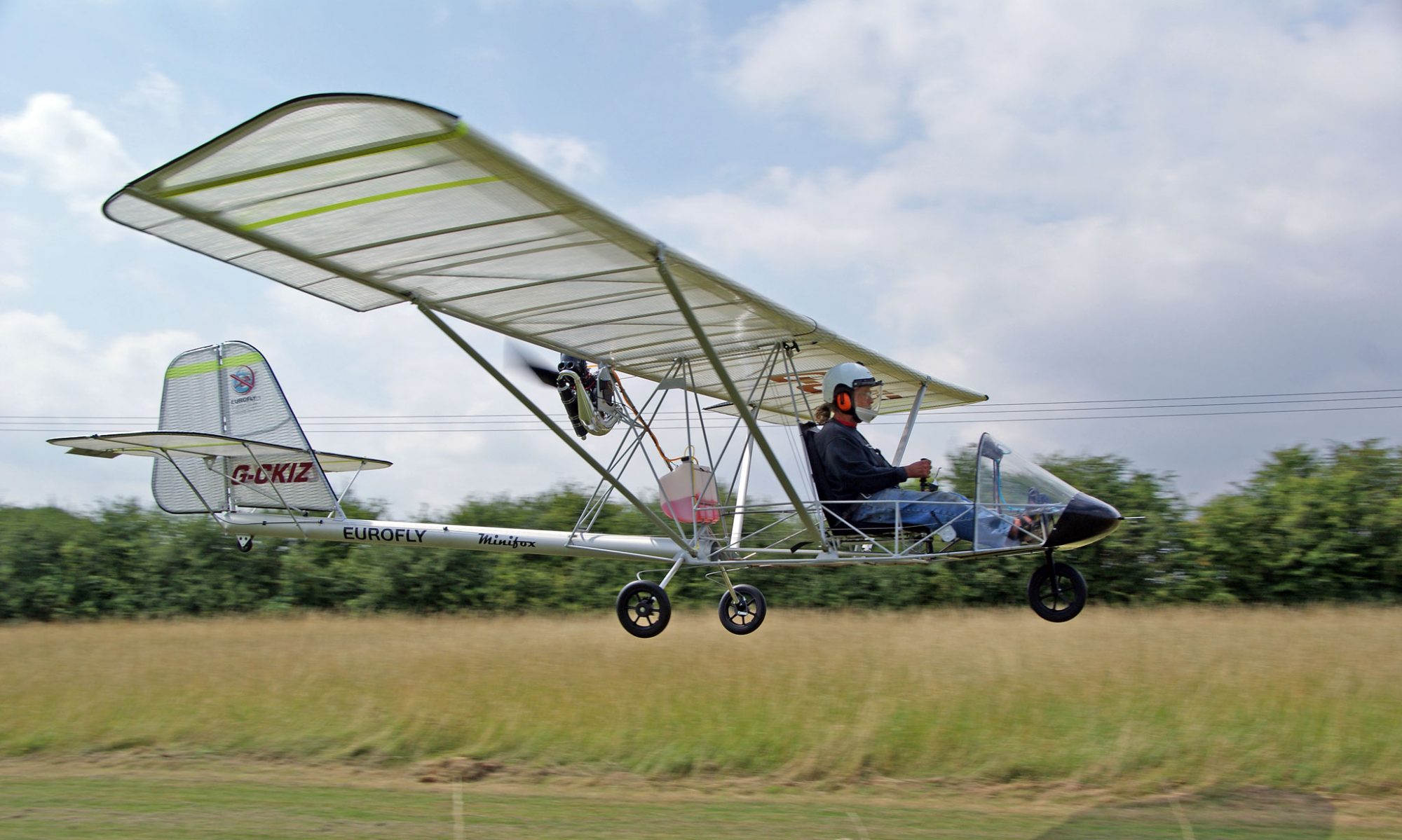
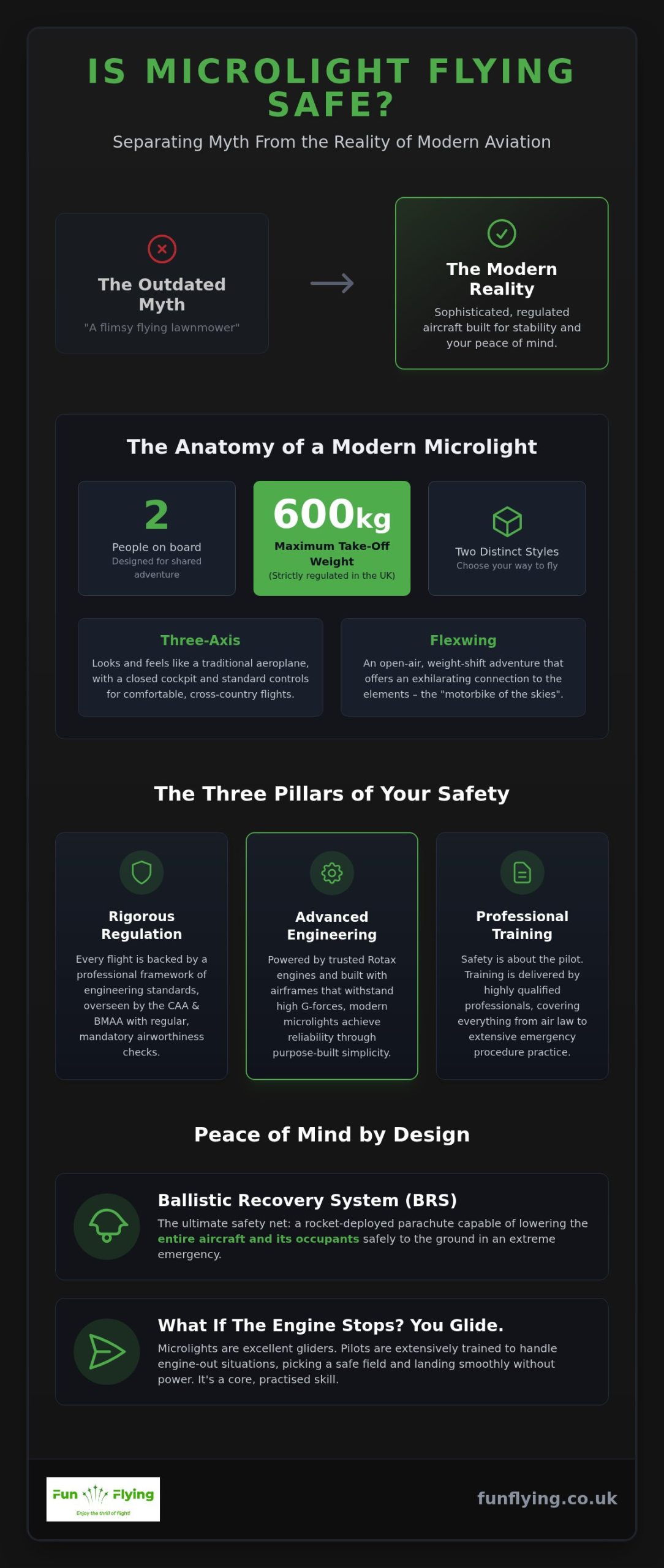
Forget the outdated image of a “flying lawnmower” or a flimsy motorised kite. Modern microlights are sophisticated, factory-built aeroplanes that offer a level of performance and reliability that rivals much larger aircraft. Many people ask is microlight flying safe because they imagine flimsy frames; in reality, these are robust machines designed for adventure. If you are asking What is a Microlight?, it is essentially a regulated aircraft designed for two people, strictly limited by weight and speed. In the UK, these machines are limited to a maximum take-off weight of 600kg. This isn’t just about weight; it’s about agility, efficiency, and pure, unadulterated fun.
The Two Main Types: Three-Axis and Flexwing
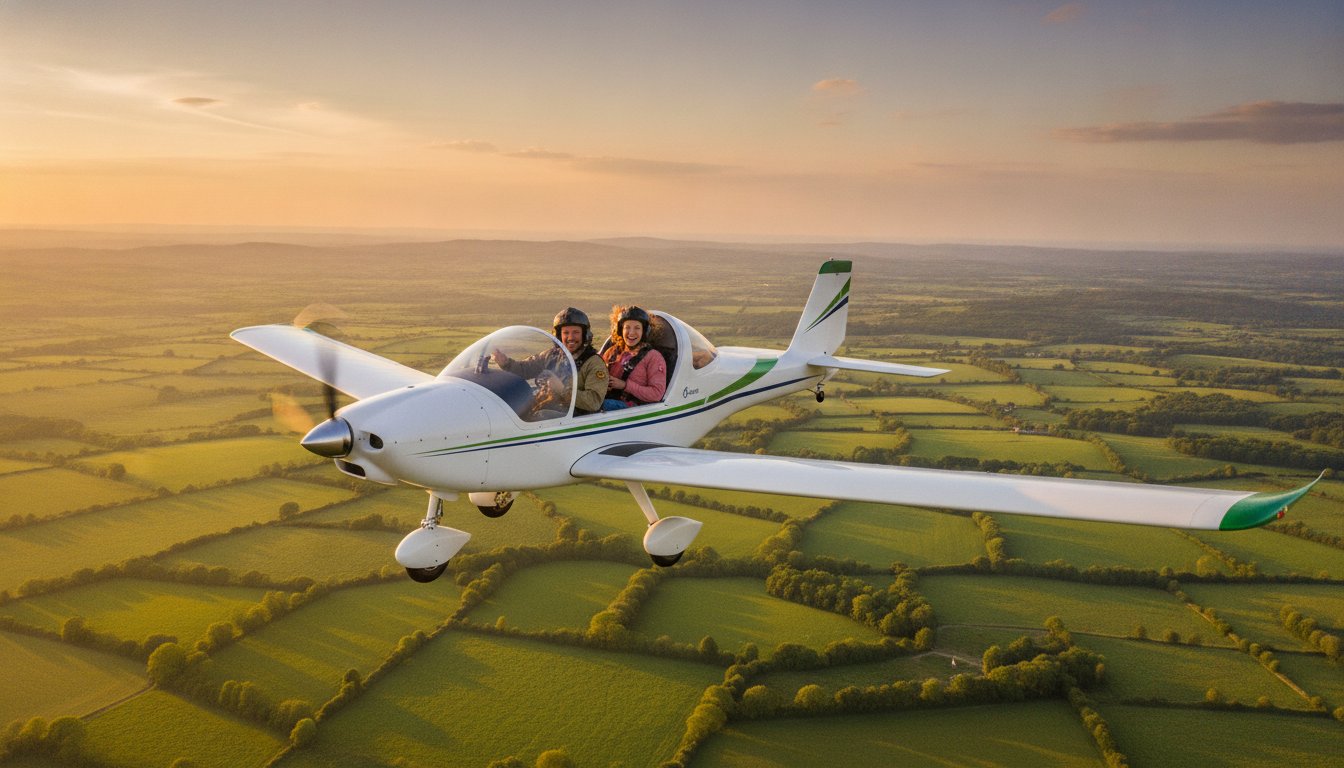
When you begin to learn to fly, you’ll choose between two distinct styles. Three-axis microlight training involves aircraft that look and feel like traditional planes, featuring a closed cockpit and standard controls. If you prefer the wind in your face, the flexwing variety offers a weight-shift, open-air adventure. Both types are incredible fun, and crucially, both must meet the same stringent UK safety requirements. Whether you want the comfort of a cabin or the raw thrill of the elements, the engineering ensures your peace of mind whilst you’re in the clouds. To explore the full range of options available to you, our guide to microlight aircraft types UK pilots can fly covers everything from flexwings to modern three-axis machines in detail.
A Regulated World: The Role of the BMAA and CAA
Safety isn’t left to chance. The Civil Aviation Authority (CAA) and the British Microlight Aircraft Association (BMAA) provide rigorous oversight. Every aircraft undergoes regular airworthiness checks to ensure it remains in peak condition. When people ask is microlight flying safe, the answer is found in the meticulous care taken by these organisations. UK regulations are amongst the strictest globally, meaning every flight you take is backed by a professional framework of engineering standards and legal requirements. It’s a professional reality that allows the infectious joy of the sport to truly shine. For those interested in how these rigorous safety principles are applied in other professional environments, you can discover You Can Do It Training Ltd and their range of accredited health and safety courses.
Engineering Peace of Mind: Why Microlights are Built for Safety
When you step into a modern cockpit, the first thing you’ll notice isn’t fragility; it’s the solid, purposeful engineering. Modern microlights are built around the legendary Rotax engine. These powerplants have an incredible power-to-weight ratio, providing snappy performance and reliability that pilots trust implicitly. It’s this “Safety by Design” philosophy that helps answer the question: is microlight flying safe? Every component is optimised for lightness without sacrificing an ounce of strength. You can feel that quality in the firm click of the harness and the responsive, sturdy feel of the controls.
The airframes themselves are designed to withstand significant G-forces, often exceeding the requirements for standard recreational flying. Imagine banking into a turn where the aircraft feels locked on rails; that’s the result of rigorous BMAA engineering standards. This professional level of construction ensures that the dream of flight feels grounded and secure, allowing you to focus on the spectacular views below.
Ballistic Recovery Systems (BRS)
One of the most exciting innovations in lightweight aviation is the Ballistic Recovery System. It’s essentially a rocket-deployed parachute designed to lower the entire aircraft safely to the ground in an extreme emergency. While they are very rarely needed, having this ultimate “safety net” provides an incredible level of reassurance for new pilots. It’s a hallmark of modern microlight technology that proves how much the industry prioritises your security.
The Strength of Simplicity
There’s a unique beauty in keeping things simple. Because microlights have fewer complex electronic systems than a commercial jet, there are fewer parts that can potentially malfunction. Their lightweight nature also allows for much lower landing speeds, giving you more time and control during the most critical phases of flight. In the world of aviation, simplicity isn’t just a design choice; it’s a direct path to reliability in the air. If you’re ready to see this engineering in action, you can learn to fly with a team that puts professional standards at the heart of every lesson.
The Human Element: Training and Emergency Preparedness
Safety isn’t just about the wings and the engine; it’s about the person in the pilot’s seat. When people ask is microlight flying safe, the answer lies heavily in the professional training required to earn a licence. At the Wiltshire Microlight Centre, our instructors aren’t just “experienced hobbyists.” They’re highly qualified professionals who have spent years mastering the skies. From your very first lesson, you’ll be taught to think like a pilot, prioritising precision and calm decision-making.
A vital part of this journey happens on the ground. Microlight ground school UK covers essential topics like air law and meteorology. Understanding the “why” behind the “how” builds a foundation of confidence that makes every flight more enjoyable and secure. If you’re just starting out, our complete guide to microlight flying for beginners walks you through everything you need to know about taking the controls for the first time. When you’re ready to take the next step and pursue your licence, our detailed guide on how to become a microlight pilot and earn your NPPL breaks down every requirement and stage of the 2026 process.
What Happens if the Engine Stops?
It’s the most common fear, but here’s a secret: microlights are incredible gliders. If the engine stops, you don’t drop like a stone. You simply glide. Practising “forced landings” is a core part of the syllabus; you’ll learn exactly how to pick a safe field and touch down smoothly without any power at all. By the time you fly solo, this becomes second nature.
Weather and Decision Making
Real safety often comes down to knowing when to stay on the ground. We use sophisticated weather forecasting and “hazard awareness” training to ensure you only take off when conditions are right. Being a pilot means having the freedom to explore, but it also means having the wisdom to respect the elements. This disciplined approach ensures that the answer to is microlight flying safe remains a resounding yes for every one of our students. To complement your aviation skills, you might choose to explore Accredited First Aid and Safety Training Courses and develop the confidence to handle medical emergencies in any environment.
You’ve read about the engineering, the rigorous standards, and the expert training. Now, it’s time to see it all in action. Booking a trial flight is the absolute best way to answer the question: is microlight flying safe? At the Wiltshire Microlight Centre, we’ve created a professional yet incredibly friendly atmosphere where safety is woven into every conversation. You aren’t just a passenger; you’re a student pilot from the moment you step onto the airfield. It’s a welcoming community where your aviation dreams finally take flight.
Taking Control from Day One
We believe in a hands-on approach from the very start. On your first flight, your instructor will encourage you to take the controls and feel how the aircraft responds to your touch. It’s an empowering, life-changing moment that builds instant confidence. You don’t need to worry about making mistakes; our aircraft are equipped with a dual-control system. This means your expert instructor can take over instantly if needed, keeping you entirely secure whilst you explore the horizon. This immediate involvement turns a simple flight into a journey of self-discovery and skill.
Start Your Aviation Journey in Wiltshire
Flying over Yatesbury offers some of the most breathtaking views in the British countryside. Imagine soaring over rolling green hills and ancient landmarks with a perspective few ever get to see. We know that life is busy, so we offer flexible scheduling six days a week to fit your lifestyle perfectly. Whether you want to fly occasionally or dive into an intensive course, you can learn to fly at your own pace. Visit us, meet the team, and see why is microlight flying safe is a question best answered with a view from the cockpit.
Take the Leap into the Skies
The question “is microlight flying safe” shouldn’t be a barrier to your aviation dreams anymore. We have explored how modern microlights are sophisticated, factory-built machines, backed by world-class UK regulations and robust engineering. When you combine that incredible technology with professional instruction at the Wiltshire Microlight Centre, you aren’t just flying; you’re joining a welcoming community built on expertise and infectious joy.
Our dedicated team is here six days a week with flexible training schedules designed to suit your busy life. You will take control from your very first lesson, feeling the immediate empowerment of pilot life firsthand. There really is no better way to replace old anxieties with pure, unadulterated exhilaration. The horizon is waiting for you, and the view from our cockpits is even more spectacular than you have imagined. It’s time to stop looking up and start looking down from the clouds.
Frequently Asked Questions
How safe is microlight flying compared to other sports?
Statistically, microlight flying is the safest form of private aviation in the UK. The Civil Aviation Authority reports that it has a lower serious accident rate than many other recreational activities. When you consider the question, is microlight flying safe, you will find the fatality rate is approximately 1 per 40,000 flying hours. This makes it a secure and thrilling hobby for residents across Wiltshire and neighbouring areas like Swindon and Bristol.
Do I need a medical certificate to fly a microlight in the UK?
You don’t need a formal medical examination from a specialist doctor to start your journey. For a National Private Pilot’s Licence, you can simply complete a medical self-declaration on the Civil Aviation Authority website. This makes the sport incredibly accessible for aspiring pilots in Newbury or Basingstoke. It’s a straightforward process that removes the stress of elite medical requirements, letting you focus on the joy of taking control in the sky.
What is the maximum weight limit for a microlight pilot?
There isn’t a single universal limit for the pilot, but the aircraft itself has a maximum take-off weight of 600kg. This total weight includes the plane, fuel, pilot, and passenger. Most microlights can comfortably accommodate pilots up to 100kg or 110kg, but it’s always best to check with our team at the Wiltshire Microlight Centre. We help students from Reading and Andover find the perfect aircraft for their specific needs.
Can a microlight fly in strong winds or rain?
Microlights are designed to fly in various conditions, but we always prioritise your comfort and security. While modern machines can handle moderate breezes, we generally avoid flying in very strong, gusty winds or heavy rain to ensure the best learning experience. Our instructors use sophisticated forecasting to plan lessons for students from Bournemouth and Portsmouth. We want every flight to be as smooth and exhilarating as possible while keeping you entirely safe.
What happens if there is an engine failure during a flight?
If an engine fails, the aircraft doesn’t stop flying; it becomes a very efficient glider. You’ll simply glide down to a safe landing spot, such as a flat field. This scenario is a core part of our training syllabus at Yatesbury. We ensure every pilot is asking is microlight flying safe with confidence, knowing they have the skills to handle a forced landing calmly. It’s a routine safety procedure we master together.
Are there any age limits for learning to fly a microlight?
You can start your flight training as young as 14, making it a brilliant head start for teenagers in Wiltshire. You can fly solo from age 16 and hold a full pilot’s licence at 17. There’s no upper age limit as long as you can make your medical self-declaration. We welcome students of all ages from Swindon to Basingstoke who have a passion for adventure and a desire to experience true freedom.