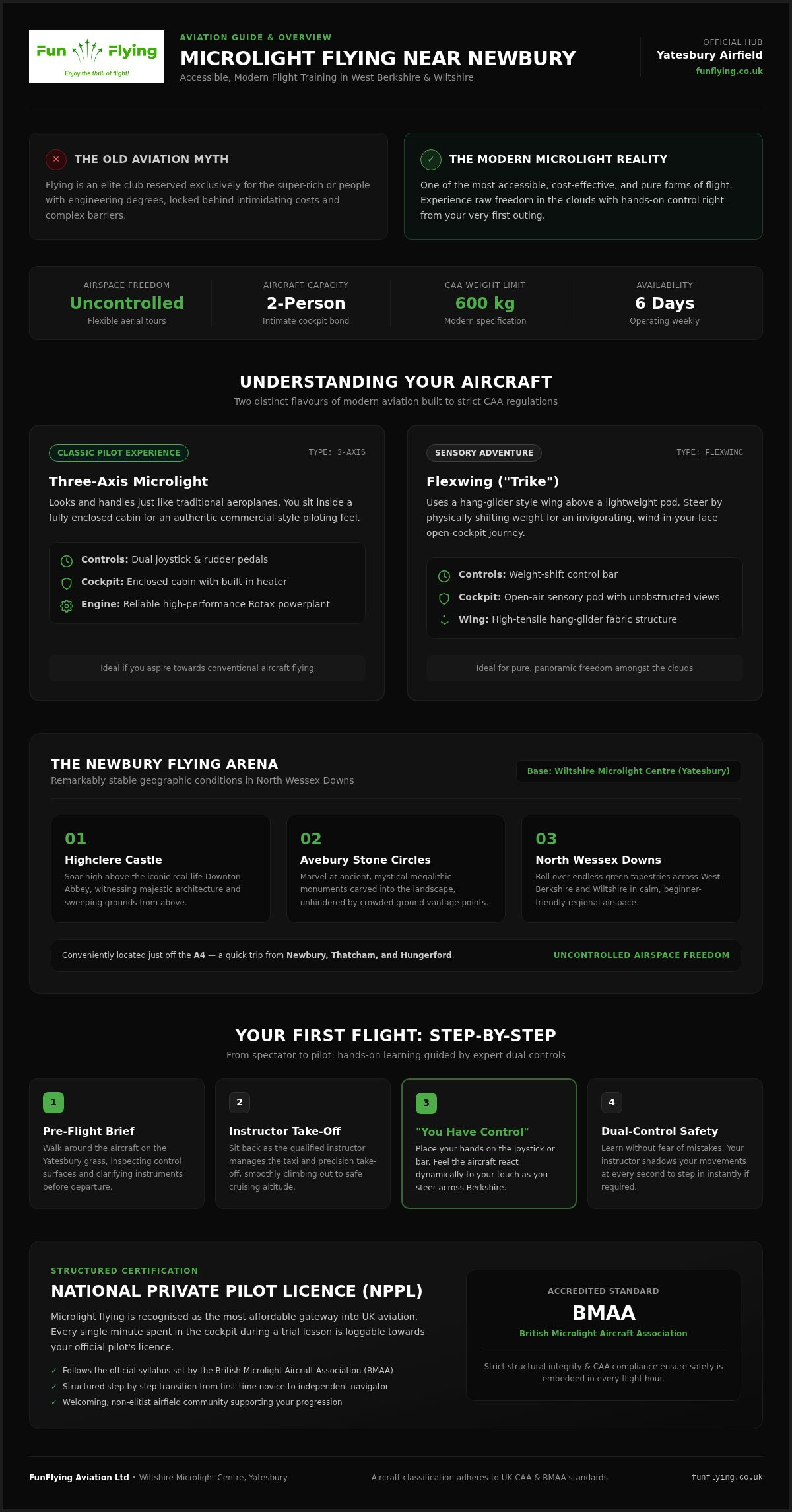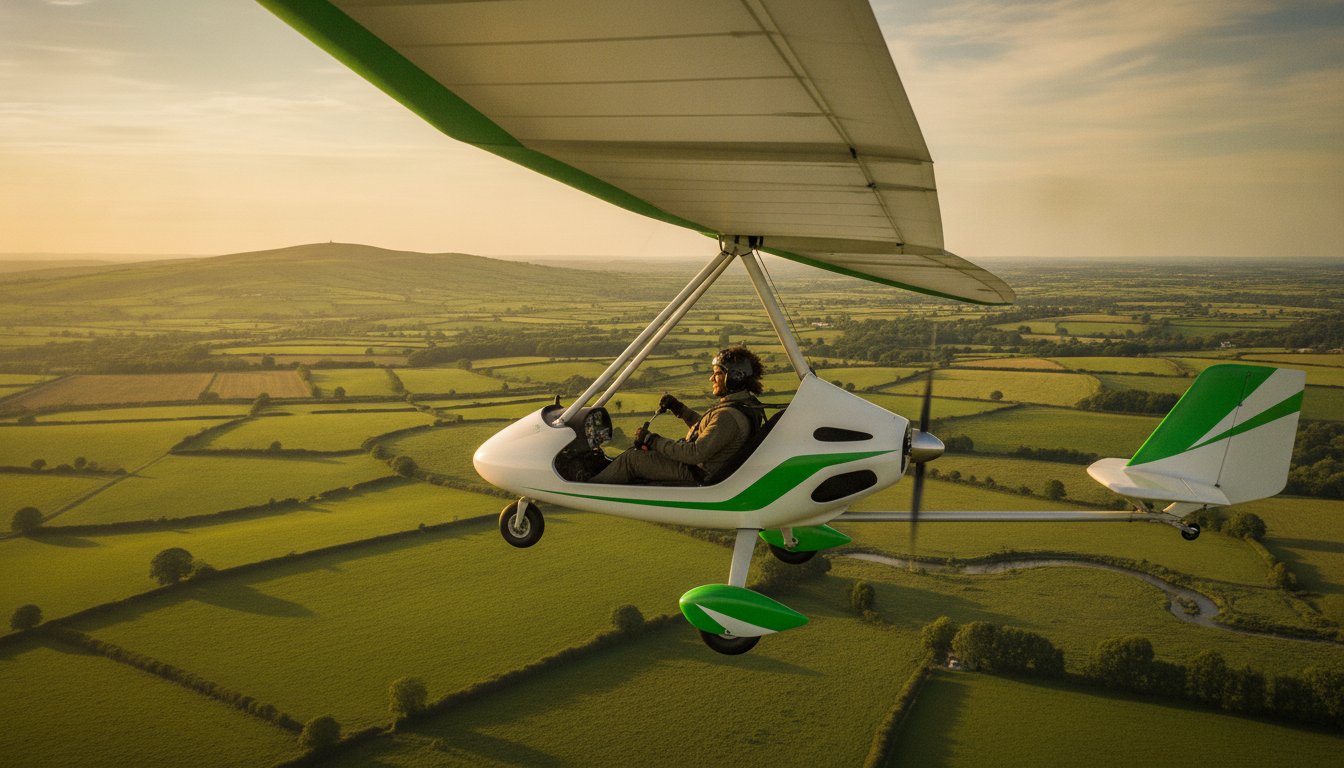
How Many Hours for a Microlight Licence? Path to the Skies

How Many Hours for a Microlight Licence? Path to the Skies

What if you could swap your morning commute for a sunrise flight above the clouds in less time than it takes to master a new language? Most people assume that becoming a pilot is a lifelong pursuit reserved for those with endless spare time. It’s completely natural to feel a bit overwhelmed by technical jargon or worry about how many hours to get microlight license status whilst balancing a busy career. You want a clear path to the cockpit without the confusion of conflicting regulations.

We’re here to clear the air and show you the exact flight times and study milestones needed to earn your wings. Whether you’re aiming for the 15-hour restricted route or the full 25-hour unrestricted National Private Pilot’s Licence, we’ve got you covered. You’ll discover the specific training requirements, the social side of ground school, and how our flexible approach at the Wiltshire Microlight Centre makes your dream of flight a practical, exhilarating reality. From medical self-declarations to taking control of the aircraft on day one, this is your roadmap to the skies.

Key Takeaways

  • Discover exactly how many hours to get microlight license, including the breakdown of dual instruction and solo flight time for a full NPPL.
  • Explore how the restricted licence option can get you airborne in just 15 hours, offering a faster route to local flying freedom.
  • Learn why ground school is a social highlight of the process, helping you master the five essential theory exams amongst a supportive community.
  • Find out how booking regular lessons and maintaining momentum can help you reach your goals faster whilst keeping your new skills sharp.
  • See why taking the controls from your very first hour ensures your journey to becoming a pilot is hands-on and exhilarating from the start.

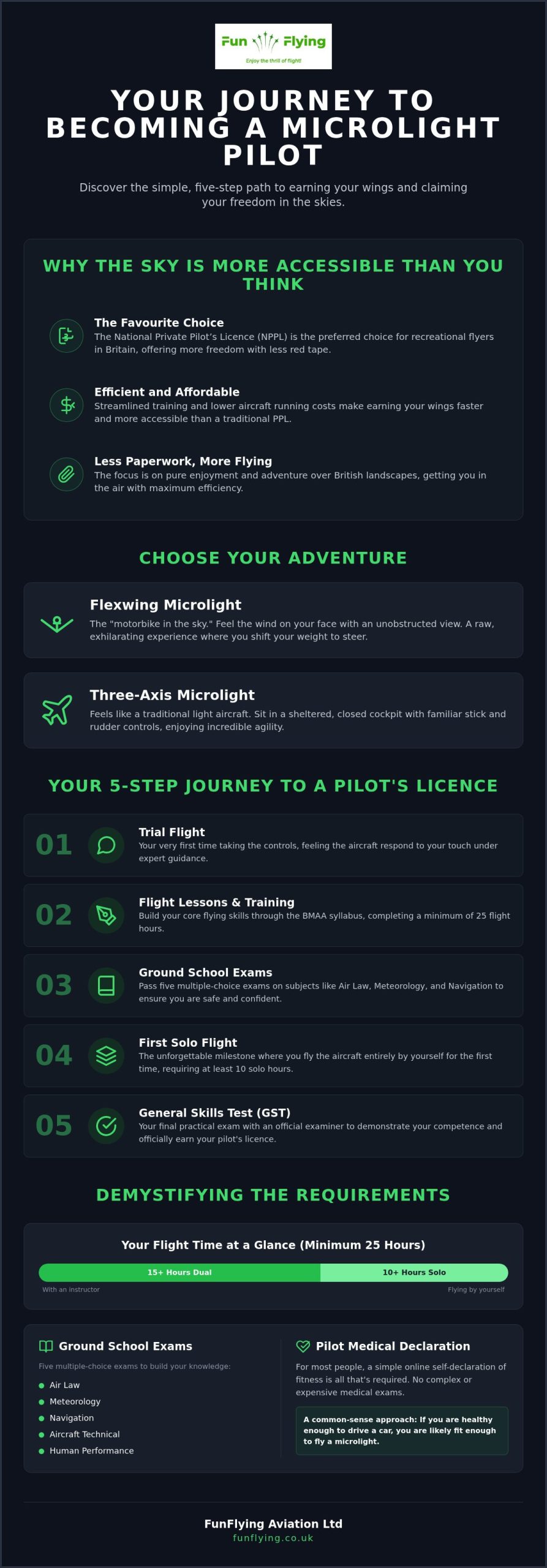
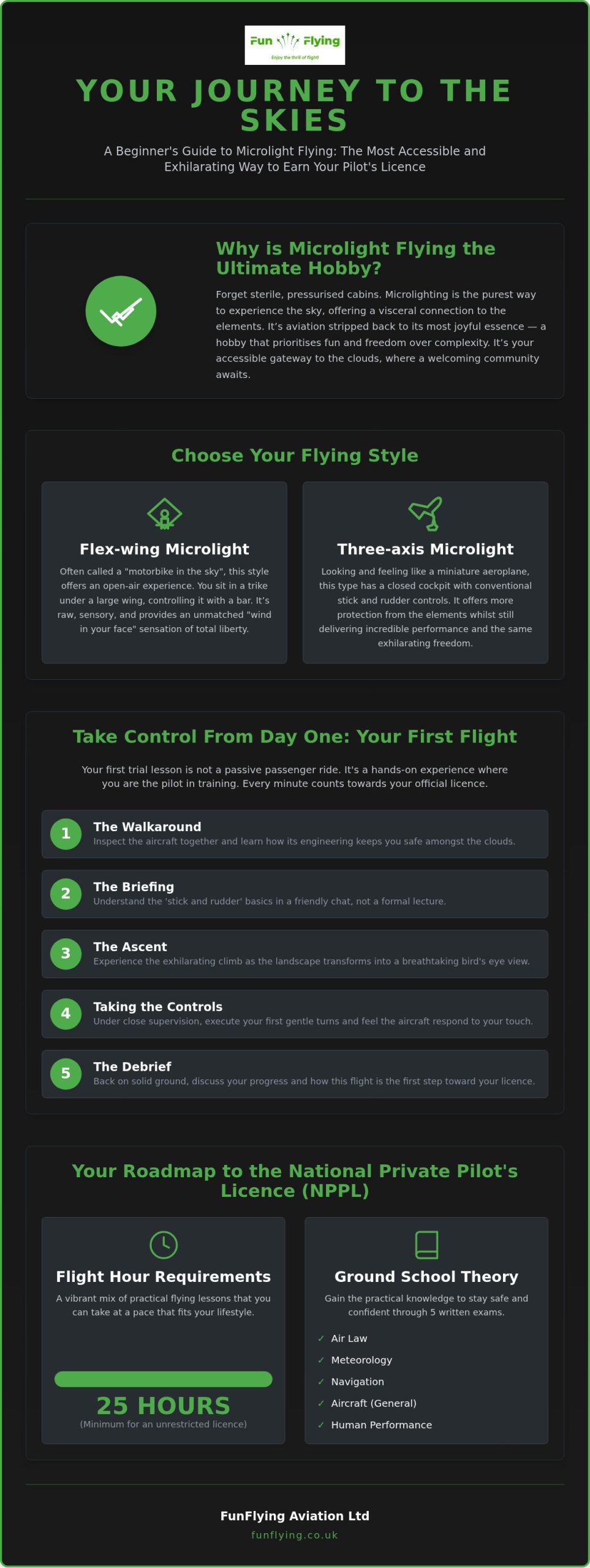
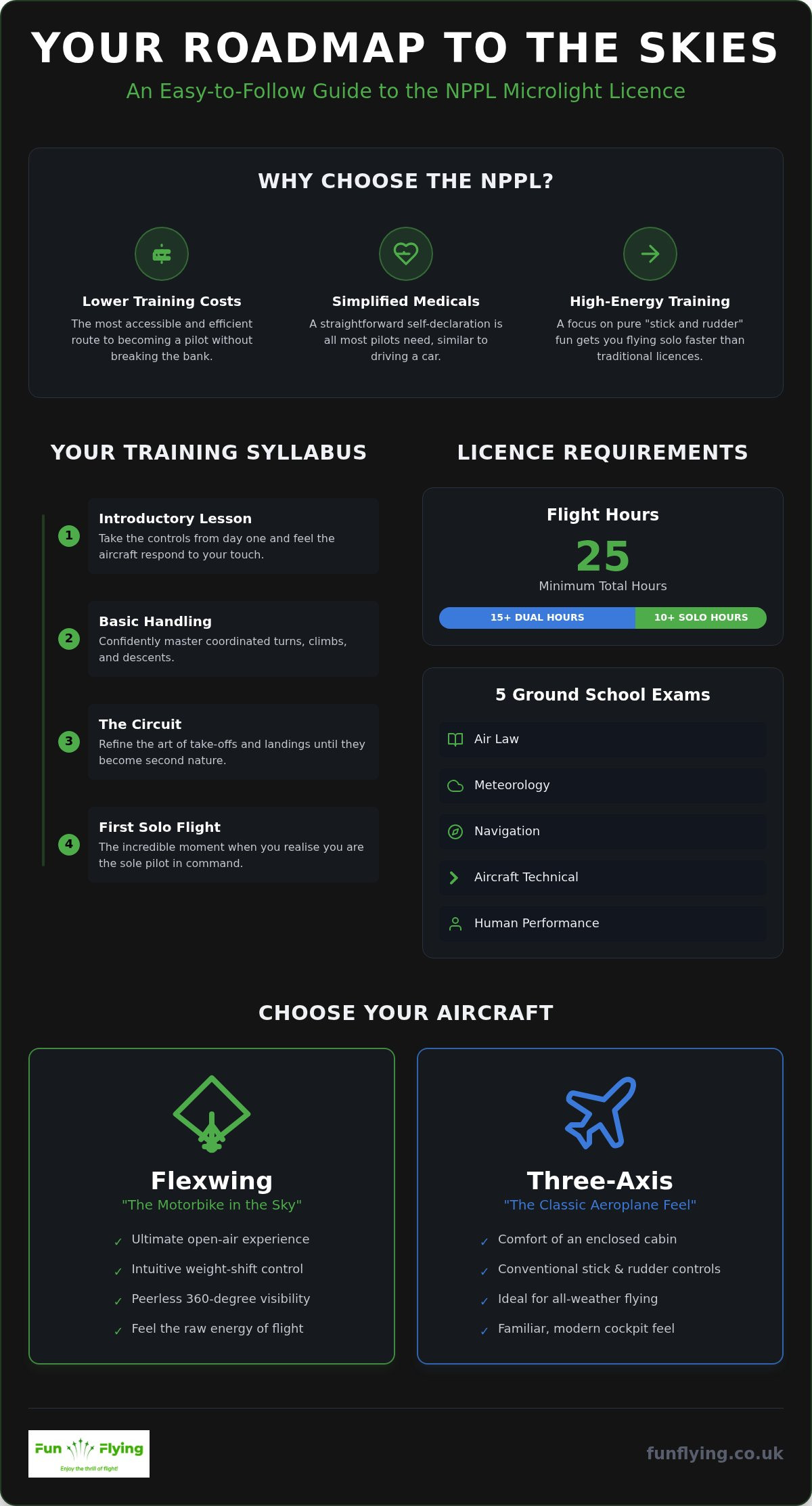
Imagine the feeling of finally pulling back the stick and seeing the ground fall away. For many, the big question is exactly how many hours to get microlight license certification. In the UK, the National Private Pilot’s Licence (NPPL) sets a legal minimum of 25 flight hours. This standard ensures you’re safe and skilled within the world of Ultralight aviation, which has evolved from simple frames into sophisticated, high-performance machines. Whilst 25 is the legal baseline, your journey is bespoke. It’s about mastery, not just ticking boxes. Most pilots find that their actual time in the air depends on how often they fly and the British weather.

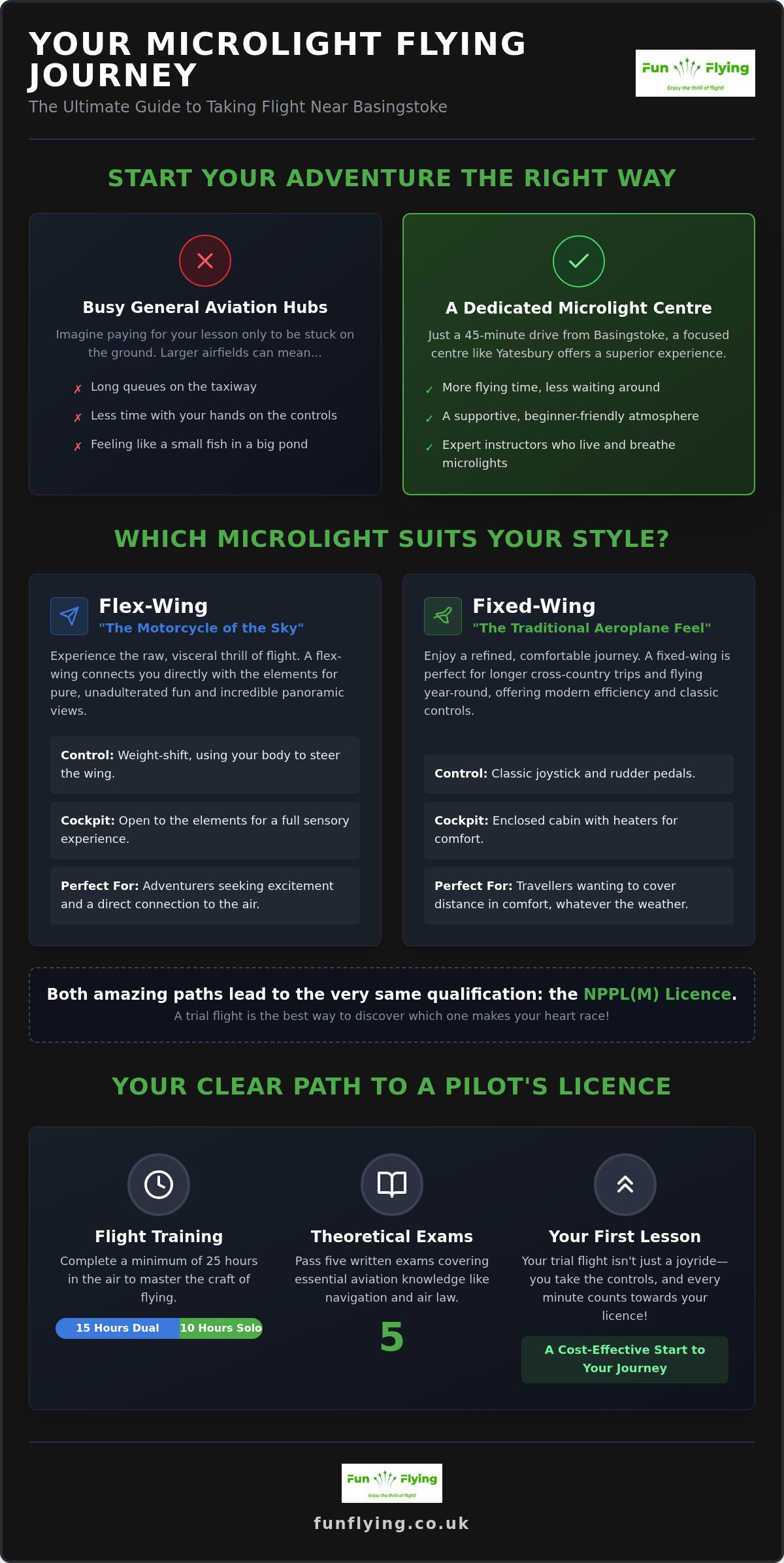
  • 15 Hours Dual Instruction: Learning the ropes directly with an expert instructor.
  • 10 Hours Solo Flight: Proving you have the confidence to handle the aircraft alone.

Dual Instruction vs Solo Flight

Dual instruction is where you build your core hands-on confidence. At Fun Flying Aviation Ltd, you’ll be learning to fly by taking control from your very first lesson. Your instructor will guide you through turns, stalls, and landings until the aircraft feels like an extension of yourself. Then comes the magic moment: your first solo circuit. It is a short, exhilarating hop around the airfield that you will never forget. Our instructors only sign you off when your landings are consistently safe and your confidence is sky-high. This transition from student to solo pilot is the ultimate milestone in your aviation adventure.

Navigating the Cross-Country Milestone

Once you’ve mastered the local area, it’s time to explore. You’ll learn to read the Wiltshire landscape from 2,000 feet, spotting landmarks amongst the rolling hills and ancient sites. The syllabus requires two qualifying cross-country flights of at least 40 nautical miles. You’ll also complete a larger 100nm flight with two landings at different airfields away from your home base. It’s a fantastic way to visit new spots near Bristol or Swindon whilst perfecting your navigation skills. These hours prove you can plan a route, communicate with air traffic control, and land safely in unfamiliar territory.

Full vs Restricted Licence: Can You Qualify in 15 Hours?

Did you know there’s a shortcut to the skies? If you’re eager to get airborne but find the full syllabus a bit daunting, the restricted licence might be your perfect match. When researching how many hours to get microlight license status, you’ll find that the UK Civil Aviation Authority NPPL regulations allow for a restricted rating with just 15 hours of flight training. It’s the fastest way to transition from an admirer of the clouds to a pilot in command.

Is the Restricted Licence Right for You?

This option is perfect for recreational pilots who love exploring their local Wiltshire patch. It’s about the immediate joy of flight without the pressure of long-distance navigation. However, there are a few boundaries to keep in mind. You’ll be restricted to flying within 8 nautical miles of your home airfield, and you won’t be able to carry passengers just yet. Weather limits are also slightly stricter to ensure you stay safe whilst building your experience. Many of our students at Yatesbury start here to get their wings quickly, whilst others prefer to go straight for the full 25-hour licence to enjoy total freedom from day one.

The Upgrade Path to Total Freedom

The best part about the restricted licence is that it isn’t a dead end. It’s a stepping stone. You can easily upgrade to a full NPPL whenever you feel ready by simply completing the remaining 10 hours of the syllabus. This includes those exciting cross-country flights we mentioned earlier. Once you’ve clocked the extra time and gained your full licence, you can then look at adding passenger-carrying ratings. This allows you to share the magic of flight with friends and family. If you’re looking for the complete roadmap, check out our guide on how to become a microlight pilot to see how these hours fit into your long-term goals. Understanding how many hours to get microlight license qualifications is just the start of your journey. Why not book a trial flight to see which path suits your lifestyle best?

Ground School: The Hours Spent Off the Aircraft

Mastering the theory is just as exciting as the physical flight training. You aren’t just memorising facts; you’re learning why the wind behaves the way it does and how to keep yourself safe amongst other pilots. When people ask how many hours to get microlight license status, they often forget that ground school hours are just as vital as air time. These sessions are flexible and designed to fit your life, making the study part of the adventure rather than a chore. Preparing for the General Skills Test (GST) is the final hurdle, but with the right support, it’s a rewarding experience that proves you’re ready to command the skies.

Demystifying the Five Exams

Meteorology becomes your best friend for planning a perfect day over the Wiltshire hills. You’ll learn to spot the difference between a bumpy afternoon and a smooth evening flight. Air Law is made simple too, giving you the confidence to stay safe and legal in UK skies. It’s about knowing who has right of way and where you can explore. These five multiple-choice exams cover everything from Human Factors to the Principles of Flight. For a deeper look at what to expect, read our guide on Mastering the Sky: Microlight Ground School.

The Radio Practical and Oral Exam

Learning the ‘language of the air’ is a huge confidence booster. You’ll master the radio skills needed to talk to air traffic control, making you feel like a true professional from your first call. The oral exam is just a friendly chat with your examiner to prove your knowledge before you head up for your final flight test. Our Yatesbury team supports you through every study hour, ensuring you feel ready and relaxed. We believe ground school should be a fun, social part of the process where you can share tips with fellow students.

How Many Hours for a Microlight Licence? Path to the Skies

Factors That Influence Your Personal Timeline

Whilst the legal minimum is a fantastic target, your personal journey to the cockpit is unique. When you’re planning how many hours to get microlight license status, it’s helpful to look at the averages. Most students find they need between 35 and 45 hours of flight time to feel truly exam-ready and confident. This isn’t because the training is difficult. It’s because aviation is about building muscle memory and sharp instincts. Your previous adventures, like paragliding or even flying high-end drones, can give you a head start, but nothing beats actual time in the pilot’s seat. Your aptitude and how quickly you pick up the “feel” of the aircraft will play a huge role in your timeline.

Beating the British Weather

Weather is the biggest variable for any UK pilot. Flexibility is your secret weapon here. At our Yatesbury base, we’ve seen every kind of sky, and we’ve learned how to keep the dream alive even when the clouds roll in. Booking intensive blocks during the brighter summer months is a brilliant way to make massive leaps in progress. On those pesky non-flying days, you can still move forward by diving into your ground school books or socialising with the supportive community at the Wiltshire Microlight Centre. We make sure that even when the aircraft are in the hangar, your learning never stops.

Momentum: The Secret to Fewer Hours

Flying twice a week is far more efficient than once a month. Why? Because you won’t spend the first twenty minutes of every lesson relearning what you did last time. Momentum is the secret to finishing in fewer total hours. We specialise in flexible schedules to suit busy lifestyles, so you can balance your career with the thrill of the skies. It’s about making your training a consistent part of your week. When you maintain that rhythm, the technicalities become second nature, and you’ll find yourself reaching for the solo milestones much sooner than you expected. This is about more than just a number; it’s about the quality of every minute you spend in the air.

Take Control of Your Dreams

Earning your wings is closer than you think. Whether you choose the 15-hour restricted route for local fun or the full 25-hour National Private Pilot’s Licence for total freedom, the roadmap is clear. You’ve seen that whilst the law sets the minimum, your personal journey depends on momentum and the supportive community you choose. Understanding how many hours to get microlight license status is the first step toward a life of adventure. At the Wiltshire Microlight Centre, we pride ourselves on flexible training tailored to your lifestyle. Our professional instructors ensure you take control of the aircraft from day one, making every minute in the air count toward your goal.

Imagine the feeling of looking down at the rolling hills of Yatesbury from your own cockpit. The confusion about different licences is gone, and the path to becoming a pilot is wide open. It’s time to stop dreaming and start flying.

The sky is waiting for you. We can’t wait to see you at the airfield and help you start this incredible new chapter.

Frequently Asked Questions

Can I count hours from a trial flight towards my microlight licence?

Yes, every minute you spend in the air during a trial flight counts towards your total training time. As long as your lesson is conducted with a qualified instructor at a registered school, you can log that initial experience in your pilot’s logbook. It is a brilliant way to kickstart your aviation adventure whilst getting a genuine feel for the controls from day one.

What is the minimum age to start counting flight hours in the UK?

You can begin logging official flying hours toward your goal from the age of 14. Whilst you must wait until you are 16 to fly solo and 17 to actually hold the licence, starting early allows you to build incredible muscle memory. It is a fantastic way for young enthusiasts to develop discipline and a unique skill set before they even learn to drive a car.

Do I need a medical certificate before I start my training hours?

You don’t need a medical certificate to begin your initial dual instruction hours with an instructor. However, you must complete a Pilot Medical Declaration via the CAA portal before you are allowed to fly solo. This is a straightforward online process based on the same health standards as a standard UK driving licence, making it accessible for the vast majority of people.

How many hours of ground school will I typically need?

There is no fixed legal minimum for ground school, but most students find that 40 to 50 hours of study is the sweet spot for mastering the theory. This time is spread across the five multiple-choice exams and happens alongside your flying. When considering how many hours to get microlight license status, these study hours are a fun, social part of the process amongst your fellow pilots at Yatesbury.

Can I transfer hours from a PPL or other aircraft types?

Yes, you can often credit previous flying experience from other pilot licences towards your microlight rating. If you already hold a PPL for aeroplanes or helicopters, you might only need a short course of conversion training to get up to speed. This can significantly reduce how many hours to get microlight license qualifications you need to log, allowing you to transition into the world of microlighting much faster.

Marce Colucci

Article by

Marce Colucci

Love to fly, and more importantly, love teaching others to fly.

SSDR Pilot Training UK: Your Complete Guide to Single-Seat Freedom

SSDR Pilot Training UK: Your Complete Guide to Single-Seat Freedom

Imagine soaring over the Wiltshire Downs with nothing between you and the horizon but a lightweight wing and the hum of a single engine. What if you could bypass the staggering costs of traditional aviation and the mountain of red tape that usually comes with it? For many, the dream of flying is often dampened by the reality of expensive lessons and complex medical requirements. It’s a common frustration; you want the sky, not a lifetime of paperwork. This is why SSDR pilot training UK is becoming the favourite choice for those seeking pure, unadulterated flight.

In this guide, you’ll discover how to take to the skies with the ultimate freedom of Single Seat Deregulation and the professional training pathway to get you there. We’ll explore the legal requirements for SSDR aircraft, the step-by-step journey from beginner to solo pilot, and how this unique category can significantly reduce the long-term costs of your flying hobby. Whether you’re looking to escape the constraints of a traditional flying school or simply want a more accessible way to own your own aircraft, we’ve got you covered. Your journey to aviation independence starts right here.

Key Takeaways

  • Understand the “magic numbers” of SSDR aircraft that unlock a world of lightweight aviation without the burden of excessive regulation.
  • Discover the essential steps for SSDR pilot training UK, starting with professional two-seat instruction to earn your NPPL (Microlight) licence.
  • Uncover the secrets to reducing your long-term flying costs, from lower fuel consumption to skipping the hassle of annual permit fees.
  • Find out why the Wiltshire Microlight Centre is the ideal launchpad for your journey, offering expert guidance and hands-on flying from day one.

Understanding SSDR: The Gateway to Accessible Aviation in the UK

Single Seat De-Regulated (SSDR) sounds a bit technical, doesn’t it? In reality, it’s the most exciting thing to happen to British aviation in decades. Essentially, it’s a sub-category of microlights that the Civil Aviation Authority (CAA) decided to set free. By removing the need for a formal “Permit to Fly,” they’ve made it easier than ever for you to own and fly your own craft. This shift has placed the UK at the forefront of Ultralight aviation, giving pilots a level of autonomy that was previously unthinkable. It’s the reason why SSDR pilot training UK is such a hot topic right now; people want that freedom.

To qualify as an SSDR, an aircraft has to meet two “magic numbers.” First, it must have a Maximum Take-Off Mass (MTOM) of no more than 300kg. If you’ve got a recovery parachute system installed, that limit nudges up to 315kg. Second, the stall speed must not exceed 35 knots. These criteria ensure the aircraft remain light, agile, and incredibly fun to handle.

Why Deregulation Doesn’t Mean “Unregulated”

Don’t let the word “deregulated” fool you into thinking it’s a free-for-all. Whilst the aircraft itself doesn’t need an annual inspection from a formal body, the pilot definitely does. You still need a valid licence to fly. This is why finding the right SSDR pilot training UK pathway is so vital. Most pilots start their journey with microlight license training to build the necessary skills. The British Microlight Aircraft Association (BMAA) still keeps a watchful eye, overseeing the SSDR registry to ensure everything stays safe and organised.

The Freedom of Maintenance

This is where the real magic happens. In the SSDR world, you are the master of your own machine. You can maintain, repair, and even modify your aircraft without needing a signed-off inspector to check your work. This doesn’t just give you a deeper connection to your plane; it also wipes out the hefty fees associated with annual permits and mandatory inspections. It’s a huge win for your wallet and your sense of adventure. You get to spend more time in the air and less time worrying about the next bill from the hangar.

The Benefits of Single-Seat Deregulation: Why Pilots are Making the Switch

Imagine the sheer thrill of a Sunday morning flight where the only schedule you follow is your own. The shift towards SSDR isn’t just about saving pennies; it’s about reclaiming the spirit of adventure. By choosing this path, you’re stepping into a community that values simplicity and the pure joy of being airborne. Investing in SSDR pilot training UK opens up a world where aviation is finally within reach, stripping away the layers of complexity that often keep aspiring flyers on the ground.

Financial Advantages of the SSDR Category

Traditional aviation often comes with a cloud of “hidden costs” that can dampen the enthusiasm of even the most dedicated pilot. From mandatory annual inspections to eye-watering hangarage fees, the bills for a standard PPL aircraft add up quickly. SSDR changes the game by offering total transparency. Since you’re responsible for your own maintenance, those recurring professional fees simply vanish. In many cases, the hourly cost of keeping an SSDR in the air is actually lower than the running costs of a mid-range family car. This cost-effectiveness means you can spend more time in the clouds and less time worrying about your bank balance. If you’re already a qualified pilot looking to make this switch, microlight conversion training UK offers a streamlined route to getting into these nimble, affordable aircraft.

The “Hangar at Home” Lifestyle

One of the most liberating features of modern SSDRs is their incredible portability. Many designs, such as the Sherwood KUB, feature clever folding wings that allow the aircraft to be tucked away in a trailer. This “hangar at home” approach means you can avoid expensive airport parking and keep your craft in your own garage or a local barn. It also opens up the world of farm strips. Instead of being tied to busy regional airports with strict opening times and landing fees, you can operate from quiet, scenic fields. The Official UK SSDR Regulations provide the framework that makes this flexibility possible, allowing you to turn any suitable patch of grass into your personal runway.

Beyond the logistics, there’s the innovation. Deregulation has sparked a creative boom in aircraft design, leading to lightweight machines that are as beautiful as they are capable. These aren’t the basic “engines on a frame” of the past; they are sophisticated, responsive aircraft that offer a truly undistracted connection between pilot and sky. If you’re ready to experience this level of autonomy, starting with professional microlight license training is your first step toward that solo seat.

The Training Pathway: How to Fly an SSDR Aircraft Legally and Safely

So, how do you actually get into that solo cockpit? It’s a question we hear a lot. Because SSDRs are single-seaters, your SSDR pilot training UK journey actually begins in a dual-control, two-seat aircraft. You need a solid foundation before you can enjoy the ultimate independence of solo flight. It’s about building muscle memory and confidence with a friendly expert by your side, ensuring you have the skills to handle any situation the sky throws at you.

Step 1: The Initial Microlight Licence

To fly any microlight legally in the UK, you need a National Private Pilot’s Licence (NPPL) with a Microlight rating. The legal minimum is 25 hours of flight training, which must include at least 10 hours of solo time. Whilst some reach the standard in the minimum time, many pilots budget for around 35 hours to feel truly competent. You’ll want to start with a structured learn to fly programme that covers everything from basic handling to emergency procedures in a stable, two-seat aircraft.

Step 2: Transitioning to Solo Flight

Once you have your licence, moving to a single-seater involves “differences training.” Since your instructor can’t sit with you in an SSDR, they use a “briefing and observation” method. They’ll talk you through the specific handling quirks of your new craft, such as the lighter control response or different stall characteristics. They then watch your take-offs and landings from the ground, providing feedback via radio. This ensures you’re never truly on your own until you are completely ready for the transition. Pilots coming from a General Aviation background will find that a structured microlight conversion training UK programme makes this transition far smoother, covering the key differences in handling and regulation.

Essential Ground School Knowledge

Flying solo means you’re the pilot, the navigator, and the weather forecaster all at once. Subjects like Air Law and Human Performance become vital when you don’t have a second pair of eyes in the cockpit. You need to understand how to stay clear of restricted airspace and how your own behaviour affects flight safety. For a deep dive into the theory, check out our Ultimate Guide to Microlight Ground School UK. It’s the perfect companion for your practical lessons.

SSDR Pilot Training UK: Your Complete Guide to Single-Seat Freedom

Start Your SSDR Journey at the Wiltshire Microlight Centre

Ready to turn your solo flight dreams into a real flight plan? If you’re living in Swindon, Bristol, or Newbury, your gateway to the sky is just down the road. At Fun Flying Aviation Ltd, we don’t believe in keeping you on the ground for weeks of theory. You’ll have your hands on the controls from your very first lesson, feeling exactly how a modern microlight responds to your touch. It’s this hands-on, immersive style that makes our SSDR pilot training UK so effective for busy people who want to get airborne without the fuss.

We know that your time is precious. That’s why we offer flexible training programmes that fit around your professional life and weekend plans. You aren’t just a number here; you’re part of a growing community of enthusiasts. We act as your “Friendly Guide” through every regulation and technical detail, making the journey to your first single-seat cockpit as smooth as a sunset landing.

Training in the Heart of Wiltshire

Yatesbury offers more than just a place to land; it’s a stunning backdrop for your aviation journey. Training at the Wiltshire Microlight Centre means you’re flying over some of the UK’s most beautiful landscapes. Imagine practicing your steep turns over the rolling downs whilst enjoying the quiet focus of a dedicated microlight strip. You won’t find yourself stuck in a long queue of commercial jets here. It’s just you, the grass runway, and the open air. This calm, dedicated environment is exactly what you need to master your SSDR pilot training UK.

Taking the First Step

The best way to find out if the SSDR lifestyle is for you is to get up there and feel it. Booking a trial flight lets you experience that lightweight, agile sensation for yourself. You’ll work with professional instructors who are genuinely excited to share their decades of experience with you. We’re here to support you even after you’ve earned your wings, providing the advice and community you need as you move into owning your own aircraft. Your adventure starts the moment you arrive.

Contact Fun Flying Aviation Ltd to discuss your SSDR training path

Claim Your Piece of the Sky Today

The journey from your first trial flight to the cockpit of your own deregulated aircraft is one of the most rewarding paths in modern aviation. We’ve seen how the SSDR category strips away the complexity of traditional flying, leaving you with the pure, affordable essence of the sport. By choosing SSDR pilot training UK through a professional school, you’re not just learning a skill; you’re joining a community that values independence and adventure above all else. It’s about making the dream of flight a practical, everyday reality.

At Fun Flying Aviation Ltd, we pride ourselves on being more than just instructors; we are your partners in this transition. Our experts at Yatesbury are ready to help you navigate every step, from those initial hours in a two-seater to the moment you’re ready to head out on your own. With a focus on inclusive, high-energy learning and flexible schedules that work for you, we ensure that the sky feels like home from your very first lesson.

Your piece of the sky is waiting. Let’s get you up there and experience that incredible sense of freedom together.

Frequently Asked Questions

Do I need a medical certificate to fly an SSDR aircraft in the UK?

No, a full aviation medical certificate is usually not required for this category. For most pilots, a simple Pilot Medical Declaration (PMD) is all you need, which is essentially the same medical standard required to drive a car on UK roads. This makes getting into the air much simpler and removes the stress of complex, expensive medical examinations that often come with traditional flying.

Can I fly a single-seat deregulated aircraft with a standard PPL?

Yes, you can fly an SSDR if you hold a standard Private Pilot’s Licence (PPL), but you must have a valid microlight rating. Because these lightweight machines handle very differently to a heavy Cessna or Piper, it’s vital to undergo differences training with an instructor. This ensures you’re comfortable with the responsive controls and lower stall speeds before you head out on your first solo adventure.

How much does it cost to train for an SSDR pilot licence?

The total investment for SSDR pilot training UK depends largely on how many hours you need to reach the required standard. The legal minimum for a microlight licence is 25 hours of flight time, though many students budget for around 35 hours to feel truly confident. You’ll also need to account for ground school materials, five multiple-choice exams, and your final General Skills Test with an examiner.

Is it legal to build my own SSDR aircraft at home?

Absolutely, and it’s one of the most rewarding ways to get involved in the hobby. Because the aircraft is deregulated, you have the freedom to build or modify your machine without needing a formal inspector to sign off on every stage of the process. This allows for incredible innovation and a deep, personal connection with your aircraft, though safety should always remain your top priority during the build.

What happens if I want to fly a two-seat microlight later?

You’ll already be qualified to do so because your initial SSDR pilot training UK journey actually takes place in a two-seat aircraft. To earn your licence, you must train and pass your tests in a dual-control machine with an instructor. This means your licence is valid for both single-seat and two-seat microlights, giving you the flexibility to fly solo or take a friend along for the ride.

Marce Colucci

Article by

Marce Colucci

Love to fly, and more importantly, love teaching others to fly.

Three-Axis Microlight Training: The Modern Path to Becoming a Pilot

Three-Axis Microlight Training: The Modern Path to Becoming a Pilot

What if you could command a modern, high-performance aircraft that feels exactly like a traditional plane, but at a fraction of the usual cost? You’ve likely dreamt of soaring through the clouds, yet perhaps you’ve been held back by the myth that flying is an elite hobby or the fear that microlights are nothing more than glorified kites. It’s a common worry, but the reality of three axis microlight training is far more professional and exciting than you might imagine. These are sophisticated aircraft with closed cockpits and familiar controls that offer a genuine, high-energy “stick and rudder” experience.

We know that the maze of licensing requirements and the anxiety over total costs can feel daunting. This guide will show you why this modern path is the most accessible and exhilarating way to earn your wings and claim your independence in the sky. We’ll explore the straightforward steps to gaining your licence, explain how you can take the controls at a local centre from day one, and help you find a friendly environment where the dream of flight finally becomes your reality.

Key Takeaways

  • Grasp why three-axis microlights offer a genuine “proper plane” experience with familiar cockpit controls and stable flight characteristics.
  • Compare control systems and flight missions to decide if a fixed-wing or weight-shift aircraft better suits your dream of cross-country touring.
  • Explore the clear, manageable path to earning your NPPL through professional three axis microlight training and structured ground school.
  • Learn how a friendly, flexible training environment at a scenic Wiltshire centre makes the journey to becoming a pilot both stress-free and enjoyable.

What is Three-Axis Microlight Training? The “Proper Plane” Experience

Imagine sitting in a cockpit with a control stick in your hand and rudder pedals at your feet. You look out over a dashboard filled with instruments, shielded from the wind by a sleek fuselage. This isn’t a “glorified kite” or a flimsy frame; it’s a sophisticated, fixed-wing aircraft. Three-axis microlights look, feel, and fly exactly like the traditional light aeroplanes you’ve seen at major airfields. The name comes from how you control the plane across three distinct points: pitch (moving the nose up or down), roll (banking the wings), and yaw (swinging the nose left or right). It’s authentic “stick and rudder” flying that rewards precision and offers an incredible sense of autonomy.

The sensory experience is unmatched. In a modern Ultralight (microlight) aircraft, you enjoy panoramic views from a comfortable, closed cockpit. The controls are incredibly responsive, reacting to the lightest touch. Unlike more exposed forms of aviation where you’re battling the elements, three-axis planes offer a refined environment. You can fly in comfort whilst still feeling every nuance of the air around you. It’s real flying, simplified.

Why it Feels Like a Traditional Aircraft

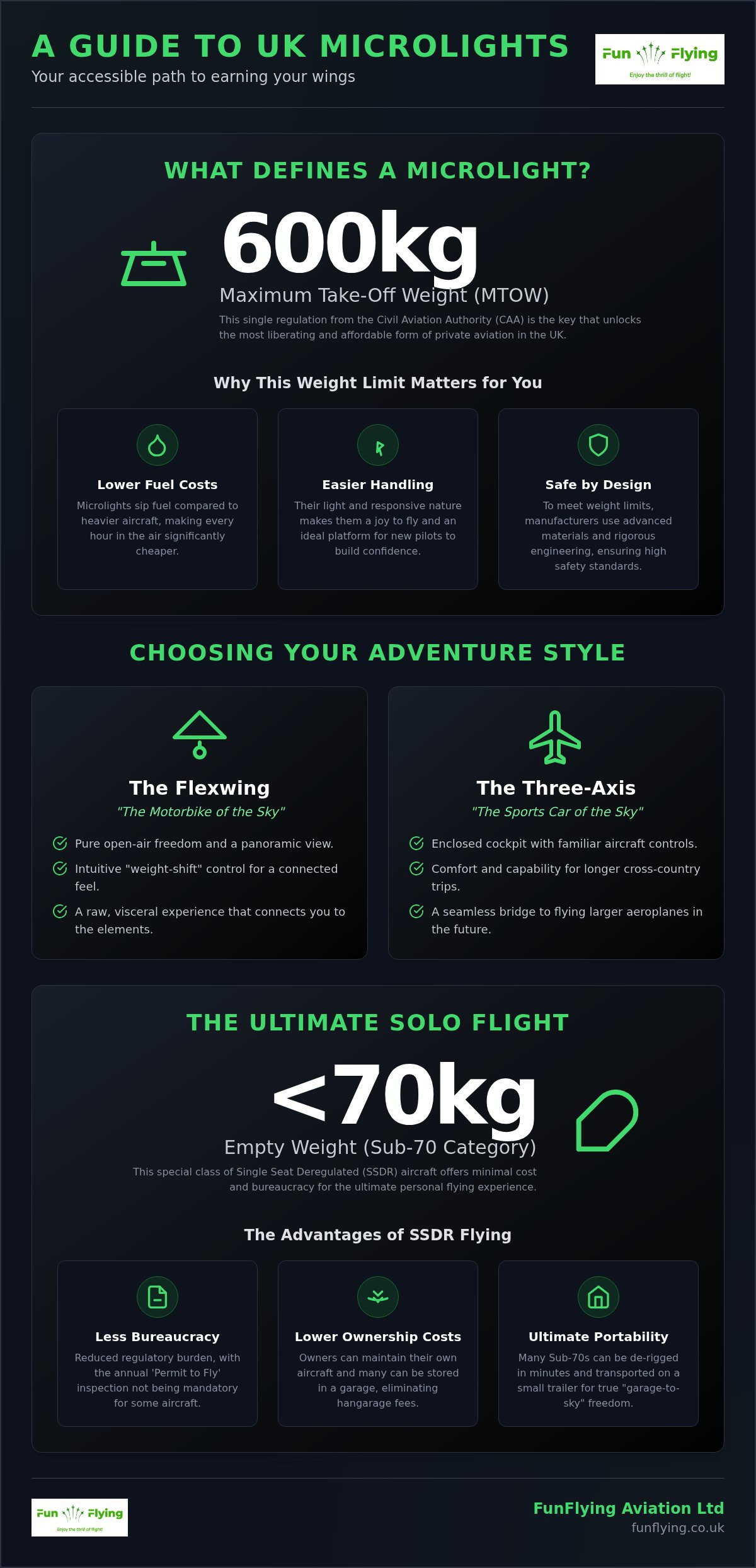
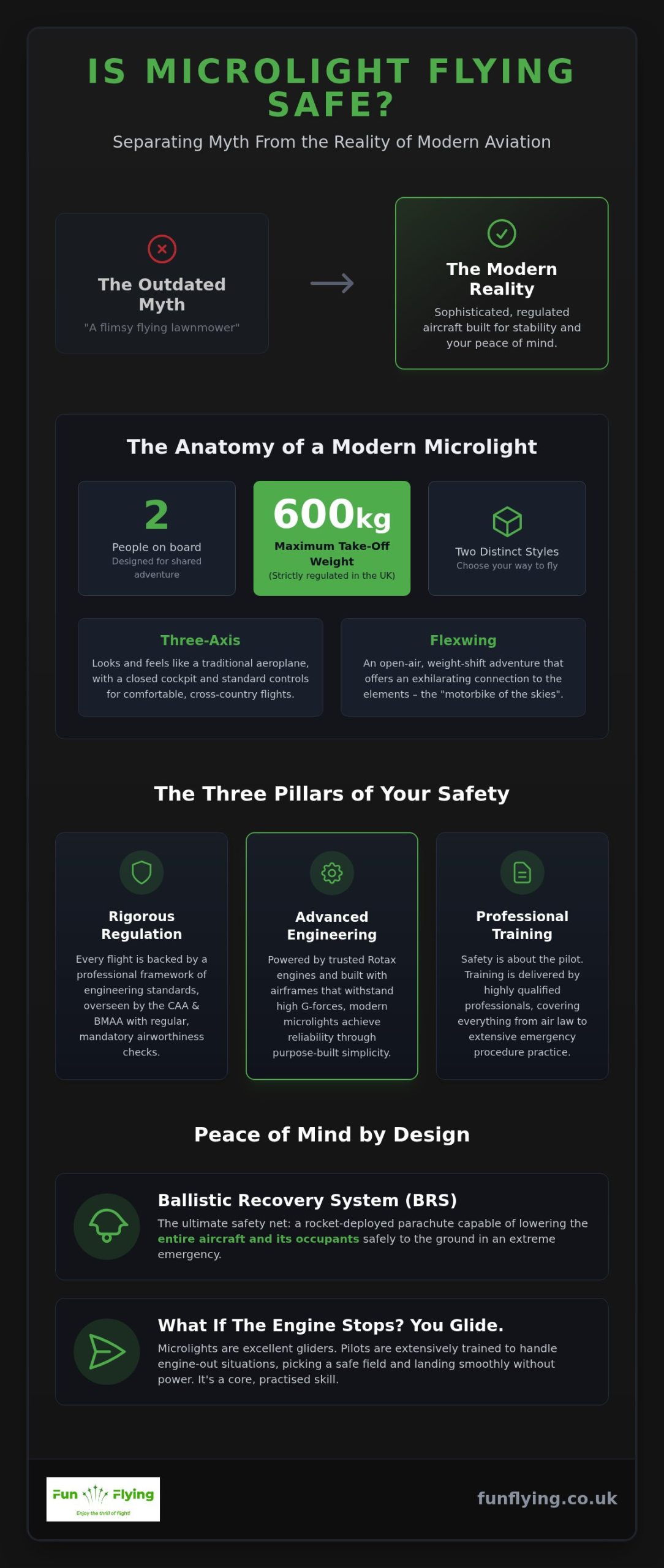
If you’ve ever dreamt of piloting a Cessna or a Piper, you’ll feel right at home here. The flight characteristics are remarkably similar, featuring familiar instruments and handling. A major turning point was the evolution of the 600kg weight limit. This regulatory shift allowed for sturdier designs and better equipment, effectively modernising the entire fleet. You get the prestige and feel of a heavy aircraft with the agility of a light one.

The Freedom of the Microlight Category

Why is this the top choice for new pilots in the UK? It’s all about the freedom. Choosing three axis microlight training means you bypass much of the heavy regulatory red tape found in traditional General Aviation. The process is streamlined, the community is welcoming, and the focus remains firmly on the joy of being airborne. It’s the most accessible path to earning your wings. You can start your journey today by booking an introductory flying lesson and taking the controls yourself.

Three-Axis vs Flexwing: Which Microlight Training is Right for You?

Deciding between a flexwing and a three-axis microlight is often the first big choice you’ll face. It really comes down to your personality and what you want your flying life to look like. A flexwing uses a “weight-shift” system; you physically push a bar to move the trike’s weight under the wing. It’s raw and exhilarating. In contrast, three axis microlight training focuses on aerodynamic surfaces. You use a stick and rudder to control the air moving over the wings and tail. For many, this feels more intuitive because the plane moves exactly where you point the stick.

Think about your “mission” in the sky. Are you looking for local sunset hops over the Wiltshire hills? A flexwing might be your dream. However, if you aspire to cross-country touring or visiting airfields across the UK and Europe, the three-axis is the clear winner. These aircraft are designed for distance and efficiency, offering better protection from the elements and higher cruising speeds. If you’re still unsure which path suits you, why not experience the difference yourself with a trial flight?

Weather also plays a role in your decision. Three-axis aircraft generally handle a wider range of conditions comfortably. They often have higher crosswind limits, meaning you’re less likely to have a lesson cancelled due to a stiff breeze. This stability makes the learning curve feel smoother for many students, as the aircraft feels planted and predictable even when the air is a little lively.

The Three-Axis Advantage for Future Pilots

If you ever plan to progress to larger aircraft, three-axis skills are incredibly transferable. You’re learning the same fundamental “stick and rudder” techniques used by pilots of much larger aeroplanes. Plus, let’s be practical about the UK climate. Having a closed cabin means you can continue your training comfortably throughout the autumn and winter. You won’t be grounded just because there’s a bit of a chill in the air.

The Flexwing Appeal

We often call the flexwing the “motorbike in the sky.” It’s for the purists who want the wind in their face and a totally unobstructed view of the ground below. To help you decide, ask yourself a simple question: do you want to drive a breezy convertible or a high-performance sports coupe? Both are fantastic, but the three-axis “coupe” offers a level of sophistication and utility that’s hard to beat for long-term adventures.

The Path to Your Pilot Licence: Training, Ground School, and Hours

Imagine the day you finally hold your National Private Pilot’s Licence (NPPL). It’s not a distant dream; it’s a structured journey that starts the moment you climb into the cockpit. At Fun Flying Aviation Ltd, we believe in a hands-on approach. You won’t just be watching; you’ll be taking the controls from your very first three axis microlight training session. The best way to dip your toe in the water is with an introductory flying lesson. It counts towards your hours and gives you a real taste of the sky.

To earn an unrestricted licence, the regulation requires a minimum of 25 hours of flight time. This includes at least 10 hours of solo flight and 5 hours of navigation. Whilst 25 is the legal minimum, most students find they reach true proficiency and confidence around the 35-hour mark. We don’t rush you. It’s about building the muscle memory and decision-making skills that make you a safe, competent pilot. You’ll progress at a pace that feels right for you, ensuring every landing is as smooth as the first.

Mastering the Theory: Ground School

Flying isn’t just about the stick and rudder; you’ll also need to master the theory. There are five multiple-choice exams to pass: Air Law, Human Factors, Meteorology, Navigation, and Aircraft Technical. Don’t let the word “exams” put you off. We integrate ground school with your flying lessons so the theory actually makes sense when you’re in the air. For a detailed breakdown of what to expect, check out our guide on Mastering the Sky: Microlight Ground School UK.

Flexible Training for Busy Lifestyles

We know you have a life outside the airfield. Whether it’s work, family, or other commitments, your three axis microlight training needs to fit around you. Our operations at the Wiltshire Microlight Centre run six days a week, giving you the flexibility to book lessons when they suit your schedule. Training amongst the stunning Wiltshire landscape makes every hour in the logbook feel like a mini-adventure rather than a chore. We provide a supportive, friendly environment where your progress is our priority.

Three-Axis Microlight Training: The Modern Path to Becoming a Pilot

Why Choose Fun Flying Aviation Ltd at the Wiltshire Microlight Centre?

Finding the right school is about more than just proximity. It’s about finding a home for your new passion. At Yatesbury, Fun Flying Aviation Ltd has cultivated a unique atmosphere that balances professional standards with a warm, welcoming spirit. You aren’t just another student in a logbook; you’re part of a community that understands the pure joy of leaving the ground behind. Our dedicated Wiltshire Microlight Centre facilities provide the perfect backdrop for your journey, offering a safe and supportive environment from your very first briefing.

Imagine the view as you bank over the Cherhill White Horse, the Wiltshire landscape spread out like a vibrant tapestry beneath your wings. The scenic beauty of this region is unparalleled, making every lesson a visual feast. It’s one thing to learn the mechanics of flight; it’s quite another to do it whilst soaring over ancient landmarks and rolling hills. To truly understand the responsiveness of these modern aircraft, you need to feel the stick in your hand. We encourage you to book a trial flight and experience the precision of three-axis controls for yourself.

A Community of Passionate Pilots

The learning doesn’t stop when you step out of the cockpit. Our club is a hub for like-minded enthusiasts who are always ready to share a story or offer a bit of encouragement. Amongst our members, you’ll find a wealth of experience and a genuine desire to see you succeed. Once you’ve earned your licence, the adventure continues with organised fly-outs to other airfields and advanced training opportunities. You’re joining a group that celebrates every milestone, from your first solo to your first cross-country tour.

Expert Instruction Tailored to You

Our instructors at Fun Flying Aviation Ltd are experts in three axis microlight training, bringing years of experience and a patient, hands-on approach to every lesson. Whether you’re a complete beginner or looking for conversion training from another aircraft type, we tailor our instruction to your specific goals. We remove the obstacles and simplify the complexities, keeping the focus on your progress and safety. Ready to see the world from a different perspective? You can start your journey today with an experience flight and discover why so many people choose Yatesbury to earn their wings.

Your Journey to the Cockpit Starts Now

The dream of flight is no longer a distant aspiration; it’s a practical reality waiting for you at the end of a runway. You’ve seen how the modern approach to three axis microlight training combines the professional feel of a traditional aircraft with an accessibility that fits your lifestyle. Whether you’re seeking the thrill of local hops or the adventure of cross-country touring, the path is clear and the support is ready.

At Fun Flying Aviation Ltd, we pride ourselves on making that first step as exciting as the day you earn your licence. With professional instructors and our breathtaking Wiltshire location at Yatesbury, you’ll be taking the controls and building your confidence from your very first flight. It’s time to claim your independence in the sky and join a community that shares your passion for adventure.

The horizon is wide open and the conditions are perfect. We can’t wait to see you in the pilot’s seat and help you experience the liberation of flight for yourself.

Frequently Asked Questions

Do I need a medical certificate to start three-axis microlight training?

You don’t need a formal Class 2 medical certificate from a specialist aviation doctor; instead, you simply need a UK Pilot Medical Declaration (PMD). This is a straightforward online process where you confirm you meet the health standards required to drive a car. It’s designed to be inclusive and accessible, ensuring that most people can enjoy the freedom of flight without jumping through complex medical hoops. You just need to have this in place before you fly solo for the first time. To ensure your body’s mechanics and movement are functioning optimally for your new hobby, you can learn more about Functional Movement Physio.

How much does it cost to get a microlight licence in the UK?

Getting your licence is significantly more affordable than traditional flight training, though the total investment depends on how many hours you need to reach proficiency. Whilst the legal minimum for an unrestricted licence is 25 hours, most students find they need around 35 hours to feel truly confident and ready for their flight test. By choosing three axis microlight training, you’re opting for a modern, cost-effective path that prioritises the joy of flying without the heavy overheads of larger aircraft; similarly, those who maintain their own vehicles can find value by sourcing spare parts from ELart, UAB.

Can I fly a three-axis microlight to other airfields or abroad?

Yes, you can absolutely fly to other airfields across the UK once you have earned your wings. Cross-country touring is one of the biggest draws of three-axis aircraft because they’re built for distance, speed, and comfort. Flying abroad is also possible, although the NPPL is a UK-specific licence, so you’ll need to check the specific entry requirements for the country you plan to visit. It’s a fantastic way to turn a sunny weekend into a real international adventure.

What is the minimum age to begin microlight flight lessons?

You can start your flight lessons as young as 14 years old. Whilst you can’t fly solo until you reach the age of 16, starting early is a brilliant way to build muscle memory and confidence in the cockpit. You must be 17 to have your licence officially issued, but there’s nothing stopping you from mastering the controls and completing your ground school exams well before your seventeenth birthday. It’s a life skill that stays with you forever.

Is three-axis microlight training safer than flexwing?

Both aircraft types are incredibly safe and strictly regulated, but three-axis microlights often handle a wider range of weather conditions with ease. Because they use aerodynamic controls like a traditional plane, they typically have higher crosswind limits than flexwings. This makes three axis microlight training a popular choice for those who want a predictable, reassuring experience, especially when the air is a bit lively. You’ll feel planted and secure in the closed cabin whilst enjoying the scenery below.

Marce Colucci

Article by

Marce Colucci

Love to fly, and more importantly, love teaching others to fly.

Wiltshire Microlight Centre: Flying at Yatesbury Guide

Wiltshire Microlight Centre: Flying at Yatesbury Guide

What if you could swap your usual weekend routine for a sunrise flight over the ancient stones of Avebury, feeling the rush of pure freedom in a machine that’s as simple to fly as it is exhilarating? Many people assume that taking to the skies is an elite club reserved for the few, but the Wiltshire Microlight Centre is here to prove that the dream of flight is closer than you think. You’ve likely felt that pull towards the clouds whilst watching a plane overhead, only to be put off by confusing technical terms or the fear that pilot training is just too complicated for a busy schedule.

It’s a feeling we understand perfectly, and that’s why we’ve put together this guide to your new favourite hobby. You’ll discover everything you need to know about starting your journey, from the thrill of your very first trial flight to the rewarding process of earning your NPPL (National Private Pilot’s Licence). We’re going to walk you through the different types of microlights, explain the hands-on training approach, and show you how this historic airfield at Yatesbury has become a vibrant, welcoming hub for aspiring pilots across the region.

Key Takeaways

  • Discover why flying over the North Wessex Downs and the ancient stones of Avebury makes this one of the most stunning locations for aviation in the UK.
  • Learn how the Wiltshire Microlight Centre simplifies the path from your first trial flight to holding a full pilot’s licence.
  • Understand the modern safety standards and professional engineering that make microlighting a secure and accessible way to experience the skies.
  • Get a clear breakdown of the NPPL requirements and how you can tailor your training to fit around a busy working week.
  • Explore the welcoming community at Yatesbury, where you can transition from a curious visitor to a confident member of the local flying scene.

Discovering the Wiltshire Microlight Centre at Yatesbury

Imagine lifting off from a runway steeped in stories. The Wiltshire Microlight Centre isn’t just another flight school; it’s the premier gateway for lightweight aviation in the South West. Nestled within the rolling greenery of the North Wessex Downs, this centre offers a perspective of England you simply can’t get from the ground. You aren’t just flying; you’re soaring over the ancient, mystical stone circles of Avebury and tracing the chalk outlines of Wiltshire’s iconic White Horses. It’s a sensory explosion of vibrant greens and deep blues that stays with you long after you’ve touched down.

The airfield itself sits on the site of historic RAF Yatesbury, a location that played a vital role in training pilots during both World Wars. Today, that legacy of excellence continues, but with a much more relaxed, community-focused heart. We’ve traded the rigid military drills for a spirit of freedom and adventure. It’s a place where the adrenaline of a new hobby meets the genuine warmth of a weekend club, making every visit feel like coming home to a group of friends who happen to share a love for the clouds.

Where is the Wiltshire Microlight Centre Located?

Getting here is remarkably simple. We’re perfectly positioned for residents of Swindon, Bristol, and Reading, making it an easy escape for a Saturday morning flight. The environment at Yatesbury is unique; it manages to feel professional and high-standard whilst remaining completely unpretentious. It’s a vast, open landscape where the sky feels bigger, providing the perfect canvas for your first aviation milestones without the stress of busy commercial airspace.

The Fun Flying Aviation Ltd Philosophy: Aviation for Everyone

We believe that the sky shouldn’t be a spectator sport. Our philosophy at Fun Flying Aviation Ltd is built on a “hands-on” approach that gets you involved immediately. On your very first lesson, you won’t just be sitting there as a passenger; you’ll be the one learning to fly the aircraft under the expert guidance of our instructors. We’re “Expert Enthusiasts” who live for that moment a student feels the controls respond for the first time. It’s about stripping away the elitism often associated with flying and replacing it with pure, accessible joy for anyone with a dream of taking flight.

Experience Flights and Pilot Training: What’s on Offer?

Ever wondered what it actually feels like to leave the ground behind? At the Wiltshire Microlight Centre, we offer a range of experience flights that turn that curiosity into reality. Whether you’re treating yourself or looking for the ultimate gift for a loved one, these sessions are designed to be unforgettable. Our operations run six days a week. This flexibility is perfect for the “weekend pilot” who needs to fit training into a busy lifestyle without the stress of a rigid schedule.

You can choose between two distinct styles of flying. Flexwing microlights look a bit like a powered hang-glider, offering an open-cockpit, “wind in your face” adventure that feels incredibly connected to the elements. Three-axis microlights, such as the modern Ikarus C42, look and feel more like a traditional light aircraft with a closed cabin and conventional controls. Both are fantastic ways to start your journey toward a National Private Pilot’s Licence (NPPL) at the Wiltshire Microlight Centre.

Your First Lesson: Taking the Controls

Your trial flight at Yatesbury isn’t just a sightseeing tour. It’s a real, hands-on lesson. You’ll feel the subtle vibration of the engine as you taxi out and the sudden, smooth lift as the wings take over. Once at a safe altitude, your instructor will invite you to take the stick. It’s surprisingly responsive; a tiny movement of your hand sends you banking gracefully over the landscape. If you’re ready to start your journey, you can book an introductory microlight lesson UK and see exactly what to expect from your very first time in the cockpit.

Ground School and Theory: Mastering the Sky

Earning your licence involves more than just time in the air. You’ll also dive into the fascinating world of navigation, meteorology, and air law. Fun Flying Aviation Ltd provides a supportive ground school environment where complex subjects are broken down into easy, conversational lessons. All our training follows the high standards set by the British Microlight Aircraft Association (BMAA), ensuring you become a safe, competent pilot. For a deeper dive into the academic side, check out our guide on Mastering the Sky: The Ultimate Guide to Microlight Ground School UK.

Facilities, Safety, and Preparing for Your Visit

The question we hear more than any other is simple: “Is it safe?” It’s a natural thought when you’re about to leave solid ground for the first time. At the Wiltshire Microlight Centre, safety isn’t just a checklist; it’s the foundation of everything we do. You’re flying in machines built with precision engineering and maintained to the highest standards. Our instructors bring a wealth of reassuring expertise to every flight, helping to settle those pre-flight butterflies so you can focus on the incredible views. They’ve seen every level of nerves and know exactly how to guide you through your first moments in the air with calm, professional confidence.

When you visit us at Yatesbury, you’ll find more than just a runway. We’ve created a space where students and their families can relax and enjoy the atmosphere. There’s plenty of room to watch the aircraft take off and land, making it a great day out for everyone. To make sure your first experience is perfect, we recommend dressing for the occasion. Even on a balmy Wiltshire afternoon, it gets significantly cooler as you climb. Wear plenty of thin layers, a windproof jacket, and don’t forget your sunglasses to handle the glare at 2,000 feet.

Safety Standards at Yatesbury

Our aircraft undergo rigorous, scheduled maintenance that meets strict national requirements. The Civil Aviation Authority (CAA) oversees all microlight aviation in the UK, ensuring that every school operates within a tightly regulated framework. Modern microlights possess a safety record that compares very favourably with traditional light aircraft, thanks to their lightweight design and robust modern engines.

Planning Your Journey to the Centre

Finding us is a breeze, whether you’re driving up from Bournemouth or coming across from Basingstoke and Andover. Most visitors find that the A303 and A361 provide the most direct routes into the heart of the Wiltshire countryside, though if you are visiting from London for a special occasion, you might prefer the premium ground transport provided by JAF Executive Travels to handle the journey. Once you arrive, there’s ample free parking right near the hangars. We suggest arriving about fifteen minutes before your scheduled slot. This gives you time to soak in the atmosphere and meet your instructor without feeling rushed.

Wiltshire Microlight Centre: Flying at Yatesbury Guide

How to Join the Yatesbury Aviation Community

Becoming a pilot is about more than just mastering a machine; it’s about joining a group of people who refuse to stay grounded. At the Wiltshire Microlight Centre, the social side of flying is just as rewarding as the time spent in the cockpit. You’ll find yourself sharing stories over a coffee after a morning flight, swapping tips with fellow pilots, and feeling part of a vibrant, supportive club. For those who already have wings, Fun Flying Aviation Ltd offers conversion training and licence revalidations to keep you current and confident in the air. It’s a place where the barrier between dreamer and aviator disappears the moment you step onto the airfield.

Booking Your First Flight

Ready to take the leap? Our booking system is built to be as flexible as possible, working around your life rather than forcing you into a rigid timetable. If you’re looking to inspire someone else, our microlight gift vouchers are a fantastic way to introduce a friend or family member to the skies. They’re easy to purchase and even easier to redeem. To understand why so many people are making the switch to this hobby, take a look at The Rise of the Weekend Pilot: Why Microlighting is the UK’s Favourite New Hobby.

The Path to Your Licence

Earning your National Private Pilot’s Licence (NPPL) is a structured, achievable journey that transforms your perspective on the world. Whilst it requires dedication to master the flying hours and ground school exams, the team at Fun Flying Aviation Ltd is here to support you every step of the way. The sky isn’t a limit; it’s your new playground, and we can’t wait to see you up there.

Start your aviation journey at the Wiltshire Microlight Centre today!

Your Journey to the Skies Starts Here

The dream of flight is no longer out of reach. We’ve explored how the Wiltshire Microlight Centre combines a historic airfield with modern, accessible aviation. You’ve seen that whether you want a one-off thrill or a structured path to your own pilot’s licence, the process is straightforward and incredibly rewarding. It’s about more than just mechanics; it’s about the pure joy of the experience.

With our professional CAA-qualified instructors guiding you, those initial nerves quickly turn into the exhilaration of seeing the White Horses and Avebury stones from a perspective few ever experience. You’ll find a friendly, inclusive atmosphere where pilots of all ages and backgrounds come together to celebrate the freedom of the air. The clouds are calling, and the controls are ready for your touch.

Stop watching from the ground and start your adventure. We can’t wait to welcome you to the airfield and help you discover the magic of microlighting for yourself.

Frequently Asked Questions

How do I find the Wiltshire Microlight Centre at Yatesbury?

You’ll find us at the historic Yatesbury Airfield, which is conveniently situated just off the A361 and easily reached from the A303. If you are driving from Swindon, Bristol, or Reading, simply follow the signs toward the ancient village of Avebury. Once you arrive at the airfield, there is plenty of free parking available right next to the hangars. It’s a scenic drive that perfectly prepares you for the incredible views you’re about to experience from the cockpit.

Do I need any previous experience to take a trial flight?

No previous experience is necessary to enjoy a trial flight with us. Our introductory sessions are designed specifically for beginners who have never been in a small aircraft before. Your professional instructor will handle the more complex parts of the journey, such as take-off and landing, whilst giving you the opportunity to take the controls once you’re at a safe altitude. It’s all about making the thrill of aviation accessible to everyone from day one.

What is the difference between a trial flight and a flying lesson?

There is actually no difference between a trial flight and your first flying lesson at the Wiltshire Microlight Centre. Every experience flight we offer is conducted as a formal lesson by a qualified instructor, which means the time you spend in the air can be officially logged toward your pilot’s licence. Whether you’re treating it as a one-off adventure or the start of your training, you’ll receive the same expert guidance and hands-on involvement throughout your time in the sky.

Are there any age or weight restrictions for flying microlights in Wiltshire?

Microlight aircraft do have specific weight limits for safety, which typically fall between 100kg and 110kg depending on the specific plane being used. Whilst there is no upper age limit for enjoying an experience flight, students must be at least 14 years old to start logging their flight hours toward a National Private Pilot’s Licence. We always encourage you to get in touch if you have any questions about physical requirements or mobility so we can ensure your visit is comfortable.

Can I buy a microlight experience flight as a gift voucher?

You can certainly purchase our experience flights as gift vouchers, providing a truly unique surprise for a friend or loved one. These vouchers are a popular choice for birthdays and anniversaries, offering the recipient the flexibility to book their session at a time that suits them. It’s a fantastic way to share the magic of the Wiltshire Microlight Centre and give someone the chance to tick a major adventure off their bucket list in a supportive, professional environment.

What happens if the weather is bad on the day of my flight?

If the weather conditions aren’t suitable for a safe and enjoyable flight, we will simply reschedule your session for another day. Safety is our absolute priority, and we monitor wind speeds and visibility constantly to ensure every trip meets our high standards. You won’t lose your booking; instead, we’ll work with you to find the next available slot when the Wiltshire skies are clear. This ensures that when you do finally take off, the experience is everything you dreamed it would be.

Marce Colucci

Article by

Marce Colucci

Love to fly, and more importantly, love teaching others to fly.

The Rise of the Weekend Pilot: Why Microlighting is the UK’s Favourite New Hobby

The Rise of the Weekend Pilot: Why Microlighting is the UK’s Favourite New Hobby

What if your Sunday morning didn’t involve the usual supermarket run or a marathon sofa session, but a 2,000-foot view of the rolling Wiltshire countryside? It’s a common assumption that taking to the skies is reserved for the elite or those with an endless bank balance. You likely feel that your busy work-life schedule leaves no room for such a daring pursuit. But here’s the secret: becoming a weekend pilot UK has never been more accessible, inclusive, or genuinely exciting.

We understand that the world of aviation often feels like a maze of confusing licences and technical jargon. That’s why we’ve created this guide to help you swap the ground for the clouds. You’ll discover how microlighting offers a clear, cost-effective path to the cockpit without demanding years of your life. We’re going to break down the different licence types, explore the incredible sense of freedom that comes with flight, and introduce you to a vibrant community of enthusiasts who are ready to help you earn your wings. It’s time to stop watching from the ground and start leading from the pilot’s seat.

Key Takeaways

  • Discover why microlighting is the ultimate accessible adventure for the modern weekend pilot UK, moving far beyond the old elite stereotypes.
  • Learn about the NPPL and why its straightforward medical requirements make the cockpit more reachable than you ever imagined.
  • Find out how to kickstart your journey with a hands-on trial flight that puts you in control from the very first moment.
  • See how flexible training and local ground school allow you to master the skies at a pace that suits your busy lifestyle.
  • Explore the thrill of flying from Yatesbury, where stunning Wiltshire views and a welcoming community of aviators await.

The Modern Weekend Pilot: More Than Just a Hobby

Imagine the world from two thousand feet up on a crisp Saturday morning. The Wiltshire Downs stretch out beneath you like a green velvet patchwork, and the air is so clear you can see for miles. This isn’t a dream for the elite; it’s the reality for the modern weekend pilot UK. In 2026, the recreational flyer is someone who chooses the cockpit over the couch, seeking a sense of freedom that ground-level life simply can’t provide. While some may prefer the luxury of on-demand charters with FlyEliteJets, for the weekend pilot, it’s no longer about owning a private jet; it’s about the pure, unadulterated joy of the journey itself.

The old stereotype of aviation being a stuffy, exclusive club is well and truly over. We’ve seen a massive shift toward “accessible adventure.” Thanks to the evolution of microlight aviation, taking to the skies is now a practical hobby for people from all walks of life. These aircraft are light, agile, and cost-effective; they make the dream of flight achievable for anyone with a bit of spirit and a spare afternoon. It’s about autonomy. It’s about the thrill of the take-off. Most importantly, it’s about the friendly, inclusive community you find waiting at the airfield.

There’s a significant mental health boost to this hobby, too. Pilots often describe a feeling of “total presence” whilst in the air. When you’re focusing on your heading and the wind, your ground-level worries don’t just feel smaller; they disappear entirely. It’s a powerful way to decompress after a hectic working week, offering a perspective on life that few other activities can match. You leave your stress on the runway and find clarity amongst the clouds, a sense of restoration that can be further enhanced at home by addressing environmental health with Radiation-Free Living.

Why Recreational Flying is Trending in the UK

Lightweight aircraft technology has reached a point where flight is smoother and safer than ever before. We’re seeing more people choose hands-on experiences over passive entertainment like streaming or gaming. There’s a growing community of sport flyers across the South West who value the skill and focus required to learn to fly. It’s a vibrant, welcoming world where the only thing that matters is your shared love for the sky. You aren’t just picking up a new skill; you’re joining a movement of innovators who believe the sky belongs to everyone.

Microlights vs. Traditional Aeroplanes: Choosing Your Path

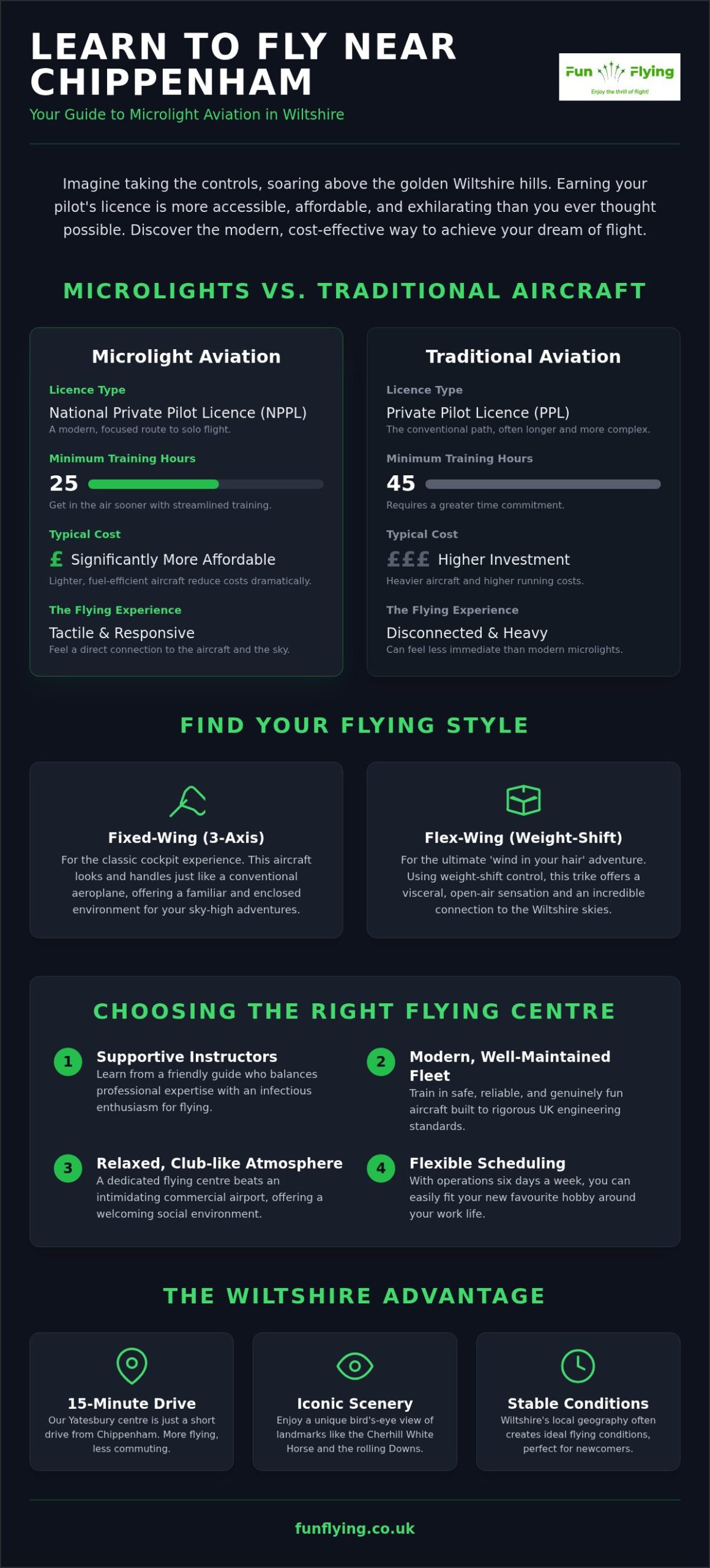
If you’re looking to become a weekend pilot UK, you’ve likely encountered two main paths: the traditional Private Pilot’s Licence (PPL) and the National Private Pilot’s Licence (NPPL) specifically for microlights. Whilst a PPL is a fantastic achievement, it often requires a minimum of 45 flying hours and a more rigorous training schedule. For the recreational flyer, the NPPL is a breath of fresh air. It’s a streamlined, focused route that allows you to reach the cockpit sooner, requiring a minimum of just 25 hours of flight time. It’s about getting you into the air safely and efficiently so you can start enjoying your weekends from a new perspective.

This focus on streamlined, accessible qualifications is a growing trend across many recreational pursuits; for those who enjoy nautical adventures, the process to stuurbrevet halen België offers a similarly structured path to gaining maritime certification.

The “feel” of the flight is where the real magic happens. Flying a traditional four-seater aeroplane can sometimes feel a bit like driving a sturdy, reliable SUV. It’s stable, but it can be a little detached. A microlight, by contrast, is the sports car of the sky. These aircraft are incredibly agile and responsive. Because they are lighter, you feel a much closer connection to the air around you. It’s a tactile, “seat-of-the-pants” experience that makes every turn and climb feel genuinely exhilarating. You aren’t just a passenger; you’re part of the machine.

One of the most reassuring aspects of microlighting is the accessibility of the medical requirements. For many traditional licences, you need to pass a Class 2 medical exam with a specialist aviation doctor. With an NPPL, the process is far more inclusive. Generally, if you are medically fit to drive a car, you are fit to fly a microlight. A simple pilot medical declaration is often all that’s required to begin your journey, removing one of the biggest perceived barriers to entry in aviation.

Breaking Down the Barriers to Entry

Choosing your aircraft style is the next exciting step. You can opt for a “three-axis” microlight, which looks and handles like a conventional aeroplane with a closed cockpit and standard controls. Alternatively, you might prefer a “flexwing” aircraft, which uses a weight-shift system and offers an open-air, wind-in-your-face experience. Both are fantastic ways to learn to fly and join a community that prioritises fun and freedom over rigid formality. Whether you want the comfort of a cabin or the raw thrill of the elements, there’s a microlight that fits your personal style perfectly.

How to Start Your Aviation Journey Around a Busy Schedule

How do you fit a pilot’s licence into a 9-to-5 life? You don’t need a sabbatical or a lottery win to earn your wings. Most successful flyers are busy professionals who chip away at their training on Saturdays and Sundays. The first step is simple: book an introductory microlight lesson UK experience flight. This isn’t just a sightseeing tour; it’s your first real lesson. You’ll sit in the pilot’s seat and feel exactly how the aircraft responds to your touch. It’s the moment the dream becomes a tangible goal.

Once you’re hooked, look for a school that offers “pay-as-you-fly” training. This flexibility is vital for any weekend pilot UK. It means you aren’t tied to huge upfront costs or rigid, unforgiving timetables. You can book lessons around your work commitments and family life, making progress at a pace that feels comfortable. It makes the path to the cockpit feel like a natural part of your routine rather than a stressful second job.

Whilst you’re building your hours, you’ll also need to tackle the theory. A structured microlight ground school makes this process far less daunting. Instead of staring at dry textbooks alone, you can learn about meteorology, navigation, and air law in a way that actually makes sense. Consistency is your best friend here. Even if it’s just one lesson every fortnight, regular time in the cockpit helps build the muscle memory you need to become a confident, safe flyer.

The Importance of a Hands-On Approach

Don’t settle for a school where you’re just a passive observer for the first ten hours. You should choose an environment where you can take control from day one. This hands-on philosophy builds confidence rapidly and keeps the excitement levels high. Your instructor should be more than just a teacher; they’re a mentor who understands your specific goals. They’ll help you navigate the complexities of weather patterns and flight planning without the stress, turning every challenge into a rewarding milestone.

The Rise of the Weekend Pilot: Why Microlighting is the UK’s Favourite New Hobby

Taking Flight in Wiltshire: Why Yatesbury is the Perfect Launchpad

There is something truly special about lifting off from Yatesbury. As you bank the aircraft, the ancient landscape of Wiltshire reveals itself in a way that ground-dwellers never get to see. You’ll find yourself soaring over the iconic White Horse carved into the hillside and looking down upon the mysterious mound of Silbury Hill. It’s a sensory experience that turns a standard lesson into a genuine adventure. This isn’t just a place to train; it’s a place to find inspiration every time you leave the runway.

For any aspiring weekend pilot UK, location and accessibility are everything. We’ve become the favourite choice for flyers from Bristol, Swindon, and Reading because we offer a perfect balance of scenic beauty and practical convenience. You don’t need to trek into the congested airspace of West London to find high-quality instruction. Instead, you can enjoy the open skies of the South West, where the air is clearer and the community is far more relaxed. To learn everything about training at our base, the complete Wiltshire Microlight Centre guide to flying at Yatesbury covers everything from your first visit to earning your wings. When you arrive for your first lesson at Fun Flying Aviation Ltd, expect a warm welcome, a hot brew, and a seat in the cockpit before you’ve even finished your first biscuit.

Joining our community means more than just learning to fly. It’s about meeting like-minded enthusiasts who share your passion for the clouds. Whether you’re swapping stories in the clubhouse or planning a cross-country trip with a fellow student, the camaraderie here is infectious. You aren’t just a customer; you’re part of a local movement of aviators who believe that the sky should be accessible to everyone with a sense of wonder.

The Fun Flying Aviation Ltd Experience

We pride ourselves on our “hands-on from day one” philosophy. We know you’re here because you want to fly, not just watch, so we ensure you’re involved in the controls from your very first introductory microlight lesson UK experience. Our instructors are expert enthusiasts who bring a high-energy, encouraging vibe to every session. We offer flexible scheduling that respects your work-life balance, making it easy to organise your training around your existing commitments.

Our support doesn’t stop once you’ve earned your wings, either. We’re here for the long haul, offering license revalidations and conversion training to keep you sharp and confident. Whether you’re a complete beginner or a seasoned flyer looking to transition into microlighting, Fun Flying Aviation Ltd provides a methodical yet breezy path to your goals. The cockpit is waiting. It’s time to stop dreaming about the view and start living it.

Your Adventure Above the Wiltshire Downs Awaits

The dream of flight isn’t a distant fantasy; it’s a practical, exhilarating reality waiting for you at the airfield. You’ve seen how microlighting strips away the barriers of traditional aviation, offering a faster and more affordable route to the cockpit. By choosing the path of a weekend pilot UK, you aren’t just gaining a hobby. You’re gaining a new perspective on the world and a community that celebrates every take-off.

Our professional instructors bring years of expertise to every session, ensuring you feel supported whilst you master the controls. You’ll experience the thrill of hands-on training from your very first lesson, all whilst soaring over the stunning Wiltshire Microlight Centre flight paths that make Yatesbury so iconic. It’s time to stop looking up and start looking down.

The sky is wide open and waiting for you. We can’t wait to see you on the runway and help you turn that Sunday sofa session into a Saturday morning adventure. Your wings are ready when you are.

Frequently Asked Questions

Do I need a special medical certificate to become a weekend pilot in the UK?

You don’t need a complex or expensive commercial medical to start your journey as a weekend pilot UK. For the National Private Pilot’s Licence (NPPL), a simple Pilot Medical Declaration is usually all that’s required. If you’re healthy enough to hold a standard UK driving licence, you’re likely fit to fly a microlight. It’s an inclusive approach that makes the cockpit accessible to almost everyone without the need for specialist aviation doctors.

How much does it typically cost to get a microlight pilot licence?

Microlighting is widely recognised as the most cost-effective way to take to the skies in the UK. Whilst total costs vary because every student learns at a different pace, the hourly rates for training and aircraft operation are significantly lower than those for traditional aeroplanes. Because the NPPL requires fewer minimum hours than a standard PPL, you’ll find the path to your licence is much lighter on your wallet while providing the same incredible thrill of flight.

Can I learn to fly if I only have time on Saturdays and Sundays?

Absolutely, you can learn to fly exclusively on your days off. Most of our students are busy professionals who can only commit to lessons on Saturdays or Sundays. We offer flexible scheduling specifically designed to help the modern weekend pilot UK progress at a steady pace. Consistency is helpful for building your skills, but your training is always tailored to fit around your existing work and family commitments. For those who want to ensure their four-legged family members are well-behaved while they are busy at the airfield, you can visit I Wuff You Dog Training to find out more about their professional canine behaviour consulting.

What is the minimum age to start flight training for a microlight?

You can begin your flight training from as young as 14 years old. Whilst you must be 16 to fly solo and 17 to hold a full licence, starting early is a fantastic way to build confidence and coordination. There is no upper age limit either. As long as you meet the basic medical requirements and have a passion for adventure, you’re never too old to take the controls and join the aviation community.

Is microlight flying safe compared to traditional light aircraft?

Microlights are incredibly safe and are built to very strict modern engineering standards in the UK. Because they are so light, they have much lower stalling speeds than traditional aircraft, which provides a significant safety margin during take-off and landing. Many modern microlights even come equipped with ballistic recovery systems, which are essentially parachutes for the entire aeroplane, giving you extra peace of mind whilst you’re in the air.

Marce Colucci

Article by

Marce Colucci

Love to fly, and more importantly, love teaching others to fly.

Flexible Flying Lessons UK: How to Earn Your Wings Around a Busy Lifestyle

Flexible Flying Lessons UK: How to Earn Your Wings Around a Busy Lifestyle

What if you could swap the grey monotony of the morning commute for a gold-tinted sunrise over the Wiltshire Downs, all without quitting your day job? It sounds like a dream, but for many, the hurdle isn’t the height of the clouds; it’s the rigidity of the classroom. Most aspiring pilots feel stuck between a passion for flight and the reality of a 9-to-5. Finding flexible flying lessons UK wide often feels like a mission in itself, especially when traditional academies demand huge upfront costs and inflexible schedules that simply don’t account for family life.

We completely understand that life doesn’t stop just because you want to reach the cockpit. You shouldn’t have to choose between your career and your wings. This article will show you exactly how to balance pilot training with your existing commitments through the UK’s most adaptable microlight programmes. We will explore the “pay-as-you-fly” financial model, the streamlined NPPL route that gets you airborne faster, and how to choose a local school that works with your calendar rather than against it. It is time to stop waiting for the perfect moment and start your journey to the skies on your own terms.

Key Takeaways

  • Discover how to master the skies without pausing your career through modular, pay-as-you-go training that fits your monthly budget.
  • Learn why the NPPL is the ultimate choice for busy professionals, offering a legal route to solo flight in significantly less time than a traditional licence.
  • Identify the best ways to find flexible flying lessons UK based that provide six-day-a-week access and adapt to your personal learning pace.
  • Understand the importance of choosing a local flight centre to minimise travel time and ensure you can make the most of every clear-sky window.
  • Gain the confidence to book your first trial flight by understanding the straightforward medical declarations and inclusive entry requirements.

Why Flexible Flying Lessons are the Future of UK Aviation

The sky used to feel like a gated community, open only to those with deep pockets or the ability to disappear into a full-time flight academy for a year. That era is ending. Today, we define flexible flying as training that adapts to your life, not the other way around. It is a modular approach where you are the pilot in command of your schedule. This shift from rigid, career-focused academies to recreational, accessible learning is transforming the UK’s General Aviation sector. Whether you are a busy parent in Swindon or a professional in Bristol, the opportunity to fly is finally becoming inclusive.

Imagine the feeling of waking up on a Saturday morning, checking the weather, and knowing that your training progress waits for you. It turns a distant “someday” dream into a tangible, “this weekend” reality. By choosing flexible flying lessons UK based students can maintain their careers whilst slowly but surely earning their wings. It is no longer about fitting your life into a flight school’s timetable; it is about finding a programme that respects your time and your ambitions.

Breaking the “Full-Time Student” Myth

You don’t need to quit your job to become a pilot. In fact, the rise of the “weekend warrior” is one of the most exciting developments in British aviation. Modular training allows you to tackle your licence in bite-sized pieces. This approach actually helps with knowledge retention. Instead of cramming complex aerodynamics into a few weeks, you digest the information over months, allowing it to truly sink in. It prevents the burnout often associated with intensive courses, keeping the joy of flight front and centre. You progress when you are ready, ensuring that every hour in the cockpit is productive and, most importantly, fun.

The Role of Microlighting in Accessible Aviation

Microlighting is the undisputed champion of flexibility. Because these aircraft are lighter and have different regulatory requirements, the path to a licence is much smoother. For many, the National Private Pilot Licence (NPPL) is the secret weapon. It is a streamlined alternative to the traditional PPL, requiring fewer hours and offering a more straightforward medical process. You can find a detailed UK pilot licensing overview on Wikipedia to see how these licences compare in the current regulatory landscape.

Because microlights are more cost-effective to operate, you can often afford to fly more frequently. Shorter, more regular lessons fit perfectly into a lunch break or a quiet Tuesday afternoon. This accessibility is why flexible flying lessons UK wide are gravitating toward the microlight category. It removes the obstacles and focuses entirely on the freedom of the experience. It is aviation simplified, making the dream of flight achievable for everyone. If you want to understand exactly how affordable this path can be, our detailed guide on affordable microlight lessons UK wide breaks down the real costs and dispels the most common myths.

Understanding the Path: How Part-Time Pilot Training Works

Earning your wings isn’t a sprint; it’s a journey that you control. When you look for flexible flying lessons UK schools offer various routes, but the most successful students follow a clear, manageable path. It starts with a simple trial flight. This isn’t just a sightseeing trip. It’s your first real lesson and a chance to see if the instructor’s teaching style clicks with you. If you feel that spark of excitement, you move to establishing a rhythm. Some students prefer a lesson every fortnight to keep costs steady, whilst others choose intensive blocks during annual leave. The beauty of this modular approach is that the schedule bends to your needs.

As you build your hours, you’ll integrate ground school study into your daily life. You can review navigation charts during your evening wind-down or listen to meteorology briefings on your morning commute. Before your first solo, you’ll need to handle the medical requirements. For microlight pilots, this is often as simple as a Pilot Medical Declaration (PMD) made online, which is far less restrictive than the traditional LAPL or Class 2 medicals. Finally, once you’ve mastered the 25-hour minimum requirement and passed your five multiple-choice exams, you’ll face the General Skills Test (GST). It’s the final validation of your hard work before your licence arrives in the post.

The “Pay-as-you-Fly” Financial Model

One of the biggest barriers to aviation used to be the demand for massive upfront payments. We’ve thrown that old model out of the window. By choosing a pay-as-you-go system, you protect your finances. There’s no risk of losing a large deposit if your circumstances change, and it allows for much better monthly budgeting. You pay for the instruction you receive, making it easier to balance flight training with family commitments or mortgage payments. Schools like FunFlying prioritise this transparency, ensuring you always know exactly where your investment is going.

Ground School: Studying on Your Own Terms

Modern ground school has moved far beyond the dusty classroom. You can now access high-quality online resources that let you study at 11 pm or 6 am. Whatever works for you. While digital platforms are fantastic for the five core exams, a truly flexible school provides one-on-one support when you hit a tricky topic like flight planning. This is the essence of flexible flying lessons UK pilots now enjoy; the ability to master theory in the comfort of their own home. Balancing your theory exams alongside your practical flying ensures that what you learn in the book is immediately applied in the cockpit. If you’re ready to see how this fits your lifestyle, booking a trial flight is the perfect first step.

Comparing Flexibility: Microlight vs Traditional PPL Training

Many aspiring pilots assume a Private Pilot Licence (PPL) is the only path to the cockpit. It isn’t. If your goal is recreational freedom, the traditional PPL route can feel like a heavy burden. It requires a minimum of 45 flying hours, though the national average to reach proficiency is actually between 55 and 60 hours. Contrast this with the National Private Pilot Licence (NPPL) for microlights, which requires a minimum of just 25 hours. That is nearly half the time commitment. For those seeking flexible flying lessons UK schools provide, this 20-hour gap is the difference between earning a licence in one season or dragging the process out over several years.

The medical requirements offer another layer of flexibility. A traditional PPL necessitates a Class 2 medical certificate, which costs between £120 and £260 and requires an appointment with a specialist examiner. Microlight pilots usually only need a Pilot Medical Declaration. This is a simple self-declaration of fitness made on the CAA website. It is free, instant, and removes the administrative hurdle that often delays training. Smaller, specialised schools also tend to have better aircraft availability than large commercial academies. You aren’t competing with hundreds of full-time students for a booking slot, meaning you can actually fly when the weather is perfect.

Which Licence Suits Your Schedule?

The NPPL is the smarter choice for anyone with a busy professional life. Because the syllabus is more concise, you reach solo status faster. This builds confidence early on. A part-time student flying once a fortnight on a 25-hour syllabus maintains much better momentum than one on a 45-hour course. You spend less time “re-learning” skills from the previous lesson. If your circumstances change in the future, you can convert your NPPL to other aircraft categories. It is a modular, future-proof way to start flying without the massive upfront commitment of traditional aviation.

The Freedom of SSDR and Nanolights

We are bold advocates for the sub-70kg category, known as Single Seat De-Regulated (SSDR) aircraft or nanolights. These represent the absolute pinnacle of low-regulation aviation. Because they are exempt from many of the rigid maintenance schedules that govern larger planes, they are incredibly reliable and ready to go at a moment’s notice. At FunFlying, we specialise in these innovative aircraft because they align perfectly with the modern need for autonomy. They allow for “pop-up” flying from local fields, offering a level of flexible flying lessons UK pilots can’t find elsewhere. It is about stripping away the bureaucracy and focusing on the pure joy of being in the air.

Flexible Flying Lessons UK: How to Earn Your Wings Around a Busy Lifestyle

Planning Your Journey: Essential Considerations for Busy Students

Success in the cockpit starts long before you reach the airfield. When searching for flexible flying lessons UK schools provide, your first priority should be the commute. We recommend choosing a training base within a 45-minute drive of your home in Swindon, Bristol, or Reading. If the journey is too long, it becomes another chore on your to-do list rather than an escape. You also need an instructor who acts as a dedicated mentor. They must understand that your progress might happen in bursts. A good mentor adapts their teaching to your specific “rhythm,” ensuring you never feel pressured to move faster than your lifestyle allows.

Your choice of aircraft also impacts your learning curve. Three-axis microlights look and feel like traditional aeroplanes, which often makes them easier to master part-time if you have used flight simulators. Flexwings offer a visceral, open-air thrill, but they require a different physical “feel” that can take slightly longer to regain after a break; if the wind-whipped experience leaves your hair needing some extra attention, you can check out Urban Care for specialised products. To manage the fickle British weather, get comfortable with apps like Windy or SkyDemon. Checking these forecasts 24 hours in advance helps you avoid wasted trips to the airfield, keeping your motivation high and your schedule intact.

Choosing the Right Airfield Environment

Training at a dedicated microlight centre like Yatesbury offers a massive advantage over busy commercial hubs. At a major airport, you might spend twenty minutes idling on the tarmac behind a holiday jet. That is time you are paying for but not learning in. Yatesbury operates in uncontrolled airspace. This term refers to regions of the sky where pilots are not required to follow specific instructions from air traffic control, allowing you to take off and practice manoeuvres without waiting for a gap in commercial traffic. It makes every minute of your lesson count.

Maximising Progress Between Lessons

Life happens, and you might occasionally face a two-week gap between flights. You can keep your “stick and rudder” skills sharp at home using a basic flight simulator. We also highly recommend “chair-flying.” This is the simple act of sitting in a quiet room and mentally rehearsing every switch, lever, and radio call of a typical circuit. It keeps your muscle memory alive even when you are grounded. By staying “flight-ready” during your time off, you won’t waste the first portion of your next lesson getting back up to speed. If you are ready to see how aviation fits into your week, you can book your trial flight today to get started.

Start Your Adventure with FunFlying at Yatesbury

At FunFlying, we believe that the sky belongs to everyone, not just those with a lifetime of free hours to spare. Our philosophy is simple. We combine professional, top-tier instruction with the infectious enthusiasm of people who truly love to be airborne. We don’t just teach you to fly; we welcome you into a world of freedom and adventure. Based at our historic airfield in Yatesbury, we operate six days a week. This schedule is specifically designed to accommodate the modern UK workforce. Whether you are navigating a busy corporate career or a hectic family life, we ensure that your training fits into the gaps that work for you.

We also promise a “hands-on from day one” experience. You won’t spend your first few lessons stuck behind a desk or merely observing from the passenger seat. From the moment you strap in for your trial flight, you take the controls. It is about building your confidence through immediate, practical experience. Finding flexible flying lessons UK pilots can actually build a lifestyle around means choosing a school that prioritises your time. If you are looking for training near Swindon or Newbury, our gates are open, and our instructors are ready to help you take that first exhilarating step toward your licence.

Our Local Wiltshire Community

Aviation is more than just a technical skill; it is a vibrant social experience. When you train with us at Yatesbury, you join a community of like-minded enthusiasts. Our clubhouse is a hub where students from Bristol, Andover, and Basingstoke gather to share stories and tips. Why learn in isolation when you can speak with current part-time students who are navigating the same journey as you? This supportive environment is what keeps our pilots motivated, even when the British weather occasionally interrupts the schedule. You are always welcome to drop by, grab a coffee, and see exactly what makes the Yatesbury atmosphere so special.

Take the First Step to Your Licence

We have stripped away the bureaucracy to make our booking process as simple as possible. There are no hidden fees or complex contracts to sign. If you are not quite ready to commit to a full course, our gift vouchers offer a perfect, low-stakes way to experience the cockpit for the first time. It is the ultimate “try before you buy” approach to aviation. Why wait for a “perfect” moment that might never arrive? The horizon is waiting, and the controls are yours for the taking. Book your flexible flying lesson at FunFlying today and discover just how accessible earning your wings can be.

Your Path to the Clouds Starts Today

The dream of flight is no longer a distant “someday” reserved for the retired or the wealthy. By choosing the NPPL route and embracing a modular approach, you can master the skies without sacrificing your career or family time. We have seen how a 25-hour minimum requirement and simplified medical declarations remove the traditional barriers to entry. Finding flexible flying lessons UK pilots can rely on is simply a matter of choosing the right environment and a mentor who understands your pace.

At the Wiltshire Microlight Centre, we make this transition seamless. With training available six days a week and expert instructors who prioritise a “hands-on from day one” philosophy, your progress is always in your own hands. You don’t need to quit your job to earn your wings; you just need to take that first step. Start your aviation journey with a flexible trial flight at FunFlying and experience the liberation of the open sky. We’ll see you on the airfield.

Frequently Asked Questions

How long does it take to get a microlight licence part-time?

Most part-time students earn their licence within six to eighteen months. While the legal minimum is 25 flight hours, your total timeline depends on how consistently you can fly and the cooperation of the British weather. Flying once a week is a fantastic pace that allows you to retain skills without feeling overwhelmed. It’s a journey, not a race, and the modular approach ensures you progress at a speed that feels right for you.

Can I learn to fly if I can only commit to one day a week?

You can certainly master the skies with a one-day-a-week commitment. Many of our most successful pilots are “weekend warriors” who balance their training with a busy Monday-to-Friday career. Because we offer flexible flying lessons UK wide that operate six days a week, you can easily find a regular slot that fits your lifestyle. Consistency is the real secret to success; even one hour a week keeps your muscle memory sharp and your progress steady.

What happens if the weather is bad on my lesson day?

If the weather is unsuitable for flying, we simply reschedule your lesson or move the session indoors for ground school. Safety is our absolute priority, so we never take chances with high winds or low visibility. We encourage students to use apps like Windy to check forecasts 24 hours in advance. If we can’t get airborne, it’s a perfect opportunity to tackle one of your five multiple-choice exams or practice cockpit drills on the ground.

Do I need to pay for my entire pilot training course upfront?

No, you never have to pay for your entire course in advance at FunFlying. We champion a transparent pay-as-you-go model that allows you to fund your training lesson by lesson. This financial flexibility is a core part of our flexible flying lessons UK programme, as it removes the stress of large upfront costs. It makes budgeting simple for families and professionals alike, ensuring that your aviation adventure stays fun and financially manageable from day one.

Is there an age limit for starting flexible flying lessons in the UK?

There is no upper age limit for starting your training, provided you are fit to fly. Many people start their aviation journey well into retirement and find it incredibly rewarding. For younger flyers, you can begin logging hours at age 14. You must be at least 16 years old to fly solo and 17 years old to be issued your pilot licence. It truly is an inclusive hobby that welcomes enthusiasts from every generation.

How much study time is required outside of the flying lessons?

Expect to spend roughly two hours studying at home for every hour you spend in the cockpit. You’ll need to pass five multiple-choice theoretical exams covering subjects like meteorology, navigation, and air law. Modern online resources make this study incredibly flexible, allowing you to review materials during your commute or in the evening. Balancing your reading with practical lessons helps the theory make sense, as you’ll see the concepts in action while you fly.

Can I switch between full-time and part-time training if my work changes?

Yes, you can easily transition between different training intensities as your professional life evolves. The NPPL syllabus is inherently modular, meaning your progress is logged and remains valid even if you need to take a short break or speed things up during a holiday. We pride ourselves on being solution-oriented guides. If your schedule changes, we simply adjust your booking rhythm to ensure you keep moving toward your goal without any added pressure.

Do I need a special medical certificate to fly microlights?

Most microlight pilots do not need a complex medical exam from a specialist doctor. Instead, you can usually complete a Pilot Medical Declaration (PMD) on the CAA website. This is a simple self-declaration of fitness based on the same standards required to hold a UK driving licence. It’s a quick, free process that removes one of the biggest administrative hurdles in aviation. It makes starting your training much faster and more accessible than traditional commercial routes.

Marce Colucci

Article by

Marce Colucci

Love to fly, and more importantly, love teaching others to fly.

Mastering the Sky: The Ultimate Guide to Microlight Ground School UK

Mastering the Sky: The Ultimate Guide to Microlight Ground School UK

Imagine the sensation of lifting off from the grass strip at Yatesbury, the ground falling away as you take control of a microlight for the first time. It’s a moment of pure, unadulterated freedom. But what if the only thing keeping you grounded isn’t the British weather, but a stack of daunting textbooks? For many, the prospect of microlight ground school UK feels like a high-altitude hurdle. You want to be in the cockpit, not stuck at a desk worrying about complex navigation or technical jargon.

We understand that the fear of failing exams or finding time between busy work shifts can make your pilot’s licence feel out of reach. It’s a common worry; whilst the NPPL(M) is much more accessible than a traditional PPL, the theory still requires a steady hand and a clear head. This guide is your flight plan to success. We’ll demystify the five core exam subjects and explain the 2026 CAA regulatory shifts so you can study with total confidence. From syllabus secrets to time-saving study tips, you’re about to discover how to turn those technical manuals into your ticket to the clouds.

Key Takeaways

  • Understand why theory training is the foundation of your safety and confidence in the cockpit, turning you from a passenger into a pilot.
  • Get a clear breakdown of the five core NPPL(M) subjects, including how to master Air Law and unpredictable British Meteorology.
  • Discover how the multiple-choice exams work and why professional microlight ground school UK tuition makes passing a stress-free process.
  • Compare the flexibility of online study platforms with the social, hands-on benefits of learning in person at our Yatesbury centre.
  • Learn how to build a structured study plan that fits around your busy work schedule, ensuring you’re ready to take control from day one.

What is Microlight Ground School and Why is it Essential?

Think of microlight ground school UK as the moment you stop being a passenger and start becoming a pilot. It isn’t just about passing exams to tick a box. It’s the mental toolkit that ensures every time you pull back on that bar, you know exactly what the aircraft is doing and why. Whilst the physical act of flying is a sensory thrill, ground school provides the logic that keeps that thrill safe. It’s where you learn to read the sky, understand the invisible forces of lift, and navigate the complex motorway of the British airwaves. Effective communication is essential for navigating the airwaves; for those looking to enhance their language skills for professional environments, click here to learn more about English Explorer.

Many students worry that they need to be a mathematical genius to handle the theory. Let’s put that myth to rest right now. You don’t need a degree in physics to fly a microlight. The syllabus is designed for practical, real-world application. If you can handle basic arithmetic and have a passion for aviation, you have everything you need to succeed. At FunFlying Aviation Ltd, we believe in "taking control from lesson one," and that philosophy applies to the classroom too. By studying your theory alongside your flight lessons, the abstract concepts you read about in the morning become the physical sensations you feel in the afternoon.

The Legal Requirement for the NPPL(M)

To fly a microlight in the UK, you need a National Private Pilot Licence with a Microlight Class Rating, commonly known as the NPPL(M). This licence is overseen by the Civil Aviation Authority (CAA), but much of the day-to-day administration and syllabus development is handled by the British Microlight Aircraft Association (BMAA). This partnership makes the NPPL one of the most accessible and cost-effective routes into the sky. You’ll need to pass five multiple-choice exams, but don’t let that number intimidate you. These subjects are the building blocks of your autonomy as a pilot, covering everything from the rules of the air to the mechanical heart of your aircraft.

The Mental Shift: From Passenger to Pilot

Ground school is where you develop "airmanship." This is a term pilots use to describe a blend of situational awareness, technical knowledge, and sound judgement. Imagine you’re cruising at 2,000 feet and the horizon starts to haze over. Because of your ground school training, you won’t panic. You’ll recognise the meteorological signs, check your charts for the nearest airfield, and make a calm, safe decision. This theoretical foundation builds the confidence required for your first solo flight. When you understand the "how" behind the flight, the "doing" becomes infinitely more enjoyable. You aren’t just following instructions; you’re commanding the aircraft with total clarity.

The Five Core Subjects of the NPPL(M) Syllabus

Stepping into the world of microlight ground school UK means tackling five distinct subjects. It is a structured journey that transforms you from a curious observer into a competent aviator. These subjects aren’t just hurdles to clear; they are the essential components of your pilot’s toolkit. By the time you sit your final paper, you’ll have a holistic understanding of how to operate safely and legally in the British sky. The five subjects you’ll master are:

  • Air Law: The rules of the sky and legal responsibilities.
  • Meteorology: Predicting and interpreting the British weather.
  • Navigation: Plotting courses and finding your way across the landscape.
  • Aircraft Technical: Understanding the mechanics and physics of your microlight.
  • Human Performance: Recognising your own physiological and psychological limits.

Meteorology and Air Law: The Big Two

Air Law is typically the first exam students sit. It provides the essential framework for everything we do in the cockpit. It covers the hierarchy of the sky, right-of-way rules, and the specific regulations that keep our airspace orderly. Imagine flying from our base at Yatesbury; you need to know exactly which airspace belongs to whom and how to communicate with other pilots in the vicinity. Air Law makes that possible.

Then there is Meteorology. In the UK, the weather is more than just a topic of conversation; it’s a critical safety factor. Ground school teaches you to respect the Wiltshire wind and interpret cloud formations. You will learn to read "Met" reports and make informed "go/no-go" decisions. Understanding how a cold front moves or how turbulence forms near hills ensures that your flights remain enjoyable rather than stressful. If you want to see how these weather patterns look from above, you can book a trial flight to experience the elements first-hand.

Navigation and Technical Knowledge

Even in 2026, as advanced 600kg microlights with digital cockpits become more common, the art of the paper chart remains vital. What happens if your electronic tablet fails? Navigation training ensures you can draw a line, calculate your heading, and account for wind drift using traditional tools. It’s a rewarding skill that connects you to the history of aviation.

Simultaneously, the Technical and Principles of Flight exam explains the magic of how you stay up there. You’ll learn how lift, weight, thrust, and drag work in harmony. This isn’t just about theory; it’s about knowing your engine’s heartbeat and understanding basic airframe maintenance. This knowledge gives you the confidence to trust your machine, knowing exactly how it will behave in every phase of flight. Human Performance rounds this off by teaching you how factors like fatigue, altitude, or even a common cold can affect your decision-making in the air.

How the Microlight Theory Exams Work: A Step-by-Step Guide

So, you’ve spent your evenings with the books and your weekends in the air. Now comes the moment to formalise that knowledge. The examination process for your microlight ground school UK training is designed to be supportive, not scary. Each of the five subjects culminates in a multiple-choice paper. These aren’t trick questions designed to catch you out. Instead, they’re practical assessments that ensure you have the core knowledge required to stay safe. Most papers consist of 10 to 20 questions, with time limits ranging from 20 to 45 minutes depending on the complexity of the subject.

The pass mark for each exam is 75%. If you don’t hit that mark on your first try, please don’t panic. It isn’t the end of your flying career. Resits are common and often provide a valuable opportunity to revisit a specific area with your instructor before trying again. The cost to sit each paper typically falls between £40 and £50. One crucial thing to keep in mind is the "validity window." You must pass all five exams within a 24-month period before you take your General Skills Test (GST). This gives you plenty of breathing room to study at a pace that suits your lifestyle. If you’re wondering how many hours to get your microlight licence alongside completing your theory exams, understanding this overall timeline will help you plan your training effectively.

Sitting Your Exams at the Flight School

While some platforms offer digital study aids, there is a distinct advantage to sitting your papers at the Wiltshire Microlight Centre. Our dedicated exam room at Yatesbury offers a quiet, professional environment away from the distractions of home. Our instructors are always on hand to offer a final bit of encouragement or clarify a tricky concept before you turn over the paper. On exam day, make sure you’re prepared. You’ll need your navigation tools for the Nav paper; think protractors, rulers, and a flight computer; and perhaps a fuel tester or checklist for the technical discussion. Having everything organised beforehand helps settle those pre-flight nerves.

Understanding the Results and Feedback

One of the best parts of sitting exams at a registered centre is the immediate feedback. You won’t be left waiting for weeks for a letter in the post. Once you finish, your instructor will mark the paper and give you your result right then and there. This is a brilliant moment for a debrief. If you missed a question about cloud formations or right-of-way rules, you can discuss it immediately whilst the information is fresh in your mind. This feedback directly informs your next flying lesson, turning a theoretical "mistake" into a practical skill. Finally, every pass is recorded in your pilot logbook, a tangible record of your progress toward earning your wings.

Mastering the Sky: The Ultimate Guide to Microlight Ground School UK

Choosing Your Study Method: Online Courses vs. Flight School Tuition

How do you prefer to learn? Some people thrive in a quiet corner with a tablet. Others need the buzz of a working airfield to truly absorb the material. When it comes to microlight ground school UK, you have two main paths: the digital route or face-to-face tuition. Both have their merits. The real magic happens when you combine them. Choosing the right method is about more than just convenience; it’s about ensuring the knowledge sticks when you’re 2,000 feet in the air.

Digital platforms like Quizaero or EasyPPL are fantastic for flexibility. They allow you to squeeze in a quick mock exam during your lunch break or review meteorology charts before bed. These tools are excellent for repetition and building familiarity with the multiple-choice format. However, an app can’t see the look of confusion on your face when you’re trying to calculate wind drift. It can’t share a story about a real-life "close call" that makes a dry regulation suddenly feel vital. You get the data, but you might miss the context.

That’s where in-person ground school at Yatesbury shines. Learning amongst fellow aviation enthusiasts turns a solitary chore into a social event. You’ll find that "hangar talk", those informal chats over a cup of tea, is often where the most profound lessons are learned. You aren’t just memorising facts; you’re joining a community of pilots who all want to see you succeed. This social environment accelerates your learning because you’re constantly talking and thinking about flight.

When to Choose In-Person Tuition

If you’re finding Navigation or Technical subjects particularly tricky, don’t struggle alone. These are the areas where tailored coaching makes all the difference. An instructor can adapt their explanation to your personal learning style, using physical models or real aircraft components to illustrate a point. This hands-on approach is the cornerstone of our microlight ground school tuition. We ensure you don’t just pass the test, but truly understand the machine you’re flying. Real-world examples from seasoned instructors turn abstract concepts into practical airmanship.

Maximising Your Home Study

Even with expert help, your home study remains a vital part of the process. Invest in the recommended BMAA textbooks and a quality flight computer. Set a realistic schedule that respects your busy work life. Perhaps thirty minutes every other evening is more sustainable than a five-hour marathon on a Sunday. Use practice exams to gauge your readiness, but remember they are a temperature check, not the whole story. The goal is to arrive at the exam desk feeling prepared, relaxed, and ready to fly.

Elevate Your Training at FunFlying: Ground School with a View

Ground school shouldn’t feel like a dry academic chore. It’s the first real step on your journey to becoming a pilot. At FunFlying, we bring the syllabus to life through our "Expert Enthusiast" approach. We aren’t just instructors; we’re pilots who still get a thrill every time we leave the ground. Our microlight ground school UK sessions are designed to be as engaging as the flights themselves. We believe that when you’re having fun, the knowledge sticks. We don’t just teach you how to pass an exam; we teach you how to think like a pilot from day one.

We take pride in removing the obstacles that often make aviation feel elite or inaccessible. Our sessions are flexible, designed to fit around your busy work life and personal commitments. Whether you need a deep dive into Navigation or a quick refresher on Air Law, we adapt our coaching to your pace. This isn’t a factory line. It’s personal, tailored tuition delivered in a friendly environment where no question is too small. We bridge the gap between the textbook and the cockpit, ensuring that every theoretical concept has a practical, real-world application you can use in the air.

Why Wiltshire is the Perfect Classroom

Our location at the Wiltshire Microlight Centre offers more than just a place to study. It provides a living laboratory for your training. Yatesbury sits in a fascinating patch of sky. When we study Navigation, we aren’t just looking at abstract lines on a map. We’re looking at the unique airspace challenges around Swindon, Bristol, and Bath. You’ll learn how to navigate these busy corridors with total confidence. It’s a rewarding feeling when you can identify the local landmarks, like the iconic white horses carved into the Wiltshire hills, to confirm your position at 2,000 feet.

This social side of ground school is invaluable. It turns a solitary study session into a shared adventure. You’ll hear stories of real flights that make the Meteorology or Technical chapters suddenly feel vital and vivid. This local context makes the theory much easier to digest because you can see it happening right outside the classroom window. Just as our community helps pilots grow, those looking to develop their professional skills in other creative fields should check out Institute of Wedding Photographers.

Start Your Aviation Journey Today

Aviation is for everyone. We’re committed to making your training inclusive, straightforward, and above all, enjoyable. You don’t need to be a mathematician or an engineer to get your wings. You just need the passion to learn and the right guidance to get you there. From your very first trial flight to the moment you hold your NPPL(M), we provide a structured, supportive path to success. Don’t let the books keep you grounded. You can organise your microlight ground school at FunFlying today and start turning your dream of flight into a reality.

Your Pilot’s Licence is Within Reach

The dream of navigating the clouds above Wiltshire is closer than you think. You’ve seen that the theory exams aren’t just hurdles to clear; they’re the building blocks of a confident, safe pilot. From mastering British meteorology to understanding the mechanical heart of your aircraft, every subject brings you one step closer to that unrestricted licence. By choosing a structured approach to microlight ground school UK, you can turn a potentially daunting syllabus into a rewarding social experience.

At FunFlying, we’re proud to be a highly rated microlight school serving Wiltshire and the South West. Based at the historic Yatesbury airfield, our expert instructors prioritise your safety and the pure joy of flight. We don’t just want you to pass; we want you to thrive in the cockpit. Whether you’re balancing study with a busy work life or looking for a community that shares your passion, we’re here to guide you every step of the way.

Ready to take control? It’s time to stop imagining and start flying. Book Your Ground School or Trial Flight at FunFlying and let’s get your aviation journey off the ground. The sky is waiting for you.

Frequently Asked Questions

How many exams are there for a microlight licence in the UK?

You must pass five theory exams to obtain your NPPL(M). These subjects are Air Law, Meteorology, Navigation, Aircraft Technical, and Human Performance. Each paper consists of multiple-choice questions designed to test your practical understanding of safe flight operations in the UK.

How hard are the microlight theory exams for beginners?

The exams are designed to be accessible and focus on practical application rather than complex academic theory. You don’t need to be a mathematician or a physicist to succeed. Most students find that with consistent study and a bit of guidance from their instructor, the concepts become clear and logical quite quickly.

Can I study for my microlight ground school online?

Yes, you can certainly use digital platforms and apps to support your microlight ground school UK training. These tools are excellent for mock exams and flexible revision. However, many pilots find that in-person tuition at a flight school provides the real-world context and personal mentorship that helps the knowledge truly stick.

How long do the microlight exam results stay valid?

Your theory exam passes remain valid for 24 months. You must complete all five exams and pass your General Skills Test (GST) within this two-year window. This timeframe is quite generous, allowing you to progress at a pace that fits around your personal life and professional commitments.

What is the pass mark for the NPPL(M) theory exams?

The pass mark for each of the five theory exams is 75%. If you happen to fall short on your first attempt, you can resit the exam after further revision. We treat a resit as a valuable learning opportunity to strengthen your knowledge in specific areas before you take to the skies again.

Do I need to pass the ground school before I start flying lessons?

No, you don’t need to finish your ground school before you begin flying. In fact, we encourage students to learn theory and practical skills concurrently. Seeing a weather front from the cockpit or using a chart during a real flight makes the microlight ground school UK syllabus much more intuitive and exciting.

How much does microlight ground school cost in the UK?

The fee to sit each of the five theory exams is typically between £40 and £50 per paper. If you opt for professional one-to-one ground school tuition, you can expect to pay between £30 and £50 per hour. Investing in expert help can often accelerate your progress and build your confidence more effectively than studying alone.

Is there an age limit for sitting the microlight theory exams?

There is no specific minimum age for sitting the theory exams, but there are age requirements for other milestones. You must be at least 14 years old for your flight hours to count towards a licence, 16 years old to fly solo, and 17 years old to be issued your pilot’s licence.

Marce Colucci

Article by

Marce Colucci

Love to fly, and more importantly, love teaching others to fly.

The Ultimate Microlight Flying Experience for Adults: A Guide to Your First Lesson

The Ultimate Microlight Flying Experience for Adults: A Guide to Your First Lesson

Have you ever looked at the clouds and wondered why humans made the dream of flying feel so complicated and expensive? It’s a common hurdle. You might feel a nagging fear of heights or assume that sitting in a cockpit requires a lottery win and years of study. We get it. Many people park their pilot dreams because the barrier to entry looks like a mountain. However, a microlight flying experience for adults is actually the most accessible, thrilling, and inclusive way to claim the sky for yourself.

This isn’t just a passive sightseeing tour; it’s a hands-on introduction to true aviation. We promise to show you how this vibrant hobby offers total freedom without the typical stress. You’ll discover how simple it is to take the controls yourself from your very first lesson. In this guide, we’ll break down the different types of aircraft, clear up the confusion around requirements, and give you the confidence to finally start your journey into the blue.

Key Takeaways

  • Learn why a microlight flying experience for adults is the ultimate way to get airborne, as you’ll be encouraged to take the controls from the very first minute.
  • Discover the high-performance engineering and strict safety regulations that ensure every flight is as secure as it is exhilarating.
  • Get a clear comparison between flex-wing and fixed-wing aircraft so you can choose the flying style that matches your sense of adventure.
  • See how the stunning Wiltshire landscape near Yatesbury provides an unbeatable setting for your introduction to the world of aviation.
  • Find out how simple it is to transition from a curious beginner to a student pilot starting your microlight licence training.

The Magic of a Microlight Flying Experience for Adults

Imagine the wind on your face and the world shrinking beneath your feet. A modern microlight isn’t some rickety contraption; it’s a high-performance, precision-engineered aircraft designed for two people. While some regions use different names, the global microlight and ultralight aviation community has evolved these machines into sophisticated tools for genuine adventure. A microlight flying experience for adults offers a unique blend of sensory overload and serene autonomy. You’ll smell the fresh Wiltshire air and enjoy unrestricted 360-degree views that simply aren’t possible from behind the thick glass of a traditional light aircraft. It’s pure, unadulterated flight.

Why are so many people choosing this over traditional flying? The answer is accessibility. You don’t need a complex medical certificate or years of prior aviation knowledge to get started. It’s the most straightforward path to becoming a pilot. Instead of navigating endless red tape, you can focus on the pure joy of the sky. It’s a hobby that respects your time and your ambition.

A Sophisticated Hobby for the Modern Adventurer

It’s about more than just a thrill. Escaping the daily grind and focusing entirely on the horizon provides a massive mental boost. You’re not just a passenger; you’re joining a vibrant social community of UK microlight clubs. Plus, it’s a far more cost-effective alternative to other pilot licences. This makes the dream of regular flying actually sustainable for busy professionals.

What Makes it a ‘Grown-Up’ Experience?

We treat you like a fellow aviator from the moment you arrive. This isn’t a passive sightseeing trip. It’s about skill acquisition. You’ll spend one-on-one time with expert instructors who respect your curiosity. Imagine the satisfaction of masterfully handling the controls as you soar over historic landscapes. A microlight flying experience for adults turns a simple afternoon into a lifelong passion for the clouds.

Taking the Controls: Your First Lesson in the Sky

Forget everything you know about being a passenger. During a microlight flying experience for adults, the very first thing we do is put you in charge. It’s a powerful psychological shift. One moment you’re on the ground, and the next, you’re responsible for the movement of an aircraft through three-dimensional space. This “hands-on” philosophy isn’t just for show. It’s the fastest way to build genuine confidence. Your instructor stays right beside you, providing a safety net whilst you feel the immediate response of the aircraft to your touch.

The transition from observer to participant happens the moment you place your hands on the controls. You aren’t just watching someone else fly; you are feeling the lift, the resistance, and the incredible freedom of movement. It’s a visceral way to learn. By taking control from minute one, you bypass the “fear of the unknown” and replace it with the thrill of mastery. If you’re ready to feel that shift from passenger to pilot, our Trial Flights are the perfect starting point for your new obsession.

The Pre-Flight Briefing: Setting the Scene

Before the engine even starts, we’ll sit down for a briefing to demystify the cockpit. You’ll learn how the aircraft moves using three basic concepts: pitch (tilting the nose up or down), roll (banking left or right), and yaw (moving the nose side-to-side). We’ll walk through the pre-flight checklist together. This is a vital part of airmanship. Whether you want a technical lesson or a gentle tour, we’ll set goals that make your first time in the air feel exactly how you imagined.

Step-by-Step: Your First 30 Minutes in the Air

Once we’re airborne, the lesson follows a clear, exciting structure designed to keep you engaged without feeling overwhelmed:

  • The Climb: You’ll help guide the aircraft to a safe altitude where the air is smooth and the views open up.
  • Basic Manoeuvres: Under steady guidance, you’ll practice gentle turns and learn how to maintain a level flight path.
  • Navigating Wiltshire: We’ll head towards local landmarks like the Cherhill White Horse, giving you a chance to steer whilst soaking in the history below.

By the time we head back to Yatesbury, the sky will no longer feel like a foreign environment. It will feel like your new playground.

Safety, Engineering, and Peace of Mind

Let’s tackle the “lawnmower with wings” myth head-on. Modern microlights are actually incredible pieces of high-tech engineering. They are built from carbon fibre and aircraft-grade aluminium, designed to be both remarkably strong and light. Every aircraft is regulated by the Civil Aviation Authority (CAA) and the British Microlight Aircraft Association (BMAA), ensuring they meet world-class standards. This is why a microlight flying experience for adults is widely regarded as one of the safest ways to enjoy recreational aviation. Many models even feature a ballistic parachute. This is a clever rocket-deployed system that can lower the entire aircraft to safety in the unlikely event of a major problem. You’re in very safe hands.

The Training and Expertise of Your Instructor

UK instructors are amongst the best-trained in the world. To earn that title, they must complete a demanding series of exams and flight tests that go far beyond basic piloting. They are required by law to undergo regular revalidations, keeping their skills razor-sharp. Your instructor acts as a reassuring expert, managing every technical detail whilst you focus on the joy of the flight. They know how to balance the excitement of your first lesson with the grounded reliability of a seasoned professional.

Weather and Flying Conditions

Safety means knowing when to stay on the ground. We only fly when the conditions are just right for a fantastic experience. If the wind is too strong or the Wiltshire mist is too thick, we’ll simply reschedule. We want your first taste of flight to be clear, calm, and utterly memorable. Our flexible approach to weather ensures you never have to worry about a “compromised” flight. When the sun is out and the air is still, that’s when the real magic happens. It’s all about making sure your microlight flying experience for adults is perfect from takeoff to landing.

Flex-wing vs Fixed-wing: Which Experience is for You?

Choosing your first microlight flying experience for adults often comes down to one big question: do you want a motorbike or a sports car? Both offer an incredible sense of freedom, but the way they move through the air is entirely different. One is visceral and open; the other is precise and enclosed. Understanding these differences helps you match your flight to your personal goals, whether you’re looking for a one-off thrill or the first step toward a pilot licence.

The Flex-wing Experience: Pure Freedom

Imagine sitting in an open cockpit with absolutely nothing between you and the horizon. This is the flex-wing microlight, often called the “weight-shift” aircraft. You control it by physically moving a bar to shift the centre of gravity. It feels incredibly intuitive and natural. It’s a sensory adventure where you feel every change in the air and see the world in high definition. For those seeking an adrenaline-fuelled connection to the sky, this is the ultimate choice. It’s raw, exciting, and completely immersive.

The Fixed-wing Experience: Precision and Comfort

If you prefer the look and feel of a traditional aeroplane, the fixed-wing microlight is for you. These “three-axis” machines use a stick and rudder pedals, just like a larger plane. Because they have a closed cockpit, you’re protected from the wind chill, making it a comfortable year-round option. This type of aircraft is the perfect bridge if you eventually plan to transition to larger light aircraft. It offers a level of precision and technical sophistication that appeals to those who love the “craft” of piloting. Ready to choose your path? You can book your first lesson through our Experience Flights today and see which style suits you best.

The Ultimate Microlight Flying Experience for Adults: A Guide to Your First Lesson

Starting Your Journey at the Wiltshire Microlight Centre

Choosing where to begin your aviation journey is just as important as the flight itself. Yatesbury is widely considered a premier location for a microlight flying experience for adults. Why? Because the views are simply legendary. Within minutes of taking off from the Wiltshire Microlight Centre, you’ll be looking down at the striking Cherhill White Horse and the prehistoric marvel of Silbury Hill. It’s one thing to see these landmarks from the road, but seeing them from the cockpit of a microlight is a perspective very few people ever get to experience. It turns a simple lesson into a genuine exploration of British history.

The Yatesbury Flying School Environment

We’ve worked hard to create a friendly, inclusive atmosphere that’s specifically designed for adult learners. You won’t find any stuffy, elitist attitudes here. Instead, you’ll find a supportive community and top-tier facilities, including our dedicated Ground School for those ready to dive into the theory. We’re also incredibly easy to reach. Whether you’re coming from Swindon, Bristol, or anywhere along the M4 corridor, your escape into the clouds is just a short drive away. It’s the perfect place to leave the stresses of the ground behind and focus on your own development.

The development and maintenance of such accessible locations often involves complex transport planning; for example, ML Traffic Engineers UK provides the specialist documentation and assessments needed for planning applications to ensure infrastructure is safe and efficient.

For those travelling from London or the Home Counties who want to arrive relaxed and ready for their lesson, you can learn more about booking a professional transfer with Fleet Minicabs to ensure a seamless journey to the airfield.

Your Future in the Clouds

Perhaps the most exciting part is that your first flight isn’t just a one-off thrill. Every minute you spend in the air during your initial experience flight counts towards the hours required for your National Private Pilot Licence (NPPL). We specialise in flexible training schedules because we know you have a career and a busy life to manage. Your new hobby should fit you, not the other way around. Whether you’re booking for yourself or buying a gift voucher for a loved one, the sky is waiting for you. Book your introductory flying lesson at FunFlying today!

Your Path to the Pilot’s Seat Starts Here

The dream of flight doesn’t have to stay grounded. You now know that modern microlights are high-performance machines backed by rigorous safety standards and sophisticated engineering. Whether you choose the visceral thrill of a flex-wing or the precise comfort of a fixed-wing aircraft, the sky is far more accessible than you might have imagined. By choosing a microlight flying experience for adults, you’re not just booking a trip; you’re starting a journey where you take the controls from day one. It is about claiming your autonomy in the air.

At the historic Yatesbury airfield, our expert instructors bring over 20 years of experience to every lesson. They’ll guide you through the clouds whilst ensuring you feel every bit of the freedom you’ve been looking for. It’s time to stop watching from the ground and start leading from the cockpit. The stunning Wiltshire landscape is waiting for you to discover it from a completely new perspective. Book Your First Microlight Experience Flight in Wiltshire and feel the incredible rush of being a pilot. We can’t wait to see you on the airfield!

Frequently Asked Questions

Is there an upper age limit for a microlight flying experience?

There is no upper age limit for enjoying a microlight flying experience for adults. As long as you are reasonably mobile and fit enough to get in and out of the aircraft, you are more than welcome to fly. Many people start their aviation journey later in life, finding it a wonderful way to stay active and engaged. It is all about your spirit of adventure rather than the date on your birth certificate.

What should I wear for my first microlight flight?

You should wear comfortable, layered clothing and sturdy, flat-soled shoes for your first flight. If you have chosen a flex-wing aircraft, remember that it has an open cockpit, so it will feel much cooler in the air than on the ground. We recommend a windproof jacket and even gloves during the colder months. For fixed-wing flights, your usual outdoor clothes are fine, but layers allow you to adjust to the cabin temperature easily.

Are there weight or height restrictions for participants?

Most microlights have a maximum weight limit for participants, which typically sits around 100kg to 110kg depending on the specific aircraft. Height can also be a factor for comfort in the cockpit, especially in fixed-wing models where space is more enclosed. We always recommend checking the specific limits for the aircraft being used before you book. These requirements are strictly in place to ensure the aircraft operates within its safe engineering design limits.

Do I need a medical certificate to take a trial flying lesson?

You do not need a medical certificate to take a trial flying lesson or an initial experience flight. It is only when you decide to pursue your pilot licence and fly solo that a medical declaration becomes necessary. For most healthy adults, this is a simple self-declaration process rather than a complex examination. This makes it incredibly easy to just turn up and taste the freedom of flight for the first time.

Can I take photos or video whilst I am in the air?

You are more than welcome to take photos or videos whilst you are in the air to capture the stunning Wiltshire scenery. However, it is vital that any cameras or phones are securely attached to you with a lanyard or strap. In an open-cockpit flex-wing, anything dropped can be dangerous to the aircraft, so safety is always the priority. Your instructor will advise you on the best times to snap a picture safely.

What happens if the weather is bad on the day of my flight?

If the weather is unsuitable for flying, we will simply postpone your session and find a new date that works for you. Safety is our absolute priority, and we want you to have the best possible experience in clear, calm conditions. We monitor the forecast closely and will contact you as early as possible if a reschedule is necessary. Your flight credit remains valid, so you won’t miss out on your adventure.

Can I bring friends or family to watch me take off?

We love it when participants bring friends or family along to watch them take off and land. There is a great sense of excitement on the airfield, and it is a wonderful experience to share with your loved ones. They can watch the pre-flight preparations and see you head off into the clouds from a safe viewing area. It is the perfect way to make your first microlight flying experience for adults feel like a real celebration.

How much does it cost to go from an experience flight to a full license?

The total cost to reach a full licence depends on how many hours of training you need to feel confident and safe. Whilst the legal minimum for an NPPL is 25 hours, many adults find they need between 35 and 50 hours to master the skills required. You will need to budget for hourly instructor rates, ground school, and exam fees. It is best to check current training rates and discuss a realistic plan with your instructor.

Marce Colucci

Article by

Marce Colucci

Love to fly, and more importantly, love teaching others to fly.

Hands-on Flying Lessons: How to Fly a Microlight on Your First Lesson

Hands-on Flying Lessons: How to Take Control of an Aircraft from Day One

What if you could take the controls and actually steer an aircraft within minutes of leaving the ground for the very first time? It sounds like a dream reserved for seasoned pros, but you can actually fly a microlight on your first lesson with the right guidance. You might think that aviation is a complex world of endless jargon, or perhaps you’re worried that you won’t be allowed to touch anything until months of study are under your belt. It’s a common concern, but it’s one we love to dismantle.

We’re here to show you exactly how you can safely move from the passenger seat to the pilot’s seat while soaring over the Wiltshire countryside. There’s no need to wait for years of training to feel the absolute thrill of autonomy in the sky. This article previews what to expect during your first flight at our historic Yatesbury airfield, explains why microlights are the perfect entry point for new flyers, and reveals why taking charge is far simpler than you ever imagined.

Key Takeaways

  • Understand why a “take control” flight is a genuine training session rather than a simple passenger ride.
  • Learn the simple mechanics of pitch, roll, and yaw to see how intuitive piloting can be.
  • Discover the exact moment you’ll hear “you have control” and actually fly a microlight on your first lesson.
  • Explore why the historic Yatesbury airfield is the perfect, friendly base for residents in Bristol and Swindon to start their journey.
  • Find out how your very first experience counts towards your National Private Pilot’s Licence requirements.

What is a “Take Control” Microlight Lesson?

Forget everything you think you know about being a passenger. When you arrive at Yatesbury, you aren’t just here for a sightseeing tour; you’re here to start your journey as a pilot. In modern UK aviation, we believe the best way to learn is by doing. This means that from the moment the wheels leave the grass, you’re transitioning from a passive observer to an active participant. It’s a psychological shift that turns a simple “bucket list” item into a life-changing hobby; while some find their first taste of the clouds through a tandem skydive London, the experience of actually flying the aircraft offers a completely different level of autonomy.

Safety is our absolute priority, which is why every Trial Flight is conducted in a dual-controlled aircraft. Think of it like a driving lesson in the sky. Your instructor is right there with you, ready to take over in a heartbeat, but the goal is for you to actually fly a microlight on your first lesson. Before you even strap in, you’ll learn What is a Microlight? and how these incredibly agile, lightweight machines respond to the slightest touch. It’s an empowering experience that replaces fear with pure, unadulterated joy.

The Difference Between a Ride and a Lesson

A ride is something you endure; a lesson is something you command. We focus on autonomy from the start. Your instructor will gauge your comfort levels and slowly introduce you to the controls. You’ll feel the aircraft respond to your movements. It’s a tactile, sensory experience that creates an immediate connection between you and the air. You’ll move from watching the horizon to shaping your path through it. This hands-on approach is the core of the FunFlying experience.

Who Can Take the Controls?

You might be surprised by how inclusive this sport is amongst people of all backgrounds. In the UK, you can begin logging flight hours towards a licence from the age of 14. There’s no need for a complex medical exam either; a simple self-declaration on the CAA website is usually enough. Whether you’re a teenager dreaming of the clouds or a retiree looking for a new adventure, no prior technical knowledge is required to begin. We specialise in making the elite world of flying feel like home for everyone.

Mastering the Basics: Pitch, Roll, and Yaw Explained

Flying isn’t just about left and right; it’s about mastering the third dimension. When you sit in the cockpit at Yatesbury, you’ll quickly realise that the aircraft moves through three distinct axes. To fly a microlight on your first lesson, you don’t need to be a physics expert. You just need to feel how the aircraft breathes with the wind. We focus on making these movements feel like second nature from the moment you take the stick.

The three axes are pitch, roll, and yaw. Pitch is the movement of the aircraft’s nose up or down, controlled by moving the elevators on the tail. By gently pulling the stick towards you, the nose rises to meet the clouds. Pushing it away makes the nose dip towards the horizon. Roll allows you to bank the wings, which is how we initiate a smooth, graceful turn. Finally, yaw is controlled by your feet on the rudder pedals, ensuring the aircraft stays straight and coordinated during flight.

The Intuitive Nature of Microlight Controls

Most of our students prefer three-axis microlights because they feel remarkably similar to a small aeroplane. The controls are incredibly tactile; you can actually feel the air resistance through the stick. This feedback tells you exactly how the plane is behaving. While different countries have varying rules for Pilot Licensing for Microlights, the physical joy of handling the controls remains a universal thrill. It’s much simpler than most people expect.

The “Lookout” Principle

Your eyes are the most vital instruments in the cockpit. We teach the 80/20 rule: spend 80% of your time looking outside at the horizon and only 20% checking the dashboard. This keeps you safe and helps you maintain a level flight path whilst performing your first manoeuvres. If you’re ready to feel that horizon tilt under your command, you can explore our Microlight license training options to see where your journey could lead.

Your First Lesson: A Step-by-Step Guide to Taking the Controls

Your journey begins at our historic Yatesbury airfield with a relaxed, face-to-face briefing. We don’t do stuffy classrooms; we talk through the day’s weather and the aircraft’s behaviour over a coffee. It’s about setting the stage for success. You’ll learn exactly what we’re going to do in the air so there are no surprises, only excitement. This isn’t just a demonstration. It’s a structured session designed to build your confidence from the ground up.

The Pre-Flight Walkaround

Before we leave the grass, we perform a thorough walkaround. This is where you’ll see why microlights are such a joy for beginners. Every component is accessible and visible. We check the fuel, the engine, and the airframe together, following the high standards of the British Microlight Aircraft Association. It provides total peace of mind. Once you’re strapped in and your headset is adjusted, you’ll feel the hum of the engine and the anticipation of what’s to come.

The transition from observer to pilot happens sooner than you think. Once we reach a safe altitude, your instructor will offer the controls. When you hear the words “you have control,” you’ll respond and take charge. This is the exact moment you fly a microlight on your first lesson. It’s an empowering, visceral sensation that stays with you long after you land. You aren’t just sitting there; you’re the one making the wings move.

In-Air Exercises for Beginners

We start with straight and level flight. You’ll learn to use the “trim” control, which takes the pressure off the stick and allows the plane to fly itself. It’s a revelation. You’ll notice the aircraft responds to your smallest touch. We’ll then move to gentle turns, banking over the Wiltshire landscape and seeing the world from a completely new perspective. It’s not just about steering. It’s about feeling the air and finding your rhythm.

After landing, we’ll head back to the clubroom for a debrief. We’ll celebrate your progress and, most importantly, log your very first flight hour in your personal logbook. Ready to make it official? Book one of our Trial Flights today and take that first step into the sky.
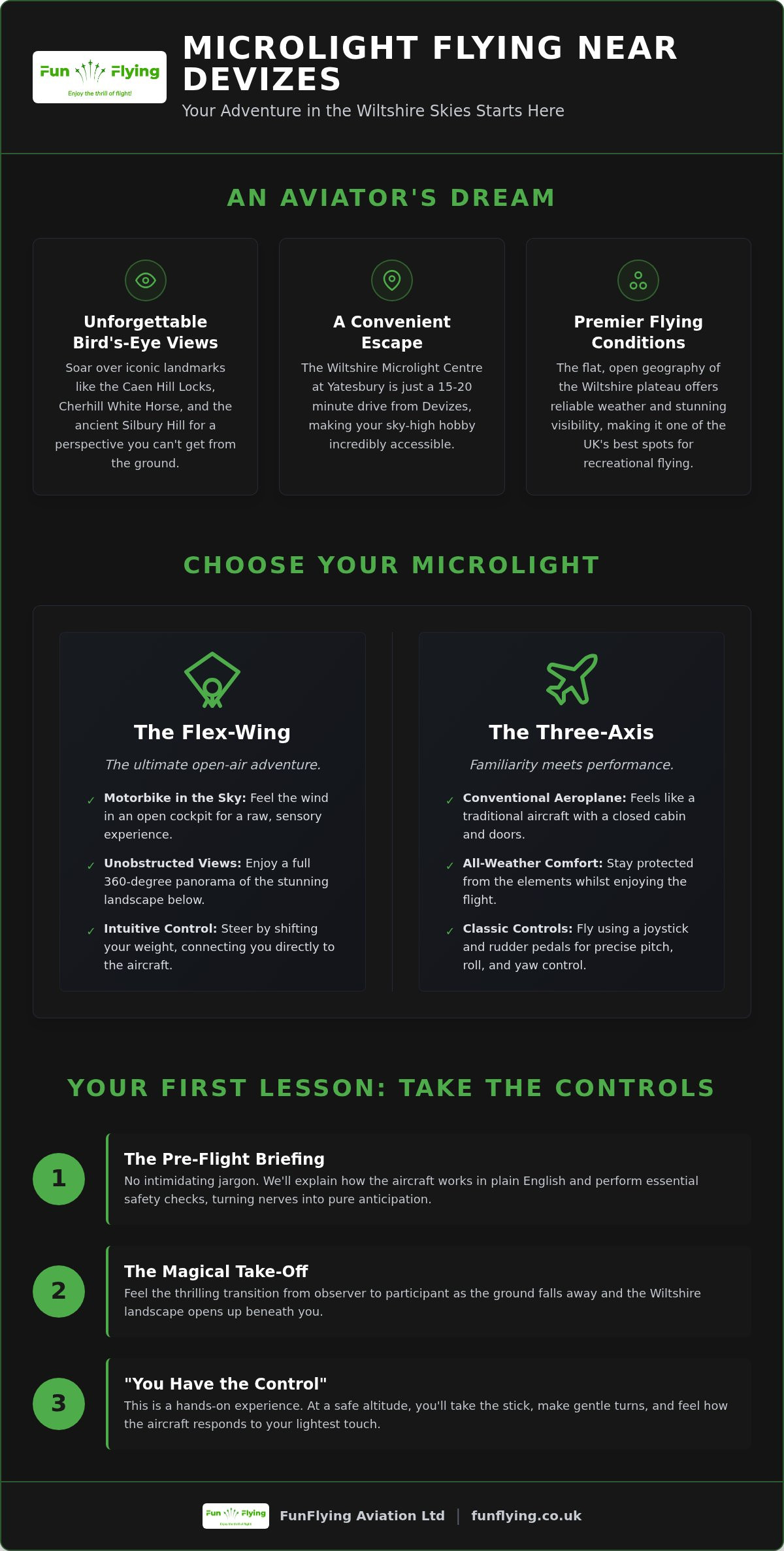
Hands-on Flying Lessons: How to Fly a Microlight on Your First Lesson

Start Your Aviation Journey at the Wiltshire Microlight Centre

Choosing where to begin your flying career is just as vital as the flight itself. Yatesbury is more than just a strip of grass; it’s a historic airfield that offers some of the most unrestricted, beautiful airspace in the South West. At Fun Flying Aviation Ltd, we pride ourselves on a non-intimidating atmosphere where the elite barriers of aviation are stripped away. We operate six days a week to ensure that your dream of taking to the skies fits perfectly around your career and family life.

Whether you start with one of our Experience Flights or jump straight into a full training course, we provide a clear, structured path. Every minute you spend in the air counts towards your National Private Pilot’s Licence (NPPL). It’s incredibly rewarding to see your logbook grow from that very first entry. Our instructors are specialists in NPPL training, ensuring you receive professional guidance with a friendly, hands-on approach from day one.

Flying Over Historic Wiltshire

The view from a microlight is unlike anything else. You’ll soar over the rolling downs and might even spot the famous Cherhill White Horse carved into the hillside. Because we’re perfectly positioned near the M4, we’re the premier choice for students coming from Swindon, Bristol, and Newbury. Depending on your preference for adventure, you can choose between the wind-in-your-face thrill of an open-cockpit aircraft or the refined comfort of an enclosed cabin. Both options allow you to fly a microlight on your first lesson whilst soaking in the Wiltshire scenery.

Booking Your First Lesson

Getting started is simple. You can purchase a voucher for a loved one or book a direct slot for yourself at a time that suits your schedule. For your first flight, we recommend wearing comfortable, windproof layers and sturdy shoes; even on warm days, it can get chilly as we climb. There’s no need for expensive gear or prior experience. If you have questions about the medical self-declaration or the five ground exams, don’t hesitate to contact us for a no-obligation chat. We’re here to make sure you feel ready and excited to take the controls.

Take the Leap and Claim Your Seat in the Cockpit

The dream of flight is far closer than you think. You’ve discovered that aviation isn’t a complex mystery reserved for the few; it’s a vibrant, accessible hobby that welcomes anyone with a sense of adventure. From mastering the intuitive basics of pitch and roll to the incredible moment you hear “you have control,” your journey into the clouds starts with a single step. There is nothing quite like the feeling of autonomy as you fly a microlight on your first lesson, looking out over the historic Wiltshire landscape.

At FunFlying Aviation Ltd, we provide more than just a flight; we offer a community. With our professional CAA-qualified instructors and a base at the historic Yatesbury airfield, you’re in the best possible hands. Whether you want a one-off thrill or a structured path toward your NPPL licence, we make the process simple and exhilarating. Don’t let another day pass just watching the horizon from the ground. Book your hands-on microlight lesson with us today! The sky is waiting, and we can’t wait to help you conquer it.

Frequently Asked Questions

Do I need any previous experience to fly a microlight on my first lesson?

You don’t need any prior aviation experience or technical knowledge to take to the skies. Our trial flights are specifically designed to introduce newcomers to the joy of flight from the very beginning. Your instructor handles the complex procedures like take-off and landing, leaving you free to focus on the pure sensation of handling the aircraft once we’re at a safe altitude.

Will I actually be allowed to steer the aircraft myself?

Yes, you’ll be encouraged to take the controls yourself under the close supervision of your instructor. The entire purpose of the session is to ensure you fly a microlight on your first lesson rather than just sitting back as a passenger. You’ll get a genuine feel for the aircraft as you perform gentle turns and maintain level flight over the Wiltshire countryside.

What happens if I make a mistake while holding the controls?

There’s no need to worry because your instructor has a full set of dual controls and can take over instantly. It’s very similar to a driving lesson where the teacher has their own set of pedals—a safety-first approach also used by Wimbledon Driving School for their road lessons. We’ll guide your movements and keep the aircraft within a safe flight path, allowing you to explore the controls with total peace of mind and confidence.

Are there any physical or age limits for taking a microlight lesson in the UK?

In the UK, you can begin logging flight hours towards a licence from the age of 14. While there’s no official upper age limit, you should be in generally good health and able to climb into the cockpit. Most microlights have a maximum seat weight limit, often around 110kg or 17 stone, so it’s always a good idea to check with us before you book your session.

Can I count the time from my first trial flight towards my pilot licence?

Absolutely, your very first flight counts as official training time toward your National Private Pilot’s Licence. Because our lessons are conducted by professional instructors at the historic Yatesbury airfield, you can log that first hour in your personal pilot’s logbook. It’s a fantastic way to start your aviation journey whilst experiencing the thrill of being at the controls for the first time.

Is microlight flying safe compared to traditional light aircraft?

Microlighting is remarkably safe and is governed by the same strict UK aviation regulations as larger aeroplanes. Modern microlights are built with high-tech materials and are often more agile than traditional light aircraft. Because they are lighter, they have lower stall speeds and can land safely in much shorter distances, making them a practical and secure choice for recreational pilots.

Marce Colucci

Article by

Marce Colucci

Love to fly, and more importantly, love teaching others to fly.

Microlight Experience Flight Gift: The Ultimate Guide to Gifting the Sky in 2026

Ikarus C42

What if the best gift you ever gave wasn’t something they could hold, but something that completely changed their perspective on the world? Most of us are tired of the same old generic ‘experience days’ where you’re just another face in a queue. You want a microlight experience flight gift that feels personal, thrilling, and genuinely life-changing. It’s only natural to want that ‘wow’ factor; however, it’s easy to feel overwhelmed by technical jargon or worried about whether they’ll actually get to take the controls.

You’ve come to the right place to turn that dream of flight into a reality. We’ll show you exactly how to choose the perfect flying gift, from demystifying the difference between a flexwing and a fixed-wing aircraft to finding the most scenic flight school in Wiltshire. You’ll discover how to avoid hidden costs and weather-related stress, ensuring your recipient enjoys a hands-on introduction to aviation they’ll never forget. Imagine them soaring over the historic Wiltshire countryside, not just as a passenger, but as a pilot in the making. Let’s get them into the cockpit and start their 2026 adventure.

Key Takeaways

  • Understand the difference between the “wind-in-your-face” thrill of a flexwing and the sleek, airplane-like comfort of a fixed-wing microlight to find the perfect fit.
  • Discover why a microlight experience flight gift is more than just a tour, offering a genuine “hands-on” lesson where the recipient actually flies the aircraft.
  • Learn how to choose the right flight duration to ensure your loved one gets enough time to soak in the stunning views of the Wiltshire countryside.
  • Explore the historic Yatesbury airfield as a premier location for spotting iconic landmarks like the Cherhill White Horse and Avebury from above.
  • Find out how a simple trial flight can be the exciting first step towards earning a full National Private Pilot’s Licence.

The Magic of a Microlight Experience Flight Gift

Forget everything you think you know about small planes. A modern microlight is a marvel of engineering; it’s a high-performance, lightweight aircraft that offers agility you simply won’t find in a heavy commercial jet. Often referred to globally as Ultralight aviation, these machines provide a sense of liberation that’s hard to match. You aren’t just a passenger peering through a tiny porthole. Instead, you’re right there in the heart of the action, feeling every gentle lift of the wings and seeing the world in glorious, high-definition detail. A microlight experience flight gift is a sensory explosion that combines the thrill of autonomy with panoramic views that take your breath away.

A Gift Like No Other: Why Choose Microlights?

Choosing a microlight experience flight gift means giving someone the chance to break the passenger mould. Unlike a standard sightseeing tour, a trial flight is actually the first entry in a pilot’s logbook. It’s a genuine lesson. The recipient doesn’t just sit back; they take the controls under the guidance of a friendly expert. There’s an incredible emotional impact in achieving something so bold. When you compare the sheer adrenaline and the “I actually flew a plane” bragging rights to a typical spa day or driving experience, the cost-to-thrill ratio is off the charts. It’s a bucket list achievement that stays with you forever.

Microlights vs Traditional Aeroplanes

Why choose a microlight over a standard light aircraft? For starters, there are fewer regulatory hurdles for beginners, which keeps the focus entirely on the joy of flying. Microlights are also perfectly suited to charming, picturesque grass airfields like Yatesbury. You won’t be stuck behind a queue of idling jets at a busy airport. Because these aircraft are so responsive, the hands-on factor is significantly higher. You feel the air, you master the movements, and you truly understand the mechanics of flight from the moment you leave the ground. It’s the most authentic, accessible entry point into the world of UK general aviation.

Flexwing vs Fixed-Wing: Which Experience Should You Gift?

Choosing a microlight experience flight gift often comes down to one big question: do they want to feel the wind in their face or sit in a cockpit that feels like a modern aeroplane? It’s the most common dilemma for gift-givers. Both aircraft types are incredibly safe and regulated by the British Microlight Aircraft Association, yet they offer completely different sensations. Understanding these differences is the key to matching the flight to your loved one’s personality and their sense of adventure.

Flexwing: The Ultimate Open-Air Adventure

If the person you’re buying for is a bit of a thrill-seeker, a flexwing microlight is likely their perfect match. Often called a “motorised hang glider” or a “trike,” this aircraft consists of a powered tricycle unit suspended under a large, fabric wing. Steering is done via a weight-shift bar; you’re physically moving the wing to change direction. It’s raw, it’s visceral, and the 360-degree visibility is simply unrivalled. There’s no glass between you and the landscape. It’s just you, the instructor, and the “wind in the wires” sensation that makes photography from the air an absolute dream. It’s the purest form of flight imaginable.

Fixed-Wing: The Modern Pilot Experience

For those who prefer a little more comfort or are dreaming of a future career in aviation, a fixed-wing microlight is the way to go. These look and feel like miniature versions of a traditional light aircraft, such as the popular Ikarus C42 often used for training. Inside the closed cabin, you’re protected from the elements, making these a fantastic choice for flights throughout the year. They use standard stick-and-rudder controls, which is exactly what you’d find in a larger Cessna or even a commercial jet. If they’ve ever said they want to “learn to fly a plane,” this is the experience that will make them feel like a captain from the moment they taxi onto the grass. You can even explore our range of Trial Flights to see which fixed-wing option suits them best.

Deciding between the two depends on the “vibe” you want to gift. If they love the idea of an open-air motorbike in the sky, go flexwing. If they want to master the art of traditional piloting in a cosy cabin, fixed-wing is the winner. Either way, they’re going to have an incredible time once they leave the ground.

From Ground Briefing to Taking the Controls: What to Expect

Stepping onto the historic airfield at Yatesbury, you’ll immediately feel the buzz of excitement. This isn’t a sterile airport terminal; it’s a vibrant community of instructors who live and breathe aviation. When you arrive with your microlight experience flight gift, you aren’t just a passenger waiting for a ride. You’re a student pilot for the day. Our team prides itself on a friendly, welcoming approach that turns nerves into pure adrenaline from the moment you meet.

The Pre-Flight Briefing and Safety

Before heading to the aircraft, you’ll sit down for an essential briefing. We keep things simple but thorough, explaining basic aerodynamics and how the aircraft behaves in the sky. You’ll learn about “flight effects,” which is the way the plane moves when you move the controls. Safety is our absolute priority. Modern microlighting is one of the most regulated and safest ways to enjoy the sky. Every single minute of your experience flight actually counts towards the requirements for a National Private Pilot’s Licence, making this a genuine step into the world of aviation.

Hands-On Flight: You Are the Pilot

The real magic happens once the engine roars to life. After a smooth take-off, you’ll feel the transition to level flight as the Wiltshire landscape opens up beneath you. This is where our “Take Control” philosophy kicks in. Under the watchful eye of your instructor, you’ll be encouraged to take the stick or the bar. You’ll execute basic manoeuvres like gentle turns, steady climbs, and controlled descents. There’s a unique thrill in feeling the aircraft respond instantly to your touch. Don’t worry about missing the view; there are plenty of opportunities to capture incredible photos and videos whilst airborne to remember your first time as a pilot.

By the time you touch back down on the grass, your perspective on the world will have shifted. It’s not just about the flight itself; it’s about the confidence you gain from mastering a new skill in the clouds. This hands-on introduction is designed to be as encouraging as it is exciting, ensuring every participant leaves with a massive smile and a certificate to prove they’ve taken to the skies.

Microlight Experience Flight Gift: The Ultimate Guide to Gifting the Sky in 2026

How to Choose the Perfect Flying Voucher in 2026

Selecting a microlight experience flight gift is about more than just clicking ‘buy’. You want to ensure the adventure matches the recipient’s dreams. Duration is your first big decision. A 30-minute flight is a fantastic “taster” for someone who wants a quick, high-energy thrill. If they’ve ever mentioned wanting to be a pilot, a 60-minute session is far superior. It provides the necessary time to really settle into the cockpit, understand the instruments, and spend longer with their hands on the controls. Location is equally vital. Flying over Wiltshire, situated perfectly between Swindon and Bristol, offers a landscape of rolling downs and ancient landmarks that you simply won’t find at a flat, urban airfield.

Practical Requirements and Restrictions

Before you commit, it’s essential to check the practicalities. Microlights are high-performance but lightweight machines, which means weight limits are a safety reality rather than a suggestion. At the Wiltshire Microlight Centre, the maximum weight for a participant is 100kg (15 stone 7lbs). Age is another factor to consider. We love seeing young enthusiasts in the sky, and teenagers can start their journey from the age of 14. Generally, if the recipient is fit enough to drive a car, they’re fit enough to take to the air; however, it’s always best to disclose any significant health concerns beforehand.

Voucher Validity and the British Weather

We all know the UK climate can be unpredictable. That’s why a gift voucher is the most flexible and stress-free way to organise a flight. Most vouchers are valid for one full year, giving your loved one plenty of time to pick a glorious, blue-sky day. If the weather doesn’t play ball on their scheduled date, a professional school will simply rebook the session at no extra cost. This “weather-proof” approach ensures the gift remains a joy rather than a logistical headache. Ready to give them the surprise of a lifetime? You can explore our range of Experience Flights to find the right duration for your budget and their ambition.

Why Yatesbury is the Ultimate Launchpad for Your Aviation Journey

Choosing the right location for a microlight experience flight gift can transform a great day into an unforgettable one. Yatesbury Airfield isn’t just a patch of grass; it’s the historic home of the Wiltshire Microlight Centre. Set on a former RAF base with deep roots in communications and radar history, the airfield carries an atmosphere of authentic aviation. When you fly from here, you’re joining a legacy of pilots who have taken to the skies for decades. Unlike generic experience providers who might send you to a busy, impersonal airport, Yatesbury offers a dedicated community where every visitor is treated like a fellow aviator.

The views from the cockpit are simply unrivalled in the South West. Within minutes of taking off, you’ll find yourself soaring over the iconic Cherhill White Horse, its chalky outline gleaming against the lush Wiltshire downs. You might even bank gently over the ancient Avebury stone circles, gaining a perspective on these prehistoric wonders that ground-based tourists can only dream of. It’s a visual feast that makes every second in the air feel like a scene from a blockbuster film.

Expert Instruction in the Heart of Wiltshire

At FunFlying, our instructors are more than just teachers; they are “Expert Enthusiasts” who live for the sky. Training in the quiet, expansive airspace near Swindon and Calne means you won’t be competing with heavy commercial traffic. This calm environment allows our team to tailor the flight perfectly to the recipient’s comfort level. Whether they want a high-energy lesson or a smooth, scenic introduction, our professional yet friendly approach ensures they feel safe and inspired throughout their journey.

For those in the leisure industry interested in how to effectively promote such unique local attractions, you can explore Advertising and Sponsored Content at FUN WITH KIDS IN LA® to see how they connect families with memorable activities.

From Gift Voucher to Pilot Licence

A single gift voucher often sparks a lifelong passion. Many of our students started with a simple trial flight and are now well on their way to earning a National Private Pilot’s Licence (NPPL). To obtain an NPPL for a microlight, the Civil Aviation Authority requires a minimum of 32 hours of flight time, including 10 hours of supervised solo flight. We offer flexible training programmes designed to fit around your favourite lifestyle, making the dream of becoming a qualified pilot more accessible than ever before. Your gift could be the very first page in their future pilot’s logbook.

Ready to Take to the Wiltshire Skies?

You’ve seen that a microlight experience flight gift is so much more than a simple sightseeing trip. It is a genuine invitation to step into the pilot’s seat and experience the world from a breathtaking new perspective. From the historic grass runways of Yatesbury to the ancient landmarks of the Wiltshire downs, this is an adventure that combines heritage with high-octane fun. By choosing a trial flight, you are giving more than a voucher; you are giving the confidence that comes from mastering the controls of a high-performance aircraft.

Our expert instructors prioritise a 100% safety focus whilst ensuring every second in the air is pure joy. With vouchers valid for a full 12 months and a stress-free rebooking policy for the unpredictable British weather, you can gift with absolute confidence. Book an unforgettable Microlight Experience Flight Gift today with FunFlying and turn their dreams of flight into a reality. The clouds are calling, and we can’t wait to welcome you to our airfield for an adventure they will never forget.

Frequently Asked Questions

What is the minimum age for a microlight experience flight in the UK?

You can start your aviation journey from the age of 14. This is the minimum age required to take the controls at the Wiltshire Microlight Centre. It’s a fantastic way for teenagers to build confidence and gain a unique skill before they’ve even learned to drive. Whilst younger children are always welcome to visit the airfield and watch the aircraft, they’ll need to wait until their 14th birthday to fly.

Is there a weight limit for microlight flying?

The maximum weight for a participant is 100kg, which is approximately 15 stone 7lbs. This limit is strictly enforced because microlights are designed to be incredibly light and agile machines. Exceeding this weight can affect the aircraft’s performance and its safety margins. We always recommend checking this detail before booking a microlight experience flight gift to ensure your recipient can fly comfortably and safely.

How much does a microlight experience flight cost in 2026?

Prices for a flight typically depend on the duration you choose for your adventure. A 30-minute taster session generally falls between £99 and £125 at airfields across the UK. If you’re looking for a more in-depth 60-minute lesson, you can expect to pay between £170 and £199. These rates usually include your professional pre-flight briefing, insurance, and all the necessary safety equipment you’ll need for the day.

What happens if the weather is bad on the day of my flight?

If the clouds are too low or the winds are too high, we’ll simply reschedule your flight for another day. Safety is our absolute priority; we only fly when conditions are perfect for an enjoyable and clear experience. Most vouchers are valid for 12 months, giving you plenty of flexibility to find a beautiful, sunny day. We’ll keep in touch leading up to your booking to monitor the forecast.

Can I take my own camera or GoPro on a microlight flight?

Do I need a medical certificate to go on a microlight trial flight?

You don’t need a formal medical certificate to enjoy a trial flight. As long as you are generally fit and healthy, you can take to the skies with us. If you decide to continue training for your full licence, you’ll eventually need to complete a medical self-declaration. For your first microlight experience flight gift, just bring your enthusiasm and a sense of adventure; we’ll handle the rest of the technicalities.

What should I wear for my microlight flying experience?

We recommend wearing comfortable, warm layers and flat-soled shoes like trainers. Even on a sunny day, it can be significantly cooler once you’re up in the air. If you’ve chosen a flexwing flight, we’ll provide a specialised flying suit to keep you snug against the wind. Avoid wearing scarves or any loose items that could blow away. Being comfortable is the best way to ensure you enjoy every second of the flight.

Can a microlight experience flight count towards a pilot licence?

Every minute you spend in the air during your experience flight counts towards your National Private Pilot’s Licence (NPPL). To gain your full licence in the UK, you’ll need a minimum of 32 hours of flight time. This includes at least 10 hours of supervised solo flight. It’s a brilliant way to see if a hobby in aviation is the right path for you whilst enjoying a truly unique perspective on the world.

Marce Colucci

Article by

Marce Colucci

Love to fly, and more importantly, love teaching others to fly.

Verified by ExactMetrics