Choose a trial flying lesson near Newbury

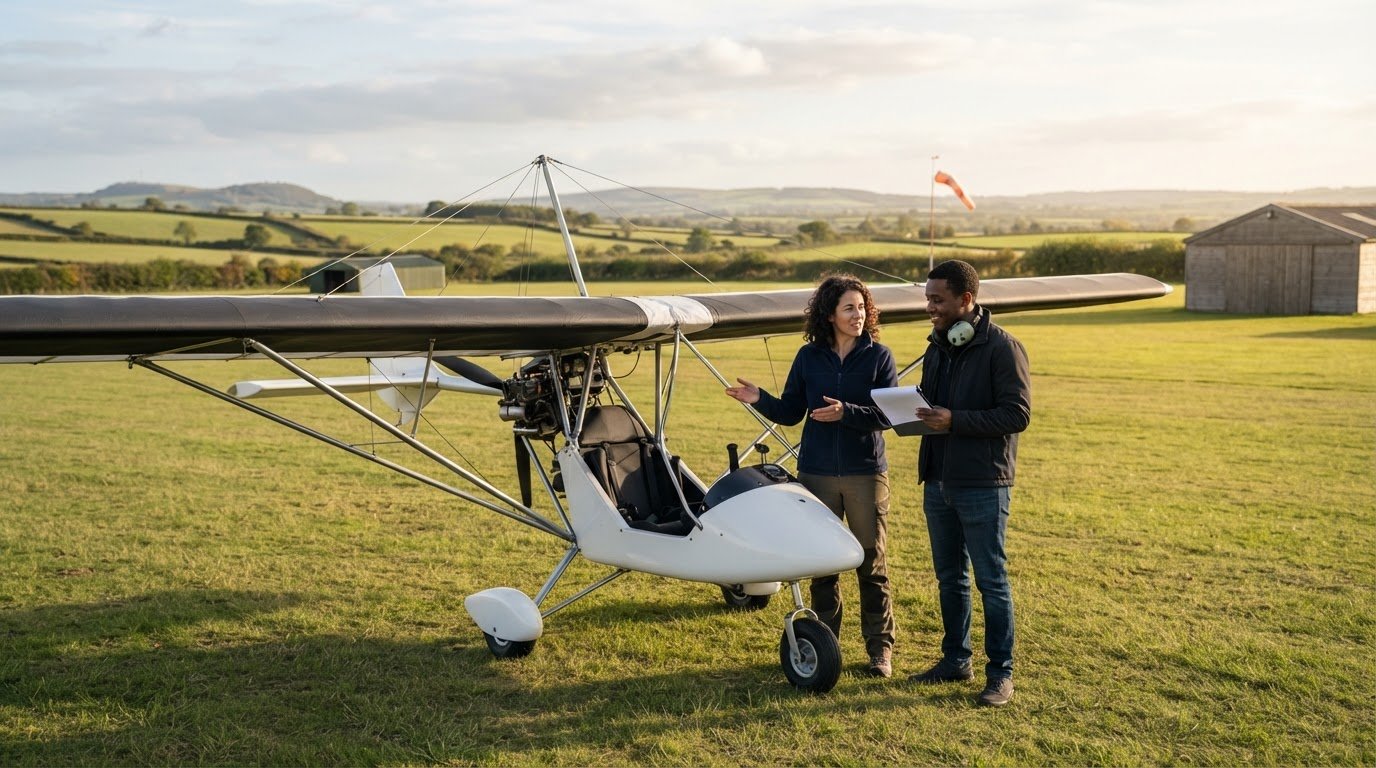
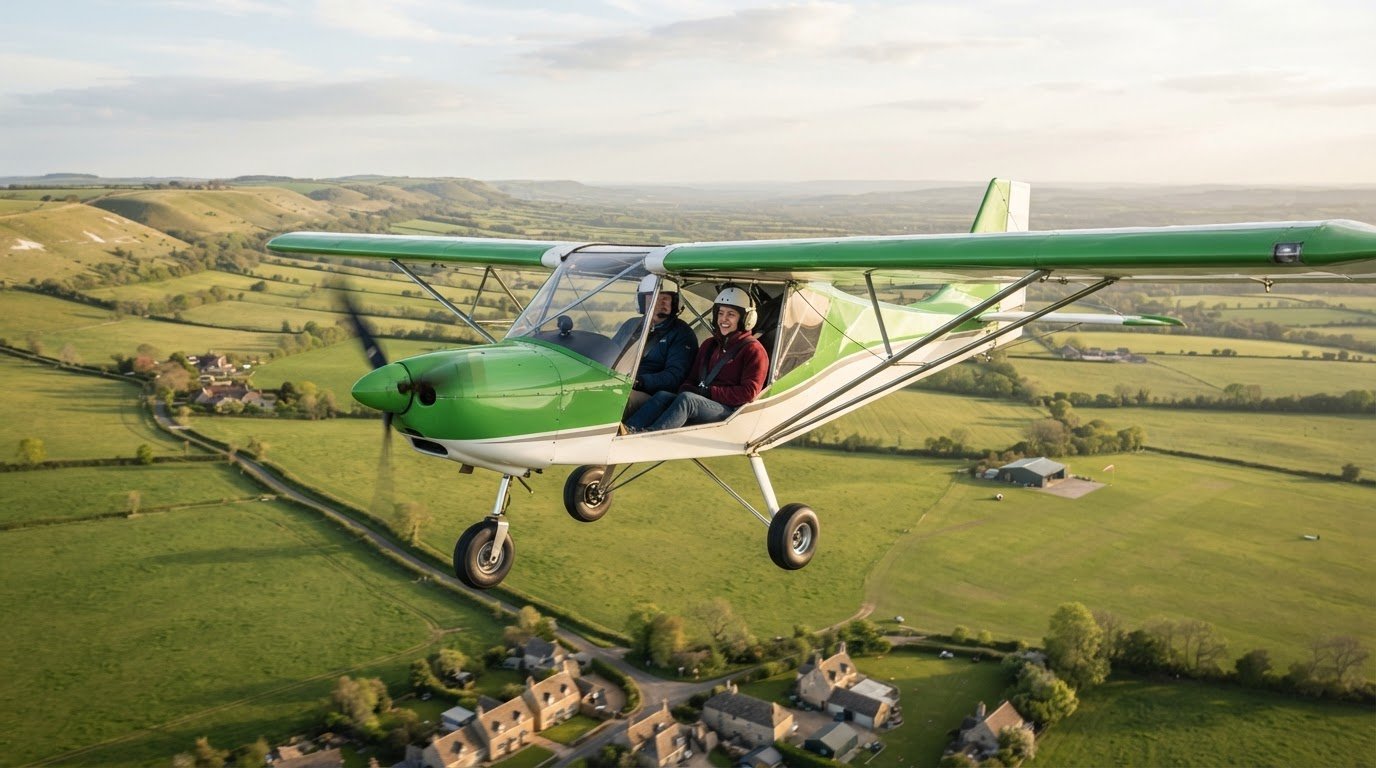
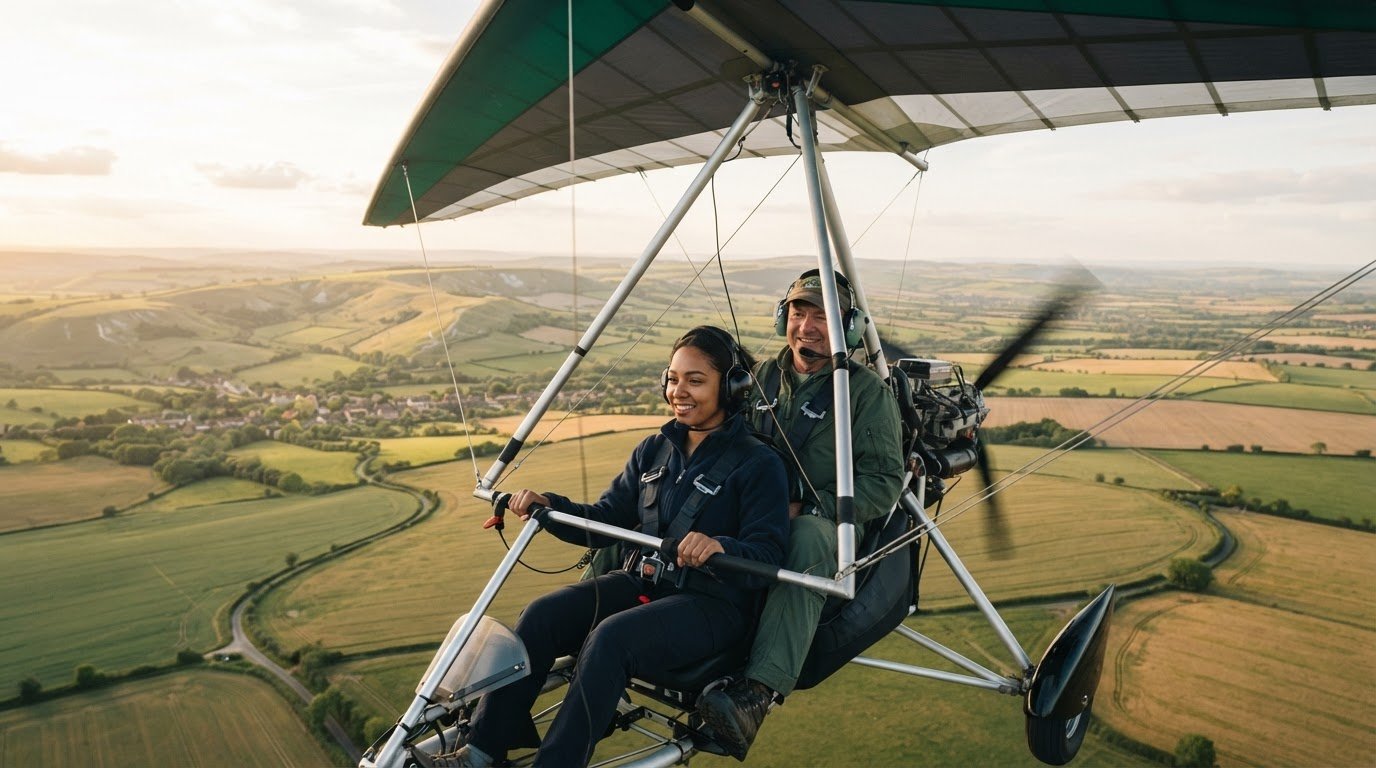
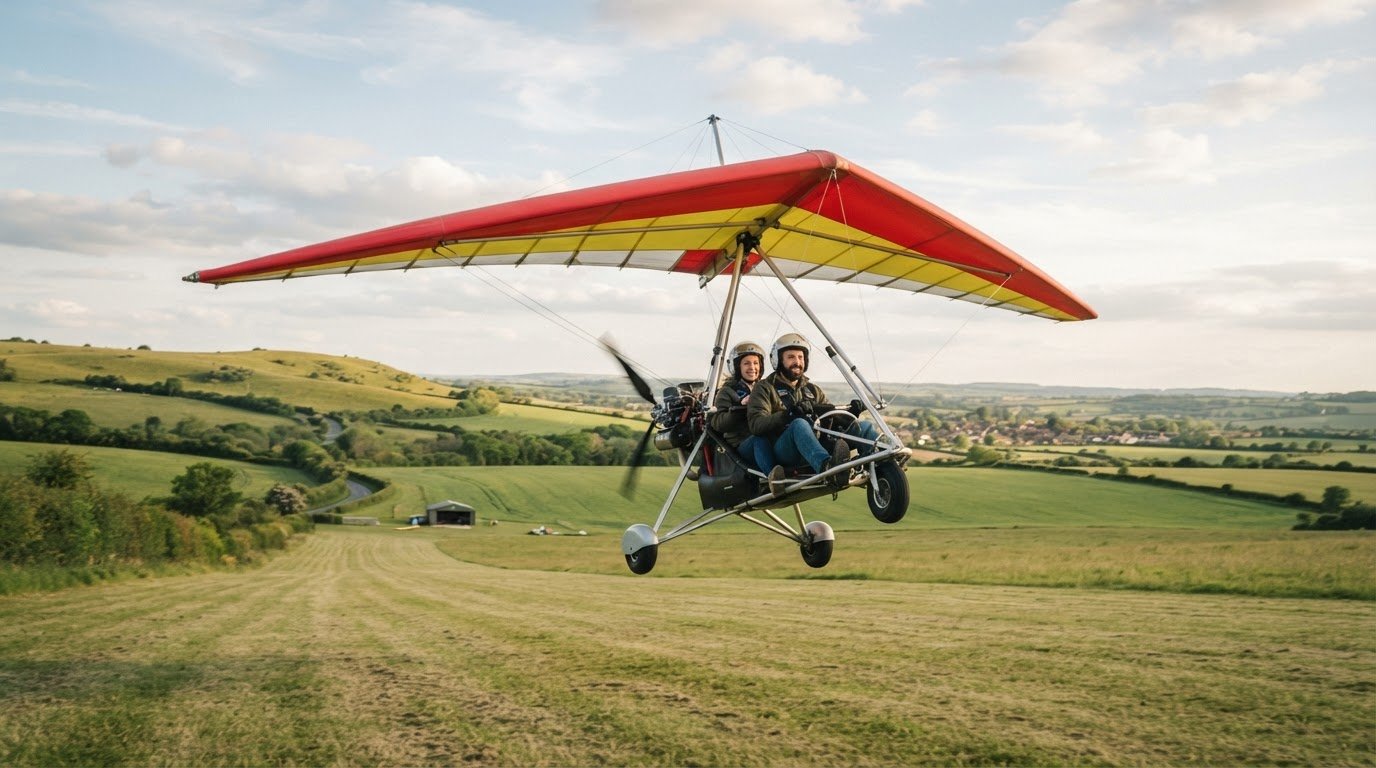
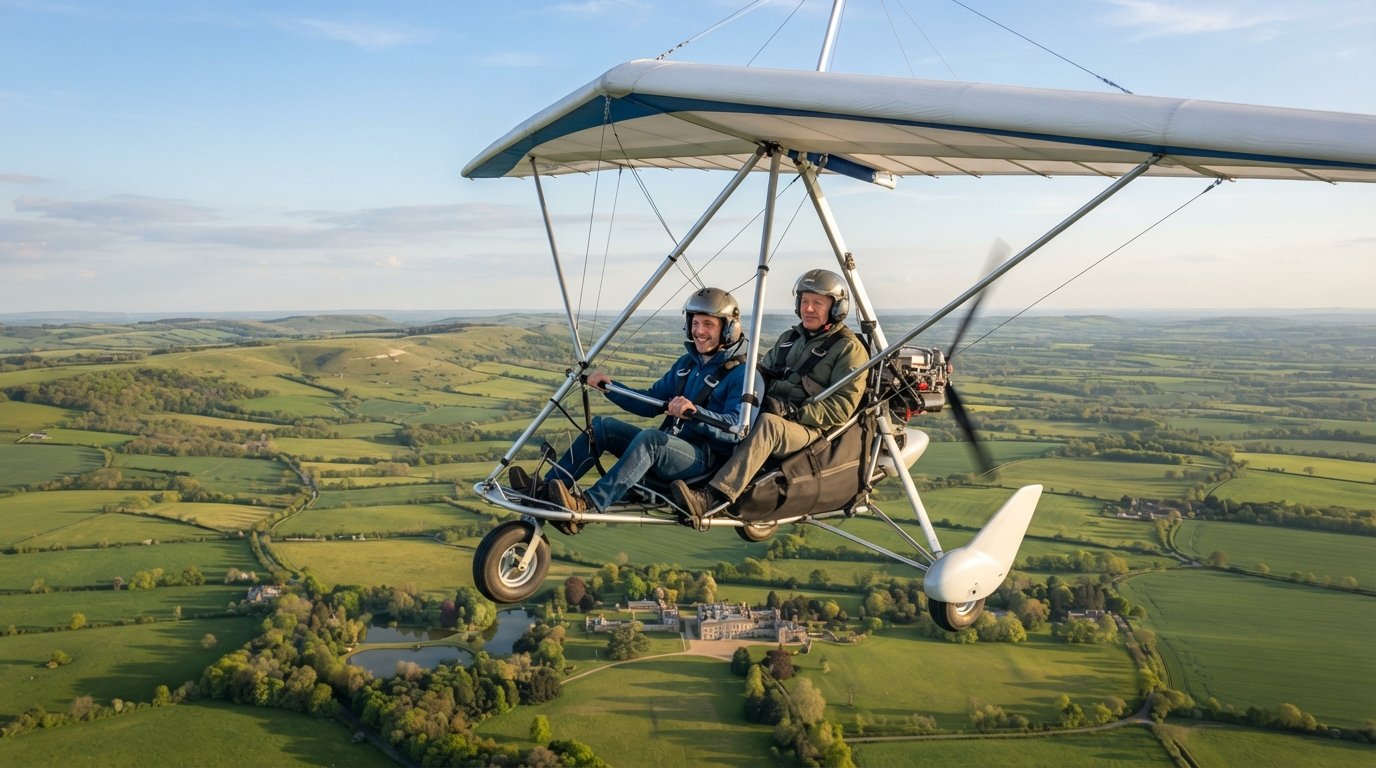
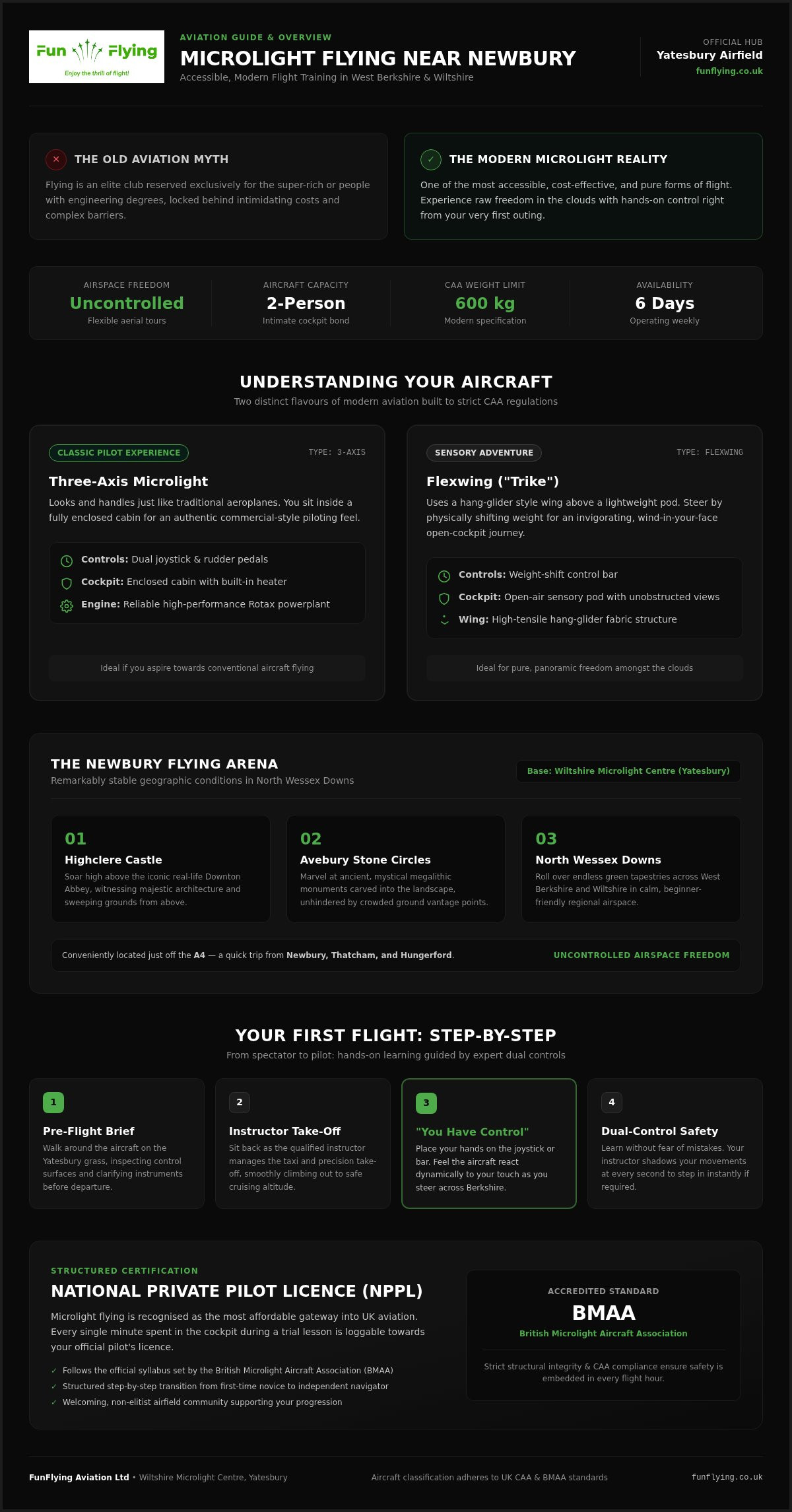
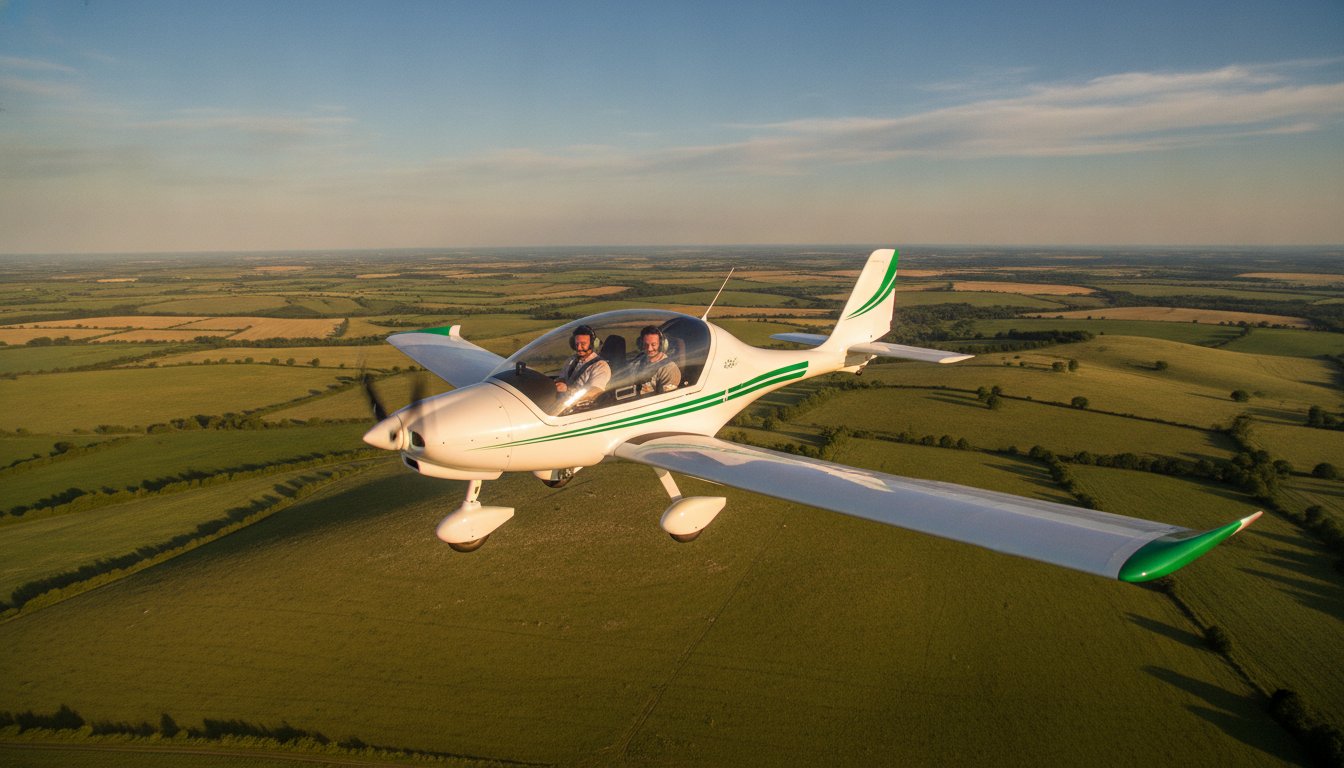
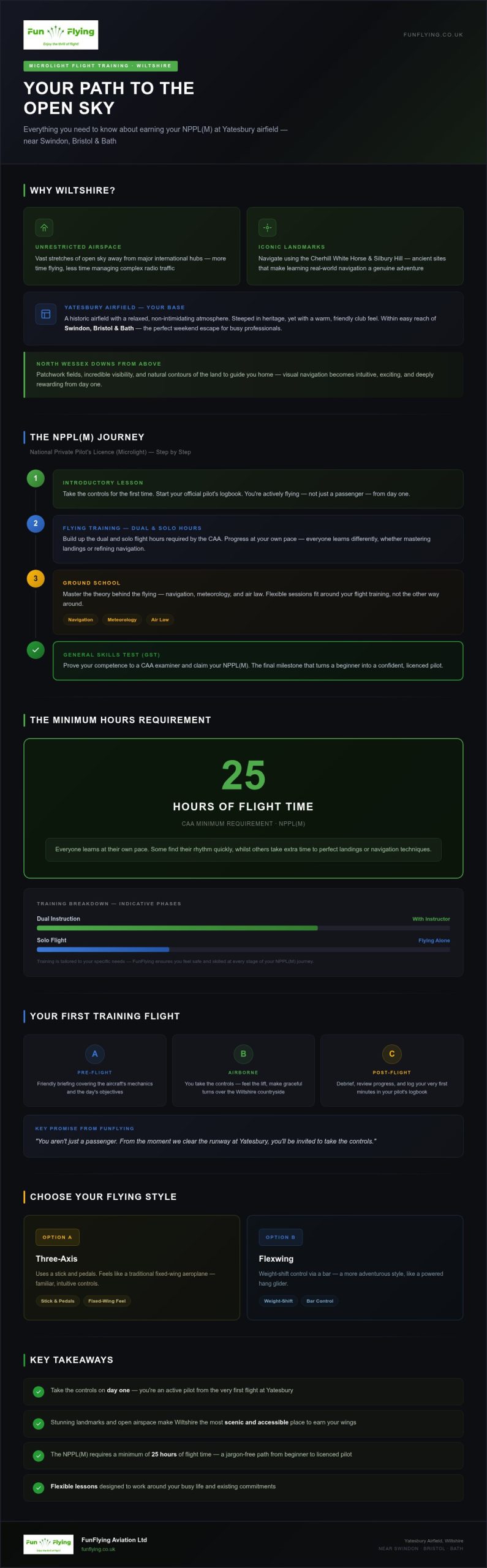
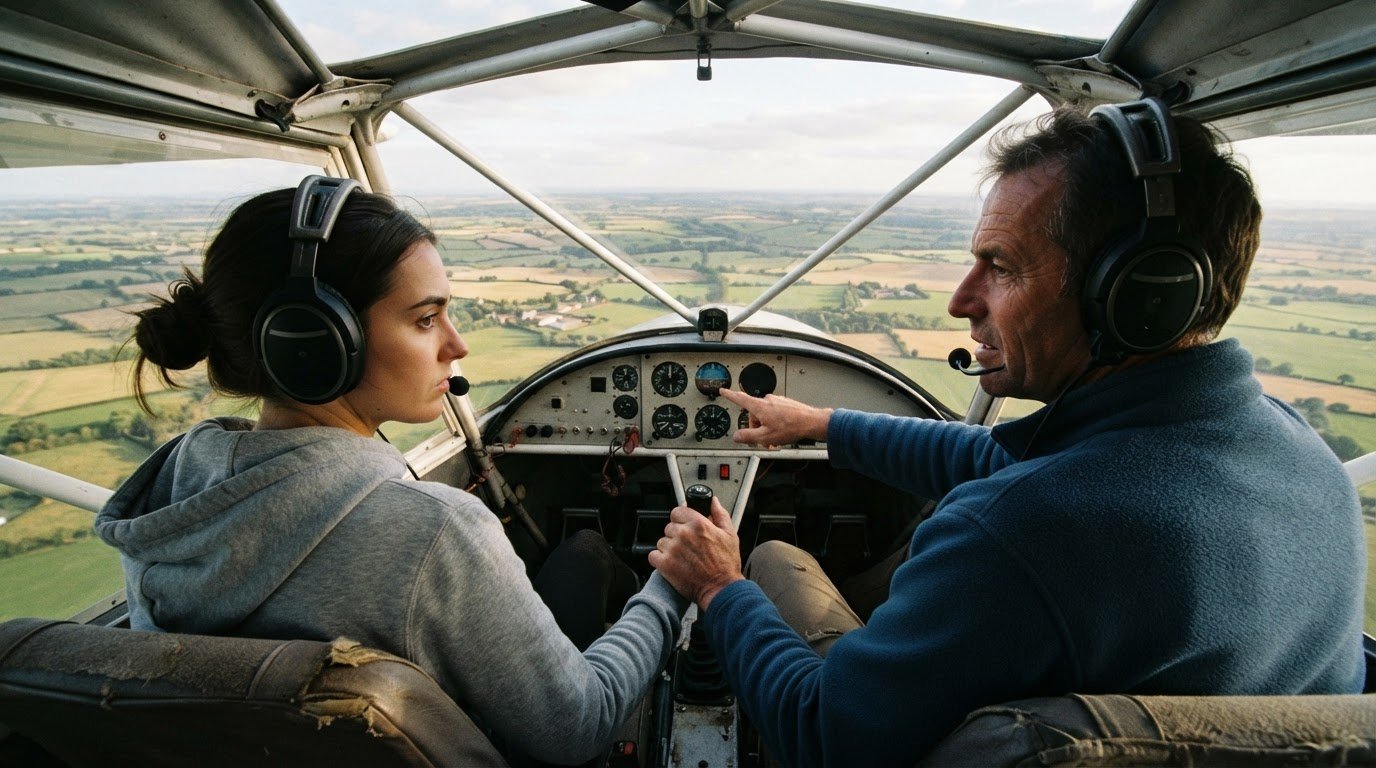
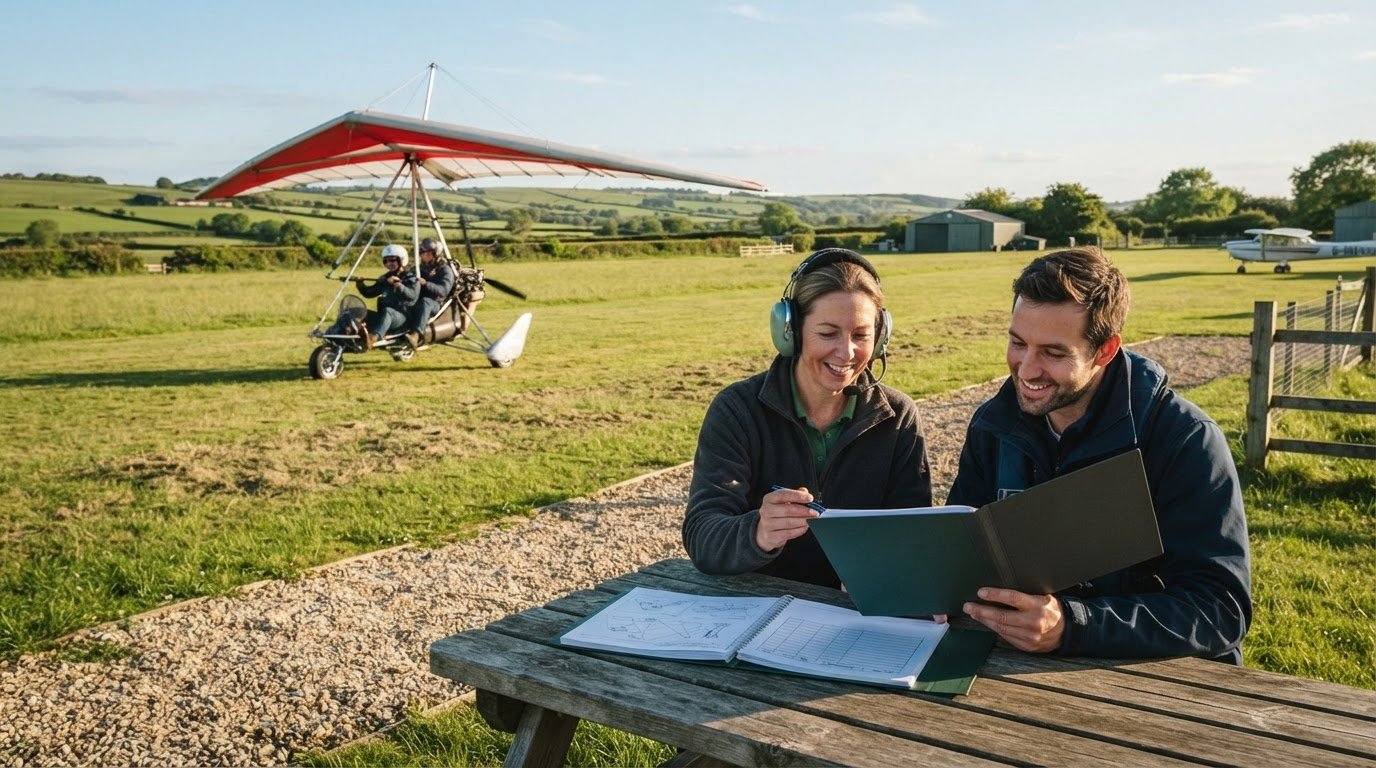
A student flies a microlight with an instructor during a trial flight near Yatesbury, Wiltshire.

A first flight can be more than a scenic trip: it can give you a feel for the controls and a route into training. On a trial flying lesson near Newbury, you can fly a microlight with an instructor at Yatesbury in Wiltshire. An introductory flying session may count towards minimum required training time if you’re at least 14 and fly without passengers.

It’s natural to wonder whether you’ll get to handle the aircraft and whether the experience could be a first step towards a licence. Fun Flying’s lessons are hands-on, with students taking control from their first lesson.

Find out what the flight involves, where it departs, how it can lead into licence training and what to consider when booking. That will help you choose an experience that suits you, whether you’re curious about flying or keen to explore where it could lead.

Key Takeaways

  • Learn what to expect from the instructor’s briefing and how you can get hands-on with the aircraft during your flight.
  • Compare nearby flying locations and lesson formats to find an experience that suits your plans.
  • Understand when an introductory flight may count towards minimum training time, and what conditions apply.
  • See how an experience flight can be a first taste of flying or a stepping stone towards microlight training.

Flying the aircraft with an instructor

A trial flight pairs an instructor’s guidance with the chance to experience the aircraft from the pilot’s seat. Near Newbury, introductory sessions are offered in light aircraft, with different seating and flight-time options.

Using controls and instruments

Before take-off, your instructor briefs you on how the aircraft flies and what its controls do. You can then try handling the controls under their guidance, making the flight a hands-on introduction rather than simply a scenic ride.

In a Cessna 152 or Piper PA-28, the instructor can explain the instruments as you encounter them. For example, the airspeed indicator shows how fast the aircraft is moving, while the altimeter shows its height. Focus on following the instructor’s directions and noticing how the controls and instruments work together.

A 30- or 60-minute introductory flying session gives you different amounts of time in the air. The longer option leaves more room to settle into the experience and practise following instructions, while the briefing helps you understand what to expect before flying.

Choosing a trial flight type

Near Newbury, introductory aeroplane flights include a two-seat Cessna 152 and a four-seat Piper PA-28. These are light-aircraft options; the available local flight details describe aeroplanes rather than helicopter flights. A Piper Warrior is a model in the PA-28 family, but the introductory aircraft is identified as a PA-28.

Yes, you can take the controls with your instructor guiding you. If you choose the four-seat aircraft, you may be able to bring up to two passengers, subject to mass and balance limits. The two-seat Cessna 152 has room for the instructor and learner, so it isn’t the option for bringing another passenger along.

Aircraft and club facilities shape the experience too. At the Wiltshire Microlight Centre in Yatesbury, the instructor, briefing and aircraft are central to the visit; the location gives you a clear base for your flight. Choose the aircraft and session length around whether you want a focused first taste or more time to handle the controls. Either way, flying with an instructor makes this an amazing experience.

Flying lesson locations near Newbury

The departure airfield determines where you travel and where your experience begins. Fun Flying’s trial flights depart from the Wiltshire Microlight Centre in Yatesbury, Wiltshire, not Cotswold Airport or Wycombe Air Park.

Cotswold Airport and Wycombe Air Park are separate locations, so don’t assume a trial flying lesson described as near Newbury departs from either one. Check your booking details for the named airfield and plan your journey there. Yatesbury is the departure location; allow time to arrive and meet your instructor before the briefing.

Age, height, weight and health affect different parts of the decision. The stated 14-year threshold concerns whether an introductory session can count towards minimum training time, provided you fly without passengers; it isn’t a general minimum age for every trial flight. The two-seat Cessna 152 has a weight limit of 14.5 stone (92 kg). Height and health are considered in relation to fitting safely in the aircraft and taking part in the flight.

Safety starts with the pre-flight briefing, where your instructor explains how the aircraft flies and how its controls work. Follow the instructor’s directions throughout the flight. Insurance is separate from this practical guidance: it concerns financial cover for specified events, while the briefing prepares you for the flight itself.

If you’re considering more than a one-off visit, distinguish an introductory experience from a training session. This flight departs from Yatesbury, which gives you a clear starting point for planning your journey. If you’re buying a voucher, check that it identifies the departure site so the recipient knows which airfield to travel to.

Choosing a named airfield first makes the next step simpler: organise your journey to Yatesbury, then arrive ready for the briefing and flight. If you’re interested in learning to fly beyond an introductory visit, explore the learn-to-fly pathway and see how training can progress.

Pilot training and licence progression

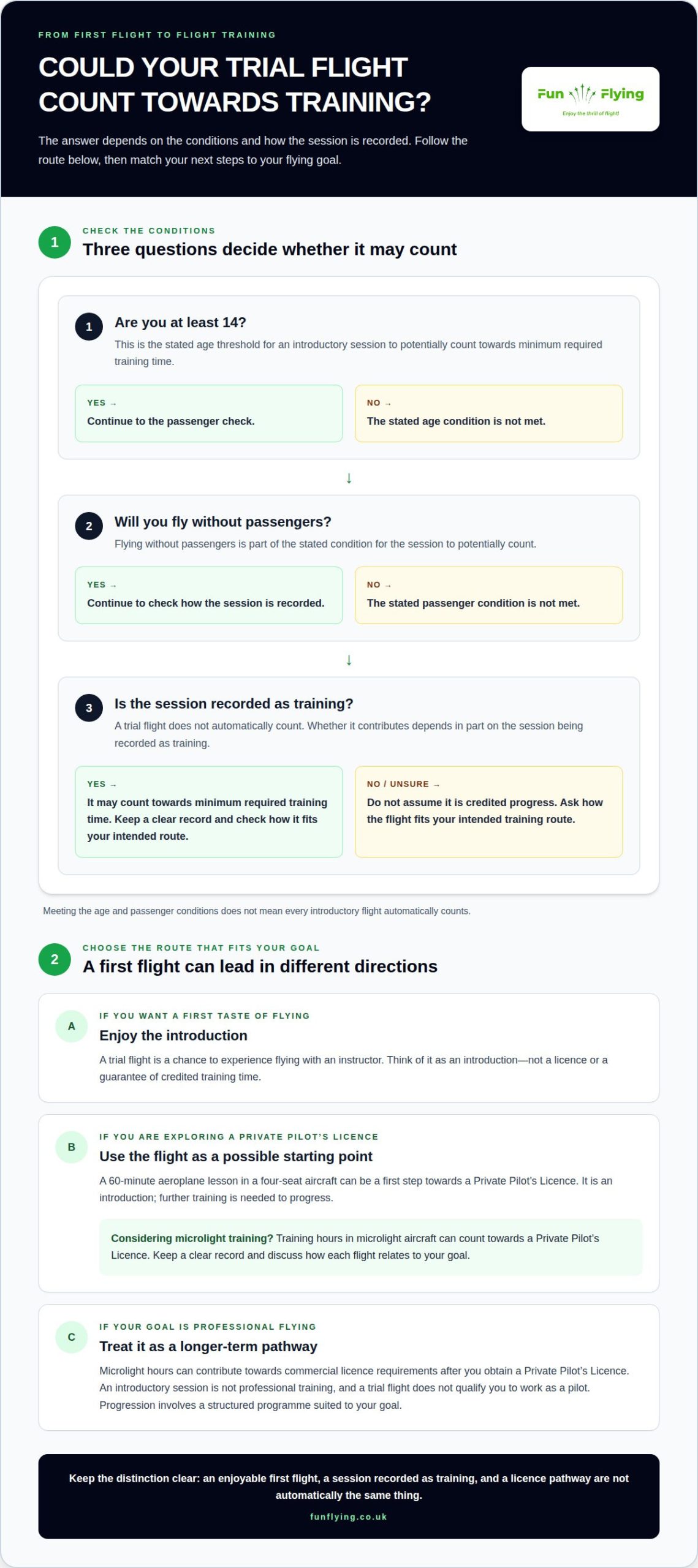
A trial flight can be a thrilling introduction to aviation, but whether it contributes towards a pilot licence depends on the flight and your next goal. The key distinction is between an enjoyable first experience and a session that forms part of structured training.

An introductory flying session may count towards minimum required training time if you’re at least 14 and fly without passengers. That doesn’t mean every trial flight automatically counts: the age and passenger conditions matter, as does whether the session is recorded as training. Ask how the flight fits your intended route before treating it as credited progress.

For a Private Pilot’s Licence, a 60-minute aeroplane flying lesson in a four-seat aircraft can be a first step. It gives a prospective private pilot time to experience a light aircraft and begin learning with an instructor. Think of it as an introduction, not the licence itself: progression involves further training beyond a single flight.

Microlight training offers another route to explore. Training hours in microlight aircraft can count towards a Private Pilot’s Licence. The aircraft type is therefore worth considering when choosing where to begin, especially if you want practical flying experience that may support a broader private-pilot goal. Keep a clear record of your training and discuss how each flight relates to your intended licence.

Professional pilot training is a separate goal from private flying. Microlight hours can contribute towards commercial licence requirements after you obtain a Private Pilot’s Licence. That doesn’t make an introductory session professional training, and a trial flight doesn’t qualify you to work as a pilot. If you want to pursue a licence, choose a structured programme suited to that goal.

Can a trial flight count towards a licence? It may contribute when the relevant age and passenger conditions are met, and some lessons can introduce a Private Pilot’s Licence pathway. Before booking, decide whether you want the excitement of a first flight, private pilot training or a longer-term professional aviation goal. This helps you choose a useful starting point rather than treating every experience flight as equivalent.
Choose a trial flying lesson near Newbury

Booking availability and lead times

Booking starts with choosing a flight and arranging a date at the departure location. If you’re travelling from Newbury, allow flexibility around your plans, since flying depends on suitable conditions and an available aircraft and instructor.

Available lesson durations

Introductory flying sessions are available in 30- or 60-minute durations. Choose the shorter flight for a first taste, or the longer option if you’d like more time in the air. The flight time is the session’s flying portion, so allow for the briefing and arrival arrangements when planning your day.

Lesson formats differ by venue across the UK. For example, Enstone Aerodrome offers 30- and 60-minute flights, while Turweston Aerodrome has 30-, 40- and 60-minute options. Those schedules illustrate why it’s useful to select the location first, then choose a duration available there.

Weather cancellations and changes

If the weather prevents a safe flight, the session can’t go ahead as planned. The booking terms explain whether the voucher can be rescheduled or refunded and what conditions apply to changing a date. Keep the voucher information and booking details together so you can follow the right process if plans change.

Weather can affect the flying schedule, so leave room to rearrange travel if a flight is postponed. Pilots and instructors need suitable conditions; a confirmed date is not a reason to fly when the weather isn’t appropriate.

To book or redeem a voucher near Newbury, follow the instructions supplied with it, choose the relevant flight duration and arrange a date at the named departure location. Keep the voucher ready when making the booking, and note any expiry or change terms before settling on travel plans.

Flights at the Wiltshire Microlight Centre depart from Yatesbury, Wiltshire. Plan your journey to that airfield rather than to another airport in the region. Booking lead time depends on available dates, aircraft and instructors, so flexibility with your preferred day can help you find a suitable slot.

Explore learning to fly

Fun Flying Aviation: Experience Flights

Fun Flying Aviation Ltd offers Experience Flights and Trial Flights for anyone ready to turn curiosity into time in the air. From the Wiltshire Microlight Centre in Yatesbury, its instructors take a friendly, hands-on approach, helping you experience flying from the pilot’s seat.

If your first flight sparks a bigger ambition, microlight licence training offers a structured next step. Ground School builds aviation knowledge alongside practical learning, while conversion training and licence revalidations support pilots with different training needs. Choose an experience flight for the thrill; consider training when you’re ready to develop your skills.

For a trial flying lesson near Newbury, or to discuss your next step, contact Fun Flying Aviation Ltd or visit funflying.co.uk.

Make your first flight the start of something

A trial flying lesson near Newbury can be more than a memorable day out. It can help you discover whether you simply love the feeling of flight or want to work towards becoming a pilot. You don’t need to have your whole aviation journey mapped out before you begin. Let the experience spark your curiosity, then decide what feels right for you.

Fun Flying Aviation Ltd offers Experience Flights and Trial Flights for the joy of flying, alongside microlight licence training for those ready to develop their skills. Ground School supports the learning that goes with training. Choose the experience that suits your ambition today, with room for it to grow.

Explore your flying options with Fun Flying Aviation

Your first time at the controls could open up a whole new direction. Take that exciting next step when you’re ready.

Frequently Asked Questions

Do trial lessons count towards a pilot’s licence?

They may count towards minimum required training time if you’re at least 14 and fly without passengers. Whether a particular session contributes depends on its training context, so distinguish a supervised introductory experience from lessons forming part of a structured programme. If your aim is a Private Pilot’s Licence, a 60-minute aeroplane lesson in a four-seat aircraft can be an introductory step, not a licence on its own.

What is included?

A trial flight starts with an instructor-led briefing on how the aircraft flies and how to use its controls, followed by flying time in the aircraft. You can handle the controls under the instructor’s guidance and, for example, learn what the main instruments show. The aircraft and flight duration depend on the option you book, so check those details when choosing your experience.

Where can I book a trial flying lesson near Newbury, Berkshire?

Fun Flying Aviation Ltd offers Trial Flights and Experience Flights from the Wiltshire Microlight Centre in Yatesbury, Wiltshire. That’s the named departure location, not an airfield in Newbury itself. Choose an experience that suits you, then use the booking details to arrange your visit. If you’re considering training afterwards, ask about the microlight training route.

How long does a trial flying lesson near Newbury last, including briefing and flight time?

Introductory flying sessions offer 30 or 60 minutes of flying time. The briefing takes place in addition to that time, so the total visit lasts longer than the flight itself. Allow extra time in your day for arrival and pre-flight preparation, rather than planning to leave immediately after the stated flying duration. The exact length of the briefing can vary with the session.

Which airfields near Newbury offer trial flying lessons, and how far are they from the town centre?

The departure location for these flights is the Wiltshire Microlight Centre in Yatesbury, Wiltshire. Cotswold Airport and Wycombe Air Park are separate locations, not the named departure point. Since no reliable distance from Newbury town centre is provided here, use Yatesbury as your destination and plan your route to that specific airfield rather than relying on the broad label “near Newbury”.

What safety measures and insurance apply to trial flying lessons in the UK?

Safety starts with a pre-flight briefing on how the aircraft flies and how its controls work. Follow your instructor’s directions, and fly only when conditions are suitable. Insurance concerns financial cover for specified events, while the briefing prepares you for the flight.
Marce Colucci

Article by

Marce Colucci

Love to fly, and more importantly, love teaching others to fly.

Structured flight training program in the UK: fees and payments

Structured flight training program in the UK: fees and payments

A structured flight training programme in the UK can follow an integrated or modular route towards commercial flying, or focus on microlight licence training. The route you choose shapes the syllabus, where you train and how payments are arranged.

It’s natural to want a clear picture of the commitment before you take to the skies. Course fees depend on the course and are given after a quote request; the route, training hours and aircraft use all affect the cost.

This guide explains the training options, what to expect from fees and payment schedules, where lessons take place and what the syllabus covers. You’ll also see how the stages fit together, so you can picture your next step towards the freedom of flying.

Key Takeaways

  • Compare course routes by their training structure and payment arrangements to see what fits your goals and budget.
  • Understand how the academy’s location shapes where your lessons take place and the practicalities of getting there.
  • Learn how flight training modules and aircraft fit into your progress from early lessons to more advanced skills.
  • Get a clearer picture of the integrated syllabus, including how classroom learning, flying and simulator work can build towards a qualification.

Course fees and payment schedule

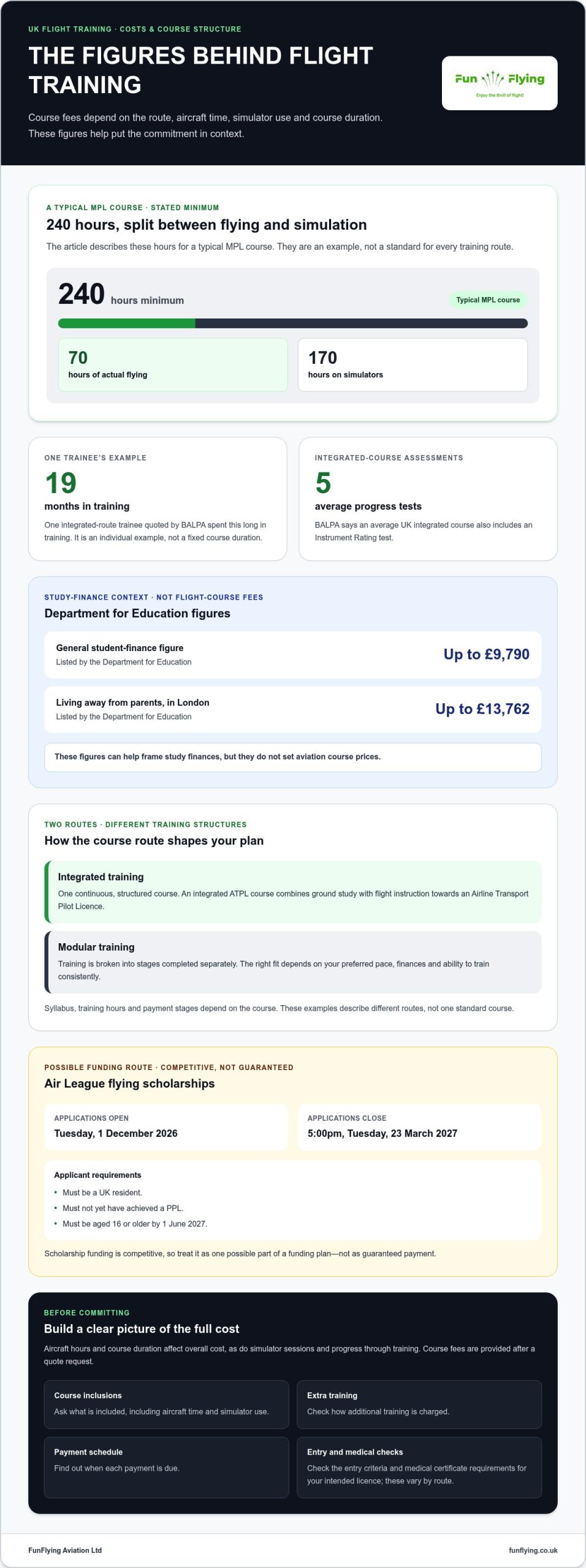
Commercial pilot training costs depend on the route, aircraft time, simulator use and course duration. When comparing courses, look for a clear breakdown of these costs and when payments fall due. That makes it easier to plan each stage instead of focusing on a single headline figure.

For context, the Department for Education lists up to £9,790. This is a general student-finance figure, not a flight-course fee. For living away from your parents, in London, the Department for Education lists up to £13,762. These figures can help frame study finances, but they do not set aviation course prices.

How do integrated and modular flight training compare in the UK? Integrated training follows one continuous, structured course, while modular training breaks the route into stages completed separately. The right fit depends on your preferred pace, finances and ability to train consistently.

An integrated ATPL course combines ground study with flight instruction towards an Airline Transport Pilot Licence. The syllabus, training hours and payment stages depend on the course. For a typical MPL course, the stated minimum is 240 hours: 70 hours of actual flying and 170 on simulators. One integrated-route trainee quoted by BALPA spent 19 months in training. These examples describe different routes, not a single standard course.

Aircraft hours and course duration affect the overall cost, as do simulator sessions and progress through training. Before paying, establish what the course includes, how extra training is charged and when fees are due. Check the entry criteria and medical certificate requirements for your intended licence before committing, as these vary by route.

Are UK pilot training loans, scholarships or airline cadet programmes available? Air League flying scholarships are one route: applicants must be UK residents and have not yet achieved a PPL. Applications open Tuesday, 1 December 2026, and close at 5:00pm on Tuesday, 23 March 2027; applicants must be aged 16 or older by 1 June 2027. Scholarship funding is competitive, so include it as one possible part of your plan, not as a guaranteed payment source.

Aviation academies and training locations

An academy’s location shapes your routine as much as its training environment. Consider how often you’ll travel to the airfield, whether ground lessons take place there and how transport fits your plans. Integrated courses may combine classroom study, simulator sessions and flying, so understand how these activities are arranged. If you’re travelling from Swindon or Bristol, compare the journey with the expected training schedule.

Flight training takes place at airfields across the UK, rather than at one central campus. For an airline pilot pathway, the facilities and aircraft should support the syllabus, including instrument rating training. An instrument rating prepares pilots to fly using cockpit instruments when outside visual references are limited. Check how classroom learning connects with practical sessions.

Accommodation matters if your chosen academy is far from home or requires regular attendance. Compare travel time, lodging options, food access and how easily you can reach classrooms and the airfield. If you’re travelling from Newbury, Reading, Basingstoke, Andover, Bournemouth or Portsmouth, weigh the practicalities of local accommodation against commuting. Your course format and circumstances will shape that decision.

Before choosing a training base, map the practical details:

  • Check the academy’s address and how you’ll get there by road or public transport.
  • Find out which activities happen at the airfield and which take place elsewhere.
  • Work out how accommodation and travel fit your timetable and budget.
  • Consider whether the location supports the flying experience you want, including instrument training.

You may believe the closest academy is automatically the easiest choice, but a suitable training environment also depends on course structure and access to the facilities you’ll use. If you’re exploring microlight training, learning to fly can help you understand what practical training involves. A clear location plan makes it easier to picture the day-to-day reality of training, not just the destination.

Flight training modules and aircraft

Flight training combines practical aircraft lessons with ground study and, on some courses, simulator sessions. Skills build progressively: students learn aircraft handling before developing navigation, communication and decision-making. The sequence depends on the course and the licence it leads to. Compare the syllabus with your goal, whether that’s personal flying or a commercial pilot career.

Aircraft choice affects the feel of each lesson. A training aircraft gives you hands-on experience with its controls, engine and flight instruments, while a simulator recreates selected situations for ground-based practice. Each has a different role: flying develops real-world handling, while simulation lets students rehearse procedures in a controlled setting. Ask how the course uses each and assesses progress.

For integrated training, BALPA says an average UK course involves five progress tests, as well as an Instrument Rating test. These assessments track development across the syllabus, rather than relying on flying experience alone. Map each test against the skills taught beforehand to see how classroom learning, simulator practice and aircraft lessons connect.

Course names can sound similar, so check what each module prepares you to do. A modular course separates training into stages; an integrated course follows a planned sequence. In either case, understand how practical lessons, ground study and assessments lead towards the intended licence. A pilot licence is a qualification, not a guarantee of a particular job.

What are the main risks and job prospects after completing flight training in the UK? The main risks include the time and financial commitment, and the possibility that an airline role may not follow immediately after qualification. Job prospects depend on the licence held, experience, employer requirements and recruitment demand. If you’re exploring hands-on flying before choosing a route, learning to fly can help you understand what practical training involves.

Structured flight training program in the UK: fees and payments

Integrated flight training structure and syllabus

An integrated programme organises training into a connected route towards a defined aviation qualification. Its value lies in how each stage prepares you for the next.

Structured programme overview

What is a structured flight training programme in the UK? It’s a planned course that combines learning and practical instruction around a clear qualification goal. Rather than selecting each stage independently, you follow a coordinated programme. When comparing courses, look for a written sequence, clear learning objectives and an explanation of how progress is reviewed.

Also consider how the schedule fits your ability to study consistently. One integrated-route trainee quoted by BALPA spent 19 months in training, but that is an individual example, not a standard completion time. Ask how the academy communicates progress and how you’ll know which skills to work on before moving forward.

Training syllabus

A useful syllabus shows what you’ll learn at each stage and how theory connects with practical flying. Look beyond course titles for clear learning goals, preparation expected before lessons and details of instructor feedback. This helps you judge whether the programme builds skills in a logical order, rather than listing topics without explaining how they fit together.

Use the syllabus to compare the training with your goals. For example, someone aiming for an airline career should understand how the qualification pathway relates to that ambition. Check how the course explains assessment outcomes, study expectations and possible next steps after completion. This helps you see what the qualification provides and what further steps your chosen career route may involve. For students weighing aviation qualifications against traditional university study, the team at Education and Training provides personalised guidance to help navigate academic options across the UK and internationally.

Explore learning to fly

Fun Flying Aviation: Experience Flights

Fun Flying Aviation Ltd offers Experience Flights for anyone who wants to try being at the controls before choosing a training route. The company also offers Trial Flights, microlight licence training and Ground School for people exploring their next step in aviation.

An Experience Flight or Trial Flight can be a practical first step if you’re curious about flying but not ready to commit to a course. If you’re in Swindon, Bristol, Newbury, Reading, Basingstoke, Andover, Bournemouth or Portsmouth and interested in a microlight licence, training and Ground School combine practical skills with aviation knowledge.

Choose the experience that suits your next step, whether you want a first taste of flying or to begin microlight training. Contact Fun Flying Aviation Ltd to explore its Experience Flights, Trial Flights and training options.

Take your next step towards flying

Turn your interest into a practical plan by deciding what you want flying to mean for you. A structured flight training programme in the UK can support different ambitions, so consider whether you’re exploring aviation recreationally or planning a longer-term career. This gives you a clearer basis for comparing pathways and choosing what to investigate next.

Before committing, note your priorities: the type of flying that appeals to you, the time you can set aside for learning and the qualification you want to pursue. Use these points to guide your next conversation and weigh up the options.

Explore learning to fly

Every pilot’s journey starts with a decision. Take yours at a pace that feels right, with your ambitions in view.

Frequently Asked Questions

What courses are available?

UK flight training includes integrated and modular routes towards professional aviation qualifications, alongside microlight licence training. Integrated courses follow a continuous plan; modular training lets you complete stages separately. If you’re exploring flying rather than committing to a licence, an Experience Flight or Trial Flight offers an introduction. Ground School covers aviation theory and can complement practical microlight training.

What is the application process?

Start by choosing your goal, such as recreational microlight flying or a professional pilot pathway. Identify a course that matches it, then review its entry criteria, syllabus, fees and payment stages. Prepare any information requested by the training organisation, including relevant flying experience or qualifications. Before committing, make sure you understand how training progresses and which licence the course supports.

What qualifications are required?

Entry qualifications depend on the route, so distinguish starting training from progressing towards a commercial licence. A modular commercial route begins after a student holds a PPL(A) and has at least 150 hours of flight experience. Commercial licence applications have specific flight-experience requirements, which depend on the route. These figures relate to commercial progression, not a universal entry requirement for every introductory or microlight course.

What’s included?

Course inclusions vary, so look for a clear breakdown of practical flying, ground instruction, simulator sessions and progress assessments. For microlight training, Ground School supports the knowledge needed alongside aircraft lessons. An introductory flight is different: it offers a supervised taste of flying, not the full syllabus of a licence course. Compare the inclusions with your goal before choosing.

What UK licences can you earn through structured pilot training?

The licence depends on the aircraft and training route. Professional aeroplane pathways may lead towards qualifications such as a PPL(A), CPL(A), ATPL or MPL, while microlight training leads towards a microlight pilot licence. These qualifications serve different purposes and aren’t interchangeable. Before enrolling, identify the exact licence the course supports and whether it matches the flying you want to do.

What are the CAA requirements to start flight training in the UK?

Requirements depend on the licence you’re pursuing, so there isn’t one checklist for every route. Establish the licence category, applicable medical certificate requirements, course entry criteria, and required training and assessments before you begin. A microlight course and an integrated airline pathway have different aims and structures. Clarifying your intended licence first helps you understand which requirements apply.

Marce Colucci

Article by

Marce Colucci

Love to fly, and more importantly, love teaching others to fly.

Questions to Ask a Flight Instructor About Training Quality

Questions to Ask a Flight Instructor About Training Quality

The most useful questions to ask a flight instructor cover who owns or leases the aircraft, how instructors are mentored, and how the school keeps training consistent. Ask how many students share each instructor and how far ahead you can schedule lessons. These answers help you understand what your training could look like in practice.

It’s natural to focus on the aircraft: you want to know what you’ll fly and whether it will be available when you’re ready to learn. But a good training experience also depends on clear progress tracking, consistent instruction and lesson times that fit your life.

This guide gives you practical questions to raise about aircraft ownership, instructor support, training consistency, student ratios and scheduling. You’ll be better prepared to compare how each school organises training and choose a path towards the freedom of flying with confidence.

Key Takeaways

  • Ask who owns or leases the aircraft and what happens to lesson plans if your instructor changes.
  • Find out how instructors are mentored, assessed and supported in keeping their knowledge current.
  • Compare student-to-instructor and student-to-aircraft ratios, then ask how these affect access to lessons.
  • Look for a clear training structure and ask how course costs, extra fees and lesson gaps are managed.

Instructor evaluation, mentoring and recurrent training

An independent instructor teaches on their own, while a flying school organises training through its instructors and course plan. Ask who tracks your progress and shares your plan if your instructor changes. A clear handover helps you continue from where you left off instead of repeating lessons.

For UK microlight training, medical requirements depend on the licence route and aircraft. Ask which medical standard applies to the licence you’re pursuing, and which licence the course prepares you to earn.

  • Ask how instructors are assessed, mentored and kept up to date. Find out what standardisation training they receive, meaning guidance that helps instructors teach using consistent methods. Ask about recurrent training too: regular refresher sessions that help instructors maintain and update their teaching knowledge.
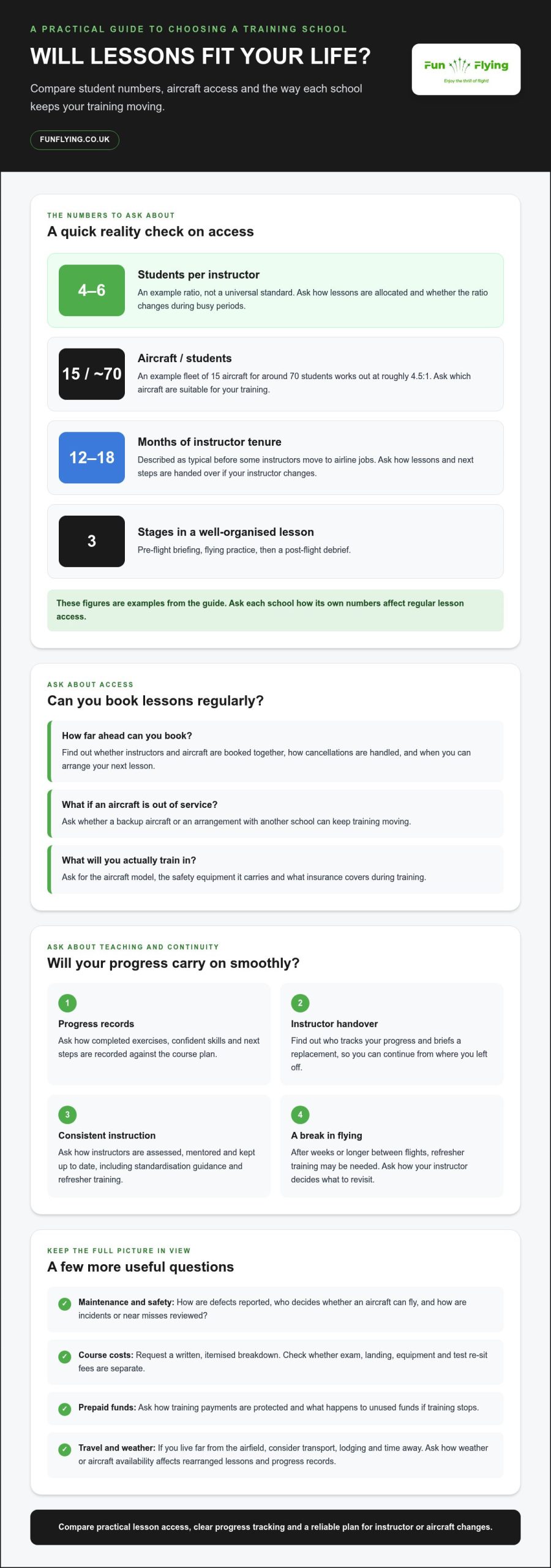
  • Ask how long instructors tend to stay and how handovers work. Instructor tenure of 12 to 18 months is described as typical before some move to airline jobs. Ask how the school records lessons, skills and next steps, and who briefs a replacement instructor.
  • Ask for outcomes and realistic timelines for your chosen course. Request the first-time pass rate for relevant UK skill tests, practical assessments of flying ability, and ask how it’s calculated. Ask for the average completion time rather than relying on the best-case estimate. If you hope to advance a flying career, ask which qualifications the course supports.
  • Ask how instructors’ experience fits your goals. Explain where you hope to be in 5 years, then ask how their teaching experience relates to that ambition. Their answer can show whether they understand your priorities, whether you’re learning for recreation or a career.
  • Ask for a written breakdown before discussing finance. Separate course charges from any exam, landing, equipment or test re-sit costs, then compare loan interest, repayment dates and total repayment. Ask how prepaid training funds are protected, and read the terms before paying.

These questions help you judge teaching quality, continuity and course fit. For a closer look at the training pathway, explore learning to fly in a microlight.

Student-to-aircraft and student-to-instructor ratios

Ask how many students each instructor teaches and how many training aircraft are available. This helps you understand how lessons are scheduled and whether you can book regularly.

  • Ask for the current student-to-instructor ratio. Around 4-6 students per instructor is an example, not a universal standard. Ask how the school allocates lessons and whether the ratio changes during busy periods.
  • Ask how many aircraft are available to active students. A useful illustration is 15 aircraft for around 70 students, a ratio of roughly 4.5:1. Ask which aircraft are suitable for your training, rather than relying on the fleet total alone.
  • Ask how far ahead you can book and how availability is managed. Find out whether instructors and aircraft are booked together, and how cancellations affect your next lesson. A booking process can matter as much as the headline fleet size.
  • Ask what happens if an aircraft is out of service for an extended period. Ask whether a backup aircraft or an arrangement with another school can keep training moving. A clear plan helps you understand how maintenance downtime could affect lesson continuity.
  • Ask which aircraft you’ll train in, what safety equipment it carries, and what insurance covers during training. Get the aircraft model and the relevant equipment and cover explained in plain language, so you know what applies to your lessons.
  • Ask how maintenance and safety are monitored. Find out how defects are reported, who decides whether an aircraft can fly, and how incidents or near misses are reviewed. Those steps show how safety information informs day-to-day decisions.

Use the answers to compare practical access, not just fleet size. If you’re exploring microlight training, the learn-to-fly information can help you understand the training pathway.

How Is Training Consistently Maintained?

A well-organised flight lesson has three stages: a pre-flight briefing, flying practice and a post-flight debrief. Ask how your instructor records progress against the course plan, identifies what to practise next and adapts the next lesson if you need more time.

  • Request a complete, itemised course breakdown. Ask which charges cover instruction and aircraft use, and whether exam fees, landing fees, equipment or test re-sits are separate. A written list makes it easier to plan the full commitment and compare like with like.
  • Ask how prepaid training funds are protected. Find out whether payments are held in a separate client account, meaning an account kept apart from the school’s everyday business funds, or covered by an insurance policy. Ask what happens to unused funds if training stops. Clear terms help you understand the arrangement before paying.
  • Ask how the school measures progress. A standard syllabus is a shared course plan that sets out the ground and flight skills students work through. Written records can show which exercises you’ve completed, where you’re confident, and what needs more practice. Ask how often your instructor reviews these records with you, rather than relying on memory between lessons.
  • Ask what happens after a break in flying. Students who go weeks or longer between training flights often need refresher training, which can increase training cost and completion time. Ask how the instructor decides what to revisit before you resume new exercises.

If you live far from the airfield, travel and accommodation may also affect your training plan. Ask whether lessons can be arranged to suit your travel, then factor in transport, lodging and time away from home. These costs depend on your circumstances, so include them in your own budget rather than considering flight fees alone.

Ask how weather changes or aircraft availability affect lesson continuity. A clear process for rearranging a session, updating your progress record and agreeing on the next practice goal helps you return with a plan.

Questions to Ask a Flight Instructor About Training Quality

Student-to-instructor ratios and lesson scheduling

A ratio gives useful context, but your timetable shows whether instruction is accessible in practice. Around 4-6 students per instructor is an example to discuss, not a rule. Ask how many students are actively flying, how teaching time is divided, and whether the figure changes during busy periods.

Map out a typical booking cycle. Ask how far ahead you can reserve a lesson, how bookings are made and how often suitable slots are available. If you can fly only around work shifts or an airline roster, explain those limits and ask how scheduling works. Understanding the process from the start makes regular lessons easier to plan.

For lesson length, cancellations, weather and rescheduling, ask what a standard session includes, how much notice you need to give to cancel, and whether weather-related changes follow a different process. Find out who contacts you, how a replacement slot is arranged and whether any cancellation charge applies. Get clear answers before you commit to a booking.

  • Ask how many students each instructor currently teaches. This helps you understand whether your preferred lesson times compete with other students’ bookings.
  • Ask how lessons are distributed across the instructor’s timetable. A clear process shows how regular training fits around other commitments.
  • Ask how open slots are shared when plans change. Knowing whether you can rebook with the same instructor helps you plan around work, study or family responsibilities.
  • Ask how the school handles weather decisions. Find out when you’ll hear whether a lesson can proceed and how you’ll arrange another session if conditions prevent flying.
  • Ask how progress is managed if scheduling causes a long gap. Agree what to review at your next lesson, so you can return with a useful focus.

Clear answers help you compare how instruction is organised, rather than relying on a headline student-to-instructor ratio. A workable schedule can make it easier to keep progressing towards your flying goals.

Explore microlight flight training

Fun Flying Aviation: Experience Flights

Fun Flying Aviation Ltd offers experience flights for anyone who wants to discover microlight flying before choosing a training path. It’s a practical first step if you’re curious about flying but not ready to commit to lessons.

If you’re ready to build towards a licence, microlight licence training and Ground School provide a route into both flying and the knowledge behind it. The school’s hands-on approach means students take control of the aircraft from their first lesson. Trial Flights are another way to explore the experience and decide whether you’d like to advance further.

You now have practical points to discuss, from instructor support to lesson availability. Contact Fun Flying Aviation Ltd to talk about training or book an experience flight, or visit FunFlying.co.uk.

Take your next step towards the cockpit

Use your first conversation to see whether you feel listened to and comfortable asking follow-up questions. The best questions to ask a flight instructor help you picture what learning with them would be like, not simply compare answers on a page. Notice whether explanations make sense and whether you feel able to speak up.

Before you book, write down what you hope to gain from flying and what might make training difficult to fit around your life. Bring those priorities into the conversation. A clear picture of your goals can help you decide whether to start training or explore flying at your own pace.

Explore microlight flight training

Your flying journey can start with a conversation. Stay curious, choose a next step that feels right, and discover what’s possible.

Frequently Asked Questions

Are your airplanes owned or leased?

A flying school may own or lease its aircraft, and either arrangement can support training. Ask which aircraft you’ll use and what arrangements are in place if it becomes unavailable. Ownership alone doesn’t tell you whether an aircraft suits your training. The model, its role in your course and the school’s plans for maintaining lesson continuity matter too.

Do you require payment for the entire cost of training upfront?

Payment arrangements vary between flying schools. Ask whether you can pay as training progresses or need to pay for a block in advance, and get the schedule in writing. Check what happens to payment for lessons you haven’t used if you pause training. Read the terms, including how unused funds are handled, before paying.

How proficient is your flight instructor?

Notice how the instructor explains tasks, responds to your questions and adapts their teaching when something isn’t clear. Ask about their experience teaching the type of aircraft you’ll fly and how they keep their aviation knowledge current. A clear explanation of what you’ll practise, why it matters and how you’ll know you’re ready to move on can help you assess their approach.

What if I decide to quit during my training, how much will I get back?

Refunds depend on the payment terms and training already completed, so ask for the method to be explained in writing before you commit. Find out how unused prepaid lessons, non-refundable charges and previous cancellations are handled. Ask for a sample calculation based on your proposed payment plan to understand the financial implications of stopping part-way through.

What questions should you ask a flight instructor before your first lesson?

Ask what to bring, what the session involves and how to prepare. You might ask, “What will I be expected to do in the aircraft?” and “How should I tell you if I’m unsure?” Discuss what you hope to learn, too. These questions to ask a flight instructor help set expectations and make it easier to take part confidently.

What qualifications and ratings should a UK flight instructor hold?

For UK microlight training, ask to see the instructor’s current qualification and privileges for teaching on the aircraft you’ll use. Ask which training or skill-test stages they’re authorised to teach and whether their experience matches your course. The school should explain their qualification in plain English, so you understand who will teach you and what their role covers.

Marce Colucci

Article by

Marce Colucci

Love to fly, and more importantly, love teaching others to fly.

ULM Plane: What It Is and How to Start Flying in the UK

ULM Plane: What It Is and How to Start Flying in the UK

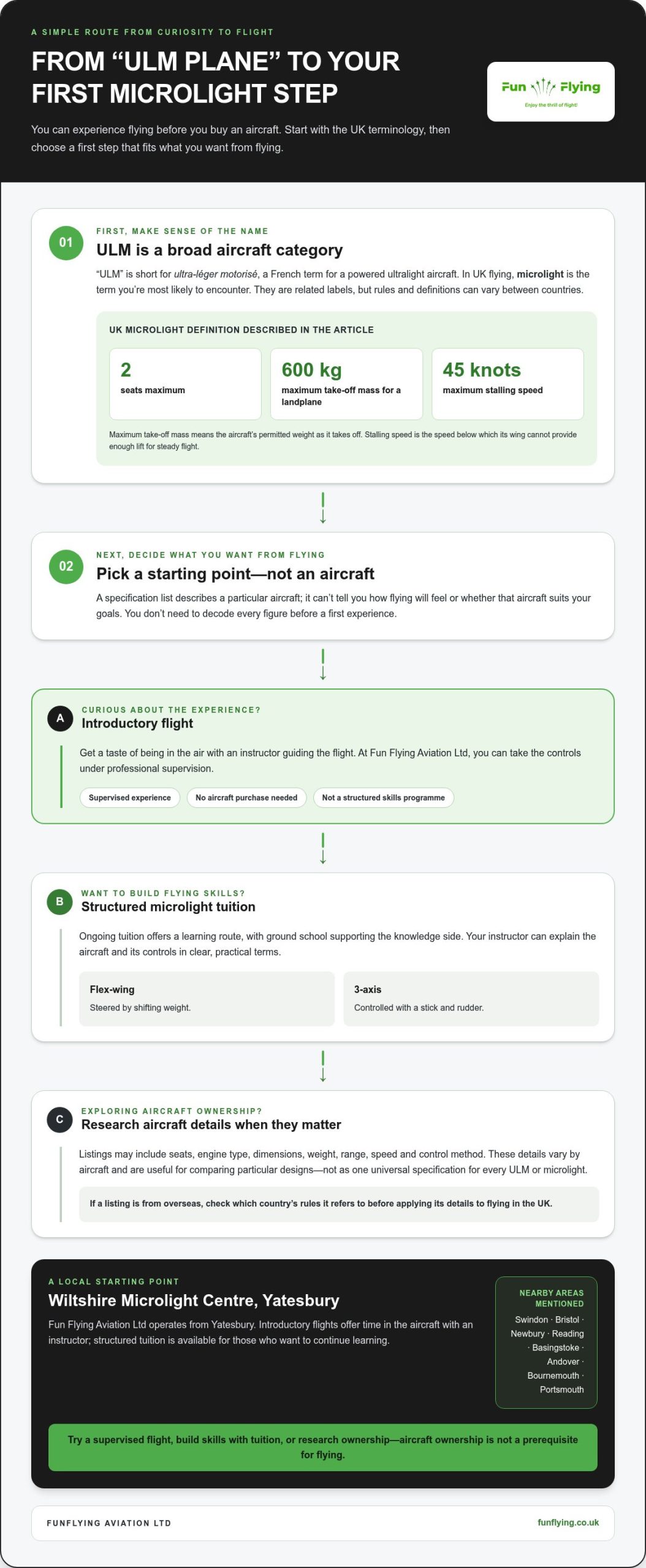
What if your first step towards flying a ulm plane didn’t involve buying one? If you’ve come across “ULM” in European aviation, you may be wondering what it means and whether it’s different from a microlight. In the UK, microlight is the term you’ll hear most often. You don’t need to own an aircraft to experience flying one.

This guide explains the term in plain English and shows you what to consider before choosing an introductory flight or training. A supervised experience can let you take the controls and discover how flying feels. If the view from above sparks a bigger ambition, structured microlight tuition and ground school can help you explore what comes next. We’ll also introduce a local starting point at Fun Flying Aviation Ltd in Yatesbury. You can begin with a first experience, not a plane of your own.

Key Takeaways

  • Understand why “ULM plane” is used in some countries, while “microlight” is the familiar term in UK flying.
  • Learn how to make sense of aircraft descriptions without getting bogged down in specifications you don’t yet need.
  • Compare a trial flight, ongoing tuition and aircraft research to decide which first step suits your goals.
  • Explore how supervised flying and structured lessons at Yatesbury can help you discover whether microlight flying is for you.

What Is a ULM Plane? A Clear Starting Point for UK Readers

ULM is short for ultra-léger motorisé, a French term for a powered ultralight aircraft. The label is used in parts of Europe, but aircraft terminology and rules vary between countries. In the UK, the Civil Aviation Authority (CAA) uses microlight as the practical term for this category. Its current definition includes aircraft with no more than two seats, a maximum take-off mass of up to 600kg for a landplane, and a stalling speed of no more than 45 knots. Maximum take-off mass means the aircraft’s total permitted weight as it takes off. Stalling speed is the speed below which its wing can no longer provide enough lift for steady flight.

A ULM plane is a broad category of lightweight powered aircraft, not the name of one particular aircraft model or brand. This distinction helps make sense of online listings. A listing may use “ULM” to describe a category, while the aircraft itself has its own make and model. For wider context on how the terminology is used internationally, see this Ultralight aviation (microlight) definition.

Does ULM Mean the Same Thing as Microlight?

Not always. Countries use different terms and apply their own rules. “ULM” is common in some European contexts, whilst “microlight” is the term you’re most likely to encounter in UK flying. Treat the words as related labels, not proof that aircraft definitions or requirements are identical across borders. If you’re reading an overseas listing, check which country’s rules it refers to before applying its details to flying in the UK.

Why ULM Plane Listings Can Feel Technical

Aircraft listings often include details such as seating, engine type and other specifications to help readers compare particular aircraft. These details describe individual designs; they aren’t a beginner’s checklist for deciding whether to try flying. You don’t need to decode every figure before booking a first experience flight. Start by understanding the broad category, then explore aircraft-specific questions when they’re relevant to your plans.

How ULM Planes Are Described, and What Beginners Actually Need to Know

Aircraft listings can look like a wall of unfamiliar terms. You may see fields for seats, engine details, dimensions, weight, range or speed, alongside descriptions of how the aircraft is controlled. These details help you compare particular aircraft, but they aren’t a universal specification that applies to every ULM plane.

Which Aircraft Details Matter Before a First Flight?

Start with what you want to do. For an introductory flight, focus on the experience rather than comparing technical figures. If you’re considering lessons, the control layout may be useful to understand: a flex-wing aircraft is steered by shifting weight, while a 3-axis aircraft is controlled with a stick and rudder. Your instructor can explain the aircraft used for your flight or tuition in clear, practical terms.

If you’re researching ownership, aircraft details matter more, but their relevance depends on the aircraft and how you intend to use it. A specification list alone can’t tell you what a beginner’s flying experience will feel like, or whether a particular aircraft suits your goals. Appropriate instruction and hands-on experience are a more useful starting point than comparing figures in isolation.

Why a ULM Plane Does Not Have One Universal Specification

Aircraft directories use different filters because they cover different designs and record different kinds of information. One listing might foreground the number of seats or engine type; another may include dimensions, weight, range or speed. Those fields describe a specific aircraft, but they don’t mean every aircraft shares the same layout or capabilities. Avoid treating one figure as a rule for the whole category.

Curious to move from browsing to learning? Explore how to learn to fly and consider which first step fits you: an introductory experience or structured tuition.

Do you need to own a microlight to try flying one?

No. You can experience microlight flying without buying an aircraft or committing to a course. A supervised introductory flight lets you experience being in the air, with an instructor guiding the flight. At Fun Flying Aviation Ltd, you can also take the controls under professional supervision.

A supervised experience flight gives you a taste of flying; aircraft ownership is a separate decision, not a prerequisite. Independent aircraft research is useful if you’re exploring ownership, but it’s different from getting airborne. You can discover whether flying appeals to you first, then decide whether you want to learn more.

Trial Flight or Pilot Training: Which Is the Better First Step?

Choose a trial flight if you’re curious about the feeling of flight and want to see how it suits you. It’s an introduction, rather than a structured programme for building skills. If you already know you want to develop as a pilot, ongoing microlight tuition offers a learning route, with ground school supporting the knowledge side. You don’t have to decide on aircraft ownership before taking either step.

A Local First Flight at Yatesbury

Fun Flying Aviation Ltd operates from the Wiltshire Microlight Centre in Yatesbury, a local starting point for people in Swindon and the surrounding area. It also serves as a practical option for people travelling from Bristol, Newbury, Reading, Basingstoke, Andover, Bournemouth and Portsmouth. An introductory flight gives you time in the aircraft with an instructor, while structured tuition is there for those who want to continue learning. The right starting point depends on your aim: enjoy a first flight, or begin building skills.

Ready to explore your next step? Explore microlight flying lessons.

ULM Plane: What It Is and How to Start Flying in the UK

From ULM Plane Curiosity to Your First Microlight Lesson

Once the term makes sense, the next step is about what you want from flying, not choosing an aircraft. Your interest in a ulm plane might lead to a one-off experience or the start of learning to fly. Either is a practical place to begin, and you can decide at your own pace.

  1. Want to experience flying? Choose an introductory flight to discover what being in the air is like.
  2. Ready to build skills? Explore structured microlight tuition, with ground school to support your learning on the ground.

At Fun Flying Aviation Ltd, lessons combine practical instruction with a hands-on approach, and scheduling can be flexible. Your pace and next steps are individual, so there’s no need to map out the whole journey before you start.

What Happens After an Introductory Flight?

If the experience leaves you wanting to learn more, you can consider moving on to structured microlight tuition. Ground school forms part of that learning pathway, building the knowledge that sits alongside practical flying. An introductory flight can help you decide whether you’d like to explore this further; it doesn’t commit you to training or guarantee a particular outcome.

Explore Microlight Training in Wiltshire

The Wiltshire Microlight Centre in Yatesbury is Fun Flying Aviation Ltd’s base for introductory flights and microlight training. It offers a local starting point for either option: experience a flight first, or look into a more structured learning route. Instructors guide the practical side, while tuition and ground school support those who want to develop their skills over time.

Ready to take your next step? Explore microlight flight training.

Let Your Curiosity Take Flight

Curiosity can be the beginning of something exciting. Before choosing your next step, think about what draws you to flying: the feeling of being in the air, the chance to learn a hands-on skill, or seeing the landscape from a new perspective. Your answer can help you choose an experience that feels right, without needing to decide how far you’ll take your interest.

If reading about a ulm plane has sparked a wish to do more than browse, let that interest lead to a practical next step. Explore what learning to fly involves and see which option fits your ambitions. There’s no need to have every detail figured out before you begin. A little curiosity is a fine place to start.

Explore microlight flight training

Your first step could open up a whole new view. Enjoy finding out where it takes you.

Frequently Asked Questions

What does ULM mean in aviation?

ULM stands for ultra-léger motorisé, French for a powered ultralight aircraft. It’s a term you may encounter in European aircraft articles or listings, where it identifies the broad type of flying being discussed. If you’re reading about flying in Britain, look for the word “microlight” too, as that’s the term commonly used in the UK.

Is a ULM plane the same as a microlight in the UK?

They’re closely related terms, but don’t assume they mean an identical regulatory category in every country. “ULM” is used in some European contexts; UK aviation uses “microlight” for the relevant aircraft category. If a ULM plane listing catches your eye, use “microlight” when looking for UK flying experiences or tuition, and read overseas descriptions in their own national context.

Can I fly a ULM plane without owning one?

Yes. You can book an introductory experience flight without buying an aircraft. A professional instructor supervises the flight, and at Fun Flying Aviation Ltd you can take the controls under that supervision. If you’re curious about handling an aircraft but aren’t ready to commit to lessons, an experience flight lets you try that aspect before deciding whether you’d like to pursue training.

Do I need a licence to fly a microlight in the UK?

Yes, to fly a microlight as a pilot in the UK, you need a National Private Pilot’s Licence (NPPL) with a Microlight Class Rating. This rating is the part of the licence that authorises you to fly microlight aircraft. That’s different from taking the controls during an instructor-supervised experience flight. Ground school, or classroom-based study, supports practical training.

Where can I try flying a microlight near Swindon?

Fun Flying Aviation Ltd offers introductory flights from the Wiltshire Microlight Centre in Yatesbury, a local option for people travelling from Swindon. The centre is also a local starting point for people coming from Bristol, Newbury, Reading, Basingstoke, Andover, Bournemouth and Portsmouth. On an introductory flight, you can experience microlight flying with an instructor and get a feel for whether you’d like to learn more.

Marce Colucci

Article by

Marce Colucci

Love to fly, and more importantly, love teaching others to fly.

What to Expect on a Trial Flight: Your First Microlight Flight

What to Expect on a Trial Flight: Your First Microlight Flight

What if your first microlight flight could be more than a scenic trip, without committing you to a full course? It’s natural to wonder what to expect on a trial flight, especially if you’ve never taken the controls of an aircraft before. You’ll be guided by an instructor and can take part at your own pace.

From arriving at Fun Flying Aviation Ltd to returning to the ground, this article walks you through how an introductory flight unfolds. You’ll find out what the briefing is for, what you might notice in the air and how your instructor supports you if you try the controls under professional supervision.

A trial flight is a chance to enjoy the view and get a real feel for flying, with no pressure to sign up for training. If you land wanting to learn more, it can also help you decide whether microlight licence training and ground school could be your next adventure.

Key Takeaways

  • Understand what to expect on a trial flight, including how the briefing helps you get familiar with the experience.
  • Find out how you can try the controls with your instructor’s professional supervision.
  • Get practical pointers for handling first-flight nerves, including listening closely and asking questions.
  • See how a flight from Yatesbury can be a memorable one-off or help you decide whether to explore microlight training.

What to expect on a trial flight: a guided first taste of flying

If you’re wondering what to expect on a trial flight, picture an introduction to flying with an instructor beside you, guiding the experience from the ground into the air. With Fun Flying Aviation Ltd, you can try the controls under professional supervision, so you’re not just watching the view pass by. Your instructor will guide you as you discover what being at the controls feels like.

A microlight trial flight is an instructor-guided flying experience, not a completed pilot course. It gives you a first-hand taste of being airborne and a chance to explore your curiosity, without committing you to structured training. The term “microlight” is used in different ways around the world; What is Ultralight Aviation? offers a wider overview of the category and its international variations.

Is a trial flight a lesson or an experience flight?

It’s a little of both, but its main purpose is to let you experience flying. Your instructor explains what’s happening and gives you the opportunity to take part. That makes the flight more hands-on than simply sitting back for a scenic outing, while keeping the focus on a first taste rather than a full programme of instruction.

One flight isn’t the same as learning to fly. Structured microlight training builds skills over time, with ground school to support your learning. If the experience leaves you keen to continue, you can explore microlight flight training as a separate next step.

Who is the first flight designed to reassure?

It’s for curious newcomers who want to find out how flying feels before deciding what comes next. You don’t need aviation knowledge or to know all the right words. Your instructor will guide you through the experience, explain things in an approachable way and help you make sense of what you’re seeing and doing. Bring your curiosity, and take the experience at your own pace.

From briefing to landing: how a microlight trial flight unfolds

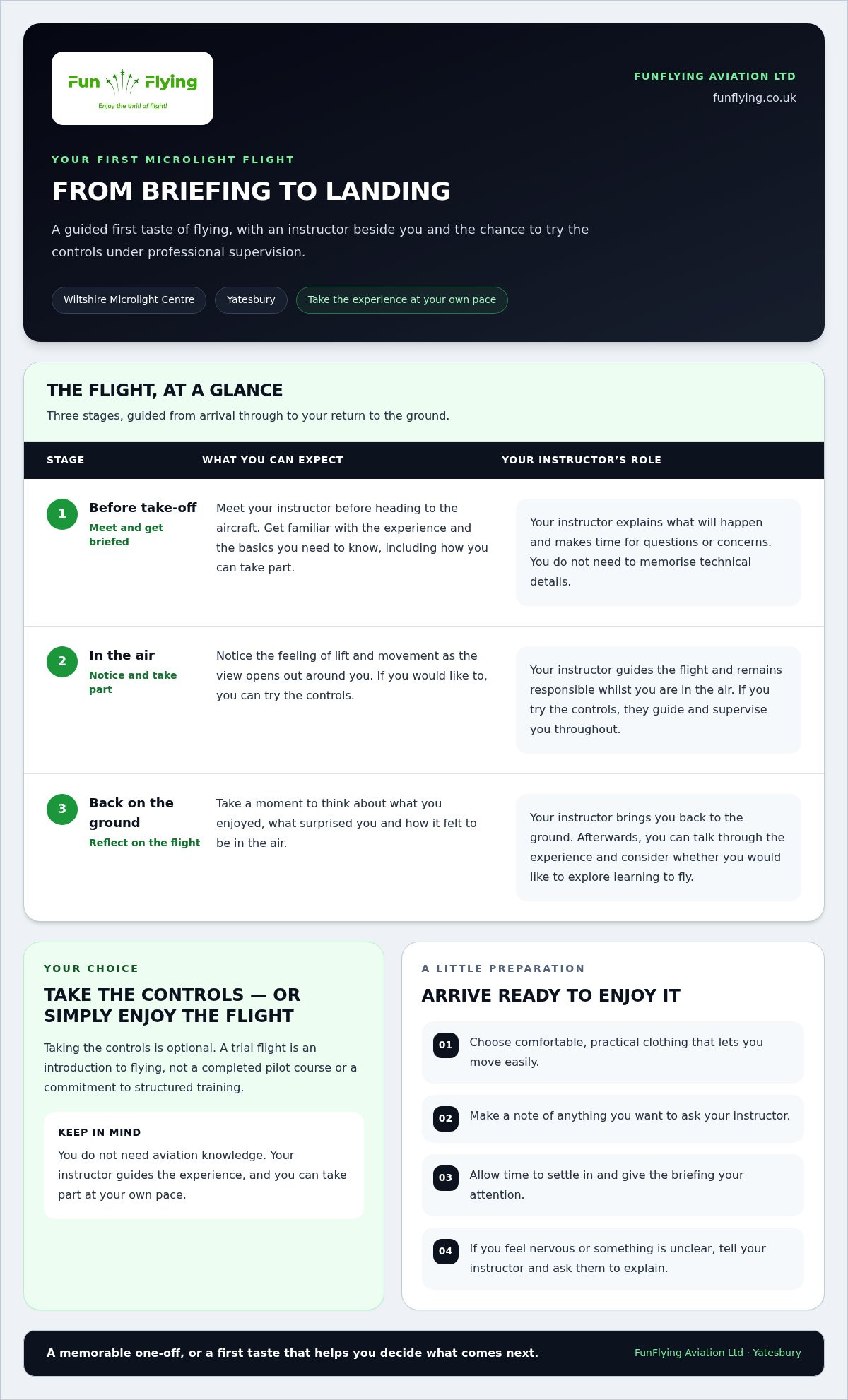
Your first flight follows a clear progression, with your instructor guiding you from arrival through to landing. The briefing helps you get oriented, understand what will happen and ask about anything that’s on your mind. You don’t need to memorise technical details. Focus on listening, and speak up if something isn’t clear.

Meet your instructor, talk through the basics, fly with their guidance, then return to the ground and share your thoughts.

Before take-off: meeting the instructor and getting briefed

At the Wiltshire Microlight Centre, you’ll meet an instructor from Fun Flying Aviation Ltd before heading to the aircraft. They’ll explain the experience and introduce the basics you need to know, including how you can take part during the flight. Use this time to raise questions or concerns, whether you’re unsure about the controls or simply want to know what happens next. UK microlight information is also available from the British Microlight Aircraft Association.

In the air and back on the ground

Once airborne, the sensation can be a striking change from looking up at aircraft on the ground. Notice the feeling of lift and movement, and take in how the view opens out around you. Your instructor guides the flight and remains responsible while you’re in the air. If you’d like to try the controls, you can do so under their professional supervision, with guidance throughout.

As the flight comes to an end, your instructor brings you back to the ground. Afterwards, take a moment to talk about what you enjoyed, what surprised you and whether flying has sparked a bigger interest. If you want to build on the experience, you can explore structured microlight flight training at your own pace.

Feeling nervous? How to prepare for your first microlight flight

It’s completely understandable to feel a flutter of nerves before trying something new, especially when it involves flying. You don’t have to pretend you’re calm or arrive knowing what to do. The briefing is there to help you get comfortable with the experience, and you can speak up whenever something feels unclear.

Your instructor guides and supervises you throughout your participation in the flight.

What if you feel nervous about taking the controls?

Tell your instructor how you’re feeling before the flight, even if you’re not sure what’s making you anxious. Taking the controls is optional. If you choose to try them, your instructor will guide and supervise you. Listen to their instructions and ask them to explain anything you’re unsure about. There’s no need to master everything at once. Focus on one instruction at a time and let your instructor lead the way.

Simple ways to arrive ready

A little preparation can help you feel more settled and ready to enjoy the experience. Allow yourself time to arrive without rushing, so you can meet your instructor and give the briefing your attention. If you’re thinking about what to expect on a trial flight, remember that asking questions is part of getting ready, not a sign that you’re unprepared.

  • Choose comfortable, practical clothing that lets you move easily.
  • Make a note of any questions you want to raise with your instructor.
  • Give yourself a moment to settle in and take in the briefing before the flight.

Keep it simple. You don’t need special flying knowledge to make the most of your first experience. Arrive curious, listen closely and ask your instructor to explain something again if needed. That way, you can focus on discovering how it feels to be in the air, at a pace that feels manageable to you.

Explore microlight training

What to Expect on a Trial Flight: Your First Microlight Flight

Flying from Yatesbury: make your trial flight a first step or a one-off

Fun Flying Aviation Ltd operates from the Wiltshire Microlight Centre in Yatesbury, welcoming curious would-be flyers from across the region. If you’re travelling from Swindon, Bristol, Newbury, Reading, Basingstoke, Andover, Bournemouth or Portsmouth, Yatesbury is the local base for your introductory microlight flight. You might come simply to enjoy the experience and see what it’s like to be in the air. Or the flight might leave you wondering what it takes to learn to fly. Either way, you can enjoy it without pressure to make a bigger commitment.

What happens if the flight sparks an interest in learning?

A trial flight offers an introduction, while structured microlight lessons and ground school give you a way to keep developing your knowledge and skills. They serve different purposes: one lets you sample flying, while the other is a learning journey that builds over time. If you’re curious about that next step, you can explore how to become a microlight pilot. There’s no need to decide before your first experience. If your interest grows, you can explore learning to fly with Fun Flying Aviation Ltd.

A local introduction to flying at Yatesbury

For those in Swindon and across the wider region, Yatesbury is where you can begin your microlight experience with Fun Flying Aviation Ltd. The Wiltshire Microlight Centre gives your first flight a clear local setting, whether you’re treating it as a special day out or the start of a new interest. After landing, take time to reflect on what you enjoyed and whether you’d like to find out more about training.

Imagine looking back on your first flight as the moment a new interest took off. Whatever you decide, let your curiosity set the pace.

Ready to see where flying could take you?

Knowing what to expect on a trial flight can help you focus less on the unknown and more on the feeling of being up in the air. Afterwards, think about what surprised you, what you enjoyed and whether the experience left you curious to learn more. There’s no wrong answer. A first flight can be a brilliant day out in its own right, or the beginning of a new ambition.

If the idea of building your skills is starting to take shape, explore the learning pathway at your own pace. Find out what microlight training involves and consider whether it feels like the right next adventure. You don’t need to make every decision straight away. Let the experience settle, then follow the curiosity it sparks.

Explore learning to fly with Fun Flying Aviation Ltd

Whether you’re ready to take another step or simply want to savour the memory, let curiosity lead. The sky may feel closer than you imagined.

Frequently Asked Questions

Can I buy a microlight trial flight as a gift?

Yes, FunFlying offers introductory experience flight vouchers for someone curious about aviation. The recipient can enjoy being in a microlight with an instructor and may try the controls under professional supervision. It’s an experience to look forward to, rather than a promise of a particular date, flight length or route. It could suit an aviation enthusiast in Swindon, Bristol, Newbury, Reading, Basingstoke, Andover, Bournemouth or Portsmouth.

Does a trial flight include ground school?

No, ground school is part of structured microlight pilot training, rather than the trial flight itself. For the introductory experience, the instructor explains what you need to know for that flight. If it sparks an interest in learning, FunFlying offers ground school alongside microlight training. That gives you a separate way to build aviation knowledge as you explore whether pilot training is right for you.

How long does it take to become a microlight pilot after a trial flight?

There’s no single timetable to expect after a trial flight. It’s an introduction, not a set amount of training, and progressing involves structured lessons and ground school. FunFlying offers flexible training schedules, but the time it takes will depend on your own learning journey. You can use the first flight to decide whether you’d like to explore training, without needing to set a target date for becoming a pilot.

Is a microlight trial flight the same as travelling in a commercial aeroplane?

No. A microlight trial flight is a flying experience with an instructor, not transport between destinations. If you’re wondering what to expect on a trial flight, the key difference is that you’re there to experience flying itself, and you may take the controls under supervision. It’s a chance to engage with flying rather than simply travel from one place to another.

Can a trial flight be a one-off experience if I don’t want pilot training?

Yes, you can enjoy a trial flight as a one-off experience, with no expectation that you’ll go on to take lessons. You might come away with a memorable story and leave it there. Or, if you find yourself wanting to understand more about flying, microlight training and ground school are available as possible next steps. The choice is yours, before the flight and afterwards.

Marce Colucci

Article by

Marce Colucci

Love to fly, and more importantly, love teaching others to fly.

Microlight Training Near Andover: Find Your Route to the Sky

Microlight Training Near Andover: Find Your Route to the Sky

What if learning to fly could fit around your life, rather than take it over? If you’re looking for microlight training near Andover, you may be weighing up a few practical questions: is there a structured route towards a microlight licence, what does training involve, and can you fit lessons around work or family life?

Fun Flying Aviation Ltd provides structured microlight training from Yatesbury. For learners travelling from Andover, training brings together practical flying lessons and ground school. Instructors put students at the controls from their first lesson, and flexible scheduling, with operations six days a week, can help you plan around everyday commitments.

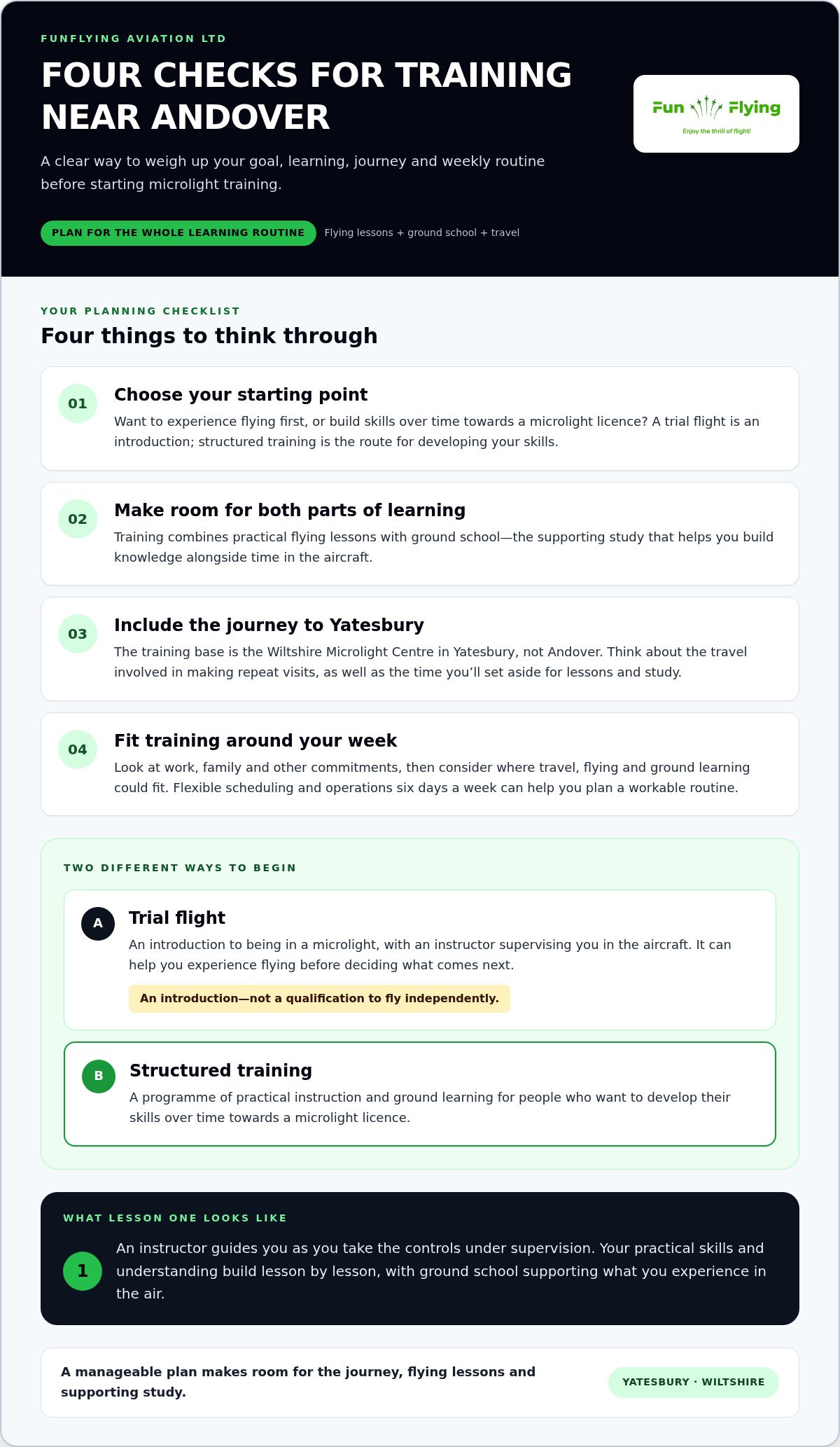
A trial flight can offer an introduction to microlighting, while training is for people who want to build their skills over time. This guide explains how flying lessons and ground school work together, what to consider when planning regular visits to Yatesbury, and how to choose a next step that suits your goals.

Key Takeaways

  • Choose structured microlight training if you want to develop your flying skills over time, rather than take only an experience flight.
  • Start with your goal: a first taste of flying and training towards a microlight licence are different ways to begin.
  • FunFlying’s training base is in Yatesbury, so include the journey from Andover in your plans for ongoing lessons.
  • Flying lessons and ground school both form part of the learning. Flexible scheduling can help you fit training around other commitments.

Microlight training near Andover: what the local option involves

Microlight training combines practical flying lessons with ground learning, the supporting study that helps you build your knowledge alongside time in the aircraft. An instructor guides you as you develop your skills over a series of lessons. That’s different from an experience flight, which is an introduction rather than a course of training. For background on the wider category, see Ultralight aviation (Microlight aviation).

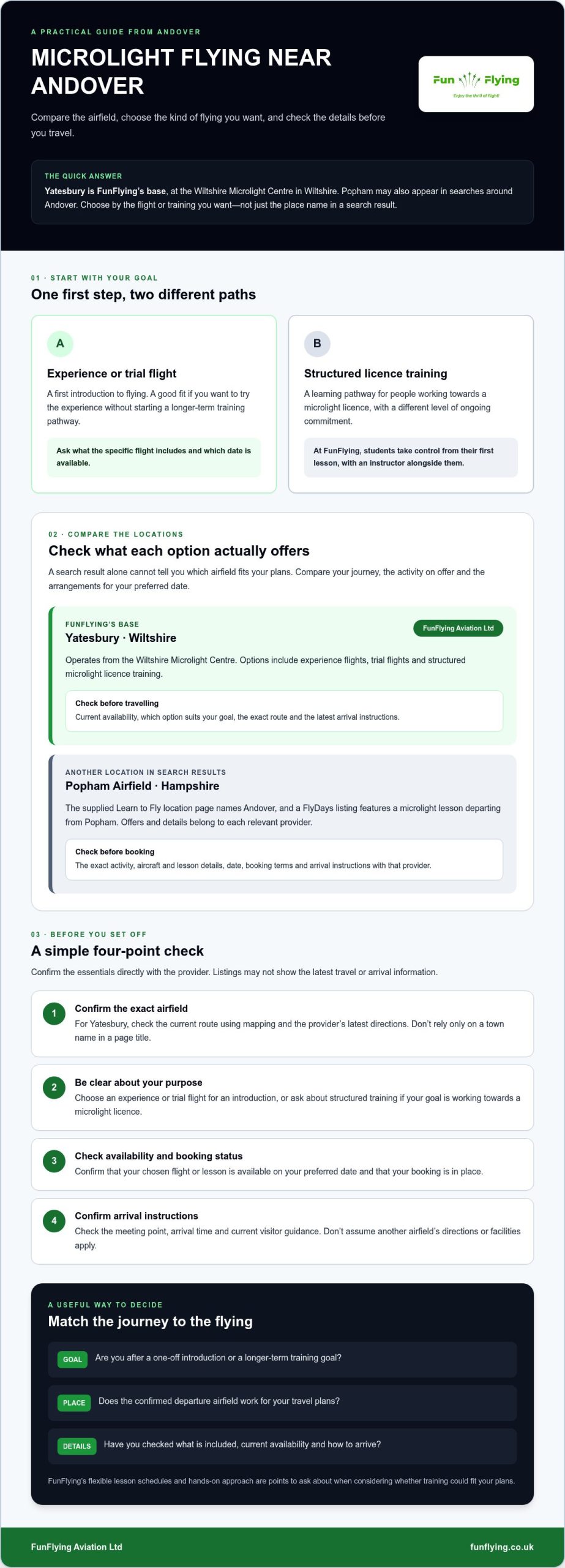
FunFlying Aviation Ltd teaches at the Wiltshire Microlight Centre in Yatesbury. The centre serves learners from Andover, although the training base is in Yatesbury rather than Andover itself. If you’re considering training, think about the journey as well as the time you can set aside for flying and ground school. A plan that works for regular visits is more useful than one based on a single trip.

Is Yatesbury a practical training base for Andover learners?

Yatesbury is where you’ll travel for training from Andover. Before you begin, consider how repeat visits could fit around work, family and other commitments. Include travel time in your weekly plan, alongside time for lessons and supporting study. You can explore the Wiltshire Microlight Centre guide to learning to fly to understand more about the training route and where it takes place.

Training or trial flight: which first step suits you?

A trial flight gives you an introduction to being in a microlight, with an instructor supervising you in the aircraft. It can suit you if you’re curious and want to experience the view and feel of flying before deciding what comes next. Structured training is for learners who want to develop their skills towards a microlight licence through practical instruction and ground learning. A trial flight is an introduction, not a qualification to fly independently. If you already know you want to learn over time, microlight training near Andover is the more direct route to explore.

What to expect from microlight lessons at Yatesbury

Your first lesson is hands-on. At Yatesbury, FunFlying Aviation Ltd’s professional instructors put students at the controls from lesson one and guide them as they begin to learn how the aircraft responds. You don’t need to arrive knowing specialist terms. Your instructor can explain unfamiliar language as it comes up, so you can focus on understanding each step.

Flying is only part of the learning. Ground school is the supporting study that helps you develop knowledge alongside practical experience in the aircraft. The British Microlight Aircraft Association (BMAA) also provides information about microlighting in the UK. Together, practical lessons and ground learning give you a structured way to build your understanding over time.

How flying lessons and ground school work together

Ground school gives context to what you experience in the air. As your practical flying develops, supporting study helps you make sense of the knowledge behind it. You don’t need to master everything before you start. Your skills and understanding build as training progresses. The pace varies, so approach training as a process rather than plan around a fixed completion date.

What happens in a first microlight lesson?

You’ll be introduced to flying with an instructor alongside you, and have the chance to take the controls under their supervision. It’s a practical way to discover what microlighting feels like while learning with professional guidance. To see how lessons and ground school fit into the wider route, explore microlight training.

Planning your routine matters, too. Flexible flight scheduling and operations six days a week can help you find a pattern that works around everyday commitments. If you’re travelling from Andover, consider how often you can make the journey and how training could fit alongside the rest of your week. Your learning develops lesson by lesson, so a workable routine is more useful than trying to predict an exact finish date.

Choosing microlight training near Andover: a practical decision guide

The best training plan is one you can keep up with. Before choosing microlight training near Andover, use these questions to compare your goals with the practical demands of learning:

  • Clarify your goal: do you want to try flying first, or are you ready to pursue structured lessons towards a microlight licence?
  • Understand the learning: plan for both flying instruction and ground school, the study that supports your practical learning.
  • Assess the location: FunFlying’s training base is in Yatesbury. Consider the time and travel involved in making repeat visits from Andover.
  • Plan your availability: look at your regular commitments and decide where lessons and ground learning could fit.

As you plan, think about the parts of your week you can realistically set aside for travel, flying and study. Flexible scheduling can help you organise training around everyday life, but your own availability will shape the routine that works. You don’t need to set a fixed pace or completion date before you start.

Questions to answer before committing to a training routine

Would you prefer to try flying first, begin training towards a licence, or take an experience flight before deciding? How often could you travel to Yatesbury, and where could ground learning fit into your week? A useful plan accounts for the journey as well as time in the aircraft and study. Thinking through those details can help you decide whether the training routine feels manageable alongside your other commitments.

How to judge whether the learning approach suits you

Consider whether you’d enjoy learning by doing. FunFlying’s instructors put students at the controls from the first lesson and provide professional guidance as they begin to develop practical skills. Ground school adds supporting knowledge, so your learning isn’t limited to what happens in the air. For a broader overview, read the microlight pilot learning guide.

Explore microlight training at Yatesbury

Microlight Training Near Andover: Find Your Route to the Sky

Start microlight training near Andover with a clear next step

If you want to develop microlight flying skills over time, structured lessons are the route to explore. FunFlying teaches learners from Andover at the Wiltshire Microlight Centre in Yatesbury. The key practical question is whether you can make the journey work as part of a regular routine.

From curious beginner to first lesson

You don’t need to have every detail worked out before taking a first step. Explore the training information and consider how flying instruction and ground school could fit together, as well as how you could plan visits around your other commitments. For more about the location, read the Wiltshire Microlight Centre guide. It explains where training takes place and gives you a clearer picture of the learning pathway, without requiring you to decide on a particular pace or completion date.

Take your next step towards the sky

At Yatesbury, professional instructors guide your practical learning, with students taking the controls from their first lesson. Ground school supports your time in the aircraft, while flexible scheduling and operations six days a week offer practical ways to plan training around everyday life. Focus on building your understanding and skills lesson by lesson, rather than racing towards a fixed timetable.

Curiosity can become a plan, one manageable step at a time. If you’re ready to explore what learning to fly involves, start with the training information.

Find out about learning to fly

Take your first step towards microlight flying

Choosing microlight training near Andover means looking beyond a first flight. If you want to build your skills over time, look for structured lessons that bring together practical flying and ground school. Then consider whether travelling to the training base can fit into your routine.

FunFlying teaches at the Wiltshire Microlight Centre in Yatesbury, serving learners from Andover and surrounding areas including Swindon, Bristol, Newbury, Reading, Basingstoke, Bournemouth and Portsmouth. Professional instructors guide students at the controls from their first lesson. Flexible scheduling and operations six days a week can help you plan training around everyday commitments, with progress developing lesson by lesson.

Ready to picture how the learning pathway could work for you? Explore FunFlying’s training information and take a clear first step towards the sky.

Explore microlight training

Your flying journey can start with a single curious step. Imagine where it could take you.

Frequently Asked Questions

Is there microlight training near Andover?

Yes. FunFlying provides microlight training for learners from Andover at the Wiltshire Microlight Centre in Yatesbury. The school also serves learners from Swindon, Bristol, Newbury, Reading, Basingstoke, Bournemouth and Portsmouth. Training combines instructor-led flying lessons with ground school, creating a structured route for people who want to build microlight skills over time.

Can a beginner start microlight training at Yatesbury?

Yes, beginners can start training at Yatesbury. Professional instructors put students at the controls from their first lesson and guide them as they begin to learn. You don’t need to arrive with flying experience or know specialist terms in advance. Ground school supports the practical lessons, helping you develop your knowledge alongside your flying skills.

What happens during a microlight training lesson?

You learn in the aircraft with a professional instructor supervising and guiding you. From your first lesson, you’ll have the opportunity to take the controls as you build practical skills. Lessons form part of a wider learning process, so your understanding develops over time. Your instructor can explain unfamiliar terms in clear, straightforward language as they arise.

Do microlight lessons include ground school?

Yes. Ground school is part of the training alongside flying lessons. It supports your learning as you gain practical experience in the aircraft. Flying gives you hands-on experience, while ground school helps you build knowledge alongside it. Together, the two elements provide a structured foundation as you develop your microlight skills.

How can I fit microlight training around work near Andover?

FunFlying offers flexible flight scheduling and operates six days a week, which can help you plan lessons around work and other commitments. Training takes place at Yatesbury, so include the journey from Andover when deciding what routine feels manageable. Make room for ground school as well as flying. Progress varies, so focus on a sustainable rhythm rather than a fixed finish date.

Marce Colucci

Article by

Marce Colucci

Love to fly, and more importantly, love teaching others to fly.

Microlight Flying Near Andover: Find Your Local Route to the Sky

Microlight Flying Near Andover: Find Your Local Route to the Sky

Could the nearest-looking airfield be the right place to start? If you’re searching for microlight flying near Andover, choosing where to fly is only part of the decision. You’ll also want to know what your first visit involves, how to confirm travel details, and whether you’re after a one-off flying experience or a route towards a pilot’s licence.

Yatesbury is an option to consider if you’re looking from Andover. Fun Flying Aviation Ltd offers experience and trial flights as well as structured microlight licence training, so you can choose a first step that fits your plans. This guide compares the options, explains what to check about directions and booking availability, and outlines the difference between an introductory flight and longer-term training. Students take control from their first lesson, with an instructor alongside them. Whether you’re travelling from Andover or comparing options from Basingstoke, Newbury, Reading, Swindon, Bristol, Bournemouth or Portsmouth, start by checking the exact airfield and the flight or training on offer.

Key Takeaways

  • For microlight flying near Andover, compare Yatesbury and Popham by the flight or training you want, not just the airfield name.
  • Before travelling, confirm the exact airfield, current availability and arrival instructions directly with the provider.
  • Decide whether you’re looking for a first-flight experience or a longer-term training goal to guide your enquiry.
  • Ask how FunFlying Aviation Ltd’s flexible lesson schedules and hands-on approach could fit your plans.

Looking for microlight flying near Andover? Start with the airfield

Searching for microlight flying near Andover can bring up listings for more than one airfield, including Popham. That doesn’t mean every option offers the same experience or training. To compare them, first decide whether you want an introductory flight or a longer-term flying goal. Then check the departure location, your travel plans and what each provider currently offers.

FunFlying Aviation Ltd provides microlight flights and training from the Wiltshire Microlight Centre in Yatesbury, Wiltshire. Andover is in Hampshire, so check the actual airfield location rather than relying on a town name in a page title. Confirm directions and arrival arrangements with the provider before setting off.

What does ‘near Andover’ mean when choosing a flying school?

“Near” is personal. Your starting point, transport plans and preferred type of flying all matter. A listing associated with Andover might refer to an airfield elsewhere, so look for the departure location and check that it suits your plans. If you’re new to the activity, a quick introduction to microlight aviation can also help you understand the kind of aircraft and flying being discussed.

Where does Fun Flying Aviation Ltd operate?

FunFlying Aviation Ltd operates from the Wiltshire Microlight Centre at Yatesbury, where it offers experience flights, trial flights and structured microlight licence training. That gives Andover-area searchers a specific location to assess, rather than a general area label. Yatesbury may suit your plans if the journey works for you and its flying options match what you’re looking for. Check current availability and travel details directly with the school before booking or travelling.

Popham or Yatesbury? Compare the details that matter

Both locations may appear in searches for microlight flying near Andover, but a search result isn’t enough to tell you which suits your plans. Popham Airfield is in Hampshire, and the supplied Learn to Fly location page names Andover. Yatesbury is FunFlying’s base. Don’t assume either is the better option based on a search result alone. Compare your journey, the activity on offer and the booking details for your preferred date.

Airfield Provider or listing Flight or training purpose Check before booking
Popham Airfield Learn to Fly page; FlyDays listing The FlyDays listing features a microlight lesson. Check each provider’s current offer. Exact activity, aircraft and lesson details, date, booking terms and arrival instructions.
Yatesbury FunFlying at the Wiltshire Microlight Centre Experience flights, trial flights and structured microlight licence training. Current availability, the right option for your goals and how to reach the airfield.

What the Popham listings tell Andover searchers

The supplied information connects Popham with Hampshire and names Andover on the Learn to Fly location page. FlyDays also lists an experience departing from Popham. Any aircraft, scenery or lesson details belong to that specific listing, not to FunFlying or its flights from Yatesbury. Check those details with the relevant provider before making plans.

How to compare Popham with Yatesbury fairly

Start with practicalities: your journey, preferred date, the type of flight or training you want, and the booking and arrival arrangements. Ask each provider what is included in the specific flight or lesson, then compare the options actually available to you. For background on UK microlight flying and its community, explore the British Microlight Aircraft Association.

If structured training at Yatesbury is on your shortlist, you can explore FunFlying’s microlight training and consider whether it fits your longer-term plans.

Plan your microlight flight near Andover with this simple checklist

A little checking before you travel can make your first flight feel more straightforward. Listings may not include the latest arrival details, so confirm the essentials directly with the provider, especially if you’re heading to Yatesbury.

  1. Confirm the airfield. Check the exact location for your booking. For Yatesbury, verify the route using current mapping and the provider’s latest directions.
  2. Be clear about your purpose. An experience or trial flight is an introduction to flying. Structured training is a learning pathway for people working towards a microlight licence, with a different level of ongoing commitment.
  3. Check availability and booking status. Make sure your chosen flight or lesson is available on your preferred date and that your booking is confirmed. Ask the provider if anything is unclear.
  4. Confirm arrival instructions. Check the meeting point, arrival time and any current visitor guidance before setting off. Don’t assume another airfield’s directions or facilities apply.

What should you confirm before travelling?

Travel details can change, so use current mapping alongside directions from the provider. Confirm the route, meeting point and arrival time directly with them, and check that your booking is in place. If a search result gives only a broad location, ask the provider to confirm the precise airfield and where to meet on arrival.

Are you looking for a taster flight or pilot training?

Choose an experience flight if you’d like an introduction before deciding whether to pursue flying further. Training is more structured and builds towards a licence. At FunFlying, students take control of the aircraft from their first lesson, with an instructor alongside them. If you’re weighing up that longer-term goal, read more about how to become a microlight pilot.

Explore microlight pilot training

Microlight Flying Near Andover: Find Your Local Route to the Sky

Take your first step with FunFlying at Yatesbury

Once you’ve matched the airfield to your plans, the next choice is whether you’d like to experience microlight flying or start learning to fly. For anyone exploring microlight flying near Andover, FunFlying offers both experience flights and structured microlight licence training from Yatesbury. If you’re unsure which suits you, ask about the options and current availability before making plans.

A first flight can be the beginning of more

An experience flight can introduce you to microlight flying without committing to a longer training pathway. If you decide you’d like to learn, FunFlying’s instructors take a hands-on approach: students take control of the aircraft from their first lesson, with an instructor alongside them. Flexible lesson schedules are available, so you can ask how the training could fit around your plans.

Choose a next step that fits your plans

Curious but not ready to commit to training? Enquire about FunFlying’s experience or trial flights, and confirm what’s currently available. If your aim is to work towards a microlight licence, structured training and ground school provide a longer-term route, with classroom learning supporting your flying lessons. You can explore how to become a microlight pilot to understand more about the training pathway.

Whether you’re starting with a flying experience or considering lessons, choose the next step that fits your plans and ask the school about the details before booking.

Explore microlight flight training with FunFlying

Make your next move towards the sky

Choosing microlight flying near Andover starts with matching the airfield to your travel plans, then deciding whether you want an introductory experience or a longer-term training goal. Check the location, current availability and arrival instructions directly with the provider before setting off.

FunFlying operates from the Wiltshire Microlight Centre in Yatesbury, offering experience flights and structured microlight licence training. For those who choose to learn, instructors take a hands-on approach, with students taking control from their first lesson under guidance. Flexible flight schedules and operations six days a week can help you explore how training might fit around your plans.

You don’t need to have every detail mapped out before you enquire. Start by telling FunFlying whether you’re interested in an experience flight or licence training, then ask about current availability and the next steps.

Explore microlight flight training with FunFlying

Frequently Asked Questions

Is there microlight flying near Andover?

Yes, you can explore microlight flying near Andover at more than one airfield. FunFlying offers experience flights and structured microlight training from the Wiltshire Microlight Centre in Yatesbury, whilst supplied listings also feature flights at Popham Airfield. FunFlying’s stated local focus includes Andover, Basingstoke, Newbury, Reading, Swindon, Bristol, Bournemouth and Portsmouth. Check each airfield’s location and current offer before choosing.

How far is the Wiltshire Microlight Centre in Yatesbury from Andover?

I can’t give you a verified distance or journey time from Andover to the Wiltshire Microlight Centre. The route and travel time can depend on your starting point and current road conditions, so check a current mapping service before travelling. Then confirm the latest directions and arrival instructions with FunFlying, using the centre’s exact location in Yatesbury rather than relying on a broad area label.

Can beginners take the controls during a microlight flight?

Yes, beginners can take the controls under professional supervision. FunFlying says students take control of the aircraft from their first training lesson, with an instructor guiding them. Its introductory experience flights also give participants the opportunity to take the controls under supervision. If this matters to you, ask the provider what’s included in the specific experience or lesson you’re considering, as arrangements may differ.

What is the difference between a microlight experience flight and pilot training?

An experience flight is an introduction to microlight flying, while pilot training is a structured learning pathway for people aiming to gain a microlight licence. FunFlying offers experience and trial flights, as well as licence training and ground school. Ground school means learning the theory that supports your flying lessons. If you’re unsure which fits your plans, ask about the options before enquiring.

What should I check before travelling to a microlight flying lesson?

Before setting off, confirm the exact airfield, your booking status, current availability, meeting point and arrival time with the provider. Ask for the latest directions and any visitor instructions, then check the route using current mapping. Don’t assume details listed for Popham apply to Yatesbury, or vice versa. If anything about the booking or arrival arrangements is unclear, contact the provider directly.

Marce Colucci

Article by

Marce Colucci

Love to fly, and more importantly, love teaching others to fly.

Microlight Flying Near Newbury: Your 2026 Guide to Taking the Controls

Microlight Flying Near Newbury: Your 2026 Guide to Taking the Controls

What if the only thing standing between you and the pilot’s seat is the mistaken belief that aviation is a hobby for someone else? You might assume that flying is an elite club reserved for the super-rich or those with a PhD in engineering. It is a common worry, but the reality is far more inclusive and exhilarating. Microlight flying near Newbury is actually one of the most accessible, cost-effective, and pure forms of flight available today. It is about the raw freedom of the clouds without the stuffy barriers or the intimidating price tags of traditional aviation.

In this guide, you will discover how to transition from a curious passenger to a confident pilot. We will demystify the different types of modern microlights, explain the clear path to earning your NPPL licence, and prepare you for the moment you finally take the controls. Whether you are seeking a one-off adventure or a lifelong passion, we’ll show you that the sky is not just for the elite. It is for you.

Key Takeaways

  • Experience the thrill of microlight flying near Newbury, where you’ll gain a breathtaking new perspective of the North Wessex Downs and local landmarks.
  • Master the distinctions between Three-Axis and Flexwing aircraft, ensuring you choose the right cockpit experience for your specific aviation goals.
  • Realise your dream of flight by taking the controls during your very first lesson, guided by experts who prioritise your hands-on learning.
  • Explore the structured path to gaining your pilot’s licence and see how a welcoming flying community makes the journey as enjoyable as the destination.

The Thrill of Microlight Flying Near Newbury: A Bird’s Eye View

Imagine leaving the bustling streets of Newbury behind and, within minutes, looking down at the world from a completely different angle. The rolling hills of the North Wessex Downs stretch out like a lush green tapestry beneath you. Microlight flying near Newbury isn’t just a hobby; it is an invitation to see West Berkshire and Wiltshire in a way that ground-dwellers never will. Whether you choose the wind-in-your-face excitement of an open cockpit or the sleek comfort of a closed one, the sensation of freedom is absolute.

What Makes the Newbury Airspace Special?

Flying in this region offers more than just pretty views. The local geography creates remarkably stable conditions, making it one of the most beginner-friendly spots in the UK. You’ll soar over iconic landmarks like Highclere Castle, better known as the real-life Downton Abbey, and the ancient, mystical circles of Avebury. Because much of this area is “uncontrolled airspace,” you aren’t restricted to rigid commercial flight paths. Instead, you and your instructor have the liberty to explore the sky, turning a flight into a bespoke aerial tour of ultralight and microlight aircraft capabilities.

A Short Journey to the Skies

You don’t need to travel hours to find this liberation. The Wiltshire Microlight Centre at Yatesbury serves as the go-to hub for residents in Newbury, Hungerford, and Thatcham. It’s a historic airfield with a vibrant, welcoming community that ditches the “elite-only” vibe for something far more inclusive. Operating six days a week, it fits perfectly around a busy lifestyle. It turns the dream of microlight flying near Newbury into a practical, local reality that’s just a short drive down the A4.

Understanding Your Aircraft: Three-Axis and Flexwing Explained

What exactly is a microlight? At its heart, it’s a lightweight, high-performance aircraft built for two people. These machines offer an intimate connection with the sky that larger planes simply cannot match. When exploring microlight flying near Newbury, you’ll find that these aircraft are no longer the rudimentary “puddle-jumpers” of the past. Today, they are sophisticated marvels that adhere to strict Civil Aviation Authority microlight regulations, including the modern 600kg weight limit classifications.

Which Flying Style Suits You?

Choosing the right aircraft is the first big decision when starting microlight flying near Newbury. You generally have two distinct flavours of aviation to choose from:

  • Three-Axis Microlights: These look and handle like traditional aeroplanes. You sit in a fully enclosed cabin, using a joystick and rudder pedals to control the craft. It is the perfect choice if you want the classic pilot experience with the added comfort of a heater.
  • Flexwing Microlights: Often called “trikes,” these use a hang-glider style wing. You steer by physically shifting the weight of the pod below. It is a raw, sensory, open-air adventure amongst the clouds.

Safety and Modern Engineering

It’s time to debunk the “lawnmower engine” myth. Modern microlights are powered by incredibly reliable Rotax engines, the same powerplants found in high-end recreational aircraft worldwide. Naturally, is microlight flying safe is the most common question we answer for beginners. The truth is that these aircraft are designed with immense structural integrity and stability. If you’re curious to feel the difference for yourself, you can explore our training options and see which cockpit feels like home.

Your First Lesson: What to Expect When You Take the Controls

Forget everything you think you know about being a passenger. When you book microlight flying near Newbury with us, the Fun Flying Aviation Ltd promise is simple: the best way to understand the sky is to feel it. From your very first outing, you’ll be encouraged to take an active role in the cockpit. It starts with a relaxed pre-flight briefing. We’ll walk around the aircraft together, explaining how the control surfaces work and what to expect once we leave the grass at Yatesbury.

The instructor handles the taxi and the initial take-off, allowing you to watch the precision required for departure. But once we reach a safe cruising altitude, the magic happens. “You have control,” the instructor will say. With your hands on the stick or bar, you’ll feel the aircraft respond to your slightest touch. It is a moment of pure, unadulterated empowerment as you soar over the Berkshire countryside.

Hands-On Learning from Day One

We believe in learning by doing. While theory is vital, nothing replaces the kinesthetic feedback of a banked turn or a steady climb. Don’t worry about making mistakes; our dual-control system ensures your instructor can shadow your movements and step in instantly if needed. This safety net allows you to explore your pilot skills with total peace of mind whilst you’re still finding your wings.

The Path to Your NPPL

Every minute you spend in the air during a trial lesson counts. These hours can be logged toward your National Private Pilot Licence (NPPL), which is the most affordable route into UK aviation. Following the syllabus set by the British Microlight Aircraft Association, we’ll guide you through the transition from novice to navigator. If you’ve ever wondered how to become a microlight pilot, this first lesson is your official starting line.

Book your first trial flight today

Microlight Flying Near Newbury: Your 2026 Guide to Taking the Controls

Starting Your Aviation Journey at the Wiltshire Microlight Centre

Yatesbury is far more than just a dedicated grass airstrip; it is a thriving community of passionate aviators. When you choose microlight flying near Newbury, you’re joining a group of enthusiasts who value the pure joy of flight. Based at the historic site of RAF Yatesbury, our centre provides the perfect backdrop for your training. We understand that your lifestyle in West Berkshire is likely a busy one. That’s why we operate six days a week, ensuring you can book lessons that fit around your personal commitments.

Our training options are designed to be as flexible as the aircraft themselves. Whether you prefer an intensive approach or want to progress through weekend lessons at your own pace, we adapt to you. Whilst the flying is the main event, mastering microlight ground school UK requirements is essential for building the confidence you need to fly solo. We ensure the technical side is just as engaging and accessible as the practical flight time.

From Experience Flights to Pilot Licences

Transitioning from a one-off trial flight to a structured syllabus is a natural progression at Yatesbury. We don’t just teach you to fly; we welcome you into the social fabric of the club. You’ll meet other local pilots, share stories after landing, and find a support network that makes the journey toward your NPPL truly memorable. It’s about more than just a qualification; it’s about joining a community that celebrates the freedom of the Wiltshire countryside.

Ready to Take Off?

Don’t let the dream of flight remain just a thought. Our team loves the sky and we want you to experience that same sense of liberation. There is no better time to start your journey and see the world from a new perspective. Stop wondering what it feels like and come find out for yourself.

Start your flying adventure near Newbury today!

Your Adventure Above the North Wessex Downs Awaits

The dream of flight is closer than you think. Microlight flying near Newbury offers a unique blend of adrenaline and serenity that stays with you long after you land. You don’t need years of technical training to begin; you just need the desire to look at the horizon differently. By choosing to take control of the aircraft on your very first lesson, you are not just a passenger. You are a pilot in training. With professional instruction at the historic Yatesbury airfield and flexible schedules to suit your lifestyle, your path to the NPPL is clear and welcoming.

Book your hands-on microlight flying lesson today

The sky is calling. It is time to swap the familiar roads of West Berkshire for the limitless freedom of the clouds. We can’t wait to see you in the pilot’s seat and help you experience the true meaning of autonomy. Your journey to becoming a pilot starts with a single, exhilarating take-off.

Frequently Asked Questions

Do I need any previous experience to try microlight flying near Newbury?

You don’t need any previous aviation experience to start microlight flying near Newbury. Our professional instructors specialise in taking you from a complete novice to a confident pilot. Because we prioritise a hands-on approach, you will actually take the controls and fly the aircraft during your very first outing. Whether you are a curious passenger or a future pilot, we provide all the guidance required to make your flight safe.

What should I wear for my first microlight flying lesson?

Comfort is key when you are in the cockpit. We recommend wearing practical, layered clothing to account for temperature changes at different altitudes. Sturdy, flat-soled shoes like trainers are essential for operating the rudder pedals safely. If you choose a flexwing flight, the sensation is brilliant, but you will need a windproof jacket and gloves to stay warm whilst soaring over the Wiltshire countryside. We provide the necessary headsets and flight suits.

Are there any age or weight restrictions for microlight passengers and students?

You can begin logging instructional flight time from the age of 14, though you must be 16 to fly solo and 17 to hold a licence. Regarding weight, microlights have strict maximum take-off mass limits under UK regulations. Weight restrictions vary depending on the specific aircraft and fuel requirements. It is always best to check with us beforehand so we can ensure the aircraft remains within safe balance limits for your flight.

What happens if the weather is poor on the day of my scheduled flight?

Aviation is entirely dependent on safe conditions, so we monitor the forecast closely. If the wind is too strong or visibility is poor, we will contact you to reschedule your session. Safety is our absolute priority, and we want your experience of microlight flying near Newbury to be enjoyable rather than a struggle against the elements. Your flight credit remains valid, and we will find a new slot that fits.

Can I use an introductory flight voucher as my first official pilot lesson?

Yes, every trial flight or experience voucher used with a certified instructor counts as official dual-instruction time. You will receive a pilot logbook where these minutes are recorded, forming the foundation of your training hours. This makes an introductory flight the perfect, low-pressure way to start your journey toward a National Private Pilot Licence (NPPL) without committing to a full course immediately. It is a practical, official first step into the sky.

Marce Colucci

Article by

Marce Colucci

Love to fly, and more importantly, love teaching others to fly.

Microlight Flight Training in Wiltshire: Your Complete Guide to Earning Your Wings

Microlight Flight Training in Wiltshire: Your Complete Guide to Earning Your Wings

What if the only thing standing between you and the open sky wasn’t a massive bank balance or a lifetime of study, but simply the courage to take the first step? For those seeking microlight flight training Wiltshire provides an incredible landscape to learn, yet many assume flying is reserved for the elite, whilst others feel lost amongst a sea of licensing jargon. You might worry that your 9-5 schedule won’t allow for such an adventure. It’s easier than you think. If you’ve ever felt a pull toward the clouds, you’re not alone in that desire for true freedom.

In this guide, you’ll discover how training at the historic Yatesbury airfield, near Swindon, Bristol, and Bath, can transform your dream into reality. We’ll show you how to navigate the path toward your National Private Pilot’s Licence (NPPL) and join a friendly community of local aviators. From your very first lesson, you’ll learn how to take the controls and experience the sheer joy of flight. We’re going to break down everything from costs to the thrill of your first solo circuit.

Key Takeaways

  • Feel the immediate thrill of taking the controls on day one, ensuring you’re an active pilot from the moment you leave the ground at Yatesbury.
  • Explore how the stunning landmarks and open airspace make microlight flight training Wiltshire the most scenic and accessible way to earn your wings.
  • Get a clear, jargon-free guide to achieving your National Private Pilot’s Licence (NPPL) and unlocking the ultimate sense of personal freedom.
  • Discover how to seamlessly integrate your flight training into a busy life with flexible lessons that work around your existing commitments.

Why Wiltshire is the Ultimate Classroom for Microlight Flight Training

Imagine leaving the ground behind and feeling the air support you in a nimble, responsive aircraft. That is the essence of microlight aviation. It’s a structured programme designed to teach you how to pilot lightweight, agile aircraft with complete confidence. If you’re looking for microlight flight training Wiltshire is undoubtedly the best place to start. You aren’t just joining a course; you’re stepping into a world where the horizon is your only limit. It’s about freedom, autonomy, and the pure thrill of the chase.

Wiltshire provides a massive advantage for any aspiring pilot. Unlike the crowded skies found near major international hubs, our region enjoys vast stretches of unrestricted airspace. This means more time focusing on your flying skills and less time managing complex radio traffic. You’ll use iconic landmarks like the Cherhill White Horse and Silbury Hill as your guides. These ancient sites aren’t just beautiful; they’re practical tools that make learning to navigate feel like a genuine adventure rather than a classroom exercise.

The Magic of the North Wessex Downs from Above

Soaring over the patchwork fields of the North Wessex Downs is a sensory experience like no other. You’ll feel the gentle lift of the wings and see the landscape in stunning high definition. The incredible visibility in this region is a game-changer for new students. It allows you to master visual navigation quickly, using the natural contours of the land to find your way home to the airfield. It’s intuitive, exciting, and deeply rewarding.

Yatesbury: A Centre of Aviation Excellence

Our base at the historic Yatesbury airfield provides a relaxed, non-intimidating environment that’s perfect for new pilots. It’s a site steeped in heritage, yet it retains a warm, friendly club atmosphere that sets us apart from busy commercial centres. Located within easy reach of Swindon, Bristol, and Bath, it’s the ultimate weekend escape for busy professionals. You can learn to fly amongst peers who share your passion for the skies. It’s the perfect hub for microlight flight training Wiltshire wide.

Your Path to the Pilot’s Seat: Understanding the NPPL Microlight Licence

Earning your wings is a journey of exciting milestones rather than a mountain of paperwork. It all begins with your introductory lesson. This is where you get your first real taste of the controls and officially start your pilot’s logbook. Unlike some schools, we ensure you’re flying from day one. From that first take-off, you’ll progress into flying training, building up the dual and solo hours required to satisfy the CAA. You’ll also tackle ground school, where you master the “why” behind the “how,” covering navigation, meteorology, and air law. Finally, you’ll face the General Skills Test (GST), proving your competence to an examiner and claiming your freedom. It’s a structured path designed to turn a complete beginner into a confident pilot.

How Many Hours Do You Really Need?

The CAA currently requires a minimum of 25 hours of flight time to qualify for an NPPL(M). However, it’s vital to remember that everyone learns at their own pace. Some students find their rhythm quickly, whilst others prefer to take extra time to perfect their landings or navigation techniques. The NPPL(M) is widely recognised as one of the most cost-effective and accessible ways to get into the air. If you’re ready to take that first step, you can learn to fly with FunFlying. We tailor your microlight flight training Wiltshire to your specific needs, ensuring you feel safe and skilled at every stage.

Ground School: Making the Theory Fun

Don’t let the thought of exams worry you. Ground school isn’t like being back in a dusty classroom; it’s practical, fascinating, and directly related to your time in the cockpit. We offer flexible ground school sessions that fit around your flight training, making the theory feel like a natural extension of your hobby. For a deeper dive into what to expect, read our guide on mastering the sky: the ultimate guide to microlight ground school UK. It’s the perfect companion for your microlight flight training Wiltshire.

What to Expect During Your First Training Flight at Yatesbury

Your journey with microlight flight training Wiltshire starts with a promise: you aren’t just a passenger. From the moment we clear the runway at Yatesbury, you’ll be invited to take the controls. It’s an empowering approach that builds confidence immediately. Before we even leave the ground, we’ll have a friendly pre-flight briefing. We’ll chat about the aircraft’s mechanics and the day’s specific objectives. It’s all about making you feel comfortable and prepared.

Once airborne, the sensation is incredible. You’ll feel the lift as the wings bite into the air, a feeling that’s both exhilarating and surprisingly stable. Modern microlights are remarkably intuitive. Small, precise movements of the controls translate into graceful turns over the Wiltshire countryside. After we land, we’ll sit down for a post-flight debrief. We’ll reflect on your progress and, most importantly, log those very first minutes in your pilot’s logbook.

Three-Axis vs. Flexwing: Choosing Your Style

You’ll need to decide which flying style resonates with your dream. Three-axis microlights feel like traditional fixed-wing aeroplanes, using a stick and pedals. Flexwings offer a more weight-shift adventure, controlled by moving a bar, much like a powered hang glider. We always encourage students to try both. One might feel like a natural extension of your body, whilst the other offers a different kind of thrill.

Safety and Expertise: Peace of Mind in the Air

Safety is our absolute priority. Every aircraft follows rigorous maintenance schedules, and the UK has some of the highest microlight regulatory standards in the world. Our instructors are seasoned professionals who live and breathe aviation. If you have any lingering doubts, check out our guide: Is Microlight Flying Safe? Everything You Need to Know Before Taking Off. We want you to feel completely at ease amongst the clouds.

Book your first lesson today

Microlight Flight Training in Wiltshire: Your Complete Guide to Earning Your Wings

Flexible Learning: Training That Fits Your Busy Lifestyle

One of the biggest myths about microlight flight training Wiltshire is that it requires you to drop everything else in your life. It doesn’t. We operate six days a week, giving you the flexibility to book lessons that actually suit your personal calendar. Whether you’re a busy professional in Swindon or a weekend adventurer from Bristol, your training happens on your terms. You set the tempo. Some students prefer an intensive burst to get their hours up quickly, whilst others enjoy a steady weekly lesson to savour the process. There’s no pressure to rush. We’re here to support your individual journey.

If you aren’t sure where to start, a trial flight is the perfect, no-pressure introduction. It’s a chance to see if the cockpit feels like home before committing to the full licence path. You’ll get a real feel for the aircraft and our friendly approach without any long-term commitment. It is the easiest way to bridge the gap between dreaming about flight and actually making it happen.

From Student to Pilot: The FunFlying Community

Learning to fly is about more than just stick and rudder skills. At the Wiltshire Microlight Centre in Yatesbury, you’ll find a second home. The “hangar talk” over tea and biscuits is where the real community spirit lives. It’s a place to swap stories, share tips, and celebrate every solo circuit. Even after you qualify, we’re still here for you. We offer licence revalidations and conversion training to keep your skills sharp and your passion for the skies alive.

Ready to Reach the Clouds?

Stop dreaming about the horizon and start exploring it. The freedom of the skies is closer than you think, and the path is clearer than ever. It’s time to take that first step toward becoming a pilot. For everything you need to know about the journey ahead, check out our how to become a microlight pilot: your complete 2026 guide to the NPPL. Your wings are waiting.

Your Skyward Adventure Starts Today

The horizon is calling. You’ve seen how the historic Yatesbury airfield serves as the ideal launchpad for your dreams of flight. From the stunning views of the North Wessex Downs to our hands-on “take control” philosophy, every aspect of microlight flight training Wiltshire is designed for your success. You aren’t just gaining a licence; you’re joining a vibrant, inclusive community that celebrates the pure joy of movement and autonomy. It’s about finding a second home amongst fellow enthusiasts who share your passion for the clouds.

With expert instructors available six days a week, you can finally fit your aviation goals around your busy lifestyle. Imagine the thrill of your first solo circuit or the peace of soaring over ancient landmarks on a clear morning. It’s time to stop looking up from the ground and start looking down from your own cockpit.

Start your aviation journey with a hands-on trial lesson at Yatesbury!

The freedom of the open sky is well within your reach. We can’t wait to see you on the runway.

Frequently Asked Questions

Do I need any previous flying experience to start microlight training?

You don’t need any prior flying experience to begin your journey at Yatesbury. Most of our students have never even sat in a small cockpit before their first trial flight. We specialise in taking complete beginners and turning them into confident pilots. When you start your microlight flight training Wiltshire instructors will guide you through the basics, encouraging you to take the controls immediately. It’s about learning by doing.

What is the minimum age to start learning to fly a microlight in the UK?

You can start taking lessons at any age, provided you can reach the controls and see out of the cockpit. However, the CAA rules state that flying hours only count toward your licence from the age of 14. You can fly solo at 16 and apply for your National Private Pilot’s Licence (NPPL) once you turn 17. It’s a fantastic way for young enthusiasts in Swindon or Bristol to build discipline and confidence.

How much does it typically cost to get a microlight licence?

The total cost of earning your wings depends on how quickly you progress through the required flying hours. Since the CAA requires a minimum of 25 hours, most students choose to pay for lessons individually to spread the investment. This pay-as-you-go approach makes microlighting far more accessible than traditional aviation. We prioritise your skills and safety without the hidden fees often found at larger commercial airports.

Can I fly a microlight if I have a medical condition?

You can often fly even with certain medical conditions. The NPPL uses a simple self-declaration system, which is generally based on the same medical standards required to drive a car in the UK. This makes it a much more inclusive option compared to the rigid requirements of commercial aviation. If you’re fit to drive to our centre in Yatesbury from places like Reading or Andover, you’re likely fit to start your training.

What is the difference between a microlight and a light aircraft (PPL)?

The main differences are weight, cost, and complexity. Microlights are lightweight, agile aircraft with a maximum take-off weight of 600kg, making them significantly cheaper to operate than heavier PPL aircraft. Whilst a PPL allows you to fly larger planes, microlight flight training Wiltshire offers a much more visceral flying experience. It’s about the pure joy of flight and the freedom of the skies rather than managing complex systems and heavy machinery.

Marce Colucci

Article by

Marce Colucci

Love to fly, and more importantly, love teaching others to fly.

Verified by ExactMetrics