What if the only thing standing between you and the open sky wasn’t a massive bank balance or a lifetime of study, but simply the courage to take the first step? For those seeking microlight flight training Wiltshire provides an incredible landscape to learn, yet many assume flying is reserved for the elite, whilst others feel lost amongst a sea of licensing jargon. You might worry that your 9-5 schedule won’t allow for such an adventure. It’s easier than you think. If you’ve ever felt a pull toward the clouds, you’re not alone in that desire for true freedom.
In this guide, you’ll discover how training at the historic Yatesbury airfield, near Swindon, Bristol, and Bath, can transform your dream into reality. We’ll show you how to navigate the path toward your National Private Pilot’s Licence (NPPL) and join a friendly community of local aviators. From your very first lesson, you’ll learn how to take the controls and experience the sheer joy of flight. We’re going to break down everything from costs to the thrill of your first solo circuit.
Key Takeaways
- Feel the immediate thrill of taking the controls on day one, ensuring you’re an active pilot from the moment you leave the ground at Yatesbury.
- Explore how the stunning landmarks and open airspace make microlight flight training Wiltshire the most scenic and accessible way to earn your wings.
- Get a clear, jargon-free guide to achieving your National Private Pilot’s Licence (NPPL) and unlocking the ultimate sense of personal freedom.
- Discover how to seamlessly integrate your flight training into a busy life with flexible lessons that work around your existing commitments.
Why Wiltshire is the Ultimate Classroom for Microlight Flight Training
Imagine leaving the ground behind and feeling the air support you in a nimble, responsive aircraft. That is the essence of microlight aviation. It’s a structured programme designed to teach you how to pilot lightweight, agile aircraft with complete confidence. If you’re looking for microlight flight training Wiltshire is undoubtedly the best place to start. You aren’t just joining a course; you’re stepping into a world where the horizon is your only limit. It’s about freedom, autonomy, and the pure thrill of the chase.
Wiltshire provides a massive advantage for any aspiring pilot. Unlike the crowded skies found near major international hubs, our region enjoys vast stretches of unrestricted airspace. This means more time focusing on your flying skills and less time managing complex radio traffic. You’ll use iconic landmarks like the Cherhill White Horse and Silbury Hill as your guides. These ancient sites aren’t just beautiful; they’re practical tools that make learning to navigate feel like a genuine adventure rather than a classroom exercise.
The Magic of the North Wessex Downs from Above
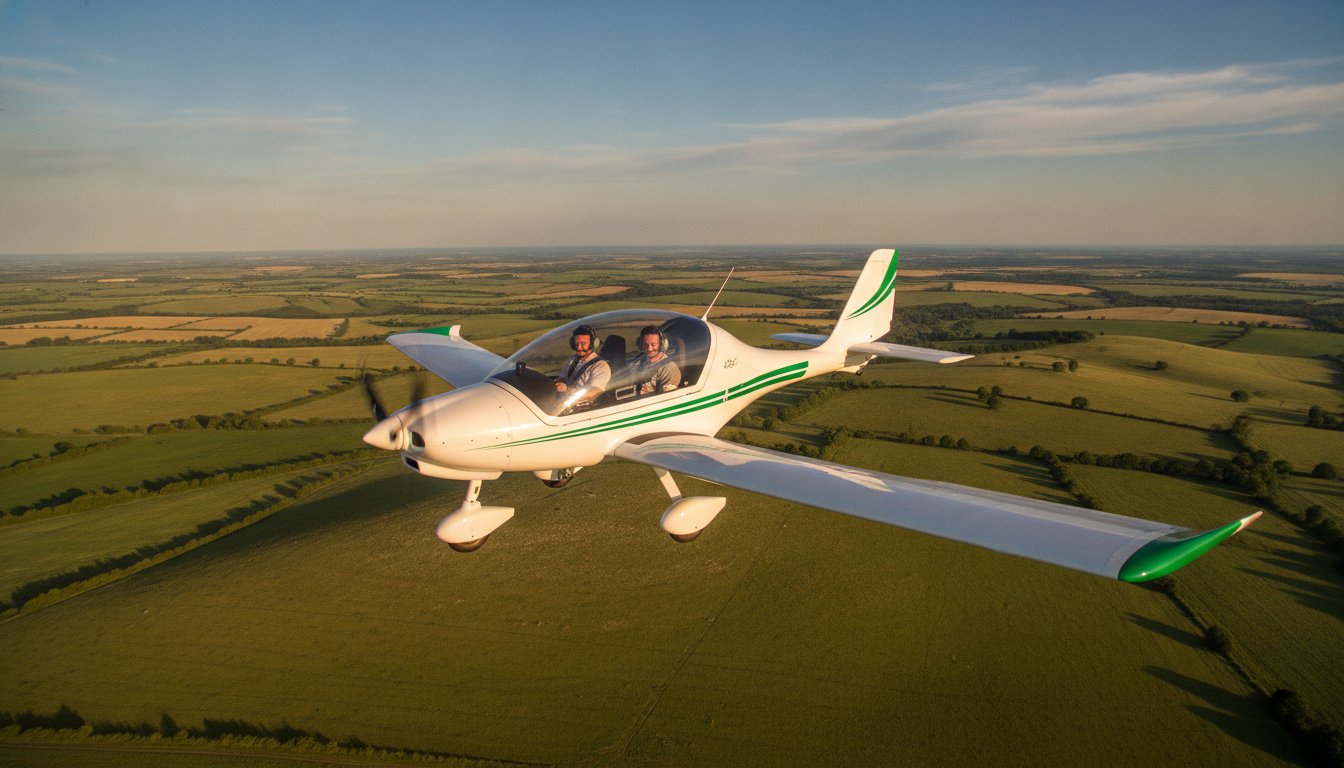
Soaring over the patchwork fields of the North Wessex Downs is a sensory experience like no other. You’ll feel the gentle lift of the wings and see the landscape in stunning high definition. The incredible visibility in this region is a game-changer for new students. It allows you to master visual navigation quickly, using the natural contours of the land to find your way home to the airfield. It’s intuitive, exciting, and deeply rewarding.
Yatesbury: A Centre of Aviation Excellence
Our base at the historic Yatesbury airfield provides a relaxed, non-intimidating environment that’s perfect for new pilots. It’s a site steeped in heritage, yet it retains a warm, friendly club atmosphere that sets us apart from busy commercial centres. Located within easy reach of Swindon, Bristol, and Bath, it’s the ultimate weekend escape for busy professionals. You can learn to fly amongst peers who share your passion for the skies. It’s the perfect hub for microlight flight training Wiltshire wide.
Your Path to the Pilot’s Seat: Understanding the NPPL Microlight Licence
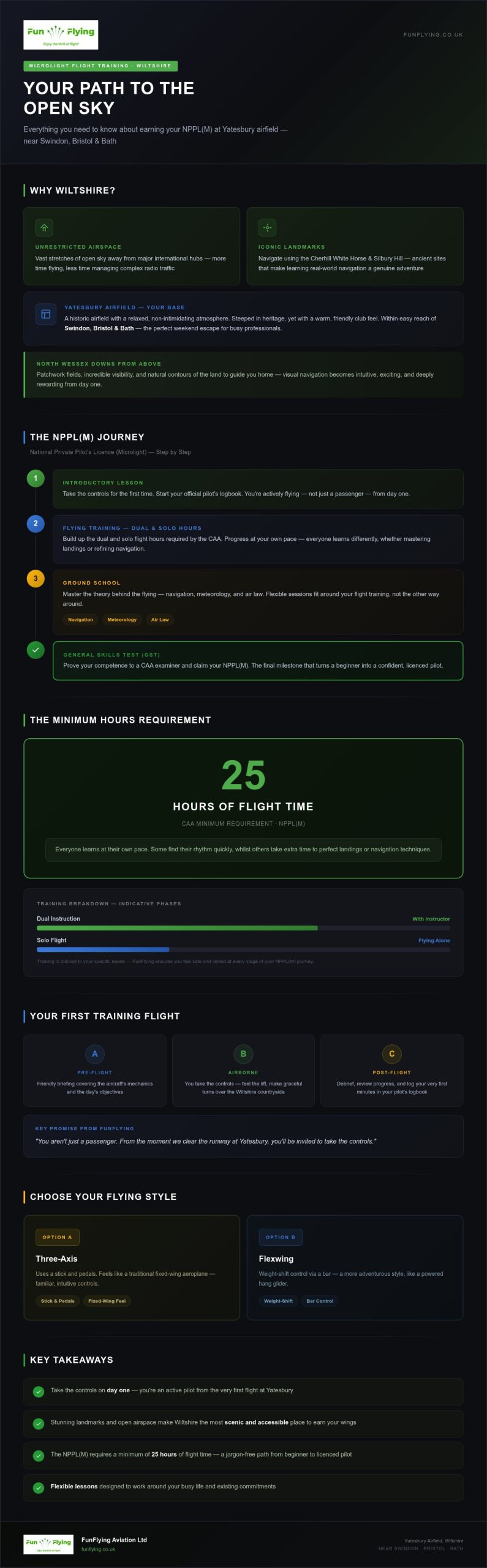
Earning your wings is a journey of exciting milestones rather than a mountain of paperwork. It all begins with your introductory lesson. This is where you get your first real taste of the controls and officially start your pilot’s logbook. Unlike some schools, we ensure you’re flying from day one. From that first take-off, you’ll progress into flying training, building up the dual and solo hours required to satisfy the CAA. You’ll also tackle ground school, where you master the “why” behind the “how,” covering navigation, meteorology, and air law. Finally, you’ll face the General Skills Test (GST), proving your competence to an examiner and claiming your freedom. It’s a structured path designed to turn a complete beginner into a confident pilot.
How Many Hours Do You Really Need?
The CAA currently requires a minimum of 25 hours of flight time to qualify for an NPPL(M). However, it’s vital to remember that everyone learns at their own pace. Some students find their rhythm quickly, whilst others prefer to take extra time to perfect their landings or navigation techniques. The NPPL(M) is widely recognised as one of the most cost-effective and accessible ways to get into the air. If you’re ready to take that first step, you can learn to fly with FunFlying. We tailor your microlight flight training Wiltshire to your specific needs, ensuring you feel safe and skilled at every stage.
Ground School: Making the Theory Fun
Don’t let the thought of exams worry you. Ground school isn’t like being back in a dusty classroom; it’s practical, fascinating, and directly related to your time in the cockpit. We offer flexible ground school sessions that fit around your flight training, making the theory feel like a natural extension of your hobby. For a deeper dive into what to expect, read our guide on mastering the sky: the ultimate guide to microlight ground school UK. It’s the perfect companion for your microlight flight training Wiltshire.
What to Expect During Your First Training Flight at Yatesbury
Your journey with microlight flight training Wiltshire starts with a promise: you aren’t just a passenger. From the moment we clear the runway at Yatesbury, you’ll be invited to take the controls. It’s an empowering approach that builds confidence immediately. Before we even leave the ground, we’ll have a friendly pre-flight briefing. We’ll chat about the aircraft’s mechanics and the day’s specific objectives. It’s all about making you feel comfortable and prepared.
Once airborne, the sensation is incredible. You’ll feel the lift as the wings bite into the air, a feeling that’s both exhilarating and surprisingly stable. Modern microlights are remarkably intuitive. Small, precise movements of the controls translate into graceful turns over the Wiltshire countryside. After we land, we’ll sit down for a post-flight debrief. We’ll reflect on your progress and, most importantly, log those very first minutes in your pilot’s logbook.
Three-Axis vs. Flexwing: Choosing Your Style
You’ll need to decide which flying style resonates with your dream. Three-axis microlights feel like traditional fixed-wing aeroplanes, using a stick and pedals. Flexwings offer a more weight-shift adventure, controlled by moving a bar, much like a powered hang glider. We always encourage students to try both. One might feel like a natural extension of your body, whilst the other offers a different kind of thrill.
Safety and Expertise: Peace of Mind in the Air
Safety is our absolute priority. Every aircraft follows rigorous maintenance schedules, and the UK has some of the highest microlight regulatory standards in the world. Our instructors are seasoned professionals who live and breathe aviation. If you have any lingering doubts, check out our guide: Is Microlight Flying Safe? Everything You Need to Know Before Taking Off. We want you to feel completely at ease amongst the clouds.
Flexible Learning: Training That Fits Your Busy Lifestyle
One of the biggest myths about microlight flight training Wiltshire is that it requires you to drop everything else in your life. It doesn’t. We operate six days a week, giving you the flexibility to book lessons that actually suit your personal calendar. Whether you’re a busy professional in Swindon or a weekend adventurer from Bristol, your training happens on your terms. You set the tempo. Some students prefer an intensive burst to get their hours up quickly, whilst others enjoy a steady weekly lesson to savour the process. There’s no pressure to rush. We’re here to support your individual journey.
If you aren’t sure where to start, a trial flight is the perfect, no-pressure introduction. It’s a chance to see if the cockpit feels like home before committing to the full licence path. You’ll get a real feel for the aircraft and our friendly approach without any long-term commitment. It is the easiest way to bridge the gap between dreaming about flight and actually making it happen.
From Student to Pilot: The FunFlying Community
Learning to fly is about more than just stick and rudder skills. At the Wiltshire Microlight Centre in Yatesbury, you’ll find a second home. The “hangar talk” over tea and biscuits is where the real community spirit lives. It’s a place to swap stories, share tips, and celebrate every solo circuit. Even after you qualify, we’re still here for you. We offer licence revalidations and conversion training to keep your skills sharp and your passion for the skies alive.
Ready to Reach the Clouds?
Stop dreaming about the horizon and start exploring it. The freedom of the skies is closer than you think, and the path is clearer than ever. It’s time to take that first step toward becoming a pilot. For everything you need to know about the journey ahead, check out our how to become a microlight pilot: your complete 2026 guide to the NPPL. Your wings are waiting.
Your Skyward Adventure Starts Today
The horizon is calling. You’ve seen how the historic Yatesbury airfield serves as the ideal launchpad for your dreams of flight. From the stunning views of the North Wessex Downs to our hands-on “take control” philosophy, every aspect of microlight flight training Wiltshire is designed for your success. You aren’t just gaining a licence; you’re joining a vibrant, inclusive community that celebrates the pure joy of movement and autonomy. It’s about finding a second home amongst fellow enthusiasts who share your passion for the clouds.
With expert instructors available six days a week, you can finally fit your aviation goals around your busy lifestyle. Imagine the thrill of your first solo circuit or the peace of soaring over ancient landmarks on a clear morning. It’s time to stop looking up from the ground and start looking down from your own cockpit.
The freedom of the open sky is well within your reach. We can’t wait to see you on the runway.
Frequently Asked Questions
Do I need any previous flying experience to start microlight training?
You don’t need any prior flying experience to begin your journey at Yatesbury. Most of our students have never even sat in a small cockpit before their first trial flight. We specialise in taking complete beginners and turning them into confident pilots. When you start your microlight flight training Wiltshire instructors will guide you through the basics, encouraging you to take the controls immediately. It’s about learning by doing.
What is the minimum age to start learning to fly a microlight in the UK?
You can start taking lessons at any age, provided you can reach the controls and see out of the cockpit. However, the CAA rules state that flying hours only count toward your licence from the age of 14. You can fly solo at 16 and apply for your National Private Pilot’s Licence (NPPL) once you turn 17. It’s a fantastic way for young enthusiasts in Swindon or Bristol to build discipline and confidence.
How much does it typically cost to get a microlight licence?
The total cost of earning your wings depends on how quickly you progress through the required flying hours. Since the CAA requires a minimum of 25 hours, most students choose to pay for lessons individually to spread the investment. This pay-as-you-go approach makes microlighting far more accessible than traditional aviation. We prioritise your skills and safety without the hidden fees often found at larger commercial airports.
Can I fly a microlight if I have a medical condition?
You can often fly even with certain medical conditions. The NPPL uses a simple self-declaration system, which is generally based on the same medical standards required to drive a car in the UK. This makes it a much more inclusive option compared to the rigid requirements of commercial aviation. If you’re fit to drive to our centre in Yatesbury from places like Reading or Andover, you’re likely fit to start your training.
What is the difference between a microlight and a light aircraft (PPL)?
The main differences are weight, cost, and complexity. Microlights are lightweight, agile aircraft with a maximum take-off weight of 600kg, making them significantly cheaper to operate than heavier PPL aircraft. Whilst a PPL allows you to fly larger planes, microlight flight training Wiltshire offers a much more visceral flying experience. It’s about the pure joy of flight and the freedom of the skies rather than managing complex systems and heavy machinery.