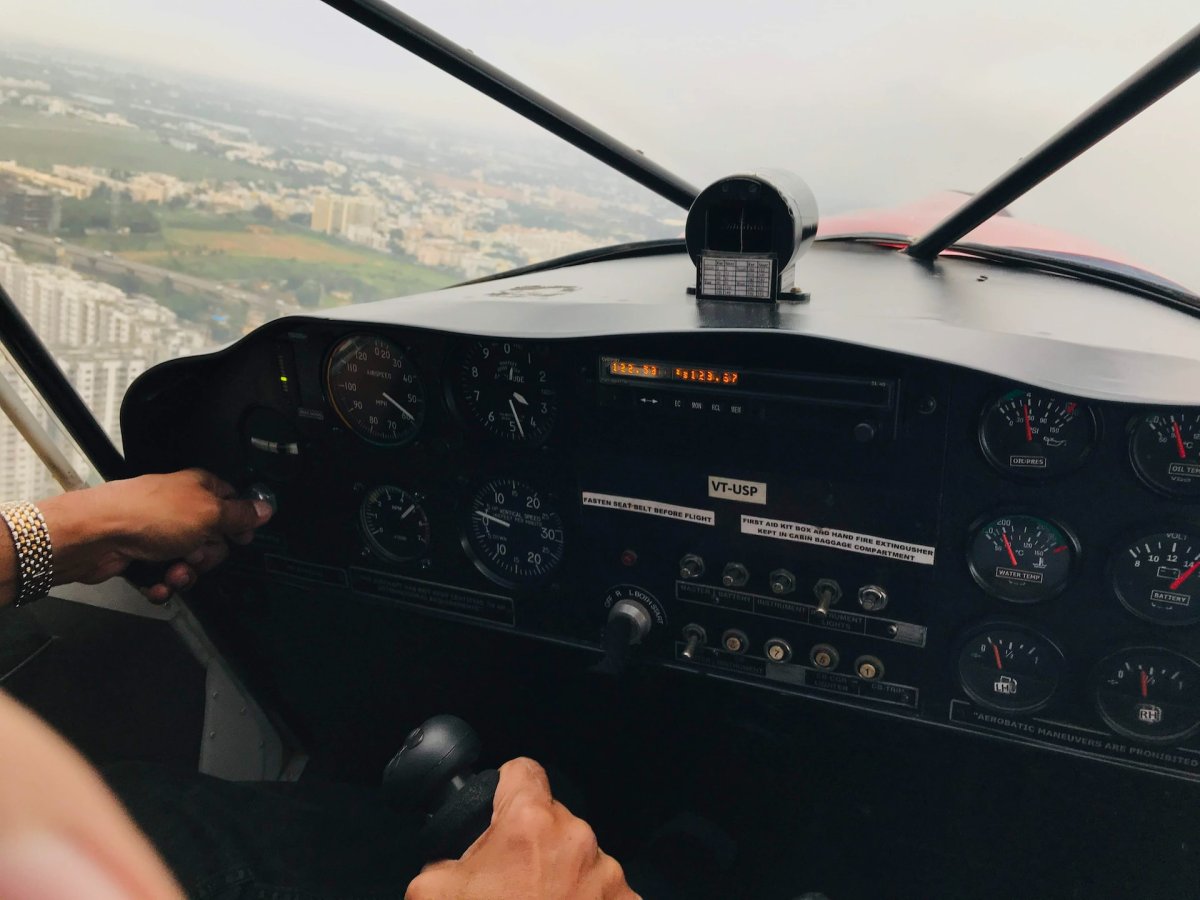
What if you could take the controls and actually steer an aircraft within minutes of leaving the ground for the very first time? It sounds like a dream reserved for seasoned pros, but you can actually fly a microlight on your first lesson with the right guidance. You might think that aviation is a complex world of endless jargon, or perhaps you’re worried that you won’t be allowed to touch anything until months of study are under your belt. It’s a common concern, but it’s one we love to dismantle.
We’re here to show you exactly how you can safely move from the passenger seat to the pilot’s seat while soaring over the Wiltshire countryside. There’s no need to wait for years of training to feel the absolute thrill of autonomy in the sky. This article previews what to expect during your first flight at our historic Yatesbury airfield, explains why microlights are the perfect entry point for new flyers, and reveals why taking charge is far simpler than you ever imagined.
Key Takeaways
- Understand why a “take control” flight is a genuine training session rather than a simple passenger ride.
- Learn the simple mechanics of pitch, roll, and yaw to see how intuitive piloting can be.
- Discover the exact moment you’ll hear “you have control” and actually fly a microlight on your first lesson.
- Explore why the historic Yatesbury airfield is the perfect, friendly base for residents in Bristol and Swindon to start their journey.
- Find out how your very first experience counts towards your National Private Pilot’s Licence requirements.
What is a “Take Control” Microlight Lesson?
Forget everything you think you know about being a passenger. When you arrive at Yatesbury, you aren’t just here for a sightseeing tour; you’re here to start your journey as a pilot. In modern UK aviation, we believe the best way to learn is by doing. This means that from the moment the wheels leave the grass, you’re transitioning from a passive observer to an active participant. It’s a psychological shift that turns a simple “bucket list” item into a life-changing hobby; while some find their first taste of the clouds through a tandem skydive London, the experience of actually flying the aircraft offers a completely different level of autonomy.
Safety is our absolute priority, which is why every Trial Flight is conducted in a dual-controlled aircraft. Think of it like a driving lesson in the sky. Your instructor is right there with you, ready to take over in a heartbeat, but the goal is for you to actually fly a microlight on your first lesson. Before you even strap in, you’ll learn What is a Microlight? and how these incredibly agile, lightweight machines respond to the slightest touch. It’s an empowering experience that replaces fear with pure, unadulterated joy.
The Difference Between a Ride and a Lesson
A ride is something you endure; a lesson is something you command. We focus on autonomy from the start. Your instructor will gauge your comfort levels and slowly introduce you to the controls. You’ll feel the aircraft respond to your movements. It’s a tactile, sensory experience that creates an immediate connection between you and the air. You’ll move from watching the horizon to shaping your path through it. This hands-on approach is the core of the FunFlying experience.
Who Can Take the Controls?
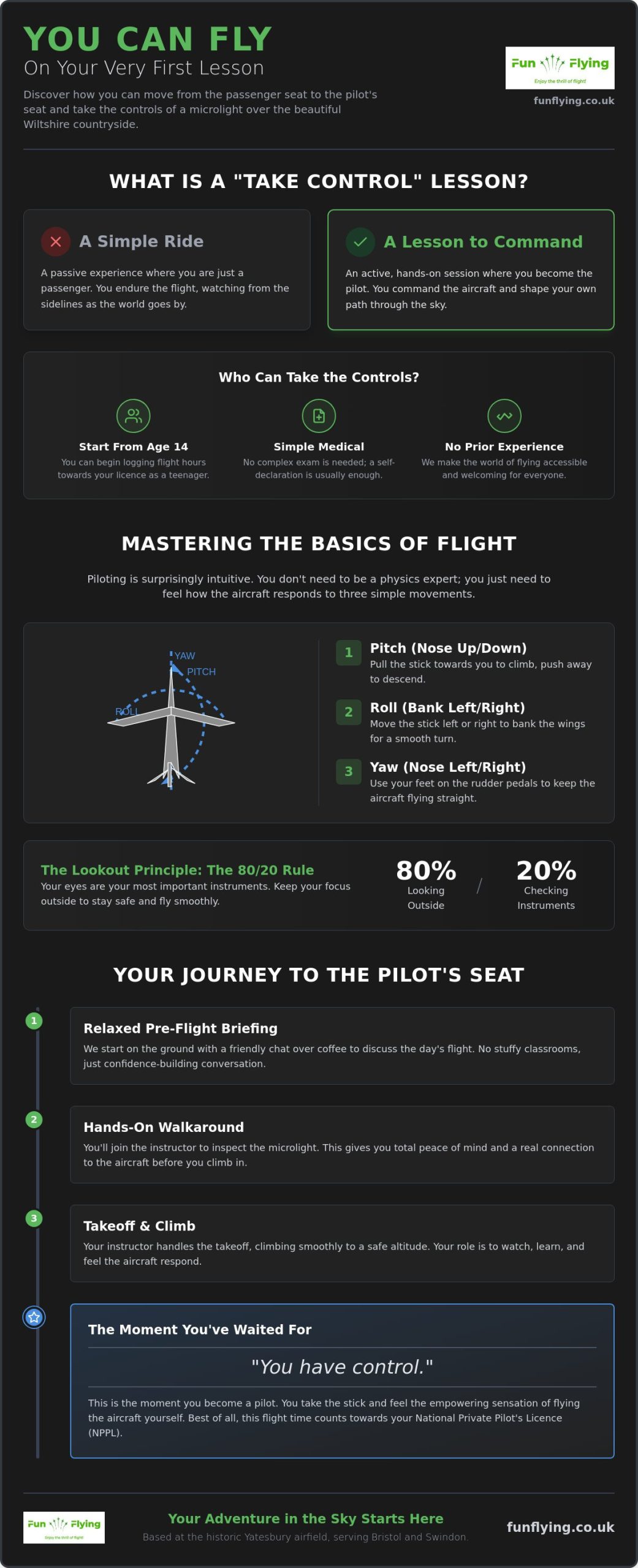
You might be surprised by how inclusive this sport is amongst people of all backgrounds. In the UK, you can begin logging flight hours towards a licence from the age of 14. There’s no need for a complex medical exam either; a simple self-declaration on the CAA website is usually enough. Whether you’re a teenager dreaming of the clouds or a retiree looking for a new adventure, no prior technical knowledge is required to begin. We specialise in making the elite world of flying feel like home for everyone.
Mastering the Basics: Pitch, Roll, and Yaw Explained
Flying isn’t just about left and right; it’s about mastering the third dimension. When you sit in the cockpit at Yatesbury, you’ll quickly realise that the aircraft moves through three distinct axes. To fly a microlight on your first lesson, you don’t need to be a physics expert. You just need to feel how the aircraft breathes with the wind. We focus on making these movements feel like second nature from the moment you take the stick.
The three axes are pitch, roll, and yaw. Pitch is the movement of the aircraft’s nose up or down, controlled by moving the elevators on the tail. By gently pulling the stick towards you, the nose rises to meet the clouds. Pushing it away makes the nose dip towards the horizon. Roll allows you to bank the wings, which is how we initiate a smooth, graceful turn. Finally, yaw is controlled by your feet on the rudder pedals, ensuring the aircraft stays straight and coordinated during flight.
The Intuitive Nature of Microlight Controls
Most of our students prefer three-axis microlights because they feel remarkably similar to a small aeroplane. The controls are incredibly tactile; you can actually feel the air resistance through the stick. This feedback tells you exactly how the plane is behaving. While different countries have varying rules for Pilot Licensing for Microlights, the physical joy of handling the controls remains a universal thrill. It’s much simpler than most people expect.
The “Lookout” Principle
Your eyes are the most vital instruments in the cockpit. We teach the 80/20 rule: spend 80% of your time looking outside at the horizon and only 20% checking the dashboard. This keeps you safe and helps you maintain a level flight path whilst performing your first manoeuvres. If you’re ready to feel that horizon tilt under your command, you can explore our Microlight license training options to see where your journey could lead.
Your First Lesson: A Step-by-Step Guide to Taking the Controls
Your journey begins at our historic Yatesbury airfield with a relaxed, face-to-face briefing. We don’t do stuffy classrooms; we talk through the day’s weather and the aircraft’s behaviour over a coffee. It’s about setting the stage for success. You’ll learn exactly what we’re going to do in the air so there are no surprises, only excitement. This isn’t just a demonstration. It’s a structured session designed to build your confidence from the ground up.
The Pre-Flight Walkaround
Before we leave the grass, we perform a thorough walkaround. This is where you’ll see why microlights are such a joy for beginners. Every component is accessible and visible. We check the fuel, the engine, and the airframe together, following the high standards of the British Microlight Aircraft Association. It provides total peace of mind. Once you’re strapped in and your headset is adjusted, you’ll feel the hum of the engine and the anticipation of what’s to come.
The transition from observer to pilot happens sooner than you think. Once we reach a safe altitude, your instructor will offer the controls. When you hear the words “you have control,” you’ll respond and take charge. This is the exact moment you fly a microlight on your first lesson. It’s an empowering, visceral sensation that stays with you long after you land. You aren’t just sitting there; you’re the one making the wings move.
In-Air Exercises for Beginners
We start with straight and level flight. You’ll learn to use the “trim” control, which takes the pressure off the stick and allows the plane to fly itself. It’s a revelation. You’ll notice the aircraft responds to your smallest touch. We’ll then move to gentle turns, banking over the Wiltshire landscape and seeing the world from a completely new perspective. It’s not just about steering. It’s about feeling the air and finding your rhythm.
After landing, we’ll head back to the clubroom for a debrief. We’ll celebrate your progress and, most importantly, log your very first flight hour in your personal logbook. Ready to make it official? Book one of our Trial Flights today and take that first step into the sky.
Start Your Aviation Journey at the Wiltshire Microlight Centre
Choosing where to begin your flying career is just as vital as the flight itself. Yatesbury is more than just a strip of grass; it’s a historic airfield that offers some of the most unrestricted, beautiful airspace in the South West. At Fun Flying Aviation Ltd, we pride ourselves on a non-intimidating atmosphere where the elite barriers of aviation are stripped away. We operate six days a week to ensure that your dream of taking to the skies fits perfectly around your career and family life.
Whether you start with one of our Experience Flights or jump straight into a full training course, we provide a clear, structured path. Every minute you spend in the air counts towards your National Private Pilot’s Licence (NPPL). It’s incredibly rewarding to see your logbook grow from that very first entry. Our instructors are specialists in NPPL training, ensuring you receive professional guidance with a friendly, hands-on approach from day one.
Flying Over Historic Wiltshire
The view from a microlight is unlike anything else. You’ll soar over the rolling downs and might even spot the famous Cherhill White Horse carved into the hillside. Because we’re perfectly positioned near the M4, we’re the premier choice for students coming from Swindon, Bristol, and Newbury. Depending on your preference for adventure, you can choose between the wind-in-your-face thrill of an open-cockpit aircraft or the refined comfort of an enclosed cabin. Both options allow you to fly a microlight on your first lesson whilst soaking in the Wiltshire scenery.
Booking Your First Lesson
Getting started is simple. You can purchase a voucher for a loved one or book a direct slot for yourself at a time that suits your schedule. For your first flight, we recommend wearing comfortable, windproof layers and sturdy shoes; even on warm days, it can get chilly as we climb. There’s no need for expensive gear or prior experience. If you have questions about the medical self-declaration or the five ground exams, don’t hesitate to contact us for a no-obligation chat. We’re here to make sure you feel ready and excited to take the controls.
Take the Leap and Claim Your Seat in the Cockpit
The dream of flight is far closer than you think. You’ve discovered that aviation isn’t a complex mystery reserved for the few; it’s a vibrant, accessible hobby that welcomes anyone with a sense of adventure. From mastering the intuitive basics of pitch and roll to the incredible moment you hear “you have control,” your journey into the clouds starts with a single step. There is nothing quite like the feeling of autonomy as you fly a microlight on your first lesson, looking out over the historic Wiltshire landscape.
At FunFlying Aviation Ltd, we provide more than just a flight; we offer a community. With our professional CAA-qualified instructors and a base at the historic Yatesbury airfield, you’re in the best possible hands. Whether you want a one-off thrill or a structured path toward your NPPL licence, we make the process simple and exhilarating. Don’t let another day pass just watching the horizon from the ground. Book your hands-on microlight lesson with us today! The sky is waiting, and we can’t wait to help you conquer it.
Frequently Asked Questions
Do I need any previous experience to fly a microlight on my first lesson?
You don’t need any prior aviation experience or technical knowledge to take to the skies. Our trial flights are specifically designed to introduce newcomers to the joy of flight from the very beginning. Your instructor handles the complex procedures like take-off and landing, leaving you free to focus on the pure sensation of handling the aircraft once we’re at a safe altitude.
Will I actually be allowed to steer the aircraft myself?
Yes, you’ll be encouraged to take the controls yourself under the close supervision of your instructor. The entire purpose of the session is to ensure you fly a microlight on your first lesson rather than just sitting back as a passenger. You’ll get a genuine feel for the aircraft as you perform gentle turns and maintain level flight over the Wiltshire countryside.
What happens if I make a mistake while holding the controls?
There’s no need to worry because your instructor has a full set of dual controls and can take over instantly. It’s very similar to a driving lesson where the teacher has their own set of pedals—a safety-first approach also used by Wimbledon Driving School for their road lessons. We’ll guide your movements and keep the aircraft within a safe flight path, allowing you to explore the controls with total peace of mind and confidence.
Are there any physical or age limits for taking a microlight lesson in the UK?
In the UK, you can begin logging flight hours towards a licence from the age of 14. While there’s no official upper age limit, you should be in generally good health and able to climb into the cockpit. Most microlights have a maximum seat weight limit, often around 110kg or 17 stone, so it’s always a good idea to check with us before you book your session.
Can I count the time from my first trial flight towards my pilot licence?
Absolutely, your very first flight counts as official training time toward your National Private Pilot’s Licence. Because our lessons are conducted by professional instructors at the historic Yatesbury airfield, you can log that first hour in your personal pilot’s logbook. It’s a fantastic way to start your aviation journey whilst experiencing the thrill of being at the controls for the first time.
Is microlight flying safe compared to traditional light aircraft?
Microlighting is remarkably safe and is governed by the same strict UK aviation regulations as larger aeroplanes. Modern microlights are built with high-tech materials and are often more agile than traditional light aircraft. Because they are lighter, they have lower stall speeds and can land safely in much shorter distances, making them a practical and secure choice for recreational pilots.