
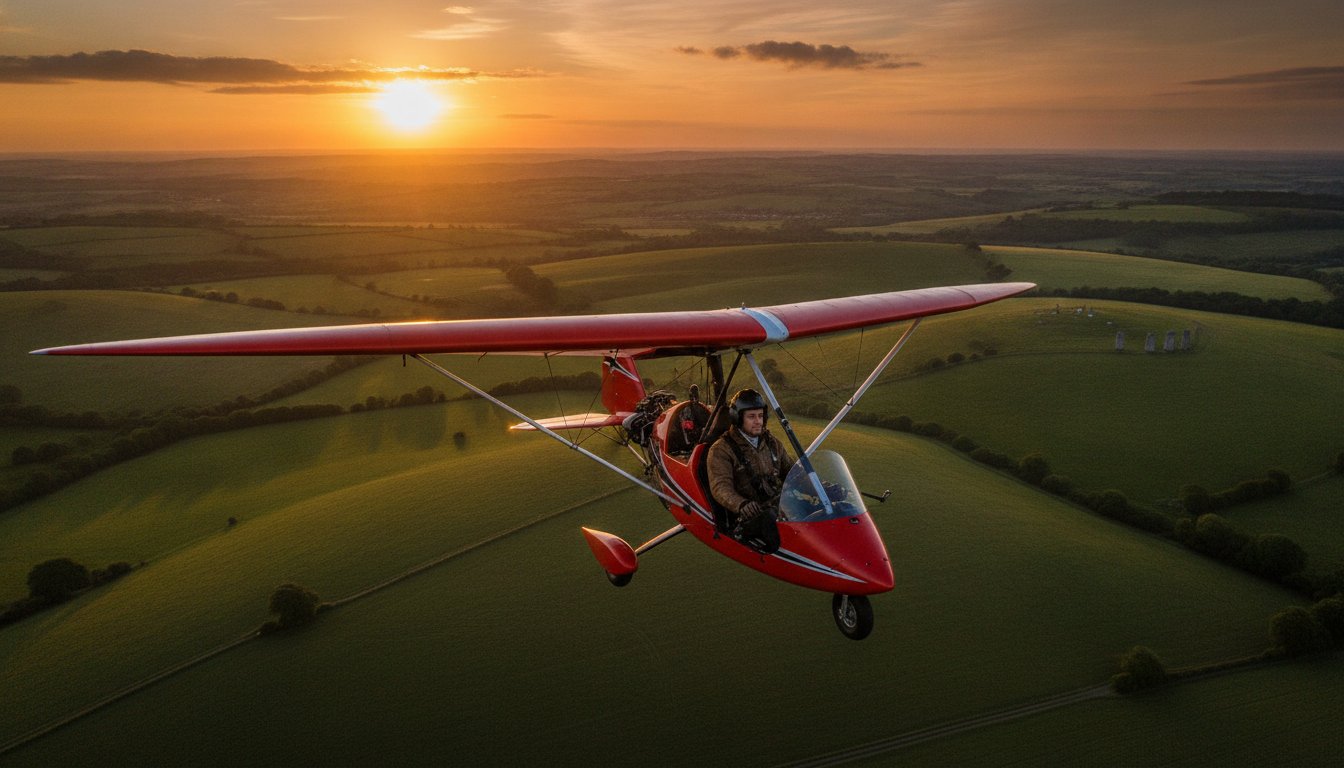
Imagine soaring over the Wiltshire Downs with nothing between you and the horizon but a lightweight wing and the hum of a single engine. What if you could bypass the staggering costs of traditional aviation and the mountain of red tape that usually comes with it? For many, the dream of flying is often dampened by the reality of expensive lessons and complex medical requirements. It’s a common frustration; you want the sky, not a lifetime of paperwork. This is why SSDR pilot training UK is becoming the favourite choice for those seeking pure, unadulterated flight.
In this guide, you’ll discover how to take to the skies with the ultimate freedom of Single Seat Deregulation and the professional training pathway to get you there. We’ll explore the legal requirements for SSDR aircraft, the step-by-step journey from beginner to solo pilot, and how this unique category can significantly reduce the long-term costs of your flying hobby. Whether you’re looking to escape the constraints of a traditional flying school or simply want a more accessible way to own your own aircraft, we’ve got you covered. Your journey to aviation independence starts right here.
Key Takeaways
- Understand the “magic numbers” of SSDR aircraft that unlock a world of lightweight aviation without the burden of excessive regulation.
- Discover the essential steps for SSDR pilot training UK, starting with professional two-seat instruction to earn your NPPL (Microlight) licence.
- Uncover the secrets to reducing your long-term flying costs, from lower fuel consumption to skipping the hassle of annual permit fees.
- Find out why the Wiltshire Microlight Centre is the ideal launchpad for your journey, offering expert guidance and hands-on flying from day one.
Understanding SSDR: The Gateway to Accessible Aviation in the UK
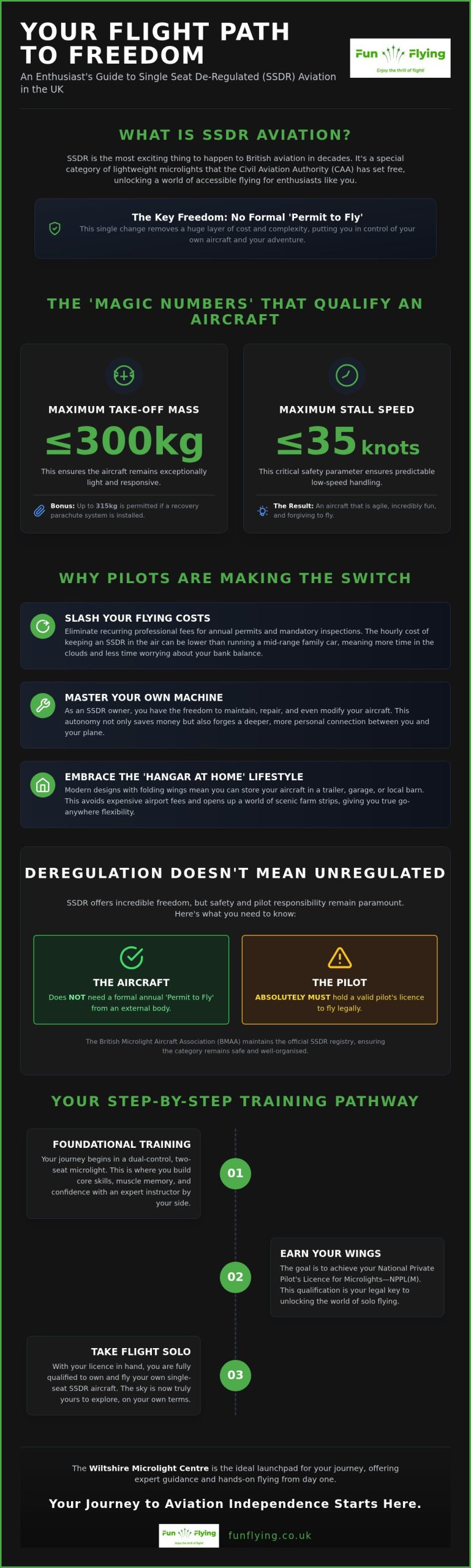
Single Seat De-Regulated (SSDR) sounds a bit technical, doesn’t it? In reality, it’s the most exciting thing to happen to British aviation in decades. Essentially, it’s a sub-category of microlights that the Civil Aviation Authority (CAA) decided to set free. By removing the need for a formal “Permit to Fly,” they’ve made it easier than ever for you to own and fly your own craft. This shift has placed the UK at the forefront of Ultralight aviation, giving pilots a level of autonomy that was previously unthinkable. It’s the reason why SSDR pilot training UK is such a hot topic right now; people want that freedom.
To qualify as an SSDR, an aircraft has to meet two “magic numbers.” First, it must have a Maximum Take-Off Mass (MTOM) of no more than 300kg. If you’ve got a recovery parachute system installed, that limit nudges up to 315kg. Second, the stall speed must not exceed 35 knots. These criteria ensure the aircraft remain light, agile, and incredibly fun to handle.
Why Deregulation Doesn’t Mean “Unregulated”
Don’t let the word “deregulated” fool you into thinking it’s a free-for-all. Whilst the aircraft itself doesn’t need an annual inspection from a formal body, the pilot definitely does. You still need a valid licence to fly. This is why finding the right SSDR pilot training UK pathway is so vital. Most pilots start their journey with microlight license training to build the necessary skills. The British Microlight Aircraft Association (BMAA) still keeps a watchful eye, overseeing the SSDR registry to ensure everything stays safe and organised.
The Freedom of Maintenance
This is where the real magic happens. In the SSDR world, you are the master of your own machine. You can maintain, repair, and even modify your aircraft without needing a signed-off inspector to check your work. This doesn’t just give you a deeper connection to your plane; it also wipes out the hefty fees associated with annual permits and mandatory inspections. It’s a huge win for your wallet and your sense of adventure. You get to spend more time in the air and less time worrying about the next bill from the hangar.
The Benefits of Single-Seat Deregulation: Why Pilots are Making the Switch
Imagine the sheer thrill of a Sunday morning flight where the only schedule you follow is your own. The shift towards SSDR isn’t just about saving pennies; it’s about reclaiming the spirit of adventure. By choosing this path, you’re stepping into a community that values simplicity and the pure joy of being airborne. Investing in SSDR pilot training UK opens up a world where aviation is finally within reach, stripping away the layers of complexity that often keep aspiring flyers on the ground.
Financial Advantages of the SSDR Category
Traditional aviation often comes with a cloud of “hidden costs” that can dampen the enthusiasm of even the most dedicated pilot. From mandatory annual inspections to eye-watering hangarage fees, the bills for a standard PPL aircraft add up quickly. SSDR changes the game by offering total transparency. Since you’re responsible for your own maintenance, those recurring professional fees simply vanish. In many cases, the hourly cost of keeping an SSDR in the air is actually lower than the running costs of a mid-range family car. This cost-effectiveness means you can spend more time in the clouds and less time worrying about your bank balance.
The “Hangar at Home” Lifestyle
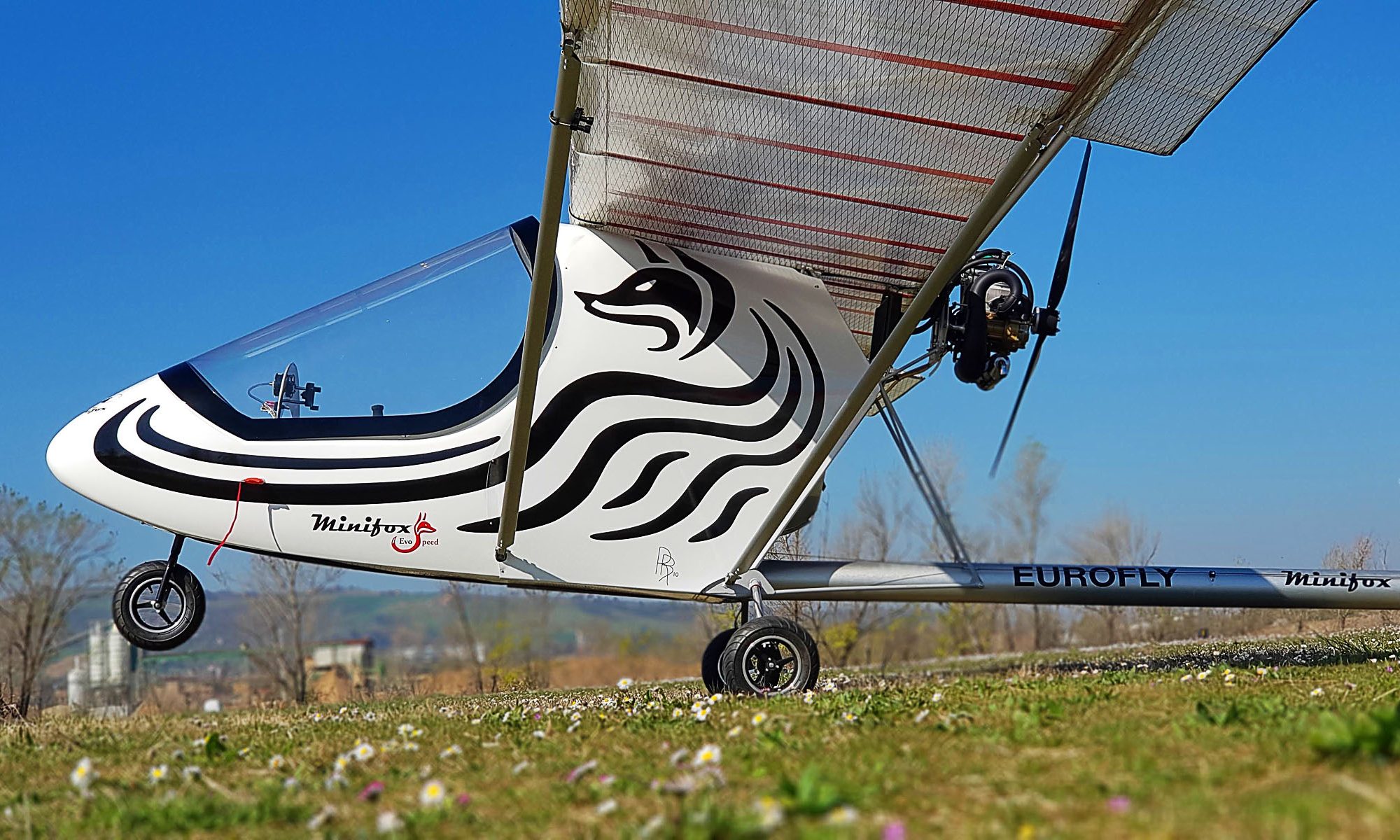
One of the most liberating features of modern SSDRs is their incredible portability. Many designs, such as the Sherwood KUB, feature clever folding wings that allow the aircraft to be tucked away in a trailer. This “hangar at home” approach means you can avoid expensive airport parking and keep your craft in your own garage or a local barn. It also opens up the world of farm strips. Instead of being tied to busy regional airports with strict opening times and landing fees, you can operate from quiet, scenic fields. The Official UK SSDR Regulations provide the framework that makes this flexibility possible, allowing you to turn any suitable patch of grass into your personal runway.
Beyond the logistics, there’s the innovation. Deregulation has sparked a creative boom in aircraft design, leading to lightweight machines that are as beautiful as they are capable. These aren’t the basic “engines on a frame” of the past; they are sophisticated, responsive aircraft that offer a truly undistracted connection between pilot and sky. If you’re ready to experience this level of autonomy, starting with professional microlight license training is your first step toward that solo seat.
The Training Pathway: How to Fly an SSDR Aircraft Legally and Safely
So, how do you actually get into that solo cockpit? It’s a question we hear a lot. Because SSDRs are single-seaters, your SSDR pilot training UK journey actually begins in a dual-control, two-seat aircraft. You need a solid foundation before you can enjoy the ultimate independence of solo flight. It’s about building muscle memory and confidence with a friendly expert by your side, ensuring you have the skills to handle any situation the sky throws at you.
Step 1: The Initial Microlight Licence
To fly any microlight legally in the UK, you need a National Private Pilot’s Licence (NPPL) with a Microlight rating. The legal minimum is 25 hours of flight training, which must include at least 10 hours of solo time. Whilst some reach the standard in the minimum time, many pilots budget for around 35 hours to feel truly competent. You’ll want to start with a structured learn to fly programme that covers everything from basic handling to emergency procedures in a stable, two-seat aircraft.
Step 2: Transitioning to Solo Flight
Once you have your licence, moving to a single-seater involves “differences training.” Since your instructor can’t sit with you in an SSDR, they use a “briefing and observation” method. They’ll talk you through the specific handling quirks of your new craft, such as the lighter control response or different stall characteristics. They then watch your take-offs and landings from the ground, providing feedback via radio. This ensures you’re never truly on your own until you are completely ready for the transition.
Essential Ground School Knowledge
Flying solo means you’re the pilot, the navigator, and the weather forecaster all at once. Subjects like Air Law and Human Performance become vital when you don’t have a second pair of eyes in the cockpit. You need to understand how to stay clear of restricted airspace and how your own behaviour affects flight safety. For a deep dive into the theory, check out our Ultimate Guide to Microlight Ground School UK. It’s the perfect companion for your practical lessons.
Start Your SSDR Journey at the Wiltshire Microlight Centre
Ready to turn your solo flight dreams into a real flight plan? If you’re living in Swindon, Bristol, or Newbury, your gateway to the sky is just down the road. At Fun Flying Aviation Ltd, we don’t believe in keeping you on the ground for weeks of theory. You’ll have your hands on the controls from your very first lesson, feeling exactly how a modern microlight responds to your touch. It’s this hands-on, immersive style that makes our SSDR pilot training UK so effective for busy people who want to get airborne without the fuss.
We know that your time is precious. That’s why we offer flexible training programmes that fit around your professional life and weekend plans. You aren’t just a number here; you’re part of a growing community of enthusiasts. We act as your “Friendly Guide” through every regulation and technical detail, making the journey to your first single-seat cockpit as smooth as a sunset landing.
Training in the Heart of Wiltshire
Yatesbury offers more than just a place to land; it’s a stunning backdrop for your aviation journey. Training at the Wiltshire Microlight Centre means you’re flying over some of the UK’s most beautiful landscapes. Imagine practicing your steep turns over the rolling downs whilst enjoying the quiet focus of a dedicated microlight strip. You won’t find yourself stuck in a long queue of commercial jets here. It’s just you, the grass runway, and the open air. This calm, dedicated environment is exactly what you need to master your SSDR pilot training UK.
Taking the First Step
The best way to find out if the SSDR lifestyle is for you is to get up there and feel it. Booking a trial flight lets you experience that lightweight, agile sensation for yourself. You’ll work with professional instructors who are genuinely excited to share their decades of experience with you. We’re here to support you even after you’ve earned your wings, providing the advice and community you need as you move into owning your own aircraft. Your adventure starts the moment you arrive.
Contact Fun Flying Aviation Ltd to discuss your SSDR training path
Claim Your Piece of the Sky Today
The journey from your first trial flight to the cockpit of your own deregulated aircraft is one of the most rewarding paths in modern aviation. We’ve seen how the SSDR category strips away the complexity of traditional flying, leaving you with the pure, affordable essence of the sport. By choosing SSDR pilot training UK through a professional school, you’re not just learning a skill; you’re joining a community that values independence and adventure above all else. It’s about making the dream of flight a practical, everyday reality.
At Fun Flying Aviation Ltd, we pride ourselves on being more than just instructors; we are your partners in this transition. Our experts at Yatesbury are ready to help you navigate every step, from those initial hours in a two-seater to the moment you’re ready to head out on your own. With a focus on inclusive, high-energy learning and flexible schedules that work for you, we ensure that the sky feels like home from your very first lesson.
Your piece of the sky is waiting. Let’s get you up there and experience that incredible sense of freedom together.
Frequently Asked Questions
Do I need a medical certificate to fly an SSDR aircraft in the UK?
No, a full aviation medical certificate is usually not required for this category. For most pilots, a simple Pilot Medical Declaration (PMD) is all you need, which is essentially the same medical standard required to drive a car on UK roads. This makes getting into the air much simpler and removes the stress of complex, expensive medical examinations that often come with traditional flying.
Can I fly a single-seat deregulated aircraft with a standard PPL?
Yes, you can fly an SSDR if you hold a standard Private Pilot’s Licence (PPL), but you must have a valid microlight rating. Because these lightweight machines handle very differently to a heavy Cessna or Piper, it’s vital to undergo differences training with an instructor. This ensures you’re comfortable with the responsive controls and lower stall speeds before you head out on your first solo adventure.
How much does it cost to train for an SSDR pilot licence?
The total investment for SSDR pilot training UK depends largely on how many hours you need to reach the required standard. The legal minimum for a microlight licence is 25 hours of flight time, though many students budget for around 35 hours to feel truly confident. You’ll also need to account for ground school materials, five multiple-choice exams, and your final General Skills Test with an examiner.
Is it legal to build my own SSDR aircraft at home?
Absolutely, and it’s one of the most rewarding ways to get involved in the hobby. Because the aircraft is deregulated, you have the freedom to build or modify your machine without needing a formal inspector to sign off on every stage of the process. This allows for incredible innovation and a deep, personal connection with your aircraft, though safety should always remain your top priority during the build.
What happens if I want to fly a two-seat microlight later?
You’ll already be qualified to do so because your initial SSDR pilot training UK journey actually takes place in a two-seat aircraft. To earn your licence, you must train and pass your tests in a dual-control machine with an instructor. This means your licence is valid for both single-seat and two-seat microlights, giving you the flexibility to fly solo or take a friend along for the ride.