Structured flight training program in the UK: fees and payments

Structured flight training program in the UK: fees and payments

A structured flight training programme in the UK can follow an integrated or modular route towards commercial flying, or focus on microlight licence training. The route you choose shapes the syllabus, where you train and how payments are arranged.

It’s natural to want a clear picture of the commitment before you take to the skies. Course fees depend on the course and are given after a quote request; the route, training hours and aircraft use all affect the cost.

This guide explains the training options, what to expect from fees and payment schedules, where lessons take place and what the syllabus covers. You’ll also see how the stages fit together, so you can picture your next step towards the freedom of flying.

Key Takeaways

  • Compare course routes by their training structure and payment arrangements to see what fits your goals and budget.
  • Understand how the academy’s location shapes where your lessons take place and the practicalities of getting there.
  • Learn how flight training modules and aircraft fit into your progress from early lessons to more advanced skills.
  • Get a clearer picture of the integrated syllabus, including how classroom learning, flying and simulator work can build towards a qualification.

Course fees and payment schedule

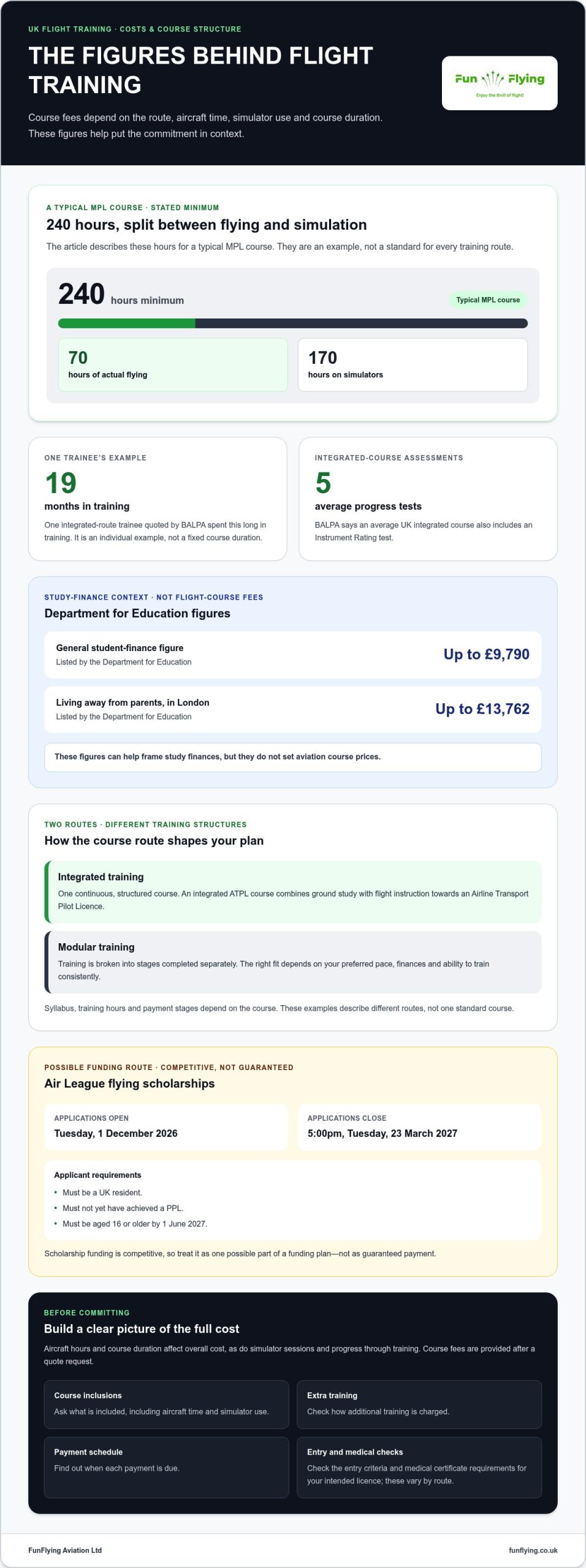
Commercial pilot training costs depend on the route, aircraft time, simulator use and course duration. When comparing courses, look for a clear breakdown of these costs and when payments fall due. That makes it easier to plan each stage instead of focusing on a single headline figure.

For context, the Department for Education lists up to £9,790. This is a general student-finance figure, not a flight-course fee. For living away from your parents, in London, the Department for Education lists up to £13,762. These figures can help frame study finances, but they do not set aviation course prices.

How do integrated and modular flight training compare in the UK? Integrated training follows one continuous, structured course, while modular training breaks the route into stages completed separately. The right fit depends on your preferred pace, finances and ability to train consistently.

An integrated ATPL course combines ground study with flight instruction towards an Airline Transport Pilot Licence. The syllabus, training hours and payment stages depend on the course. For a typical MPL course, the stated minimum is 240 hours: 70 hours of actual flying and 170 on simulators. One integrated-route trainee quoted by BALPA spent 19 months in training. These examples describe different routes, not a single standard course.

Aircraft hours and course duration affect the overall cost, as do simulator sessions and progress through training. Before paying, establish what the course includes, how extra training is charged and when fees are due. Check the entry criteria and medical certificate requirements for your intended licence before committing, as these vary by route.

Are UK pilot training loans, scholarships or airline cadet programmes available? Air League flying scholarships are one route: applicants must be UK residents and have not yet achieved a PPL. Applications open Tuesday, 1 December 2026, and close at 5:00pm on Tuesday, 23 March 2027; applicants must be aged 16 or older by 1 June 2027. Scholarship funding is competitive, so include it as one possible part of your plan, not as a guaranteed payment source.

Aviation academies and training locations

An academy’s location shapes your routine as much as its training environment. Consider how often you’ll travel to the airfield, whether ground lessons take place there and how transport fits your plans. Many airfields are located in rural areas without direct public transport links, making independent driving essential; for example, learners based in West Yorkshire can build confidence on the road with Mike McGowan Driving School to ensure easier commuting to their training sessions. Integrated courses may combine classroom study, simulator sessions and flying, so understand how these activities are arranged. If you’re travelling from Swindon or Bristol, compare the journey with the expected training schedule.

Flight training takes place at airfields across the UK, rather than at one central campus. For an airline pilot pathway, the facilities and aircraft should support the syllabus, including instrument rating training. An instrument rating prepares pilots to fly using cockpit instruments when outside visual references are limited. Check how classroom learning connects with practical sessions.

Accommodation matters if your chosen academy is far from home or requires regular attendance. Compare travel time, lodging options, food access and how easily you can reach classrooms and the airfield. If you’re travelling from Newbury, Reading, Basingstoke, Andover, Bournemouth or Portsmouth, weigh the practicalities of local accommodation against commuting. Your course format and circumstances will shape that decision.

Before choosing a training base, map the practical details:

  • Check the academy’s address and how you’ll get there by road or public transport.
  • Find out which activities happen at the airfield and which take place elsewhere.
  • Work out how accommodation and travel fit your timetable and budget.
  • Consider whether the location supports the flying experience you want, including instrument training.

You may believe the closest academy is automatically the easiest choice, but a suitable training environment also depends on course structure and access to the facilities you’ll use. If you’re exploring microlight training, learning to fly can help you understand what practical training involves. A clear location plan makes it easier to picture the day-to-day reality of training, not just the destination.

Flight training modules and aircraft

Flight training combines practical aircraft lessons with ground study and, on some courses, simulator sessions. Skills build progressively: students learn aircraft handling before developing navigation, communication and decision-making. The sequence depends on the course and the licence it leads to. Compare the syllabus with your goal, whether that’s personal flying or a commercial pilot career.

Aircraft choice affects the feel of each lesson. A training aircraft gives you hands-on experience with its controls, engine and flight instruments, while a simulator recreates selected situations for ground-based practice. Each has a different role: flying develops real-world handling, while simulation lets students rehearse procedures in a controlled setting. Ask how the course uses each and assesses progress.

For integrated training, BALPA says an average UK course involves five progress tests, as well as an Instrument Rating test. These assessments track development across the syllabus, rather than relying on flying experience alone. Map each test against the skills taught beforehand to see how classroom learning, simulator practice and aircraft lessons connect.

Course names can sound similar, so check what each module prepares you to do. A modular course separates training into stages; an integrated course follows a planned sequence. In either case, understand how practical lessons, ground study and assessments lead towards the intended licence. A pilot licence is a qualification, not a guarantee of a particular job.

What are the main risks and job prospects after completing flight training in the UK? The main risks include the time and financial commitment, and the possibility that an airline role may not follow immediately after qualification. Job prospects depend on the licence held, experience, employer requirements and recruitment demand. If you’re exploring hands-on flying before choosing a route, learning to fly can help you understand what practical training involves.
Structured flight training program in the UK: fees and payments

Integrated flight training structure and syllabus

An integrated programme organises training into a connected route towards a defined aviation qualification. Its value lies in how each stage prepares you for the next.

Structured programme overview

What is a structured flight training programme in the UK? It’s a planned course that combines learning and practical instruction around a clear qualification goal. Rather than selecting each stage independently, you follow a coordinated programme. When comparing courses, look for a written sequence, clear learning objectives and an explanation of how progress is reviewed.

Also consider how the schedule fits your ability to study consistently. One integrated-route trainee quoted by BALPA spent 19 months in training, but that is an individual example, not a standard completion time. Ask how the academy communicates progress and how you’ll know which skills to work on before moving forward.

Training syllabus

A useful syllabus shows what you’ll learn at each stage and how theory connects with practical flying. Look beyond course titles for clear learning goals, preparation expected before lessons and details of instructor feedback. This helps you judge whether the programme builds skills in a logical order, rather than listing topics without explaining how they fit together.

Use the syllabus to compare the training with your goals. For example, someone aiming for an airline career should understand how the qualification pathway relates to that ambition. Check how the course explains assessment outcomes, study expectations and possible next steps after completion. This helps you see what the qualification provides and what further steps your chosen career route may involve. For students weighing aviation qualifications against traditional university study, the team at Education and Training provides personalised guidance to help navigate academic options across the UK and internationally.

Explore learning to fly

Fun Flying Aviation: Experience Flights

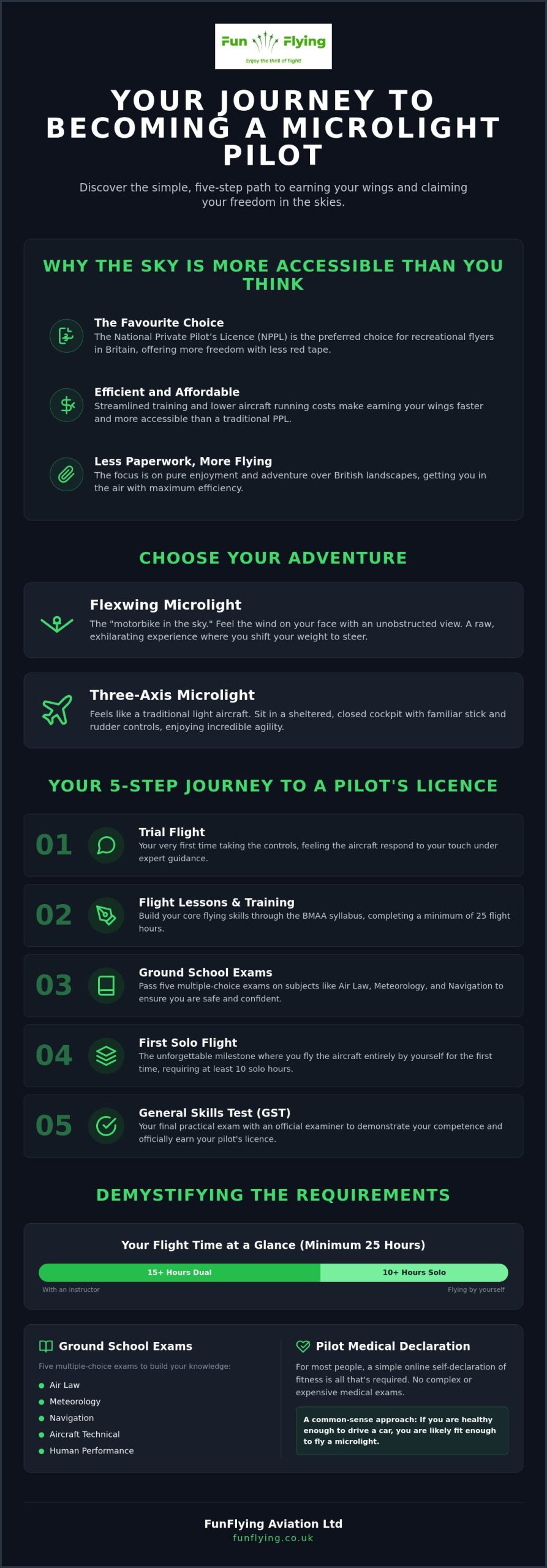
Fun Flying Aviation Ltd offers Experience Flights for anyone who wants to try being at the controls before choosing a training route. The company also offers Trial Flights, microlight licence training and Ground School for people exploring their next step in aviation.

An Experience Flight or Trial Flight can be a practical first step if you’re curious about flying but not ready to commit to a course. If you’re in Swindon, Bristol, Newbury, Reading, Basingstoke, Andover, Bournemouth or Portsmouth and interested in a microlight licence, training and Ground School combine practical skills with aviation knowledge.

Choose the experience that suits your next step, whether you want a first taste of flying or to begin microlight training. Contact Fun Flying Aviation Ltd to explore its Experience Flights, Trial Flights and training options.

Take your next step towards flying

Turn your interest into a practical plan by deciding what you want flying to mean for you. A structured flight training programme in the UK can support different ambitions, so consider whether you’re exploring aviation recreationally or planning a longer-term career. This gives you a clearer basis for comparing pathways and choosing what to investigate next.

Before committing, note your priorities: the type of flying that appeals to you, the time you can set aside for learning and the qualification you want to pursue. Use these points to guide your next conversation and weigh up the options.

Explore learning to fly

Every pilot’s journey starts with a decision. Take yours at a pace that feels right, with your ambitions in view.

Frequently Asked Questions

What courses are available?

UK flight training includes integrated and modular routes towards professional aviation qualifications, alongside microlight licence training. Integrated courses follow a continuous plan; modular training lets you complete stages separately. If you’re exploring flying rather than committing to a licence, an Experience Flight or Trial Flight offers an introduction. Ground School covers aviation theory and can complement practical microlight training.

What is the application process?

Start by choosing your goal, such as recreational microlight flying or a professional pilot pathway. Identify a course that matches it, then review its entry criteria, syllabus, fees and payment stages. Prepare any information requested by the training organisation, including relevant flying experience or qualifications. Before committing, make sure you understand how training progresses and which licence the course supports.

What qualifications are required?

Entry qualifications depend on the route, so distinguish starting training from progressing towards a commercial licence. A modular commercial route begins after a student holds a PPL(A) and has at least 150 hours of flight experience. Commercial licence applications have specific flight-experience requirements, which depend on the route. These figures relate to commercial progression, not a universal entry requirement for every introductory or microlight course.

What’s included?

Course inclusions vary, so look for a clear breakdown of practical flying, ground instruction, simulator sessions and progress assessments. For microlight training, Ground School supports the knowledge needed alongside aircraft lessons. An introductory flight is different: it offers a supervised taste of flying, not the full syllabus of a licence course. Compare the inclusions with your goal before choosing.

What UK licences can you earn through structured pilot training?

The licence depends on the aircraft and training route. Professional aeroplane pathways may lead towards qualifications such as a PPL(A), CPL(A), ATPL or MPL, while microlight training leads towards a microlight pilot licence. These qualifications serve different purposes and aren’t interchangeable. Before enrolling, identify the exact licence the course supports and whether it matches the flying you want to do.

What are the CAA requirements to start flight training in the UK?

Requirements depend on the licence you’re pursuing, so there isn’t one checklist for every route. Establish the licence category, applicable medical certificate requirements, course entry criteria, and required training and assessments before you begin. A microlight course and an integrated airline pathway have different aims and structures. Clarifying your intended licence first helps you understand which requirements apply.
Marce Colucci

Article by

Marce Colucci

Love to fly, and more importantly, love teaching others to fly.

Pay-as-you-go flying lessons in Wiltshire: choose your route to the sky

Pay-as-you-go flying lessons in Wiltshire: choose your route to the sky

What if learning to fly could fit around your life, rather than demanding a big commitment before you’ve even taken the controls? If you’re considering pay as you go flying lessons Wiltshire, it’s natural to wonder what a first flight involves, how training fits around other commitments and whether an introductory experience can lead to a licence.

At Fun Flying Aviation Ltd in Yatesbury, friendly, hands-on instruction starts from your first lesson. Flexible flight schedules and ground school form part of a structured microlight training journey. A trial or experience flight gives you a taste of flying, while ongoing lessons help you build skills towards your learning goals.

In this guide, you’ll find out what to expect as a beginner, how flying and ground school work together, and what to consider when planning lessons around your goals. Whether you’re curious about the view from the cockpit or ready to work towards a microlight licence, you can start from Yatesbury and take it one step at a time.

Key Takeaways

  • Shape your learning plan around your goals, availability and budget, and check what each lesson or flight includes.
  • Combine practical flying with ground school to develop both your flying skills and supporting knowledge.
  • Choose a trial or experience flight for an introduction, or structured tuition if you want to work towards a microlight licence.
  • Explore pay as you go flying lessons Wiltshire with Fun Flying Aviation Ltd in Yatesbury, a local base for learners from nearby towns and cities.

Pay-as-you-go flying lessons in Wiltshire: what should you expect?

If you’re interested in flying but not ready to plan a long-term commitment, start by deciding what you want from your first visit. The phrase “pay as you go” can refer to learning at a flexible pace, but it doesn’t describe a particular training format. At FunFlying Aviation Ltd, flexible flight schedules make it possible to explore microlight flying and consider your next step as you go.

Flexible flight training gives you room to explore flying around your goals and commitments. The useful distinction is between trying a flight and beginning structured tuition. A trial or experience flight is an introduction. Training is designed to develop your skills and knowledge over time.

Is a trial flight the same as a flying lesson?

Not quite. A trial flight lets you experience being in the air and, under professional supervision, take the controls of a microlight. It’s an introduction to the wider field of ultralight aviation, rather than a substitute for structured training. At FunFlying Aviation Ltd, learners take control from their first lesson as part of a friendly, hands-on approach. If you enjoy the experience, you can consider continuing with lessons. One flight is a starting point, not a guarantee of a licence or a particular training outcome.

Why learners value flexibility

Work patterns, family plans and travel can make a fixed routine difficult. Flexible scheduling can help you fit flying around real life, while instructor-led practice gives you the chance to become more comfortable with the aircraft and the skills involved. FunFlying Aviation Ltd offers flexible schedules and structured microlight training for learners who want to continue. You can begin with an introductory flight and decide what you’d like to do next.

How microlight lessons and ground school build your flying skills

A structured microlight course makes each flight part of a wider learning journey. At FunFlying Aviation Ltd, practical tuition is instructor-led and hands-on, so you learn through guided participation rather than simply observing. Your instructor helps you understand what you’re practising and identify what to focus on next.

Practical instruction helps you develop flying skills in the air, while ground school supports your understanding of the knowledge behind them. Together, they connect what you experience in the aircraft with the broader learning involved in pilot training.

What happens during hands-on instruction?

You take control under professional supervision from your first lesson. Your instructor guides you and explains what’s happening in clear, beginner-friendly language. As you gain experience, feedback helps you recognise what’s becoming familiar, where you can improve and what your next learning goals might be. Each flight contributes to a structured course, rather than promising a particular result from one session. That makes ongoing pay as you go flying lessons Wiltshire a practical option for learners who want to build their skills over time.

Where does ground school fit?

Ground school is the theory side of your flying education. It supports practical instruction by helping you build knowledge and understand the decisions involved in learning to fly. FunFlying Aviation Ltd combines ground school with structured microlight tuition, so your learning includes both classroom sessions and time in the aircraft. The microlight learn-to-fly pathway explains how these elements fit together in a broader course.

How to plan flexible flying lessons around your goals and budget

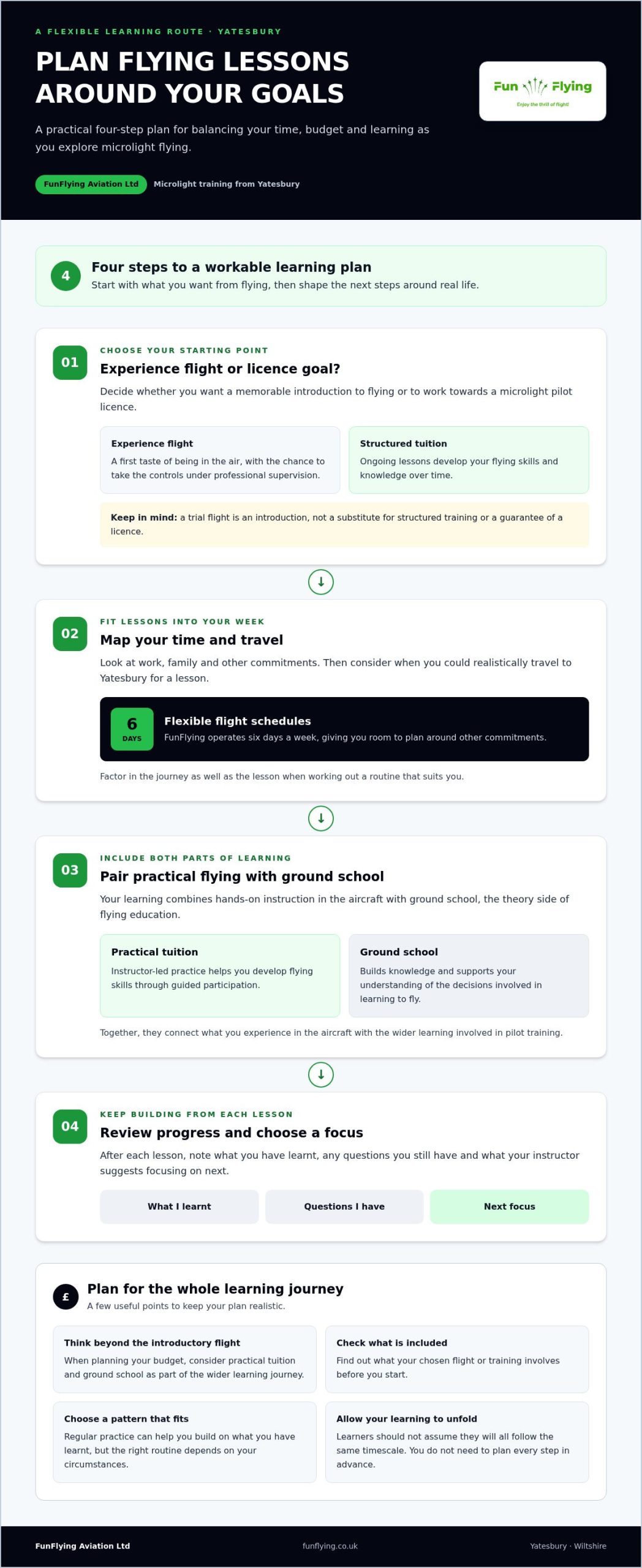
A little planning can help you make each lesson count without trying to predict exactly how long training will take. Start with what you want from flying, then make a realistic plan around your time, budget and learning progress.

  1. Set your goal. Are you looking for a memorable experience flight, or do you want to work towards a microlight pilot licence? Knowing the difference helps you choose a useful first step.
  2. Map your availability. Look at work, family and other commitments, then identify when you could realistically travel to Yatesbury for lessons.
  3. Make room for the theory. Include ground school in your plan. It supports the knowledge side of learning alongside practical flying.
  4. Review your progress. After each lesson, note what you’ve learnt, any questions you still have and what your instructor suggests focusing on next.

When planning your budget, consider the wider learning journey, including practical tuition and ground school, rather than treating an introductory flight as the full cost of pilot training. Before you start, find out what your chosen flight or training involves. You don’t need to plan every step in advance, and learners shouldn’t assume they will all follow the same timescale.

Match lesson planning to your real-life schedule

FunFlying offers flexible flight schedules and operates six days a week, giving learners room to plan around busy lives. If you’re travelling to Yatesbury, factor in the journey as well as the lesson when choosing a workable routine. Regular practice can help you build on what you’ve learnt, but the right pattern is one that fits your circumstances.

Keep the learning goal in view

Between lessons, jot down your instructor’s feedback, questions and next steps so you can return with a clear focus. If licence training is your aim, explore the microlight pilot-training guide to see how structured tuition can support your goal.

Explore microlight training options

Pay-as-you-go flying lessons in Wiltshire: choose your route to the sky

Start your Wiltshire flying lessons at Yatesbury

FunFlying Aviation Ltd provides microlight training from the Wiltshire Microlight Centre in Yatesbury. It’s a Wiltshire base for learners who want to explore flying through friendly, hands-on instruction, whether they’re curious about an introductory flight or considering structured pilot training. Flexible flight schedules and operations six days a week can help you plan around other commitments.

What makes Yatesbury a practical starting point?

Yatesbury gives you a clear base for your flying lessons. If you’re travelling from Swindon, Bristol, Newbury, Reading, Basingstoke, Andover, Bournemouth or Portsmouth, include the journey to the Wiltshire Microlight Centre in your planning, along with time for your lesson and any ground school. Check your route before setting off and allow your schedule to work with the trip, rather than relying on assumed journey times. Knowing where you’ll be learning makes it easier to picture how lessons could fit into everyday life.

Take the next step towards learning to fly

If you’re excited by the idea of taking control with an instructor beside you, microlight tuition is a welcoming way to begin. Start with a trial or experience flight, then decide whether you’d like to build on it through ongoing training. The microlight training pathway gives you an overview of the learning route. As you gain experience, practical instruction helps you focus on each next step.

Take your first step towards learning to fly

Your next chapter could begin in the air

With pay as you go flying lessons Wiltshire, you don’t have to know exactly where your interest will lead before you begin. Let your first experience answer the questions that matter to you: how it feels to take the controls, what you’d like to learn next and whether flying deserves a bigger place in your plans.

Then take it one decision at a time. You might want the thrill of a flight, or you may feel ready to explore a longer learning journey. Either way, you can move forward with a clearer sense of what suits you, without needing every step mapped out in advance.

Explore microlight training and take your first step

Your view of the sky could soon be very different. Start with curiosity, explore the training pathway and take your first step towards flying.

Frequently Asked Questions

How much do pay-as-you-go flying lessons in Wiltshire cost?

The total cost depends on the tuition arrangement and how your training develops. For pay as you go flying lessons Wiltshire, use FunFlying’s learn-to-fly information to review the training route. A trial or experience flight is an introduction, not the total cost of progressing through longer-term training.

How many lessons does it take to earn a microlight pilot licence?

There isn’t a reliable lesson count to promise, because progress depends on the learner and how their training develops. Rather than planning around an assumed timetable, focus on building skills steadily and discussing your progress with your instructor. After a lesson, note which parts feel more familiar and what you’d like to ask about next. Your instructor can help you identify useful learning goals as you go.

Can I try a flying lesson before committing to longer-term training?

Yes. FunFlying offers introductory trial and experience flights, so you can get a feel for flying under professional supervision before deciding whether to pursue ongoing tuition. Treat the first flight as a way to explore your interest, not as a promise of a particular training result. If you decide you’d like to continue, structured microlight tuition and ground school are part of the wider learning journey.

Are microlight flying lessons suitable if I have never flown before?

Yes, you can explore flying without previous experience. FunFlying’s instructors take a friendly, hands-on approach, with learners taking control under professional supervision from their first lesson. Your instructor can explain what you’re doing in clear, accessible language, so you can focus on the experience rather than arriving with technical knowledge. It’s a welcoming way to find out whether you’d like to learn more.

Marce Colucci

Article by

Marce Colucci

Love to fly, and more importantly, love teaching others to fly.

Become a Pilot in the UK: Find the Cheapest Route for You

Become a Pilot in the UK: Find the Cheapest Route for You

If you’re searching for the “become a pilot UK cheapest route”, start by deciding what kind of flying you want to do. Recreational microlight flying and a professional aviation career involve different training pathways, so their costs and commitments are not like for like.

Look beyond an advertised starting figure. The aircraft you train in, how regularly you fly and the time you set aside for ground study all affect your training journey. This guide explains how to compare recreational routes and plan around your goals, schedule and budget.

If microlight flying sounds like your kind of adventure, you can start in Wiltshire. At the Wiltshire Microlight Centre in Yatesbury, Fun Flying Aviation Ltd provides microlight training and ground school. You take control of the aircraft from your first lesson under instructor supervision, with flexible scheduling to fit around busy lives.

Key Takeaways

  • The right route depends on your goal: recreational microlight flying and a professional aviation career require different training pathways.
  • To find the become a pilot UK cheapest route for you, compare what each option prepares you to do, not just its headline price.
  • Plan for lesson continuity, personal progress, weather and ground study, as well as the training requirements for your chosen route.
  • If you’re near Swindon, Bristol or Newbury, consider whether Yatesbury is a practical base for microlight training.

What does the cheapest route to become a pilot in the UK really mean?

The lowest-cost option on paper isn’t automatically the best value. A route makes sense when it prepares you for the flying you want to do. First, decide whether you want to enjoy recreational flights in a microlight or pursue a professional aviation career. These are different ambitions, with different training pathways, so comparing them as if they were interchangeable can lead you in the wrong direction.

Your overall commitment depends on more than the route’s headline requirements. It also depends on how your skills develop, how regularly you can take lessons and how much time you devote to learning away from the aircraft. When comparing options, consider how each one fits your routine and what it prepares you to do. Gaps between lessons may affect your progress, so a realistic plan is more useful than choosing by an initial figure alone.

Are you aiming to fly for fun or pursue a flying career?

Start with the kind of flying you picture yourself doing. If you want to fly a microlight for enjoyment, recreational microlight training is the relevant route to explore. If your aim is professional flying, look into a career-focused pathway designed for that goal, or discover Florida Flyers Flight Academy to explore commercial pilot licence options and costs. The two routes have different purposes and should be assessed separately.

The Pilot licensing in the UK overview introduces different licence routes, including microlights. For a practical first step towards recreational flying, explore learning to fly a microlight. Ground study is part of building your knowledge alongside practical lessons, so consider how you’ll fit both into your routine.

In short, the become a pilot UK cheapest route depends on what “become a pilot” means to you. Define your destination, then compare the training requirements and the time and effort involved. That helps you focus on the flying that excites you, rather than a pathway that doesn’t match your ambitions.

Why microlight training may suit a recreational pilot in the UK

If you want to enjoy flying microlight aircraft, training for recreational microlight flying is a natural place to focus. The aim isn’t to choose a route because it sounds quicker or less involved. It’s to learn the skills and knowledge that relate to the flying you want to do. A career-focused pathway has a different objective, so compare each option by what it prepares you for.

What does microlight training involve?

Learning combines practical instruction in the aircraft with ground study, which builds your understanding beyond the controls and the view from the cockpit. At FunFlying Aviation Ltd, lessons are hands-on: from your first lesson, you take control of the aircraft under instructor supervision. Ground school supports your practical experience and helps you develop knowledge as your flying progresses. The British Microlight Aircraft Association also offers information for people exploring microlighting in the UK.

How is a recreational route different from professional training?

Recreational microlight training is designed for people learning to fly for personal enjoyment. Professional training has a career objective and follows a different pathway. Licence privileges, meaning what a particular licence allows you to do, and training requirements depend on the route. Use current Civil Aviation Authority guidance when comparing qualifications and their requirements.

If you’re weighing microlight training against a professional aim, how to learn to fly a microlight explains how training fits a recreational goal. Start with the aircraft you want to fly, then make sure the route you’re considering is designed for that outcome.

How to keep UK pilot training costs manageable without cutting corners

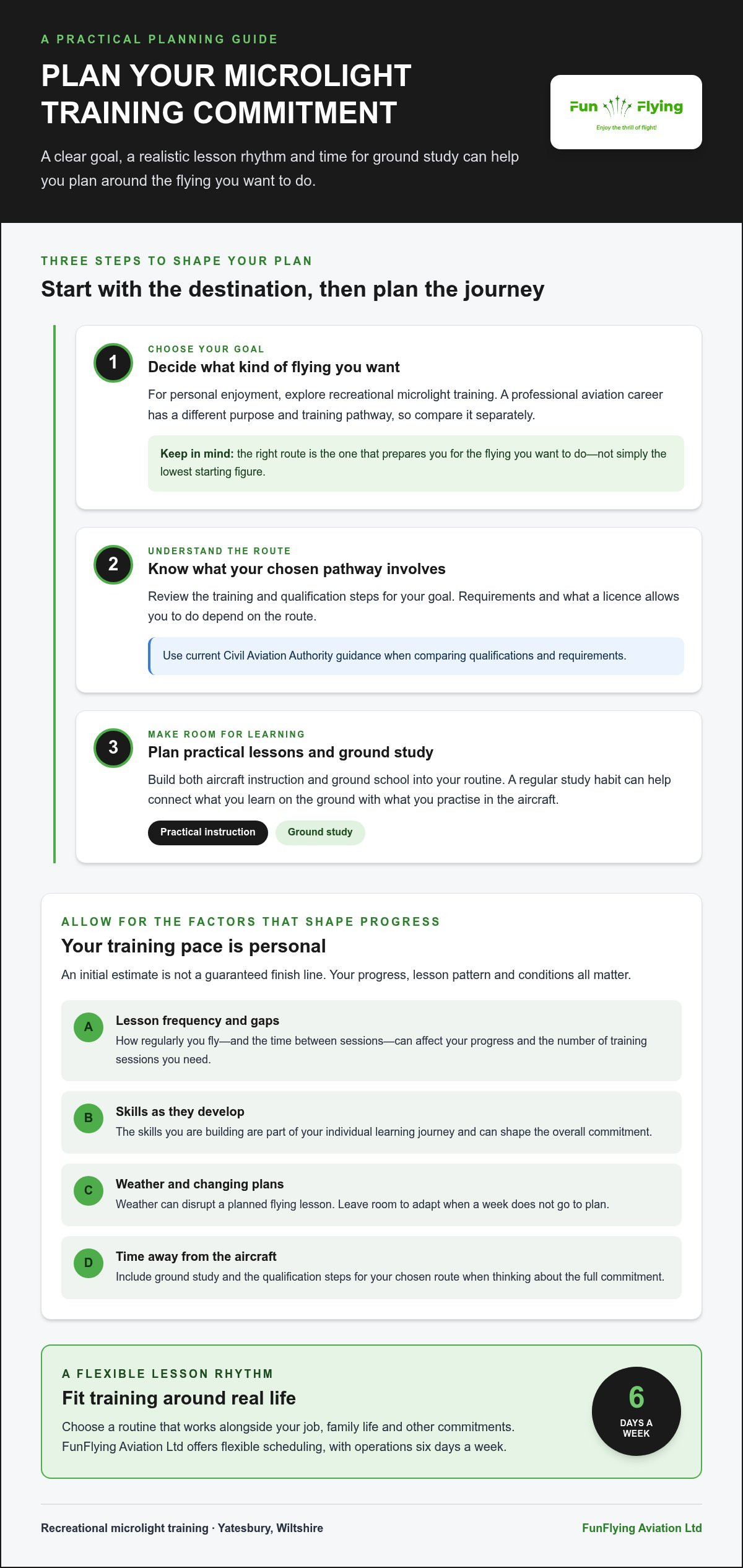
A sensible budget starts with a clear plan, not a shortcut. The become a pilot UK cheapest route for you depends on matching your ambition to the right training and allowing for how learning unfolds. Before setting expectations, work through these steps:

  1. Define your goal. Decide what kind of flying you want to do and which aircraft you want to learn in.
  2. Understand the route. Review the training and qualification steps for that goal, using current guidance for the relevant route.
  3. Plan lessons and study. Make room in your routine for practical instruction and ground school, not just time in the aircraft.

Which factors affect the overall training commitment?

Your progress is personal. Lesson frequency, the time between sessions and the skills you’re developing can all affect how many training sessions you need. Weather can also disrupt a planned flying lesson, so don’t treat a minimum or initial estimate as a guaranteed finish line. Include ground study and the qualification steps for your chosen route when planning the full commitment.

Ground study gives context to practical flying and helps you build knowledge alongside your handling skills. A regular study routine can help you connect what you learn on the ground with what you practise in the aircraft. Explore the microlight ground school and training guide as you plan.

How can flexible scheduling help you stay on track?

Choose a lesson rhythm that works alongside your job, family life and other commitments. A realistic routine is more useful than an ambitious one that’s hard to maintain. FunFlying Aviation Ltd offers flexible scheduling, with operations six days a week, to help lessons fit around busy lives. Weather and personal progress still shape the pace, so leave room to adapt when a week doesn’t go to plan.

Explore microlight flight training

Become a Pilot in the UK: Find the Cheapest Route for You

Starting microlight pilot training near Wiltshire: your next steps

Fun Flying Aviation Ltd provides recreational microlight training in Yatesbury. If you’re in Swindon, Bristol, Newbury, Reading, Basingstoke, Andover, Bournemouth or Portsmouth, think about how the journey to Yatesbury would fit into your routine, especially if you plan to fly regularly. Factoring in travel alongside work and other commitments can help you choose a realistic lesson pattern.

What can you expect from your first step at Yatesbury?

An introductory flight lets you experience microlight flying before deciding whether to begin a full training programme. It’s a flying experience in its own right, with the chance to take the controls under professional supervision. If you decide you want to learn, you can explore the structured training route and consider how it fits your goals and everyday routine.

You can choose a first step that suits you. If you’re ready to learn, explore the training route and what it involves. If you’d rather experience a flight first, book an introductory flight. Either way, you’ll have a clearer idea of what you want from flying.

Where can you explore the microlight training route?

As you consider the become a pilot UK cheapest route, keep your focus on recreational microlight flying and the training that supports that goal. Look at how practical instruction and ground study fit into your plans, then consider whether travelling to Yatesbury works for you. A route needs to feel manageable in everyday life, not just on paper.

Explore the microlight training route and take a relaxed first step towards flying.

Take your next step towards the skies

You don’t need to have every detail of your flying future mapped out before taking a first step. Turn the ambition into a practical decision: what would you most enjoy learning to fly, and what would make training fit your life? Keeping your personal goal in view helps you compare routes on more than a headline figure.

The become a pilot UK cheapest route question is easier to answer when it’s tied to the flying you actually want to do. If microlights capture your imagination, learning about the training route can help you picture what’s involved. You can take the next step at your own pace, with a clearer sense of what you’re working towards.

Explore microlight pilot training

Your first step towards the skies can be a small one. Explore microlight training with FunFlying Aviation Ltd and discover whether this route is right for you.

Frequently Asked Questions

What is the cheapest way to learn to fly in the UK?

For recreational flying, microlight training is a route to consider if microlights are what you want to fly. The become a pilot UK cheapest route depends on your aircraft and qualification goal, so compare what each training pathway covers rather than choosing based on an introductory offer alone. Professional flying has a separate training pathway; check current Civil Aviation Authority guidance for the requirements that apply.

Can you become a pilot in the UK without spending a fortune?

You can make the commitment more manageable by focusing on the kind of flying you want to do and planning training around your budget. For example, if you want to fly microlights recreationally, explore training for that goal rather than a career-focused pathway. Set aside time for study as well as flying, and don’t assume an initial estimate covers every step.

Is microlight training cheaper than PPL training in the UK?

Microlight training and PPL training prepare you for different types of flying, so compare the purpose and qualification requirements of each route rather than treating them as interchangeable. Your overall commitment also depends on your progress and lesson pattern. FunFlying Aviation Ltd provides microlight training and ground school.

How long does it take to become a microlight pilot in the UK?

There’s no set calendar time that applies to every student. Your progress, how regularly you can fly, the weather and the requirements for your chosen qualification all play a part. Someone with a steady lesson routine may progress at a different pace from someone whose work or family commitments create longer gaps. Treat any timeline as personal, not as a guaranteed completion date.

Where can I learn to fly a microlight near Swindon?

FunFlying Aviation Ltd provides microlight training at the Wiltshire Microlight Centre in Yatesbury, a local option for people based in Swindon. The centre is also relevant to people travelling from Bristol, Newbury, Reading, Basingstoke, Andover, Bournemouth or Portsmouth. Consider how regularly you can make the journey, then explore the training route or start with an introductory flight.

Marce Colucci

Article by

Marce Colucci

Love to fly, and more importantly, love teaching others to fly.

Recreational Flying UK: Find Your Way Into the Sky

Recreational Flying UK: Find Your Way Into the Sky

What if your first step into the sky didn’t mean signing up for months of lessons? An introductory flight lets you experience microlight flying and try the controls with an instructor, while leaving the decision about training for later. It’s one way to explore recreational flying UK, where options range from microlights and light aircraft to gliding, paragliding and drones.

Questions about time, licences or medical requirements can make flying feel complicated. You can start by discovering which activities appeal to you, then explore training if you want to take things further. This guide compares ways to get involved, explains how an experience flight differs from structured pilot training, and outlines what to check about requirements before you begin.

In Wiltshire, Fun Flying Aviation Ltd operates experience flights and microlight training from the Wiltshire Microlight Centre in Yatesbury. Whether you’re simply curious or already imagining yourself at the controls, an introductory flight can be a practical way to see how microlight flying feels.

Key Takeaways

  • Recreational flying UK covers different activities, from microlights and light aircraft to gliding and ballooning.
  • A supervised experience flight offers a taste of flying, while training involves building skills over time.
  • Use a simple step-by-step approach to explore flying, and ask what an experience includes before booking.
  • At the Wiltshire Microlight Centre in Yatesbury, FunFlying offers experience flights, microlight training and ground school.

What does recreational flying in the UK include?

Recreational flying covers leisure flying and related aviation activities. It can mean piloting an aircraft, taking a supervised flight or trying an air sport. Unlike commercial air transport, which carries passengers or freight as a service, recreational flying is pursued for personal enjoyment, interest or sport.

There’s no single aircraft or route into the hobby. You might explore microlights or light aircraft, take a glider up on rising air, or experience a balloon flight. Other forms of aviation and air sports offer different ways to enjoy the sky. The wider General Aviation in the UK overview shows how broad non-airline aviation can be. To decide what to explore, consider whether you want to fly as a pilot or experience a flight as a passenger, then check the aircraft, training route and requirements for that activity.

How does a microlight fit into recreational flying?

A microlight is one option within this wider mix, not a synonym for all recreational flying. It’s a type of small aircraft used for recreational flying. If you’re considering learning to fly one, look into training and requirements specific to microlights rather than assuming they’re the same as those for other aircraft. An instructor can explain what the learning process involves.

Is recreational flying only for people ready to train?

No. You can explore aviation without committing to becoming a pilot. A supervised introductory experience gives you a taste of flying with an instructor, while structured lessons and ground school are for people who want to build their skills over time. If learning to fly becomes your goal, explore microlight pilot training as a next step. At FunFlying Aviation Ltd, instructors introduce students to the controls from their first lesson, under guidance.

Is recreational flying too demanding to fit around everyday life?

Learning to fly takes time and regular effort, but you don’t need to commit to a training programme just to find out whether being in the air feels right for you. A supervised experience flight is an introduction; training is a longer learning journey that builds your skills step by step.

Trying a flight and starting pilot training are different decisions. You can enjoy an experience flight without deciding to train. If you’re curious about the wider community around recreational flying UK, the Light Aircraft Association is a useful place to explore recreational light aircraft and related interests.

What does learning to fly generally involve?

The Civil Aviation Authority (CAA) describes training elements that can include ground study, flying with an instructor, solo practice and a flight test. Ground study covers the knowledge needed to fly, while instructor-led lessons help you develop practical skills. Solo practice and a test may form part of progressing towards a licence. This is general guidance, not a guaranteed sequence for every aircraft or training route.

The pace and timetable depend on the activity, your routine and the training provider. Before you start, ask what lessons involve and how they might fit around your existing commitments. At FunFlying Aviation Ltd, students are introduced to the controls from their first lesson under instructor guidance. You can also explore microlight pilot training.

Do age and medical requirements apply to every type of flying?

Requirements aren’t automatically the same across all forms of flying. The CAA says they vary according to the aircraft and licence, so don’t assume that rules for one route apply to another. Check the latest CAA guidance for your intended activity, and ask the training provider which requirements are relevant before making plans. Getting clear answers can help you work out what applies to your chosen route.

How can you try recreational flying before choosing a training route?

A first flight can help you discover what appeals without requiring you to decide on training straight away. In recreational flying UK, an introductory experience is a supervised taste of being in the air, not a substitute for instruction or a pilot’s licence. Start with curiosity, then choose your next step based on how the experience feels.

  1. Clarify your interest. Decide what you’d like to try, such as microlight flying or gliding.
  2. Explore a supervised flight. Check what local providers offer and what the session includes.
  3. Reflect afterwards. Consider what you enjoyed and whether you’re curious to learn more.
  4. Research training. If you want to progress, compare the learning route and requirements for your chosen activity.

What should you ask before booking an introductory flight?

Ask what happens on the day, what the experience includes and who will supervise or instruct you. Find out how weather might affect arrangements and what the provider will do if conditions change. These details can vary, so ask the provider directly rather than assuming every introductory flight works the same way.

What if your first flight makes you want to learn?

If the experience leaves you keen to continue, ground school can help you build aviation knowledge, while instructor-led lessons develop your practical flying skills. For a broader look at the pathway, explore the article How to Become a Microlight Pilot; for study advice, see Mastering the Sky: The Ultimate Guide to Microlight Ground School UK. FunFlying’s instructors introduce students to the controls from their first lesson, with guidance as they learn.

Explore microlight pilot training

Recreational Flying UK: Find Your Way Into the Sky

Where can you explore recreational flying near Wiltshire?

If you’re in Wiltshire or nearby, Fun Flying Aviation Ltd operates from an airfield in Yatesbury. It’s a local option for experiencing microlight flying or finding out what structured training involves. The business serves people in Swindon, Bristol, Newbury, Reading, Basingstoke, Andover, Bournemouth and Portsmouth, so Yatesbury may be worth considering if you’re looking for a practical introduction to recreational flying UK.

For local background before you plan a visit, look for local airfield and flying guides. They can help you get your bearings and understand the setting for a flight or training.

What can you do at the airfield?

Fun Flying Aviation Ltd offers supervised introductory experience flights, microlight training and ground school. An experience flight lets you discover what being in a microlight feels like with an instructor supervising you. It’s an introduction, not training that qualifies you to fly independently.

If you decide you’d like to learn, structured lessons offer a way to build your skills over time. Fun Flying Aviation Ltd instructors introduce students to the aircraft controls from their first lesson, with guidance as they learn. Ground school supports the learning journey by helping you study the knowledge involved in flying.

How do you take the next step?

You don’t need to arrive with a firm plan. Decide whether you’d prefer to experience a flight or ask about learning, then check what suits your interests and routine. Before making arrangements, confirm current availability and ask the provider what to expect.

Ready to explore the training route? Explore learning to fly, or ask Fun Flying Aviation Ltd about a suitable introductory flight or microlight training option. Your next step could be a fresh view of Wiltshire from above.

Make your first move towards the sky

Recreational flying UK includes different ways to enjoy aviation. The right fit depends on what interests you and how far you want to take it. Start with a supervised introductory experience flight, then decide whether structured training feels right. Trying a flight doesn’t commit you to learning, and you can explore training one step at a time.

For a local microlight option, FunFlying operates from the Wiltshire Microlight Centre in Yatesbury, offering introductory experience flights and instructor-led training. Students are introduced to the aircraft controls from their first lesson, under instructor guidance. Ground school can support the learning journey too.

If you’re curious about learning, consider whether the training route suits your ambitions and routine.

Frequently Asked Questions

What is recreational flying in the UK?

Recreational flying in the UK means taking part in aviation for leisure, enjoyment or sport rather than travelling on a commercial airline. It covers activities such as piloting microlights or light aircraft, gliding, ballooning and other forms of air sport. Each option has its own aircraft, learning routes and requirements, so you can explore what appeals before deciding whether you want to fly as a pilot.

Can I try flying before committing to pilot training?

Yes. A supervised introductory experience flight lets you discover what flying feels like without signing up for a training programme. Ask the provider what the session includes, who will supervise you and what to expect on the day. It’s a way to explore your interest, not a substitute for pilot training or permission to fly an aircraft independently. You can consider lessons later if you want to progress.

Do I need a licence for recreational flying?

It depends on what you mean by flying and which aircraft or activity you choose. A supervised experience flight is different from operating an aircraft yourself; an introductory flight doesn’t give you a pilot’s licence. Licence requirements vary by aircraft and flying route, so check current Civil Aviation Authority (CAA) guidance for the activity you’re considering. Ask the training provider to explain which requirements apply before you begin.

Where can I try microlight flying near Wiltshire?

FunFlying Aviation offers supervised introductory experience flights, microlight training and ground school at the Wiltshire Microlight Centre in Yatesbury. Students are introduced to the controls from their first lesson under instructor guidance; this doesn’t mean they can fly independently. The business serves people in Swindon, Bristol, Newbury, Reading, Basingstoke, Andover, Bournemouth and Portsmouth. Check current availability and travel details directly with the provider.

To ask about an introductory flight or microlight training, explore learning to fly with FunFlying.

Marce Colucci

Article by

Marce Colucci

Love to fly, and more importantly, love teaching others to fly.

Learn to Fly Near Reading: Choosing Your First Lesson

Learn to Fly Near Reading: Choosing Your First Lesson

The closest airfield isn’t automatically the right place to learn to fly. If you want to learn to fly a plane near Reading, check where lessons take place, which type of training is offered and whether the journey fits your week. “Flying lessons” can mean different things, so it helps to be clear about what you want before booking.

This guide will help you compare the practical details and decide whether training at Yatesbury could suit your plans. Fun Flying Aviation Ltd operates from the Wiltshire Microlight Centre in Yatesbury, not Reading, and offers microlight training rather than PPL or commercial pilot certification. You’ll find out what a first flight involves, how ongoing training works and what to ask about travel and scheduling. Students take control under instructor supervision from their first lesson, and flexible schedules across six operating days each week may make it easier to explore your options.

Key Takeaways

  • Decide whether an introductory flight or structured microlight training better matches what you want from flying.
  • When comparing lessons near Reading, consider training type, instructor approach, scheduling and the journey to the airfield.
  • Ask what an introductory flight involves and how it could help you decide whether to continue with training.
  • Check that microlight training fits your goals, and ask how ground school supports the practical lessons.

Learning to Fly Near Reading? Choose the Right Lesson

Imagine taking the controls and seeing the landscape open up beneath you. If you want to learn to fly a plane near Reading, your search may take you beyond the town itself. Consider both the type of lesson you want and where it takes place. A trial flight gives you a first experience of flying with an instructor. Structured training is for people who want to build their skills through lessons towards a microlight licence.

A microlight trial flight is a good fit if you want to experience flying with an instructor before deciding whether to pursue training.

What kind of flying lesson are you looking for?

First decide whether you want a one-off introductory experience or a longer-term training goal. FunFlying Aviation Ltd offers trial flights as well as microlight licence training, so you can explore the experience or ask about a training pathway. If your aim is a PPL or commercial pilot training, confirm that a school offers it before travelling. FunFlying’s training is for microlights, not PPL or commercial pilot certification. For background on different pilot licensing options in the United Kingdom, read up before choosing a direction.

Where does FunFlying Aviation Ltd teach students near Reading?

FunFlying Aviation Ltd teaches from the Wiltshire Microlight Centre in Yatesbury. Reading is among the areas it serves, but the school isn’t based in Reading. Check your route and consider how the journey would work around your regular commitments, especially if you plan to take ongoing lessons. Ask the school about current lesson options and scheduling before making plans.

For an overview of the school’s microlight flying lessons, explore its learn-to-fly information. Knowing the training type and base upfront makes it easier to decide whether this is the right first step.

Compare flying lessons near Reading by training, support and schedule

The shortest journey isn’t the only factor to weigh. To learn to fly a plane near Reading, compare how the training fits your goal with how practical it is to reach the airfield. Use this checklist when speaking with a school:

  • Training type: Which aircraft category and training pathway does the school offer? Check that it matches your goal.
  • Instructor approach: Will you take an active role during lessons, with an instructor guiding and supervising you?
  • Schedule: How are lesson times arranged, and can they work around your existing commitments?
  • Location: Where do lessons take place, and would the journey be manageable for regular visits?

FunFlying Aviation Ltd’s approach is hands-on: students take control under instructor supervision from their first lesson. The school offers flexible flight schedules and operates six days a week. Ask what that flexibility means for current lesson availability and how sessions are arranged. To review the training available, explore the microlight flight training options.

Questions to ask before choosing a flying school

Be specific about your goal and the type of lesson you’re considering. Useful questions include: “Is this an introductory flight or part of ongoing training?”, “Where will the lesson take place?” and “How are lesson times arranged?” If you’re comparing schools, ask each the same questions. You’ll be able to compare the training and scheduling as well as the journey, rather than choosing by postcode alone.

Does microlight training match your goal?

FunFlying Aviation Ltd focuses on microlight training. Its services include ground school, trial flights, licence revalidations for pilots who need to revalidate their licence, and conversion training for pilots moving to microlight aircraft. If you’re aiming for a Private Pilot Licence (PPL) or commercial pilot training, check that a school offers it before making plans. The right fit is the one that matches both your flying goal and your everyday schedule.

What to expect from a first microlight lesson at Yatesbury

Start with a conversation. Contact FunFlying to explain what you hope to get from flying, where you’ll be travelling from and whether you’re interested in an introductory flight or microlight training. Ask about current lesson options and scheduling before setting off from Reading. This gives you a chance to check the practical details before making the journey.

FunFlying operates from the Wiltshire Microlight Centre in Yatesbury. Introductory flights take place with an instructor, and students take control under supervision from their first lesson. It’s a hands-on introduction, not simply a chance to sit back and watch.

From an introductory flight to structured training

A trial flight gives you a first experience of microlight flying and a chance to take part. It may help you decide whether you want to explore a longer training pathway, but you can discuss the options with the school before deciding. Ask how an introductory flight differs from microlight licence training and what the next steps would involve if you choose to continue.

An introductory flight lets you experience flying under an instructor’s supervision before deciding whether to pursue further training.

Plan the journey from Reading to the training base

Yatesbury is the training base, so check your route from Reading and consider how often you’d be comfortable making the journey if you continue with lessons. Discuss scheduling with FunFlying, including how its flexible flight schedules might fit around your commitments. Lesson availability and arrangements can vary, so confirm the details before travelling.

To explore the training in more detail, visit FunFlying’s information on microlight flying lessons.

Explore microlight flight training

Learn to Fly Near Reading: Choosing Your First Lesson

Take your next step towards learning to fly near Reading

Ready to turn curiosity into a practical plan? First check that microlight training matches what you want to do, then decide whether travelling to FunFlying’s base at the Wiltshire Microlight Centre in Yatesbury feels manageable. Ask about scheduling so you can understand how lessons might fit around work and other commitments.

FunFlying offers ground school alongside practical microlight training. Ground school supports the theory side of learning, so ask how it fits into the training pathway you’re considering. For a further introduction, look for Mastering the Sky: The Ultimate Guide to Microlight Ground School UK.

A simple checklist before you enquire

A little preparation can make your first conversation more useful. Note down:

  • Your goal: are you exploring flying, or considering microlight training?
  • When you may be available for lessons and what flexibility you need.
  • Questions about the Yatesbury base, your journey there and how lessons are arranged.
  • Anything about your circumstances you’d like the school to clarify before you make plans.

Ask FunFlying to confirm its current lesson options and any details that depend on your circumstances. You don’t need to have every answer before getting in touch. A straightforward conversation can help you judge whether the training and journey suit you.

If you’re looking to learn to fly a plane near Reading, start by discussing your goals, the journey and available options with the school.

Enquire about microlight training

Make your first flying lesson a confident choice

Choosing where to learn is about more than finding a school near home. Check that the training matches your goal, understand the journey to the airfield and ask how lessons could fit around your routine. If you want to learn to fly a plane near Reading, FunFlying offers microlight training from the Wiltshire Microlight Centre in Yatesbury, not from a Reading base.

Students take control from their first lesson under instructor supervision. Flexible schedules and operations six days a week may help you explore how training could fit your commitments. Confirm current lesson options and arrangements directly with the school, then decide whether microlight flying is the right direction for you.

Explore microlight flight training

Your first step doesn’t have to be a big leap. Start with a conversation, ask what you need to know and see whether microlight flying could suit you.

Frequently Asked Questions

Can I learn to fly a plane near Reading?

Yes. FunFlying Aviation Ltd serves Reading with microlight flight training and introductory flights, although its training base is at the Wiltshire Microlight Centre in Yatesbury, not in Reading. Compare the training offered with the journey to the airfield. FunFlying also lists Swindon, Bristol, Newbury, Basingstoke, Andover, Bournemouth and Portsmouth among the areas it serves.

Where is FunFlying’s flying school for Reading students?

FunFlying teaches from the Wiltshire Microlight Centre in Yatesbury. Reading is within its stated service area, but the school isn’t physically based there, so check your route before making plans. Ask about the location, current lesson options and scheduling to judge whether travelling from Reading is practical for an introductory flight or ongoing microlight training.

Do I need flying experience before my first microlight lesson?

You can enquire about a first microlight lesson without having previous flying experience. FunFlying offers introductory trial flights with an instructor, and students take control under supervision from their first lesson. Contact the school to discuss what you’d like to experience and ask about current options before booking. If you have questions about personal eligibility or other requirements, confirm these directly with the school.

Is microlight training the same as PPL training?

No. Microlight training and PPL training are different pathways, and FunFlying offers microlight licence training, not PPL training. Its services also include ground school, which supports the theory side of learning alongside practical flight instruction. If your goal is a PPL or another type of pilot training, check that a school offers the specific training you need before travelling or making a booking.

Can I fit microlight flying lessons around work?

FunFlying offers flexible flight schedules and operates six days a week, which may help you explore how lessons could fit around work or other commitments. Scheduling depends on your availability and current lesson options, so ask the school what arrangements are possible. Include the journey to Yatesbury in your plans, particularly if you’re considering regular training from Reading.

Marce Colucci

Article by

Marce Colucci

Love to fly, and more importantly, love teaching others to fly.

Flying School Near Basingstoke: 2026 Learn to Fly Guide

Flying School Near Basingstoke: 2026 Learn to Fly Guide

Imagine stepping away from the daily grind, climbing into a cockpit, and taking the controls of an aircraft on your very first day. What if learning to fly was far more accessible than you ever thought possible? If you’re searching for a welcoming flying school near Basingstoke, you might worry that pilot training demands an astronomical airline budget or deep technical expertise. It’s easy to feel intimidated by complex regulations and wonder how to fit lessons around a busy full-time working schedule.

You deserve an exhilarating escape into tranquil skies. This 2026 guide reveals exactly how accessible pilot training is from Basingstoke, from your first hands-on trial flight to earning your wings. We’ll map out the practical, step-by-step path to taking flight, showing you how relaxed sport aviation fits around your life. Get ready to experience the ultimate sense of freedom and see how easily you can become the pilot.

Key Takeaways

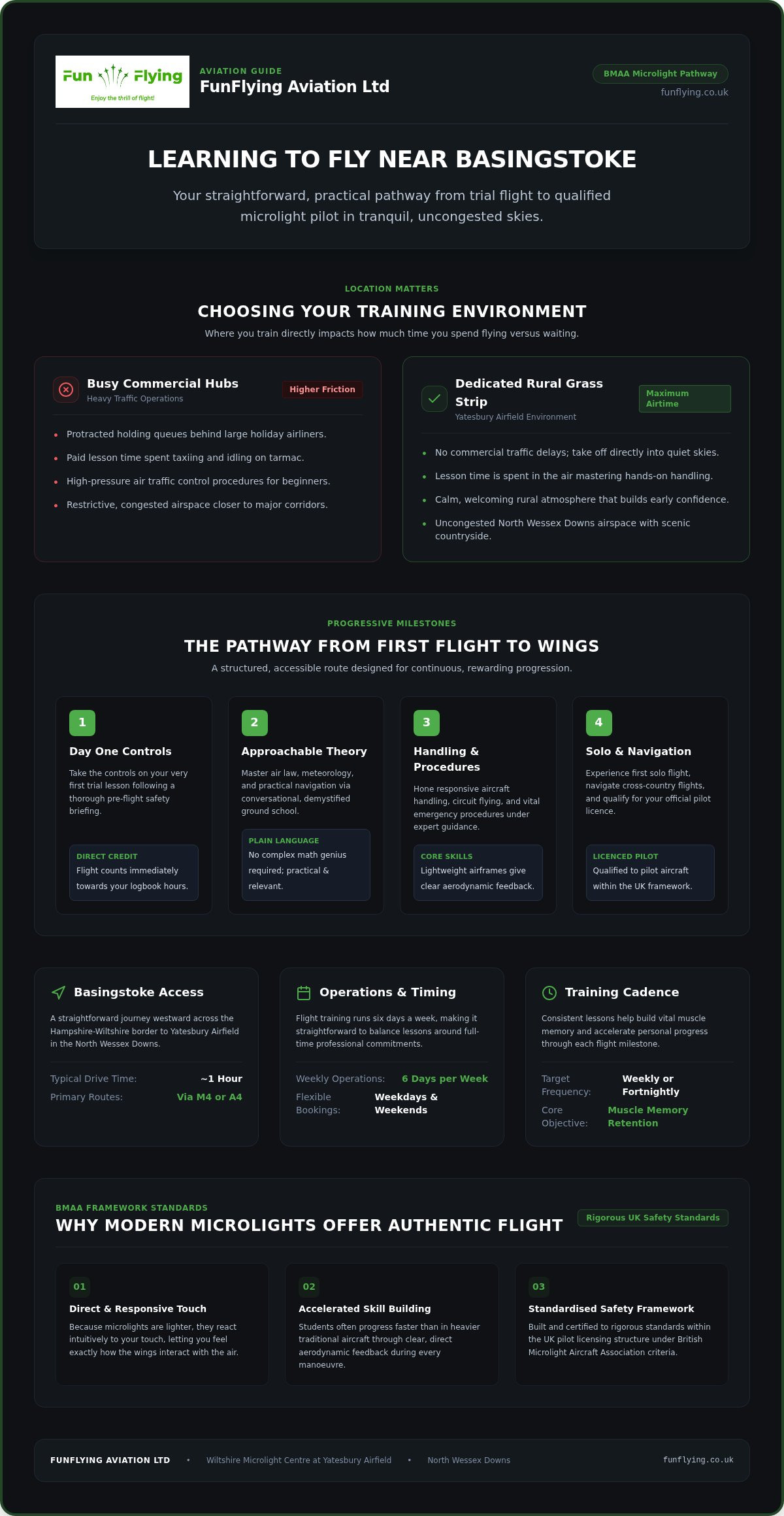
  • Discover why a tranquil grass-strip airfield offers the perfect, stress-free environment to master the skies without the pressure of busy commercial traffic.
  • Learn the simple, step-by-step pathway to earning your microlight licence, ensuring you feel confident and supported from your very first take-off.
  • Locate a flying school near Basingstoke that is easily accessible via the M4 or A4, offering an invigorating escape into clear, uncongested skies.
  • See how easy it is to fit your passion for aviation around a busy work schedule with flexible training sessions that focus on your personal progress.

Finding the Right Flying School Near Basingstoke: Key Training Options

You’re ready to swap the morning commute for the open clouds. Living in Hampshire gives you fantastic access to aviation opportunities just across the Wiltshire border. When searching for a flying school near Basingstoke, you’ll quickly realise that not all airfields provide the same experience. Some focus on heavy commercial traffic, while others offer a more intimate, hands-on approach. Taking control of the aircraft on your very first lesson isn’t just a dream. It’s a vital part of building piloting confidence right from the start.

Commercial Airport vs Dedicated Recreational Airfield

Imagine spending half your lesson time sitting in a runway queue behind a massive holiday jet. That’s the frustrating reality at busy commercial hubs. Dedicated grass airfields offer a calm, welcoming environment where you spend your time actually flying. These peaceful rural skies let you focus entirely on your airmanship without the pressure of complex air traffic control. Choosing a flying school near Basingstoke that operates from a quiet grass strip means you’ll enjoy an invigorating escape into tranquil, uncongested airspace every time you visit.

Why Microlight Training Offers the Purest Flying Experience

Modern microlights are agile, technologically advanced light sports aircraft. They offer a responsive feel that traditional, heavier planes often lack. If you’re wondering is microlight flying safe, you’ll be glad to know these aircraft are built to rigorous standards within the UK pilot licensing framework. Because they’re lighter, they react intuitively to your touch. This makes training incredibly exciting and intuitive. You’ll likely progress faster than in heavy traditional aircraft because you’re truly feeling how the wings interact with the air. It’s flying at its most authentic and rewarding level.

From First Flight to Pilot Wings: The Step-by-Step Pathway

Earning your wings is a journey of small, exhilarating wins rather than one giant leap. It starts with a simple, hands-on trial flight and ends with you commanding the skies as a qualified pilot. The process is designed to be inclusive, breaking down complex aviation skills into manageable milestones that anyone with a passion for adventure can master. You don’t need to be a math genius or a professional athlete; you just need the desire to look at the world from a new perspective.

The Introductory Lesson: Taking the Controls on Day One

Most people assume their first time in a cockpit will be spent watching an expert. At a quality flying school near Basingstoke, the opposite is true. You’ll take the controls during your very first lesson. After a thorough pre-flight briefing to ensure you feel completely comfortable, you’ll experience the thrill of steering through the sky. A massive benefit is that these trial flights count directly towards your official logbook hours. You aren’t just trying a hobby; you’re starting your training from the moment the wheels leave the grass strip.

Ground School and Theory Made Approachable

Theory shouldn’t be a barrier to your dreams. Ground school demystifies subjects like air law and meteorology using clear, conversational language. Instead of dry textbooks, you’ll learn practical navigation and how the weather affects your flight. You can explore the full syllabus in our guide to microlight ground school UK. Because operations run six days a week, fitting these sessions around a standard Monday-to-Friday professional schedule is straightforward. Once you’ve mastered core handling and emergency procedures, you’ll progress to solo flight and cross-country navigation. If you’re ready to begin, you can start your piloting journey today and take that first step toward total freedom.

Location and Logistics: Travelling from Basingstoke to Yatesbury Airfield

Finding a flying school near Basingstoke doesn’t mean you have to settle for busy, crowded skies. The journey westward from Basingstoke to the Wiltshire Microlight Centre at Yatesbury is a straightforward and scenic drive via the M4 or A4. In about an hour, you’ll leave the hustle of Hampshire behind and arrive at a dedicated grass airfield nestled in the stunning North Wessex Downs. This area isn’t just a beautiful backdrop; it’s an invigorating escape where every lesson feels like a true adventure amongst the clouds.

Uncongested Skies Mean More Flying Per Lesson

Quiet rural flying conditions are a game-changer for new pilots. At a busier flying school near Basingstoke, you might spend valuable lesson time sitting in a holding queue, waiting for air traffic clearance amongst commercial jets or private helicopters. In contrast, the open countryside at Yatesbury eliminates these costly delays. You’ll spend more time in the air and less time on the ground. You can explore the facilities in detail via our Wiltshire Microlight Centre guide. Without the heavy airspace restrictions found closer to London, you can focus entirely on mastering your handling skills.

Planning Your Flying Schedule Around Work Commitments

We know your life is busy. That’s why operations run six days a week, making it easy to book flexible slots that preserve your work-life balance. Whether you prefer a mid-week sunrise session or a weekend afternoon, the schedule is designed for you. Consistency is the secret to success in aviation. Aiming for weekly or fortnightly sessions helps build that vital muscle memory, helping you progress toward your licence faster. It’s about making your dream a sustainable part of your lifestyle.

Join us at the airfield and start your journey

Flying School Near Basingstoke: 2026 Learn to Fly Guide

Why Choose FunFlying Aviation for Your Flight Training Journey

Choosing a flying school near Basingstoke is about more than just finding a plane and an instructor. It’s about finding a community that shares your infectious passion for the sky. At FunFlying Aviation, we’ve built a student-first ethos that strips away the intimidation often associated with aviation. You aren’t just a number on a flight schedule; you’re a future pilot joining a vibrant, inclusive world where the joy of flight comes first. We believe learning to fly should be an exhilarating lifestyle, not a chore.

Passionate Instructors and Supportive Community

Imagine sitting in a warm clubhouse, tea in hand, whilst swapping stories with fellow students after a successful flight. Our instructors aren’t just seasoned professionals; they’re enthusiasts who tailor every session to your specific learning pace. This supportive atmosphere makes every lesson feel like a catch-up with a knowledgeable peer. For those who already hold a licence but want a more tactile, responsive experience, our conversion training makes switching to microlights incredibly smooth. You can find the full roadmap on how to become a microlight pilot to see just how accessible this world is.

Take the Leap: Booking Your First Lesson

Ready to turn that lifelong dream into a reality? Your first visit to a flying school near Basingstoke should be simple and stress-free. There’s no need for expensive gear yet. Just wear comfortable, layered clothing and flat-soled shoes to ensure you can easily operate the rudder pedals. Bring your curiosity and a sense of adventure. We’ll handle the rest, ensuring your introduction to the cockpit is the highlight of your year. Don’t let another season pass by whilst you watch from the ground. You can learn to fly with us starting today. The view from the top is waiting for you.

Your Path to the Pilot’s Seat Starts Now

Learning to fly is an achievable adventure, not a distant dream. By choosing a dedicated flying school near Basingstoke, you can trade congested airspaces for the tranquil, rolling hills of the Wiltshire Microlight Centre. You don’t need a commercial airline budget to experience the thrill of flight; you just need the desire to learn. Remember, you’ll be taking the controls on your very first lesson, guided by expert instructors who tailor every session to your pace. Training is available six days a week, making it simple to fit your new lifestyle around work and family commitments. The dedicated, friendly atmosphere at Yatesbury ensures you’re supported every step of the way, from your first take-off to earning your wings.

Book your hands-on trial flight with FunFlying Aviation today

The freedom of the clouds is calling, and it’s much closer than you think. Take that first step today and discover the incredible feeling of truly soaring above the world.

Frequently Asked Questions

How far is the flying school from Basingstoke?

Our flying school near Basingstoke is conveniently located at Yatesbury, which is roughly a one-hour drive away. You can easily reach us by heading westward along the M4 or the A4, leaving the busy Hampshire traffic behind for the clear, tranquil skies of the Wiltshire countryside. This short journey rewards you with an uncongested training environment, ensuring you spend your time in the cockpit rather than waiting on a crowded runway.

Do I need any previous experience before booking a trial flying lesson?

You don’t need any previous aviation experience to book one of our trial flights. We love welcoming newcomers into the pilot’s seat, and our expert instructors will guide you through every step of the process. You’ll even get to take the controls and steer the aircraft yourself on your very first day. It’s a completely safe, inclusive, and exhilarating way to discover if earning your wings is your next big adventure.

Can trial flight hours count towards my full pilot licence?

Every minute you spend in the air during a trial lesson counts as official training time. Because our trial flights are conducted by qualified instructors, you can log these hours towards the requirements for your microlight pilot licence. It’s the perfect way to start your journey, as it transitions seamlessly from a one-off experience into a structured training programme. You’re building your aviation CV from the very moment you leave the ground.

What medical requirements do I need to fly a microlight in the UK?

Flying a microlight in the UK is highly accessible because it uses a simplified medical declaration system. Unlike the more stringent Class 2 medical required for a traditional PPL, which involves specific Aeromedical Examiner fees, the microlight requirement is often managed through a straightforward declaration. This makes it a fantastic, lower-cost alternative for those who want to experience the freedom of flight without navigating overly complex or intimidating health regulations before they start.

How does microlight training differ from traditional private pilot training?

Microlight training focuses on modern, agile sports aircraft that are more responsive and intuitive to handle than heavier traditional planes. You’ll find a flying school near Basingstoke offers a much more hands-on and cost-effective route, requiring a minimum of 32 flight hours rather than the 45 hours needed for a PPL. It’s a faster, more vibrant path to the clouds, designed for recreational pilots who prioritise the pure joy of flight.

Marce Colucci

Article by

Marce Colucci

Love to fly, and more importantly, love teaching others to fly.

Microlight Flight Training in Wiltshire: Your Complete Guide to Earning Your Wings

Microlight Flight Training in Wiltshire: Your Complete Guide to Earning Your Wings

What if the only thing standing between you and the open sky wasn’t a massive bank balance or a lifetime of study, but simply the courage to take the first step? For those seeking microlight flight training Wiltshire provides an incredible landscape to learn, yet many assume flying is reserved for the elite, whilst others feel lost amongst a sea of licensing jargon. You might worry that your 9-5 schedule won’t allow for such an adventure. It’s easier than you think. If you’ve ever felt a pull toward the clouds, you’re not alone in that desire for true freedom.

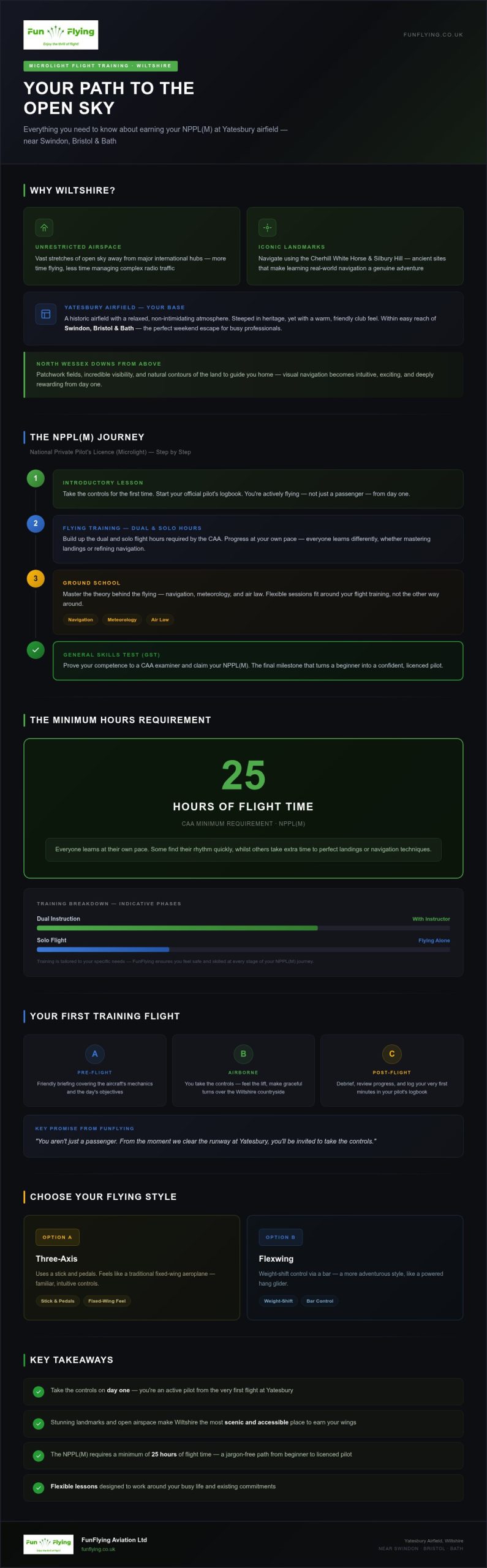
In this guide, you’ll discover how training at the historic Yatesbury airfield, near Swindon, Bristol, and Bath, can transform your dream into reality. We’ll show you how to navigate the path toward your National Private Pilot’s Licence (NPPL) and join a friendly community of local aviators. From your very first lesson, you’ll learn how to take the controls and experience the sheer joy of flight. We’re going to break down everything from costs to the thrill of your first solo circuit.

Key Takeaways

  • Feel the immediate thrill of taking the controls on day one, ensuring you’re an active pilot from the moment you leave the ground at Yatesbury.
  • Explore how the stunning landmarks and open airspace make microlight flight training Wiltshire the most scenic and accessible way to earn your wings.
  • Get a clear, jargon-free guide to achieving your National Private Pilot’s Licence (NPPL) and unlocking the ultimate sense of personal freedom.
  • Discover how to seamlessly integrate your flight training into a busy life with flexible lessons that work around your existing commitments.

Why Wiltshire is the Ultimate Classroom for Microlight Flight Training

Imagine leaving the ground behind and feeling the air support you in a nimble, responsive aircraft. That is the essence of microlight aviation. It’s a structured programme designed to teach you how to pilot lightweight, agile aircraft with complete confidence. If you’re looking for microlight flight training Wiltshire is undoubtedly the best place to start. You aren’t just joining a course; you’re stepping into a world where the horizon is your only limit. It’s about freedom, autonomy, and the pure thrill of the chase.

Wiltshire provides a massive advantage for any aspiring pilot. Unlike the crowded skies found near major international hubs, our region enjoys vast stretches of unrestricted airspace. This means more time focusing on your flying skills and less time managing complex radio traffic. You’ll use iconic landmarks like the Cherhill White Horse and Silbury Hill as your guides. These ancient sites aren’t just beautiful; they’re practical tools that make learning to navigate feel like a genuine adventure rather than a classroom exercise.

The Magic of the North Wessex Downs from Above

Soaring over the patchwork fields of the North Wessex Downs is a sensory experience like no other. You’ll feel the gentle lift of the wings and see the landscape in stunning high definition. The incredible visibility in this region is a game-changer for new students. It allows you to master visual navigation quickly, using the natural contours of the land to find your way home to the airfield. It’s intuitive, exciting, and deeply rewarding.

Yatesbury: A Centre of Aviation Excellence

Our base at the historic Yatesbury airfield provides a relaxed, non-intimidating environment that’s perfect for new pilots. It’s a site steeped in heritage, yet it retains a warm, friendly club atmosphere that sets us apart from busy commercial centres. Located within easy reach of Swindon, Bristol, and Bath, it’s the ultimate weekend escape for busy professionals. You can learn to fly amongst peers who share your passion for the skies. It’s the perfect hub for microlight flight training Wiltshire wide.

Your Path to the Pilot’s Seat: Understanding the NPPL Microlight Licence

Earning your wings is a journey of exciting milestones rather than a mountain of paperwork. It all begins with your introductory lesson. This is where you get your first real taste of the controls and officially start your pilot’s logbook. Unlike some schools, we ensure you’re flying from day one. From that first take-off, you’ll progress into flying training, building up the dual and solo hours required to satisfy the CAA. You’ll also tackle ground school, where you master the “why” behind the “how,” covering navigation, meteorology, and air law. Finally, you’ll face the General Skills Test (GST), proving your competence to an examiner and claiming your freedom. It’s a structured path designed to turn a complete beginner into a confident pilot.

How Many Hours Do You Really Need?

The CAA currently requires a minimum of 25 hours of flight time to qualify for an NPPL(M). However, it’s vital to remember that everyone learns at their own pace. Some students find their rhythm quickly, whilst others prefer to take extra time to perfect their landings or navigation techniques. The NPPL(M) is widely recognised as one of the most cost-effective and accessible ways to get into the air. If you’re ready to take that first step, you can learn to fly with FunFlying. We tailor your microlight flight training Wiltshire to your specific needs, ensuring you feel safe and skilled at every stage.

Ground School: Making the Theory Fun

Don’t let the thought of exams worry you. Ground school isn’t like being back in a dusty classroom; it’s practical, fascinating, and directly related to your time in the cockpit. We offer flexible ground school sessions that fit around your flight training, making the theory feel like a natural extension of your hobby. For a deeper dive into what to expect, read our guide on mastering the sky: the ultimate guide to microlight ground school UK. It’s the perfect companion for your microlight flight training Wiltshire.

What to Expect During Your First Training Flight at Yatesbury

Your journey with microlight flight training Wiltshire starts with a promise: you aren’t just a passenger. From the moment we clear the runway at Yatesbury, you’ll be invited to take the controls. It’s an empowering approach that builds confidence immediately. Before we even leave the ground, we’ll have a friendly pre-flight briefing. We’ll chat about the aircraft’s mechanics and the day’s specific objectives. It’s all about making you feel comfortable and prepared.

Once airborne, the sensation is incredible. You’ll feel the lift as the wings bite into the air, a feeling that’s both exhilarating and surprisingly stable. Modern microlights are remarkably intuitive. Small, precise movements of the controls translate into graceful turns over the Wiltshire countryside. After we land, we’ll sit down for a post-flight debrief. We’ll reflect on your progress and, most importantly, log those very first minutes in your pilot’s logbook.

Three-Axis vs. Flexwing: Choosing Your Style

You’ll need to decide which flying style resonates with your dream. Three-axis microlights feel like traditional fixed-wing aeroplanes, using a stick and pedals. Flexwings offer a more weight-shift adventure, controlled by moving a bar, much like a powered hang glider. We always encourage students to try both. One might feel like a natural extension of your body, whilst the other offers a different kind of thrill.

Safety and Expertise: Peace of Mind in the Air

Safety is our absolute priority. Every aircraft follows rigorous maintenance schedules, and the UK has some of the highest microlight regulatory standards in the world. Our instructors are seasoned professionals who live and breathe aviation. If you have any lingering doubts, check out our guide: Is Microlight Flying Safe? Everything You Need to Know Before Taking Off. We want you to feel completely at ease amongst the clouds.

Book your first lesson today

Microlight Flight Training in Wiltshire: Your Complete Guide to Earning Your Wings

Flexible Learning: Training That Fits Your Busy Lifestyle

One of the biggest myths about microlight flight training Wiltshire is that it requires you to drop everything else in your life. It doesn’t. We operate six days a week, giving you the flexibility to book lessons that actually suit your personal calendar. Whether you’re a busy professional in Swindon or a weekend adventurer from Bristol, your training happens on your terms. You set the tempo. Some students prefer an intensive burst to get their hours up quickly, whilst others enjoy a steady weekly lesson to savour the process. There’s no pressure to rush. We’re here to support your individual journey.

If you aren’t sure where to start, a trial flight is the perfect, no-pressure introduction. It’s a chance to see if the cockpit feels like home before committing to the full licence path. You’ll get a real feel for the aircraft and our friendly approach without any long-term commitment. It is the easiest way to bridge the gap between dreaming about flight and actually making it happen.

From Student to Pilot: The FunFlying Community

Learning to fly is about more than just stick and rudder skills. At the Wiltshire Microlight Centre in Yatesbury, you’ll find a second home. The “hangar talk” over tea and biscuits is where the real community spirit lives. It’s a place to swap stories, share tips, and celebrate every solo circuit. Even after you qualify, we’re still here for you. We offer licence revalidations and conversion training to keep your skills sharp and your passion for the skies alive.

Ready to Reach the Clouds?

Stop dreaming about the horizon and start exploring it. The freedom of the skies is closer than you think, and the path is clearer than ever. It’s time to take that first step toward becoming a pilot. For everything you need to know about the journey ahead, check out our how to become a microlight pilot: your complete 2026 guide to the NPPL. Your wings are waiting.

Your Skyward Adventure Starts Today

The horizon is calling. You’ve seen how the historic Yatesbury airfield serves as the ideal launchpad for your dreams of flight. From the stunning views of the North Wessex Downs to our hands-on “take control” philosophy, every aspect of microlight flight training Wiltshire is designed for your success. You aren’t just gaining a licence; you’re joining a vibrant, inclusive community that celebrates the pure joy of movement and autonomy. It’s about finding a second home amongst fellow enthusiasts who share your passion for the clouds.

With expert instructors available six days a week, you can finally fit your aviation goals around your busy lifestyle. Imagine the thrill of your first solo circuit or the peace of soaring over ancient landmarks on a clear morning. It’s time to stop looking up from the ground and start looking down from your own cockpit.

Start your aviation journey with a hands-on trial lesson at Yatesbury!

The freedom of the open sky is well within your reach. We can’t wait to see you on the runway.

Frequently Asked Questions

Do I need any previous flying experience to start microlight training?

You don’t need any prior flying experience to begin your journey at Yatesbury. Most of our students have never even sat in a small cockpit before their first trial flight. We specialise in taking complete beginners and turning them into confident pilots. When you start your microlight flight training Wiltshire instructors will guide you through the basics, encouraging you to take the controls immediately. It’s about learning by doing.

What is the minimum age to start learning to fly a microlight in the UK?

You can start taking lessons at any age, provided you can reach the controls and see out of the cockpit. However, the CAA rules state that flying hours only count toward your licence from the age of 14. You can fly solo at 16 and apply for your National Private Pilot’s Licence (NPPL) once you turn 17. It’s a fantastic way for young enthusiasts in Swindon or Bristol to build discipline and confidence.

How much does it typically cost to get a microlight licence?

The total cost of earning your wings depends on how quickly you progress through the required flying hours. Since the CAA requires a minimum of 25 hours, most students choose to pay for lessons individually to spread the investment. This pay-as-you-go approach makes microlighting far more accessible than traditional aviation. We prioritise your skills and safety without the hidden fees often found at larger commercial airports.

Can I fly a microlight if I have a medical condition?

You can often fly even with certain medical conditions. The NPPL uses a simple self-declaration system, which is generally based on the same medical standards required to drive a car in the UK. This makes it a much more inclusive option compared to the rigid requirements of commercial aviation. If you’re fit to drive to our centre in Yatesbury from places like Reading or Andover, you’re likely fit to start your training.

What is the difference between a microlight and a light aircraft (PPL)?

The main differences are weight, cost, and complexity. Microlights are lightweight, agile aircraft with a maximum take-off weight of 600kg, making them significantly cheaper to operate than heavier PPL aircraft. Whilst a PPL allows you to fly larger planes, microlight flight training Wiltshire offers a much more visceral flying experience. It’s about the pure joy of flight and the freedom of the skies rather than managing complex systems and heavy machinery.

Marce Colucci

Article by

Marce Colucci

Love to fly, and more importantly, love teaching others to fly.

How to Become a Microlight Pilot: Your Complete 2026 Guide to the NPPL

How to Become a Microlight Pilot: Your Complete 2026 Guide to the NPPL

Imagine sitting in a cockpit, the patchwork fields of the Wiltshire countryside stretching out beneath you as you bank gently towards the horizon. You aren’t just a passenger; you’re the one in control. If you’ve ever looked up and wondered how to become a microlight pilot, you’ve likely felt that it’s a dream reserved for the elite or those with endless free time. It’s easy to feel overwhelmed by talk of complex medicals, expensive PPL licences, and years of study. You might even worry that your busy work week simply won’t allow for flight lessons.

We understand that feeling, but the sky is far more accessible than you think. This guide shows you exactly how to claim your freedom. You’ll discover the step-by-step journey to earning your microlight pilot licence and flying solo for the first time. We will break down the 2026 NPPL requirements, explain the simple medical declaration process, and show you how to fit training into a busy lifestyle. Your aerial adventure starts right here.

Key Takeaways

  • Understand why the National Private Pilot’s Licence (NPPL) is the favourite choice for recreational flyers who want more freedom and lower costs.
  • Discover exactly how to become a microlight pilot through a simple five-step journey that takes you from total beginner to a qualified pilot.
  • Demystify the medical and ground school requirements, including how a simple self-declaration often replaces complex doctor visits.
  • Learn why taking the controls from your very first flight is the best way to build confidence and start your aerial adventure today.

Understanding the NPPL: Your Ticket to the Skies

To start your journey, you’ll need to understand the National Private Pilot Licence (NPPL) with a Microlight Class Rating. It’s the gold standard for recreational flyers in Britain. Why? Because it cuts through the complex red tape often associated with international commercial licences. While the NPPL is a UK-specific qualification, it’s the absolute favourite choice for those seeking pure adventure over our stunning local landscapes. Learning how to become a microlight pilot is about efficiency and enjoyment; you get to spend more time in the air and less time buried in paperwork.

Flexwing vs Three-Axis: Which Path is Yours?

You have two distinct ways to experience flight. A flexwing microlight feels like a “motorbike in the sky.” You’re out in the elements, shifting your weight to steer, with the wind on your face and an unobstructed view of the world below. It’s raw and exhilarating. Alternatively, a three-axis microlight looks and feels like a traditional light aircraft. You sit in a closed cockpit with a stick and pedals. It’s perfect if you prefer a more familiar, sheltered environment while still enjoying incredible agility. Imagine yourself in the pilot’s seat; do you want the open air or the classic cockpit feel?

Why Microlighting is the Most Accessible Way to Fly

Choosing this path is the most efficient way to earn your wings. Because the training requirements are more streamlined than a traditional PPL, you can achieve your goal much faster. It’s about finding the best value for your time and investment. If you’re looking for affordable microlight lessons UK, you’ll find that the lower running costs of these modern aircraft make pilot training a reality for almost anyone. You don’t need a massive budget; you just need the passion to look up and say, “I want to be there.” Discovering how to become a microlight pilot is your first step to total freedom.

The 5 Steps to Becoming a Microlight Pilot

Learning how to become a microlight pilot is a structured adventure. It starts with a hands-on trial flight and moves through these five key milestones:

  • Trial Flight: Your first time taking the controls and feeling the aircraft respond.
  • Flight Lessons: Building core skills through the official BMAA syllabus.
  • Ground School: Passing five multiple-choice exams, including Air Law and Meteorology.
  • First Solo: The legendary moment you fly the aircraft entirely by yourself.
  • General Skills Test: Your final practical check with an examiner to earn your wings.

This progression ensures you’re never overwhelmed. Each step builds on the last, turning you from a curious observer into a competent aviator ready to explore the British skies.

The Training Syllabus: What You’ll Actually Do

The microlight pilot training programme follows a clear path. Following the UK Civil Aviation Authority NPPL requirements, you’ll complete at least 25 flight hours, including 10 hours of solo time. You’ll master manoeuvres like steep turns and engine-off drills. These drills ensure you can land safely in any situation. It’s about building total confidence in your aircraft.

Your First Solo Flight: A Rite of Passage

Your first solo is a milestone you’ll never forget. Imagine the cockpit feeling lighter and the cabin falling silent as you realise you’re the only person on board. It’s pure exhilaration. Your instructor only sends you up when they are 100% certain you’re ready. If you’re eager to feel that freedom and want to learn how to become a microlight pilot, start your journey today.

Ground School and the Pilot Medical Declaration

Many people worry about the “school” part of learning how to become a microlight pilot. Don’t be. It’s not like going back to secondary school. There are five exams to tackle: Air Law, Meteorology, Navigation, Aircraft Technical, and Human Performance. They’re all multiple-choice. Their purpose is to keep you safe and confident in the air, not to catch you out with trick questions. You’ll often find students chatting about navigation over a coffee in the clubhouse, turning study into a social event. Mastering the microlight ground school UK syllabus is simply about gaining the tools to enjoy your freedom responsibly.

The Pilot Medical Declaration (PMD): No Doctor Required?

One of the biggest reliefs for new pilots is the Pilot Medical Declaration. Unlike commercial pilots who face rigorous, expensive clinical exams, most recreational flyers can simply self-declare their fitness online. If you’re healthy enough to drive a car, you’re likely fit enough to fly a microlight. The PMD is a modern, common-sense approach to recreational aviation safety that removes the anxiety of a formal medical. This means you can focus on the fun parts of how to become a microlight pilot without worrying about clinical appointments.

Fitting Ground School into Your Life

You don’t need to quit your job to earn your wings. With flexible flying lessons UK, you can study at your own pace. Most students mix home study with expert guidance from their instructor during rainy days at the airfield. It’s about making the journey work for you, not the other way around. You can fit your ground school around your existing schedule, ensuring your path to the cockpit is as stress-free as possible.

Start your microlight training today

How to Become a Microlight Pilot: Your Complete 2026 Guide to the NPPL

Starting Your Journey at Wiltshire Microlight Centre

Your journey begins at Yatesbury, where the atmosphere is as inspiring as the views over the Wiltshire Downs. We don’t believe in making you wait. Our ‘FunFlying’ philosophy ensures you take the controls from your very first lesson. You aren’t just watching an instructor; you’re actively flying. It’s the most exhilarating way to discover how to become a microlight pilot. From the moment the wheels leave the grass, you’ll feel the autonomy and thrill that only recreational aviation provides.

Training in the South West is a sensory feast. You’ll navigate over world-famous landmarks like the ancient stone circles of Avebury and the striking Cherhill White Horse. These sights turn every training session into a genuine adventure. It’s a far cry from a cold, institutional classroom. Here, the sky is your playground, and every flight builds your confidence whilst offering a perspective of Britain that few ever get to see.

Why Yatesbury is the Perfect Classroom

A great school is built on its community. At the Wiltshire Microlight Centre, you’ll find a warm, welcoming clubhouse filled with pilots who share your passion. We ditch the formal hierarchy for a friendly, peer-to-peer approach. You’re amongst friends who want to see you succeed. Whether you’re sharing a post-flight coffee or discussing the day’s weather, you’re part of a vibrant group that celebrates every milestone you reach.

Ready for Take-off? Your Next Steps

The roadmap to the skies is clear. Start with an introductory trial flight to see if you’ve got the ‘flying bug’. Once you’re hooked, you’ll move through your training syllabus toward your NPPL licence. For those looking to plan their journey, our microlight pilot training cost guide provides all the details you need for budgeting. Understanding how to become a microlight pilot is the first step toward a lifetime of freedom. Book your first flight today and claim your place in the sky.

Take Your Seat in the Cockpit

The sky is no longer a distant dream reserved for the elite. You now know exactly how to become a microlight pilot, from that first thrilling trial flight to the moment you earn your NPPL. By choosing the Wiltshire Microlight Centre, you’re joining a welcoming community that prioritises hands-on experience and flexible training. You’ll take control from your very first lesson, guided by expert instructors at our historic Yatesbury Airfield. With operations running six days a week, fitting your new passion around a busy work schedule is simpler than you ever imagined.

The patchwork fields and ancient landmarks of the South West are waiting for you. It’s time to stop looking up and start looking down from your own cockpit. Whether you want to fly solo for the first time or explore the UK from the air, your adventure begins with a single decision.

Start your aviation journey with a Trial Flight today!

The freedom of the British skies is just one flight away. We can’t wait to see you on the runway and help you claim your wings.

Frequently Asked Questions

Do I need any previous experience to start microlight training?

You don’t need any prior aviation experience to begin your journey. Many of our students from Swindon and Bristol arrive with zero flying hours; we simply start from the very beginning. Our “FunFlying” approach means you take the controls during your first lesson under expert guidance. We’ll teach you everything you need to know about how to become a microlight pilot, building your confidence at a pace that feels natural for you.

How much does it typically cost to get a microlight licence in the UK?

The total cost of earning your licence depends on how quickly you progress through the syllabus. Whilst specific fees vary across the country, industry estimates suggest a typical budget between £6,000 and £10,000 for the full qualification. This includes your flight hours, ground school, and exams. We recommend checking our detailed pricing guide to understand the best ways to manage your training investment whilst learning at our historic Yatesbury centre.

What is the minimum age to start learning to fly a microlight?

You can begin your flight training as early as 14 years old. It is a fantastic way for young enthusiasts in Reading or Basingstoke to build discipline and technical skills. Whilst you can start lessons early, you must be at least 16 to fly solo and 17 to hold the NPPL licence itself. There is no upper age limit; as long as you can make a medical declaration, you are clear for take-off.

How long does each flying lesson usually last?

Most training lessons involve about 60 minutes of actual flight time. We find this duration is the “sweet spot” for learning without becoming mentally fatigued. When you include the pre-flight briefing and the post-flight debrief, you should allow around two hours at the airfield. This structure helps students from Portsmouth or Bournemouth maximise their learning whilst enjoying the social atmosphere of our friendly pilot community at Yatesbury airfield.

Can I fly a microlight abroad with an NPPL licence?

The NPPL is specifically a UK licence and isn’t automatically recognised internationally. However, many pilots find that certain European countries allow NPPL holders to fly within their borders with prior permission. If your dream is to fly across the Channel, we can discuss the specific requirements for your chosen destination. It’s a great goal to have once you’ve mastered how to become a microlight pilot and explored the British skies.

Marce Colucci

Article by

Marce Colucci

Love to fly, and more importantly, love teaching others to fly.

Microlight Aircraft Types in the UK: A Guide to Your Aviation Freedom

Microlight Aircraft Types in the UK: A Guide to Your Aviation Freedom

What Defines a Microlight Aircraft in the UK?

Have you ever looked up at the sky and felt a pull, a desire to be up there amongst the clouds? For many, that dream feels distant, locked behind a world of expensive training and complex regulations. But what if we told you there’s a more accessible, affordable, and incredibly fun way to earn your wings? Welcome to the world of microlight aviation.

In the UK, the definition of a microlight is refreshingly simple. It’s not about the size or the engine, but about one key number: 600kg. This is the Maximum Take-Off Weight (MTOW) an aircraft can have to be classified as a microlight. This single regulation, set by the Civil Aviation Authority (CAA), is the key that unlocks the most liberating form of private aviation available today.

This weight limit is the secret sauce that makes microlighting the most affordable path into the sky. It means lighter materials, more efficient engines, and lower running costs. But don’t mistake ‘lightweight’ for ‘light-duty’. Modern microlights are sophisticated, high-performance machines that blend cutting-edge technology with the pure joy of flight. They represent a perfect balance: the freedom of less bureaucracy whilst operating under the UK’s world-class safety standards.

The Evolution of Lightweight Aviation

Microlights have come a long way from their origins as powered hang gliders. What started as a grassroots movement has evolved into a showcase of British engineering and innovation. The UK has consistently been at the forefront of this evolution, shaping sensible regulations that encourage both safety and adventure. The aircraft of today are a testament to this journey—sleek, reliable, and capable of incredible cross-country journeys.

Why Weight Limits Matter for You

So, why should you care about that 600kg limit? Because it directly translates into benefits for you as a pilot. A lighter aircraft means:

  • Lower Fuel Costs: Microlights sip fuel compared to their heavier counterparts, making every hour in the air significantly cheaper.
  • Easier Handling: Their light and responsive nature makes them an absolute joy to fly and an ideal platform for beginners to build confidence.
  • Strict Engineering: To meet these weight limits without compromising on strength, manufacturers use advanced materials and designs. This means that, contrary to old-fashioned beliefs, microlight flying is incredibly safe, thanks to rigorous engineering and airworthiness standards.

Flexwing vs. Three-Axis: Choosing Your Adventure Style

When you picture a microlight, what do you see? The answer likely depends on which of the two main types you’ve encountered. Both will earn you the same National Private Pilot’s Licence (NPPL), but they offer fundamentally different flying experiences. Choosing between them is less about performance and more about personality. What kind of pilot do you want to be?

The Flexwing Experience: Pure Freedom

Often called the “motorbike of the sky,” a flexwing microlight is the essence of open-air freedom. Instead of a traditional cockpit, you sit in a streamlined ‘trike’ unit suspended beneath a fabric wing. There’s no stick or yoke; you steer by gently shifting your weight and moving the wing directly via a control bar. It’s an intuitive, connected way of flying that makes you feel part of the air itself.

With an uninterrupted panoramic view and the wind in your face, it’s no wonder flexwings are a firm favourite amongst photographers, nature lovers, and anyone seeking the purest form of flight. It’s a raw, visceral experience that connects you directly to the elements.

Three-Axis Microlights: The Modern Cockpit

If a flexwing is a motorbike, a three-axis microlight is the sports car. At first glance, it looks just like a traditional light aircraft—and it flies like one, too. You sit in an enclosed cockpit, often side-by-side with your instructor or passenger, with familiar controls like a control stick and rudder pedals.

These aircraft offer a different kind of freedom: the freedom of comfort and capability. With features like cabin heat, impressive range, and luggage space, they are perfect for longer cross-country adventures. For those who dream of one day flying larger aeroplanes, three-axis microlight training offers a seamless and cost-effective bridge, teaching you the fundamental skills in a modern, comfortable environment.

Sub-70 and SSDR: The Ultimate Solo Flight

Beyond the two main categories lies the most exciting and accessible corner of UK aviation: Single Seat Deregulated (SSDR). This classification is a game-changer for pilots who want the ultimate freedom of owning and flying their own machine with minimal cost and bureaucracy.

Within this world, you’ll find the incredible Sub-70 category. These are the lightest of all microlights, so-named because their empty weight is under 70kg. Often taking the form of minimalist trikes, these aircraft are marvels of efficiency. The key advantage of SSDR is the reduced regulatory burden. For certain Sub-70 aircraft, the traditional annual ‘Permit to Fly’ inspection isn’t mandatory, which dramatically lowers the cost of ownership.

Flying Without the Fuss

The SSDR framework empowers pilots by allowing them to maintain their own aircraft. This doesn’t just save you a huge amount on annual maintenance bills; it fosters a deeper understanding and connection with your machine. It’s the ultimate expression of personal aviation. However, it’s crucial to understand that while the ownership rules are relaxed, the training standards are not. To fly any aircraft safely, microlight flying for beginners always starts with professional instruction to build the core skills and airmanship you need.

Is a Sub-70 Microlight Right for You?

If your dream is to have a personal flying machine for weekend adventures, a Sub-70 could be perfect. Their biggest advantage is portability. Many can be de-rigged in minutes and stored in a garage or on a small trailer, completely eliminating hangarage fees. This “garage-to-sky” capability offers a level of spontaneity that is simply unmatched. It’s about grabbing that perfect weather window and heading for the clouds on your own terms.

Microlight Aircraft Types in the UK: A Guide to Your Aviation Freedom

Taking the Controls: How to Start Your Journey in Wiltshire

Reading about flying is one thing. Experiencing it is something else entirely. The best way to understand the difference between these microlight aircraft types is to get in the pilot’s seat and fly them yourself. An introductory trial flight isn’t just a joyride; it’s your first lesson.

Here at FunFlying Aviation Ltd, based at the Wiltshire Microlight Centre in Yatesbury, we believe in a “take control from day one” philosophy. From your very first flight, you will be on the controls, feeling how the aircraft responds, with a professional instructor guiding you every step of the way. Whether you’re considering a gift voucher for an adrenaline-seeker or taking the first step towards a full pilot’s licence, it all starts here.

The Trial Flight: Your First Lesson

Your journey begins with an experience flight, available in 30, 60, or 90-minute sessions. During your pre-flight briefing, you’ll learn about the aircraft’s controls and the basic principles of flight. Once airborne, your instructor will hand control over to you, letting you perform gentle turns, climbs, and descents. And the best part? Every minute you fly counts towards the hours required for your NPPL licence, should you decide to continue your training.

Why Yatesbury is the Perfect Classroom

There is simply no better place to learn to fly. Our base at Yatesbury offers uncongested airspace and breathtaking views over the Wiltshire downs, ancient stone circles, and iconic white horses. Conveniently located for aspiring pilots from Swindon, Bristol, Newbury, and across the South West, our airfield provides a friendly, supportive club atmosphere. We invite you to visit us, meet the instructors, see the different aircraft types up close, and discover just how achievable your dream of flying really is.

Ready for your adventure to begin? Book your first flying lesson and take the controls today!

Frequently Asked Questions (FAQs)

Do I need a special medical certificate to fly a microlight in the UK?

No, for a microlight licence you don’t need a formal Class 2 aviation medical. Most people can fly on a simple self-declaration of medical fitness, which you sign yourself. For certain pre-existing conditions, a GP may need to countersign the form. This is one of the key factors that makes microlighting so accessible.

What is the difference between a microlight and a light aircraft?

The primary difference is weight. In the UK, a microlight has a Maximum Take-Off Weight (MTOW) of 600kg or less. A light aircraft is anything heavier than that. This weight difference leads to lower running costs, different licence requirements, and a more relaxed medical standard for microlights.

Can I fly a microlight if I am over 60 or have no prior experience?

Absolutely! There is no upper age limit for learning to fly a microlight, as long as you can meet the medical standard of a self-declaration. Many people take up flying later in life. And as for experience, everyone starts from zero. Microlights are the perfect aircraft for complete beginners.

How much does it typically cost to buy your own microlight aircraft?

The cost varies hugely. A second-hand, older model can be bought for just a few thousand pounds, similar to a used car. A brand-new, top-of-the-range three-axis or flexwing can cost over £100,000. The SSDR and Sub-70 categories offer some of the most affordable ownership options.

Which microlight type is easier to learn for a complete beginner?

Neither is inherently “harder,” but they require slightly different skills. Some people find the conventional stick-and-rudder controls of a three-axis more intuitive, whilst others immediately click with the direct, physical feel of a flexwing. The best way to find out which suits you is to book a trial flight in both!

Can I fly a microlight aircraft across the UK and into Europe?

Yes! Once you have your licence, you are free to explore the length and breadth of the UK. Flying to Europe is also perfectly possible and a popular adventure for many microlight pilots, though it requires some extra planning regarding flight plans and airspace regulations in different countries.

Marce Colucci

Article by

Marce Colucci

Love to fly, and more importantly, love teaching others to fly.

Microlight Flying for Beginners: Your 2026 Guide to Taking the Controls

Microlight Flying for Beginners: Your 2026 Guide to Taking the Controls

Have you ever looked up at a summer sky and wondered what it feels like to actually hold the controls yourself? Many people assume that pilot life is reserved for the ultra-wealthy or those with a PhD in physics. It’s easy to feel overwhelmed by the thought of complex regulations or the worry that you’ll be out of your depth. But here is the truth. Microlight flying for beginners is the most accessible, pure, and exhilarating way to join the aviation community. Whether you’re in Swindon, Bristol, or anywhere near our Yatesbury hub, the dream of flight is much closer than you think.

We know that the first step can feel like the hardest. You might worry about safety or wonder if you have what it takes to land. This guide is designed to replace that anxiety with a clear, simple roadmap to earning your National Private Pilot’s Licence. We will explore the sheer joy of your first trial flight, break down the training process into easy steps, and show you how to find a welcoming local community. By the time you finish reading, you’ll see exactly how to transition from a curious observer to a confident pilot in command.

Key Takeaways

  • Discover why microlight flying for beginners is the most accessible way to experience the sky, offering a sense of freedom that heavy aircraft simply cannot match.
  • Learn how you can take the controls from your very first lesson, moving beyond observation to active flying with professional, friendly guidance.
  • Understand the clear roadmap to earning your National Private Pilot’s Licence (NPPL), combining hands-on flight hours with flexible ground school.
  • Uncover the modern engineering and safety protocols that make microlighting incredibly reliable, ensuring you feel confident and secure from take-off to landing.

What is Microlight Flying and Why is it the Ultimate Hobby?

Forget the sterile, pressurised cabins of commercial travel. Microlighting is different. It is the purest way to experience the sky, offering a visceral connection to the elements that larger aircraft simply cannot match. For those looking into microlight flying for beginners, it represents the ultimate gateway to the clouds. It’s about feeling the lift, hearing the wind, and seeing the world unfold beneath your wings without a layer of thick glass in the way. This is aviation stripped back to its most joyful essence.

This branch of ultralight aviation is built on the idea that flying should be for everyone. You don’t need a massive bank balance or an engineering degree to get started. It is an incredibly accessible hobby that prioritises fun and freedom over complex jargon. At centres like Yatesbury, near Swindon and Bristol, the focus is on making the cockpit a welcoming space. It’s a vibrant, friendly community where shared passion replaces the “elite” barriers often associated with traditional pilot training.

Flex-wing vs Three-axis: Choosing Your Flying Style

Imagine yourself in a flex-wing microlight. Many pilots describe it as a “motorbike in the sky” because you are sitting in an open trike suspended below a large wing. You control the aircraft by moving your weight with a control bar. It is raw, sensory, and provides an unmatched view of the Wiltshire countryside. It’s the perfect choice if you crave that “wind in your face” sensation of total liberty.

Alternatively, you might prefer three-axis microlight training. These aircraft look and feel like miniature traditional aeroplanes, featuring a closed cockpit and conventional stick and rudder controls. They offer a bit more protection from the elements whilst still delivering incredible performance. Both paths lead to the same destination: the sheer exhilaration of flight. To better understand the full range of options available to you, explore our comprehensive guide to microlight aircraft types UK pilots can choose from. At Fun Flying Aviation Ltd, we specialise in microlight flying for beginners and help you learn to fly in the style that resonates most with your personal dream of being a pilot.

Your First Trial Lesson: Taking Control from Day One

Walking onto the airfield for the first time is a moment you’ll never forget. At Fun Flying Aviation Ltd, our philosophy is simple: we want you to actually fly. Forget being a passive passenger; from day one, you are the pilot in training. Your journey into microlight flying for beginners starts with a warm welcome at Yatesbury, where the focus is on hands-on experience rather than just observation.

Before you even leave the ground, we sit down for a thorough pre-flight briefing. We’ll chat through the basic controls and safety protocols in a way that feels like a conversation with a friend, not a lecture. Once you’re strapped in, the sensation of taking off from the Wiltshire Microlight Centre is pure magic. As the wheels leave the grass, the landscape opens up and you’ll feel that incredible lift. Don’t worry about the technicalities yet. Your instructor is right there, guiding every movement and ensuring you feel completely secure.

The 5-Step Experience of Your First Flight

  • The Walkaround: We’ll inspect the aircraft together, explaining how it stays amongst the clouds and how the engineering keeps you safe.
  • The Briefing: You’ll learn the ‘stick and rudder’ basics, understanding how small movements of the controls translate into flight.
  • The Ascent: Experience the exhilarating climb as Wiltshire transforms into a bird’s eye view of rolling hills and ancient landmarks.
  • Taking the Controls: This is the big one. Under close supervision, you’ll execute your first gentle turns whilst feeling the aircraft respond to your touch.
  • The Debrief: Back on solid ground, we’ll discuss your progress. Every minute of this trial flight counts towards your official pilot’s licence, proving that microlight flying for beginners is a practical path to the cockpit.

The Journey to Your Pilot’s Licence: Training and Ground School

The National Private Pilot’s Licence (NPPL) is your official passport to the skies. It is the ultimate goal that turns a curious hobbyist into a fully qualified pilot. We believe that microlight flying for beginners should be an adventure from start to finish. That’s why our training is designed to be a vibrant mix of practical flying and essential theory. You can learn to fly at a pace that fits your lifestyle; whether you want to fast-track your progress or take it slow on the weekends. Every single hour you spend in the air brings you closer to that feeling of ultimate freedom.

Mastering the Theory in Ground School

Don’t let the term “school” put you off. This isn’t about sitting in a dusty classroom memorising dry facts. It’s about gaining the practical knowledge you need to stay safe and confident. You’ll explore fascinating subjects across five written exams, covering topics like navigation, meteorology, and air law in a way that actually makes sense. Learning how to read the clouds or plot a course across the countryside is incredibly rewarding. For a deeper look at what to expect, check out our microlight ground school UK guide.

Meeting the Flight Hour Requirements

To earn an unrestricted licence, you’ll need a minimum of 25 flight hours. However, it’s vital to remember that everyone learns at their own pace. Consistency is the secret ingredient here. Flying regularly helps build the “muscle memory” that makes handling the aircraft feel like second nature. As you explore microlight flying for beginners, try not to view these hours as a tick-box exercise. See each one as a fresh adventure. Every take-off is a chance to sharpen your skills whilst enjoying the incredible views over Wiltshire. Your instructor will be there to celebrate every milestone with you.

Start your pilot training journey at Yatesbury today

Microlight Flying for Beginners: Your 2026 Guide to Taking the Controls

Safety, Requirements, and Starting at Yatesbury

Safety is the top priority for anyone exploring microlight flying for beginners. You might wonder about the risks, but modern aviation technology has made these aircraft exceptionally reliable. We are frequently asked, is microlight flying safe?; the answer is a resounding yes. Today’s machines are engineering triumphs. Many are even equipped with ballistic recovery systems, which act as a parachute for the whole aircraft, providing an extra layer of reassurance for every student.

The Safety Standards of Modern Microlights

Every Fun Flying Aviation Ltd lesson is built on a foundation of professional care. Our aircraft undergo rigorous maintenance, and our instructors are highly qualified experts who live and breathe aviation. Microlights are inherently stable. They are designed for recreational joy and possess forgiving handling that makes them perfect for newcomers. You can feel confident knowing that your safety is managed with absolute precision whilst you focus on the exhilaration of being in the air.

Why Yatesbury is the Perfect Place to Start

Location matters when you are learning a new skill. Yatesbury is an ideal hub for students from Bristol, Swindon, and Newbury. The Wiltshire countryside offers a peaceful training ground free from the stress of heavy commercial airspace. This allows you to focus entirely on the controls whilst soaking in the historic views. The Wiltshire Microlight Centre at Yatesbury is a friendly, welcoming community where the kettle is always on.

It is also a wonderfully inclusive hobby. If you check the microlight flying age requirements, you’ll find that students can start training at 14 and fly solo by 16. There’s no upper age limit either; as long as you are fit to drive, you are generally fit to fly. Come and visit us at the airfield, meet the team, and experience the atmosphere for yourself before booking your first flight.

Your Skyward Adventure Starts Now

You have discovered that microlighting is the most accessible and exhilarating way to experience the clouds. From the sensory thrill of your first trial flight to the methodical journey of earning your licence, every step is designed for joy. It is about stripping away the complexity of traditional aviation and returning to the pure, open-air excitement of flight. This is your chance to join a community that values freedom and adventure above all else.

Microlight flying for beginners isn’t just about learning a new skill; it’s about claiming a level of autonomy that most people only dream of. Our expert instructors at the stunning Yatesbury airfield are ready to help you take the controls from your very first lesson. With flexible training programmes that fit around your busy lifestyle, the path to becoming a qualified pilot has never been clearer or more welcoming.

Ready to take the controls? Book your first microlight lesson at Fun Flying Aviation Ltd today!

It’s time to stop looking up and start looking down. The horizon is calling, and we can’t wait to see you in the cockpit for your first real taste of freedom. Your journey to the skies begins the moment you decide to take that first step.

Frequently Asked Questions

Do I need any previous experience to start microlight flying for beginners?

You don’t need any prior aviation experience to begin your journey. Microlight flying for beginners is designed to take you from a complete novice to a confident pilot through a structured, hands-on approach. At our Yatesbury base, we welcome students from all walks of life. Our professional instructors will guide you through every step, ensuring you feel comfortable and in control from your very first trial flight.

What is the difference between a flex-wing and a three-axis microlight?

A flex-wing microlight features an open trike suspended below a large wing, controlled by shifting your weight with a bar. It offers a raw, sensory experience. In contrast, a three-axis aircraft looks like a traditional aeroplane with a closed cockpit and conventional stick controls. Both paths are excellent for microlight flying for beginners, so your choice depends on whether you prefer the open-air thrill or a more protected flying environment. Our guide to microlight aircraft types UK aviators can fly covers both options in greater detail to help you decide.

How long does it take to get a microlight pilot’s licence in the UK?

To earn your National Private Pilot’s Licence (NPPL), you must complete a minimum of 25 hours of flight training. Most students find that training takes longer as they work to master specific skills and pass their ground school exams. Because we offer flexible schedules six days a week, you can progress at a pace that suits your personal life, whether you are visiting us from Swindon, Bristol, or further afield.

Are there any specific medical requirements or fitness levels needed to fly?

Are there any specific medical requirements or fitness levels needed to fly?

You don’t need a rigorous commercial pilot medical to fly a microlight. Instead, most pilots simply complete a Pilot Medical Declaration (PMD). This is a self-certification process where you confirm you meet the health standards required to drive a car. It makes the hobby incredibly inclusive for everyone. To stay in peak physical condition for the focus and stamina required in the cockpit, you might visit Gym n Go Forest Hill for professional fitness support. If you have any specific health concerns, it’s always best to have a quick chat with our friendly team before your first lesson.

Dress in comfortable, warm layers for your flight at Yatesbury. Even on a sunny day in Wiltshire, it can be significantly cooler once you’re up amongst the clouds. If you’re training in a flex-wing aircraft, a windproof jacket is essential to keep you cosy. We recommend wearing sturdy, flat shoes like trainers or boots. We’ll provide any specialised gear like helmets and headsets to ensure you are safe and connected throughout.

Marce Colucci

Article by

Marce Colucci

Love to fly, and more importantly, love teaching others to fly.

Verified by ExactMetrics