
What if you could swap the grey monotony of the morning commute for a gold-tinted sunrise over the Wiltshire Downs, all without quitting your day job? It sounds like a dream, but for many, the hurdle isn’t the height of the clouds; it’s the rigidity of the classroom. Most aspiring pilots feel stuck between a passion for flight and the reality of a 9-to-5. Finding flexible flying lessons UK wide often feels like a mission in itself, especially when traditional academies demand huge upfront costs and inflexible schedules that simply don’t account for family life.
We completely understand that life doesn’t stop just because you want to reach the cockpit. You shouldn’t have to choose between your career and your wings. This article will show you exactly how to balance pilot training with your existing commitments through the UK’s most adaptable microlight programmes. We will explore the “pay-as-you-fly” financial model, the streamlined NPPL route that gets you airborne faster, and how to choose a local school that works with your calendar rather than against it. It is time to stop waiting for the perfect moment and start your journey to the skies on your own terms.
Key Takeaways
- Discover how to master the skies without pausing your career through modular, pay-as-you-go training that fits your monthly budget.
- Learn why the NPPL is the ultimate choice for busy professionals, offering a legal route to solo flight in significantly less time than a traditional licence.
- Identify the best ways to find flexible flying lessons UK based that provide six-day-a-week access and adapt to your personal learning pace.
- Understand the importance of choosing a local flight centre to minimise travel time and ensure you can make the most of every clear-sky window.
- Gain the confidence to book your first trial flight by understanding the straightforward medical declarations and inclusive entry requirements.
Why Flexible Flying Lessons are the Future of UK Aviation
The sky used to feel like a gated community, open only to those with deep pockets or the ability to disappear into a full-time flight academy for a year. That era is ending. Today, we define flexible flying as training that adapts to your life, not the other way around. It is a modular approach where you are the pilot in command of your schedule. This shift from rigid, career-focused academies to recreational, accessible learning is transforming the UK’s General Aviation sector. Whether you are a busy parent in Swindon or a professional in Bristol, the opportunity to fly is finally becoming inclusive.
Imagine the feeling of waking up on a Saturday morning, checking the weather, and knowing that your training progress waits for you. It turns a distant “someday” dream into a tangible, “this weekend” reality. By choosing flexible flying lessons UK based students can maintain their careers whilst slowly but surely earning their wings. It is no longer about fitting your life into a flight school’s timetable; it is about finding a programme that respects your time and your ambitions.
Breaking the “Full-Time Student” Myth
You don’t need to quit your job to become a pilot. In fact, the rise of the “weekend warrior” is one of the most exciting developments in British aviation. Modular training allows you to tackle your licence in bite-sized pieces. This approach actually helps with knowledge retention. Instead of cramming complex aerodynamics into a few weeks, you digest the information over months, allowing it to truly sink in. It prevents the burnout often associated with intensive courses, keeping the joy of flight front and centre. You progress when you are ready, ensuring that every hour in the cockpit is productive and, most importantly, fun.
The Role of Microlighting in Accessible Aviation
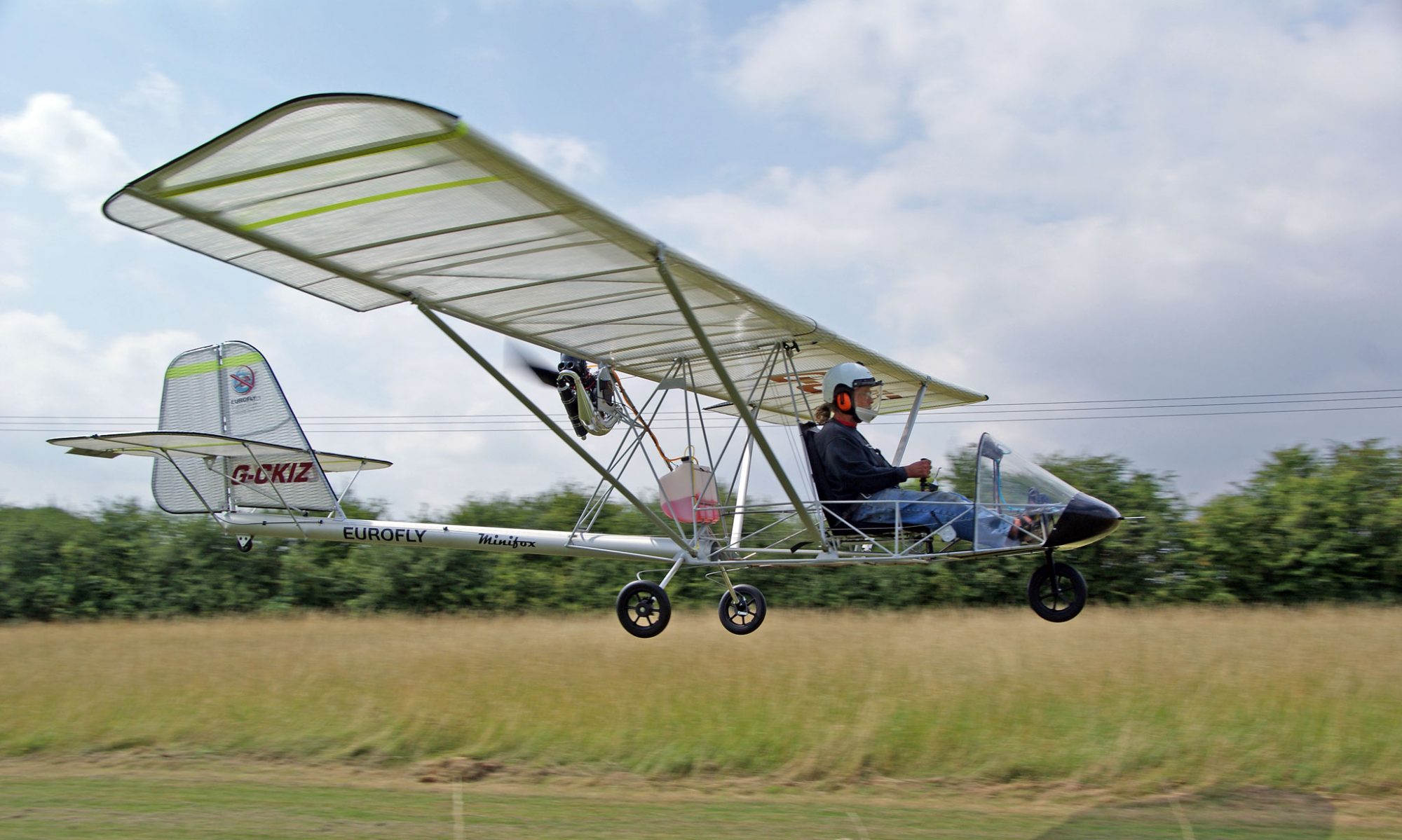
Microlighting is the undisputed champion of flexibility. Because these aircraft are lighter and have different regulatory requirements, the path to a licence is much smoother. For many, the National Private Pilot Licence (NPPL) is the secret weapon. It is a streamlined alternative to the traditional PPL, requiring fewer hours and offering a more straightforward medical process. You can find a detailed UK pilot licensing overview on Wikipedia to see how these licences compare in the current regulatory landscape.
Because microlights are more cost-effective to operate, you can often afford to fly more frequently. Shorter, more regular lessons fit perfectly into a lunch break or a quiet Tuesday afternoon. This accessibility is why flexible flying lessons UK wide are gravitating toward the microlight category. It removes the obstacles and focuses entirely on the freedom of the experience. It is aviation simplified, making the dream of flight achievable for everyone.
Understanding the Path: How Part-Time Pilot Training Works
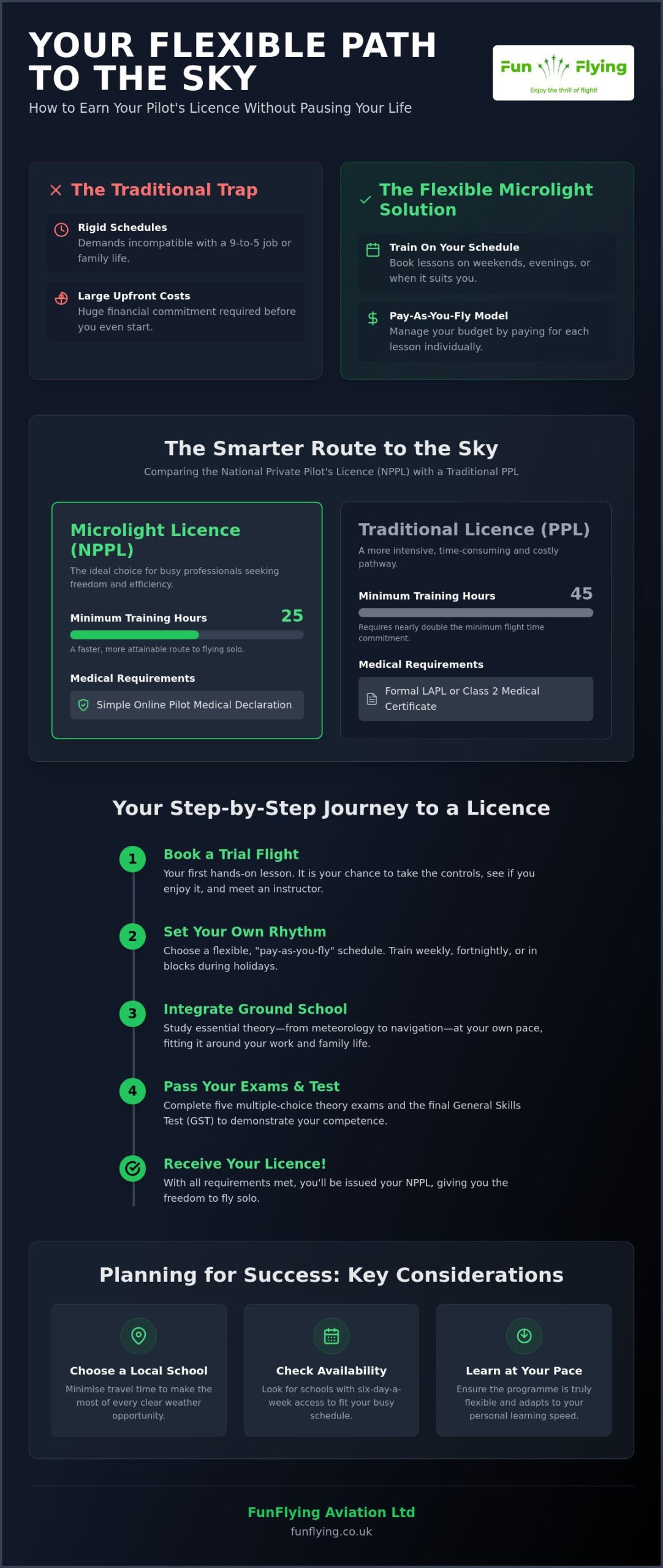
Earning your wings isn’t a sprint; it’s a journey that you control. When you look for flexible flying lessons UK schools offer various routes, but the most successful students follow a clear, manageable path. It starts with a simple trial flight. This isn’t just a sightseeing trip. It’s your first real lesson and a chance to see if the instructor’s teaching style clicks with you. If you feel that spark of excitement, you move to establishing a rhythm. Some students prefer a lesson every fortnight to keep costs steady, whilst others choose intensive blocks during annual leave. The beauty of this modular approach is that the schedule bends to your needs.
As you build your hours, you’ll integrate ground school study into your daily life. You can review navigation charts during your evening wind-down or listen to meteorology briefings on your morning commute. Before your first solo, you’ll need to handle the medical requirements. For microlight pilots, this is often as simple as a Pilot Medical Declaration (PMD) made online, which is far less restrictive than the traditional LAPL or Class 2 medicals. Finally, once you’ve mastered the 25-hour minimum requirement and passed your five multiple-choice exams, you’ll face the General Skills Test (GST). It’s the final validation of your hard work before your licence arrives in the post.
The “Pay-as-you-Fly” Financial Model
One of the biggest barriers to aviation used to be the demand for massive upfront payments. We’ve thrown that old model out of the window. By choosing a pay-as-you-go system, you protect your finances. There’s no risk of losing a large deposit if your circumstances change, and it allows for much better monthly budgeting. You pay for the instruction you receive, making it easier to balance flight training with family commitments or mortgage payments. Schools like FunFlying prioritise this transparency, ensuring you always know exactly where your investment is going.
Ground School: Studying on Your Own Terms
Modern ground school has moved far beyond the dusty classroom. You can now access high-quality online resources that let you study at 11 pm or 6 am. Whatever works for you. While digital platforms are fantastic for the five core exams, a truly flexible school provides one-on-one support when you hit a tricky topic like flight planning. This is the essence of flexible flying lessons UK pilots now enjoy; the ability to master theory in the comfort of their own home. Balancing your theory exams alongside your practical flying ensures that what you learn in the book is immediately applied in the cockpit. If you’re ready to see how this fits your lifestyle, booking a trial flight is the perfect first step.
Comparing Flexibility: Microlight vs Traditional PPL Training
Many aspiring pilots assume a Private Pilot Licence (PPL) is the only path to the cockpit. It isn’t. If your goal is recreational freedom, the traditional PPL route can feel like a heavy burden. It requires a minimum of 45 flying hours, though the national average to reach proficiency is actually between 55 and 60 hours. Contrast this with the National Private Pilot Licence (NPPL) for microlights, which requires a minimum of just 25 hours. That is nearly half the time commitment. For those seeking flexible flying lessons UK schools provide, this 20-hour gap is the difference between earning a licence in one season or dragging the process out over several years.
The medical requirements offer another layer of flexibility. A traditional PPL necessitates a Class 2 medical certificate, which costs between £120 and £260 and requires an appointment with a specialist examiner. Microlight pilots usually only need a Pilot Medical Declaration. This is a simple self-declaration of fitness made on the CAA website. It is free, instant, and removes the administrative hurdle that often delays training. Smaller, specialised schools also tend to have better aircraft availability than large commercial academies. You aren’t competing with hundreds of full-time students for a booking slot, meaning you can actually fly when the weather is perfect.
Which Licence Suits Your Schedule?
The NPPL is the smarter choice for anyone with a busy professional life. Because the syllabus is more concise, you reach solo status faster. This builds confidence early on. A part-time student flying once a fortnight on a 25-hour syllabus maintains much better momentum than one on a 45-hour course. You spend less time “re-learning” skills from the previous lesson. If your circumstances change in the future, you can convert your NPPL to other aircraft categories. It is a modular, future-proof way to start flying without the massive upfront commitment of traditional aviation.
The Freedom of SSDR and Nanolights
We are bold advocates for the sub-70kg category, known as Single Seat De-Regulated (SSDR) aircraft or nanolights. These represent the absolute pinnacle of low-regulation aviation. Because they are exempt from many of the rigid maintenance schedules that govern larger planes, they are incredibly reliable and ready to go at a moment’s notice. At FunFlying, we specialise in these innovative aircraft because they align perfectly with the modern need for autonomy. They allow for “pop-up” flying from local fields, offering a level of flexible flying lessons UK pilots can’t find elsewhere. It is about stripping away the bureaucracy and focusing on the pure joy of being in the air.
Planning Your Journey: Essential Considerations for Busy Students
Success in the cockpit starts long before you reach the airfield. When searching for flexible flying lessons UK schools provide, your first priority should be the commute. We recommend choosing a training base within a 45-minute drive of your home in Swindon, Bristol, or Reading. If the journey is too long, it becomes another chore on your to-do list rather than an escape. You also need an instructor who acts as a dedicated mentor. They must understand that your progress might happen in bursts. A good mentor adapts their teaching to your specific “rhythm,” ensuring you never feel pressured to move faster than your lifestyle allows.
Your choice of aircraft also impacts your learning curve. Three-axis microlights look and feel like traditional aeroplanes, which often makes them easier to master part-time if you have used flight simulators. Flexwings offer a visceral, open-air thrill, but they require a different physical “feel” that can take slightly longer to regain after a break; if the wind-whipped experience leaves your hair needing some extra attention, you can check out Urban Care for specialised products. To manage the fickle British weather, get comfortable with apps like Windy or SkyDemon. Checking these forecasts 24 hours in advance helps you avoid wasted trips to the airfield, keeping your motivation high and your schedule intact.
Choosing the Right Airfield Environment
Training at a dedicated microlight centre like Yatesbury offers a massive advantage over busy commercial hubs. At a major airport, you might spend twenty minutes idling on the tarmac behind a holiday jet. That is time you are paying for but not learning in. Yatesbury operates in uncontrolled airspace. This term refers to regions of the sky where pilots are not required to follow specific instructions from air traffic control, allowing you to take off and practice manoeuvres without waiting for a gap in commercial traffic. It makes every minute of your lesson count.
Maximising Progress Between Lessons
Life happens, and you might occasionally face a two-week gap between flights. You can keep your “stick and rudder” skills sharp at home using a basic flight simulator. We also highly recommend “chair-flying.” This is the simple act of sitting in a quiet room and mentally rehearsing every switch, lever, and radio call of a typical circuit. It keeps your muscle memory alive even when you are grounded. By staying “flight-ready” during your time off, you won’t waste the first portion of your next lesson getting back up to speed. If you are ready to see how aviation fits into your week, you can book your trial flight today to get started.
Start Your Adventure with FunFlying at Yatesbury
At FunFlying, we believe that the sky belongs to everyone, not just those with a lifetime of free hours to spare. Our philosophy is simple. We combine professional, top-tier instruction with the infectious enthusiasm of people who truly love to be airborne. We don’t just teach you to fly; we welcome you into a world of freedom and adventure. Based at our historic airfield in Yatesbury, we operate six days a week. This schedule is specifically designed to accommodate the modern UK workforce. Whether you are navigating a busy corporate career or a hectic family life, we ensure that your training fits into the gaps that work for you.
We also promise a “hands-on from day one” experience. You won’t spend your first few lessons stuck behind a desk or merely observing from the passenger seat. From the moment you strap in for your trial flight, you take the controls. It is about building your confidence through immediate, practical experience. Finding flexible flying lessons UK pilots can actually build a lifestyle around means choosing a school that prioritises your time. If you are looking for training near Swindon or Newbury, our gates are open, and our instructors are ready to help you take that first exhilarating step toward your licence.
Our Local Wiltshire Community
Aviation is more than just a technical skill; it is a vibrant social experience. When you train with us at Yatesbury, you join a community of like-minded enthusiasts. Our clubhouse is a hub where students from Bristol, Andover, and Basingstoke gather to share stories and tips. Why learn in isolation when you can speak with current part-time students who are navigating the same journey as you? This supportive environment is what keeps our pilots motivated, even when the British weather occasionally interrupts the schedule. You are always welcome to drop by, grab a coffee, and see exactly what makes the Yatesbury atmosphere so special.
Take the First Step to Your Licence
We have stripped away the bureaucracy to make our booking process as simple as possible. There are no hidden fees or complex contracts to sign. If you are not quite ready to commit to a full course, our gift vouchers offer a perfect, low-stakes way to experience the cockpit for the first time. It is the ultimate “try before you buy” approach to aviation. Why wait for a “perfect” moment that might never arrive? The horizon is waiting, and the controls are yours for the taking. Book your flexible flying lesson at FunFlying today and discover just how accessible earning your wings can be.
Your Path to the Clouds Starts Today
The dream of flight is no longer a distant “someday” reserved for the retired or the wealthy. By choosing the NPPL route and embracing a modular approach, you can master the skies without sacrificing your career or family time. We have seen how a 25-hour minimum requirement and simplified medical declarations remove the traditional barriers to entry. Finding flexible flying lessons UK pilots can rely on is simply a matter of choosing the right environment and a mentor who understands your pace.
At the Wiltshire Microlight Centre, we make this transition seamless. With training available six days a week and expert instructors who prioritise a “hands-on from day one” philosophy, your progress is always in your own hands. You don’t need to quit your job to earn your wings; you just need to take that first step. Start your aviation journey with a flexible trial flight at FunFlying and experience the liberation of the open sky. We’ll see you on the airfield.
Frequently Asked Questions
How long does it take to get a microlight licence part-time?
Most part-time students earn their licence within six to eighteen months. While the legal minimum is 25 flight hours, your total timeline depends on how consistently you can fly and the cooperation of the British weather. Flying once a week is a fantastic pace that allows you to retain skills without feeling overwhelmed. It’s a journey, not a race, and the modular approach ensures you progress at a speed that feels right for you.
Can I learn to fly if I can only commit to one day a week?
You can certainly master the skies with a one-day-a-week commitment. Many of our most successful pilots are “weekend warriors” who balance their training with a busy Monday-to-Friday career. Because we offer flexible flying lessons UK wide that operate six days a week, you can easily find a regular slot that fits your lifestyle. Consistency is the real secret to success; even one hour a week keeps your muscle memory sharp and your progress steady.
What happens if the weather is bad on my lesson day?
If the weather is unsuitable for flying, we simply reschedule your lesson or move the session indoors for ground school. Safety is our absolute priority, so we never take chances with high winds or low visibility. We encourage students to use apps like Windy to check forecasts 24 hours in advance. If we can’t get airborne, it’s a perfect opportunity to tackle one of your five multiple-choice exams or practice cockpit drills on the ground.
Do I need to pay for my entire pilot training course upfront?
No, you never have to pay for your entire course in advance at FunFlying. We champion a transparent pay-as-you-go model that allows you to fund your training lesson by lesson. This financial flexibility is a core part of our flexible flying lessons UK programme, as it removes the stress of large upfront costs. It makes budgeting simple for families and professionals alike, ensuring that your aviation adventure stays fun and financially manageable from day one.
Is there an age limit for starting flexible flying lessons in the UK?
There is no upper age limit for starting your training, provided you are fit to fly. Many people start their aviation journey well into retirement and find it incredibly rewarding. For younger flyers, you can begin logging hours at age 14. You must be at least 16 years old to fly solo and 17 years old to be issued your pilot licence. It truly is an inclusive hobby that welcomes enthusiasts from every generation.
How much study time is required outside of the flying lessons?
Expect to spend roughly two hours studying at home for every hour you spend in the cockpit. You’ll need to pass five multiple-choice theoretical exams covering subjects like meteorology, navigation, and air law. Modern online resources make this study incredibly flexible, allowing you to review materials during your commute or in the evening. Balancing your reading with practical lessons helps the theory make sense, as you’ll see the concepts in action while you fly.
Can I switch between full-time and part-time training if my work changes?
Yes, you can easily transition between different training intensities as your professional life evolves. The NPPL syllabus is inherently modular, meaning your progress is logged and remains valid even if you need to take a short break or speed things up during a holiday. We pride ourselves on being solution-oriented guides. If your schedule changes, we simply adjust your booking rhythm to ensure you keep moving toward your goal without any added pressure.
Do I need a special medical certificate to fly microlights?
Most microlight pilots do not need a complex medical exam from a specialist doctor. Instead, you can usually complete a Pilot Medical Declaration (PMD) on the CAA website. This is a simple self-declaration of fitness based on the same standards required to hold a UK driving licence. It’s a quick, free process that removes one of the biggest administrative hurdles in aviation. It makes starting your training much faster and more accessible than traditional commercial routes.