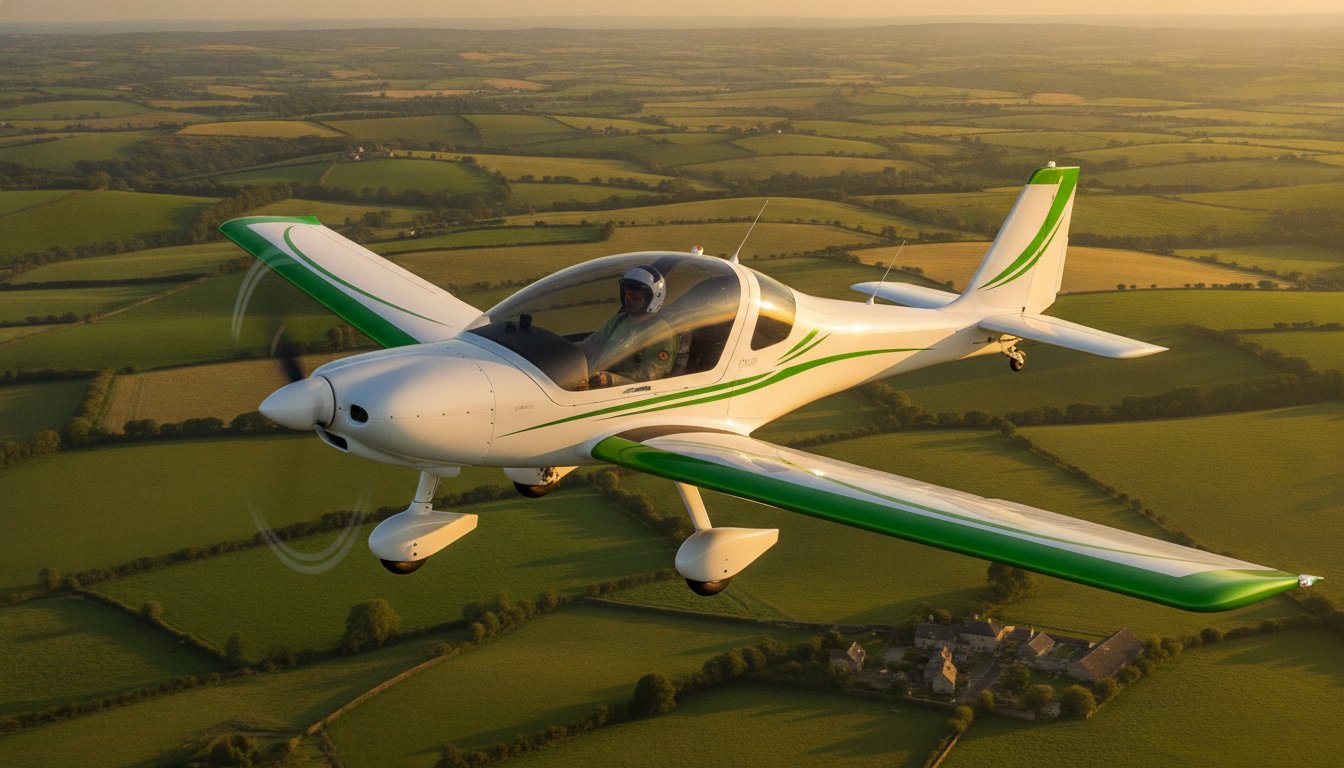
What if you could command a modern, high-performance aircraft that feels exactly like a traditional plane, but at a fraction of the usual cost? You’ve likely dreamt of soaring through the clouds, yet perhaps you’ve been held back by the myth that flying is an elite hobby or the fear that microlights are nothing more than glorified kites. It’s a common worry, but the reality of three axis microlight training is far more professional and exciting than you might imagine. These are sophisticated aircraft with closed cockpits and familiar controls that offer a genuine, high-energy “stick and rudder” experience.
We know that the maze of licensing requirements and the anxiety over total costs can feel daunting. This guide will show you why this modern path is the most accessible and exhilarating way to earn your wings and claim your independence in the sky. We’ll explore the straightforward steps to gaining your licence, explain how you can take the controls at a local centre from day one, and help you find a friendly environment where the dream of flight finally becomes your reality.
Key Takeaways
- Grasp why three-axis microlights offer a genuine “proper plane” experience with familiar cockpit controls and stable flight characteristics.
- Compare control systems and flight missions to decide if a fixed-wing or weight-shift aircraft better suits your dream of cross-country touring.
- Explore the clear, manageable path to earning your NPPL through professional three axis microlight training and structured ground school.
- Learn how a friendly, flexible training environment at a scenic Wiltshire centre makes the journey to becoming a pilot both stress-free and enjoyable.
What is Three-Axis Microlight Training? The “Proper Plane” Experience
Imagine sitting in a cockpit with a control stick in your hand and rudder pedals at your feet. You look out over a dashboard filled with instruments, shielded from the wind by a sleek fuselage. This isn’t a “glorified kite” or a flimsy frame; it’s a sophisticated, fixed-wing aircraft. Three-axis microlights look, feel, and fly exactly like the traditional light aeroplanes you’ve seen at major airfields. The name comes from how you control the plane across three distinct points: pitch (moving the nose up or down), roll (banking the wings), and yaw (swinging the nose left or right). It’s authentic “stick and rudder” flying that rewards precision and offers an incredible sense of autonomy.
The sensory experience is unmatched. In a modern Ultralight (microlight) aircraft, you enjoy panoramic views from a comfortable, closed cockpit. The controls are incredibly responsive, reacting to the lightest touch. Unlike more exposed forms of aviation where you’re battling the elements, three-axis planes offer a refined environment. You can fly in comfort whilst still feeling every nuance of the air around you. It’s real flying, simplified.
Why it Feels Like a Traditional Aircraft
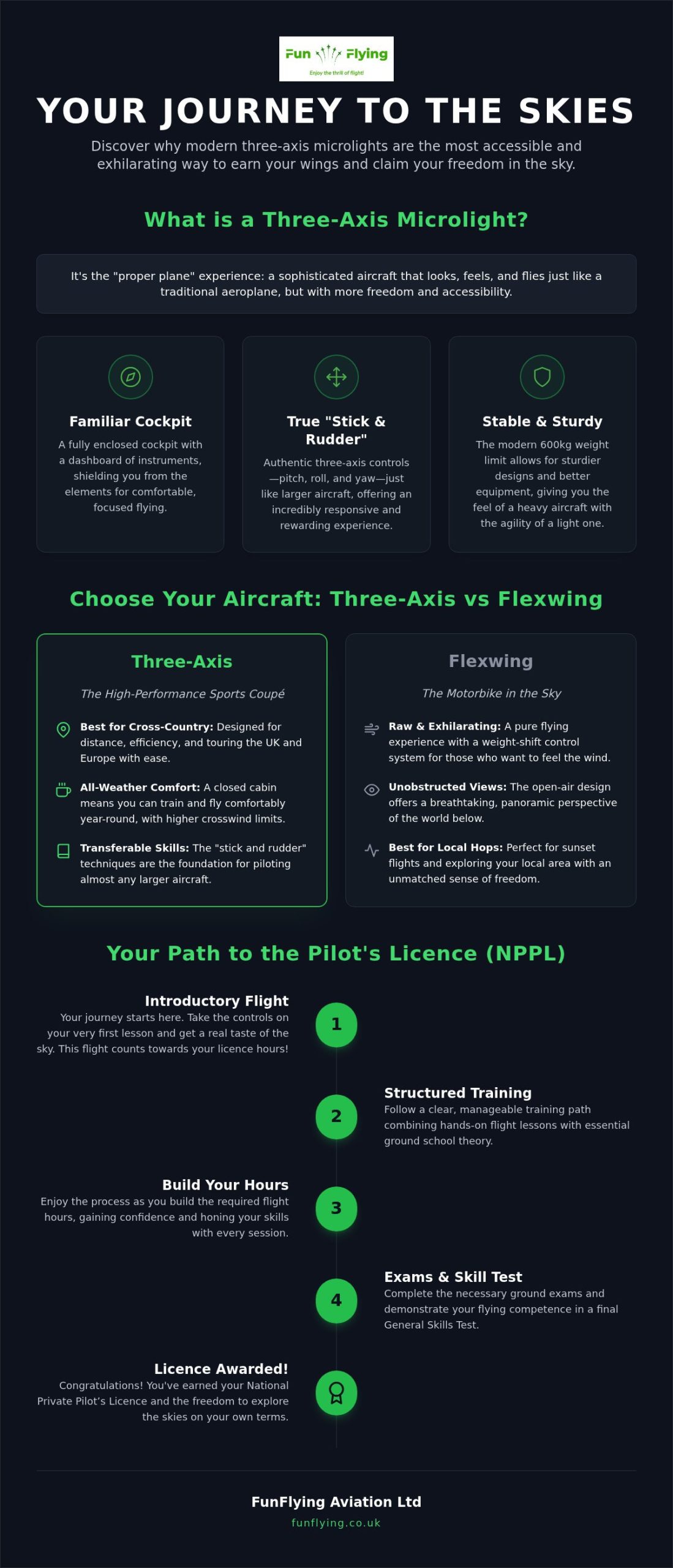
If you’ve ever dreamt of piloting a Cessna or a Piper, you’ll feel right at home here. The flight characteristics are remarkably similar, featuring familiar instruments and handling. A major turning point was the evolution of the 600kg weight limit. This regulatory shift allowed for sturdier designs and better equipment, effectively modernising the entire fleet. You get the prestige and feel of a heavy aircraft with the agility of a light one.
The Freedom of the Microlight Category
Why is this the top choice for new pilots in the UK? It’s all about the freedom. Choosing three axis microlight training means you bypass much of the heavy regulatory red tape found in traditional General Aviation. The process is streamlined, the community is welcoming, and the focus remains firmly on the joy of being airborne. It’s the most accessible path to earning your wings. You can start your journey today by booking an introductory flying lesson and taking the controls yourself.
Three-Axis vs Flexwing: Which Microlight Training is Right for You?
Deciding between a flexwing and a three-axis microlight is often the first big choice you’ll face. It really comes down to your personality and what you want your flying life to look like. A flexwing uses a “weight-shift” system; you physically push a bar to move the trike’s weight under the wing. It’s raw and exhilarating. In contrast, three axis microlight training focuses on aerodynamic surfaces. You use a stick and rudder to control the air moving over the wings and tail. For many, this feels more intuitive because the plane moves exactly where you point the stick.
Think about your “mission” in the sky. Are you looking for local sunset hops over the Wiltshire hills? A flexwing might be your dream. However, if you aspire to cross-country touring or visiting airfields across the UK and Europe, the three-axis is the clear winner. These aircraft are designed for distance and efficiency, offering better protection from the elements and higher cruising speeds. If you’re still unsure which path suits you, why not experience the difference yourself with a trial flight?
Weather also plays a role in your decision. Three-axis aircraft generally handle a wider range of conditions comfortably. They often have higher crosswind limits, meaning you’re less likely to have a lesson cancelled due to a stiff breeze. This stability makes the learning curve feel smoother for many students, as the aircraft feels planted and predictable even when the air is a little lively.
The Three-Axis Advantage for Future Pilots
If you ever plan to progress to larger aircraft, three-axis skills are incredibly transferable. You’re learning the same fundamental “stick and rudder” techniques used by pilots of much larger aeroplanes. Plus, let’s be practical about the UK climate. Having a closed cabin means you can continue your training comfortably throughout the autumn and winter. You won’t be grounded just because there’s a bit of a chill in the air.
The Flexwing Appeal
We often call the flexwing the “motorbike in the sky.” It’s for the purists who want the wind in their face and a totally unobstructed view of the ground below. To help you decide, ask yourself a simple question: do you want to drive a breezy convertible or a high-performance sports coupe? Both are fantastic, but the three-axis “coupe” offers a level of sophistication and utility that’s hard to beat for long-term adventures.
The Path to Your Pilot Licence: Training, Ground School, and Hours
Imagine the day you finally hold your National Private Pilot’s Licence (NPPL). It’s not a distant dream; it’s a structured journey that starts the moment you climb into the cockpit. At Fun Flying Aviation Ltd, we believe in a hands-on approach. You won’t just be watching; you’ll be taking the controls from your very first three axis microlight training session. The best way to dip your toe in the water is with an introductory flying lesson. It counts towards your hours and gives you a real taste of the sky.
To earn an unrestricted licence, the regulation requires a minimum of 25 hours of flight time. This includes at least 10 hours of solo flight and 5 hours of navigation. Whilst 25 is the legal minimum, most students find they reach true proficiency and confidence around the 35-hour mark. We don’t rush you. It’s about building the muscle memory and decision-making skills that make you a safe, competent pilot. You’ll progress at a pace that feels right for you, ensuring every landing is as smooth as the first.
Mastering the Theory: Ground School
Flying isn’t just about the stick and rudder; you’ll also need to master the theory. There are five multiple-choice exams to pass: Air Law, Human Factors, Meteorology, Navigation, and Aircraft Technical. Don’t let the word “exams” put you off. We integrate ground school with your flying lessons so the theory actually makes sense when you’re in the air. For a detailed breakdown of what to expect, check out our guide on Mastering the Sky: Microlight Ground School UK.
Flexible Training for Busy Lifestyles
We know you have a life outside the airfield. Whether it’s work, family, or other commitments, your three axis microlight training needs to fit around you. Our operations at the Wiltshire Microlight Centre run six days a week, giving you the flexibility to book lessons when they suit your schedule. Training amongst the stunning Wiltshire landscape makes every hour in the logbook feel like a mini-adventure rather than a chore. We provide a supportive, friendly environment where your progress is our priority.
Why Choose Fun Flying Aviation Ltd at the Wiltshire Microlight Centre?
Finding the right school is about more than just proximity. It’s about finding a home for your new passion. At Yatesbury, Fun Flying Aviation Ltd has cultivated a unique atmosphere that balances professional standards with a warm, welcoming spirit. You aren’t just another student in a logbook; you’re part of a community that understands the pure joy of leaving the ground behind. Our dedicated Wiltshire Microlight Centre facilities provide the perfect backdrop for your journey, offering a safe and supportive environment from your very first briefing.
Imagine the view as you bank over the Cherhill White Horse, the Wiltshire landscape spread out like a vibrant tapestry beneath your wings. The scenic beauty of this region is unparalleled, making every lesson a visual feast. It’s one thing to learn the mechanics of flight; it’s quite another to do it whilst soaring over ancient landmarks and rolling hills. To truly understand the responsiveness of these modern aircraft, you need to feel the stick in your hand. We encourage you to book a trial flight and experience the precision of three-axis controls for yourself.
A Community of Passionate Pilots
The learning doesn’t stop when you step out of the cockpit. Our club is a hub for like-minded enthusiasts who are always ready to share a story or offer a bit of encouragement. Amongst our members, you’ll find a wealth of experience and a genuine desire to see you succeed. Once you’ve earned your licence, the adventure continues with organised fly-outs to other airfields and advanced training opportunities. You’re joining a group that celebrates every milestone, from your first solo to your first cross-country tour.
Expert Instruction Tailored to You
Our instructors at Fun Flying Aviation Ltd are experts in three axis microlight training, bringing years of experience and a patient, hands-on approach to every lesson. Whether you’re a complete beginner or looking for conversion training from another aircraft type, we tailor our instruction to your specific goals. We remove the obstacles and simplify the complexities, keeping the focus on your progress and safety. Ready to see the world from a different perspective? You can start your journey today with an experience flight and discover why so many people choose Yatesbury to earn their wings.
Your Journey to the Cockpit Starts Now
The dream of flight is no longer a distant aspiration; it’s a practical reality waiting for you at the end of a runway. You’ve seen how the modern approach to three axis microlight training combines the professional feel of a traditional aircraft with an accessibility that fits your lifestyle. Whether you’re seeking the thrill of local hops or the adventure of cross-country touring, the path is clear and the support is ready.
At Fun Flying Aviation Ltd, we pride ourselves on making that first step as exciting as the day you earn your licence. With professional instructors and our breathtaking Wiltshire location at Yatesbury, you’ll be taking the controls and building your confidence from your very first flight. It’s time to claim your independence in the sky and join a community that shares your passion for adventure.
The horizon is wide open and the conditions are perfect. We can’t wait to see you in the pilot’s seat and help you experience the liberation of flight for yourself.
Frequently Asked Questions
Do I need a medical certificate to start three-axis microlight training?
You don’t need a formal Class 2 medical certificate from a specialist aviation doctor; instead, you simply need a UK Pilot Medical Declaration (PMD). This is a straightforward online process where you confirm you meet the health standards required to drive a car. It’s designed to be inclusive and accessible, ensuring that most people can enjoy the freedom of flight without jumping through complex medical hoops. You just need to have this in place before you fly solo for the first time.
How much does it cost to get a microlight licence in the UK?
Getting your licence is significantly more affordable than traditional flight training, though the total investment depends on how many hours you need to reach proficiency. Whilst the legal minimum for an unrestricted licence is 25 hours, most students find they need around 35 hours to feel truly confident and ready for their flight test. By choosing three axis microlight training, you’re opting for a modern, cost-effective path that prioritises the joy of flying without the heavy overheads of larger aircraft.
Can I fly a three-axis microlight to other airfields or abroad?
Yes, you can absolutely fly to other airfields across the UK once you have earned your wings. Cross-country touring is one of the biggest draws of three-axis aircraft because they’re built for distance, speed, and comfort. Flying abroad is also possible, although the NPPL is a UK-specific licence, so you’ll need to check the specific entry requirements for the country you plan to visit. It’s a fantastic way to turn a sunny weekend into a real international adventure.
What is the minimum age to begin microlight flight lessons?
You can start your flight lessons as young as 14 years old. Whilst you can’t fly solo until you reach the age of 16, starting early is a brilliant way to build muscle memory and confidence in the cockpit. You must be 17 to have your licence officially issued, but there’s nothing stopping you from mastering the controls and completing your ground school exams well before your seventeenth birthday. It’s a life skill that stays with you forever.
Is three-axis microlight training safer than flexwing?
Both aircraft types are incredibly safe and strictly regulated, but three-axis microlights often handle a wider range of weather conditions with ease. Because they use aerodynamic controls like a traditional plane, they typically have higher crosswind limits than flexwings. This makes three axis microlight training a popular choice for those who want a predictable, reassuring experience, especially when the air is a bit lively. You’ll feel planted and secure in the closed cabin whilst enjoying the scenery below.