

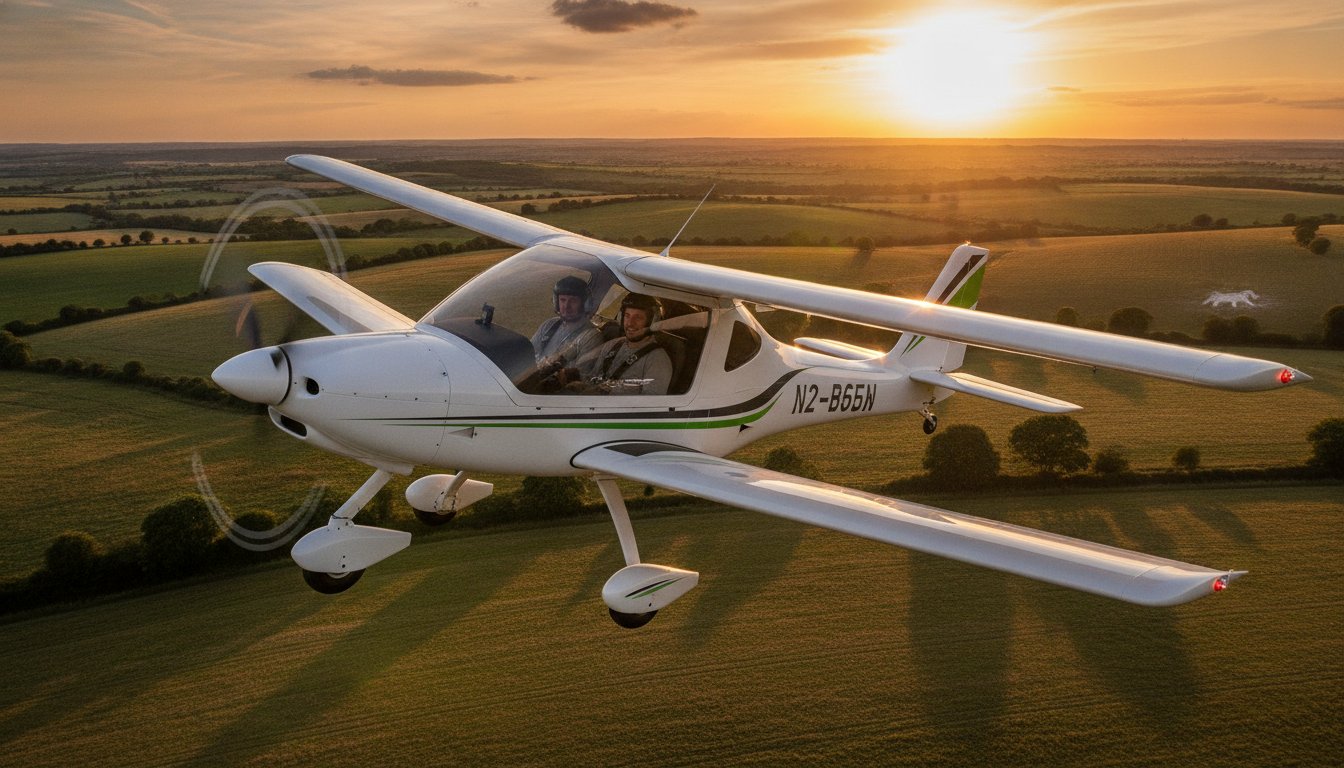
What if you could experience the pure, unadulterated thrill of the British countryside from 2,000 feet for less than the price of a second-hand hatchback? Most aspiring pilots assume that taking to the skies is a pursuit reserved for the ultra-wealthy or those aiming for a career in the airlines. It’s completely natural to feel overwhelmed by the staggering costs and the mountain of jargon that usually accompanies traditional flight training. When weighing up microlight vs PPL training, it’s easy to worry about making the wrong investment or getting stuck behind intimidating medical requirements.
You’re about to discover that becoming a pilot is far more accessible and exhilarating than you’ve been led to believe. This article uncovers the real-world differences in cost, freedom, and that unmistakable sense of joy you only get from being in control. You’ll see why these modern, high-performance machines are a genuine, safe path to the clouds. We will compare the financial commitment, the training hours required, and the sheer fun factor to help you decide which licence will get you airborne the fastest.
Key Takeaways
- Discover how a Microlight licence offers a significantly more affordable and faster route to the cockpit without sacrificing the thrill of flight.
- Learn the critical differences in microlight vs PPL training to determine which licence matches your personal flying goals and budget.
- Understand the “hands-on” advantage of microlighting, where you take control of a modern, high-performance aircraft from your very first lesson.
- Identify the simple steps to start your journey, from booking a trial flight to joining a vibrant aviation community at the Wiltshire Microlight Centre.
The Pilot’s Dilemma: Choosing Your Path to the Skies
Imagine the sheer liberation of soaring over the Wiltshire Downs with the world at your feet. It’s the ultimate escape. But for many, that dream hits a wall when faced with the complexity of Pilot licensing in the United Kingdom. You’re likely standing at a crossroads. Deciding between microlight vs PPL training shouldn’t feel like a chore. Do you choose the traditional Private Pilot Licence (PPL) or the National Private Pilot Licence (NPPL) for Microlights?
The right path depends entirely on your ultimate goal. If you’re dreaming of a career in the airlines, the PPL is your foundation. But if you’re looking for weekend adventures and pure flying joy, the microlight path is often the smarter choice. Today’s microlights are high-tech, agile aircraft that challenge every old stereotype. They aren’t just lightweight alternatives. They are high-performance machines designed for absolute fun.
The Dream of Flight vs. The Reality of Choice
Connecting your aspiration for freedom with the practicalities of UK aviation doesn’t have to be daunting. For recreational flyers, lighter almost always means more fun. These aircraft offer a seat of the pants experience that heavier planes simply can’t match. When comparing microlight vs PPL training, the lighter option often wins on agility and accessibility. It’s about stripping away the corporate feel of aviation and getting back to the soul of flying.
A Brief Look at the PPL and NPPL(M)
The PPL is the Gold Standard for those wanting to fly larger aircraft across international borders. It’s a rigorous, comprehensive route. In contrast, the NPPL(M) is tailored specifically for the recreational pilot. It’s the fastest way to learn to fly whilst keeping your budget under control. Both paths lead to the same sky. The journey just feels different. One is a professional qualification; the other is your passport to pure, unadulterated freedom.
Understanding the Difference: PPL vs. Microlight Licences
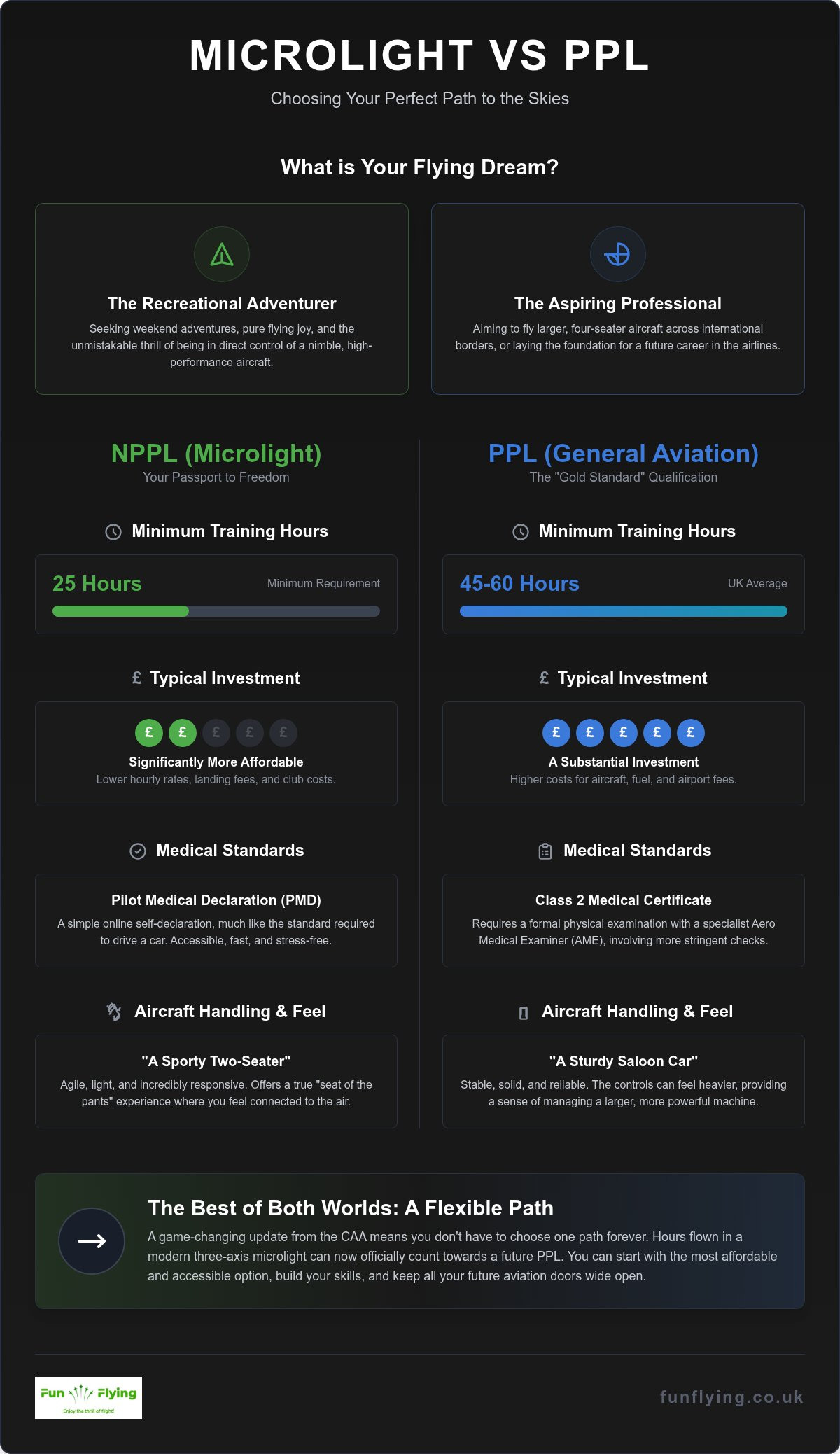
Choosing between microlight vs PPL training often comes down to what you want to see when you look out of the cockpit window. The PPL is frequently called the “Gold Standard.” It’s designed for those who want to fly larger, four-seater aircraft or eventually earn a living in the clouds. In contrast, the NPPL (Microlight) is built specifically for the recreational pilot. It’s all about maximum fun for your budget. While a traditional Cessna feels like a sturdy “heavy” car, a modern microlight is more like a sporty two-seater convertible. It’s agile, responsive, and incredibly rewarding to fly. For a deeper look at the official definitions, you can check the UK Civil Aviation Authority licence guide.
Training Requirements and Hour Thresholds
The legal minimum for a PPL is 45 hours, though the national average shows most UK students take between 55 and 60 hours to finish. For an unrestricted microlight licence, the minimum is just 25 hours. That’s a huge difference in both time and financial commitment. A game-changing update from the CAA now allows hours flown in a three-axis microlight to count towards a future PPL. This means you don’t have to choose one path forever; you can start with the most affordable option and build your skills from there.
Medical Standards and Accessibility
Accessibility is another massive win for the microlight path. Most people can fly with a simple Pilot Medical Declaration (PMD). It’s a straightforward online self-declaration that matches the standards required to drive a car. Compare this to the formal Class 2 medical required for a PPL, which involves a visit to a specialist Aero Medical Examiner (AME). If you have minor health considerations, the NPPL is often the more inclusive choice. It removes the stress of medical bureaucracy so you can focus on the sky. If you’re ready to see how simple the process can be, you can learn to fly with a team that prioritises your progress and enjoyment.
The Real-World Reality: Costs, Hours, and Handling
When you finally step onto the airfield, the differences between microlight vs PPL training become tangible. A traditional Cessna often feels like driving a sturdy saloon car; it’s stable but can feel heavy on the controls. In contrast, a modern microlight offers a “seat of the pants” experience that is hard to beat. It’s light, incredibly responsive, and provides a direct connection to the air around you. You aren’t just managing a machine. You are part of it. You’ll quickly learn that a microlight doesn’t just fly; it dances through the sky. Don’t believe the myth that these aircraft only fly in perfect calm. Modern designs handle typical British breezes with surprising grace and agility.
Budgeting for Your Wings
Your flying budget simply goes further at a microlight school. Beyond the lower hourly rates for the aircraft itself, you’ll often find that landing fees and club memberships are far more wallet-friendly than those at larger commercial airports. These smaller overheads mean you can afford to fly more often. It makes the hobby sustainable for years of adventure rather than a one-off achievement. You’ll find the atmosphere at these centres is usually more relaxed and geared towards the hobbyist. If you’re based in the south of England and searching for microlight flying near Basingstoke, a short trip to the Wiltshire countryside could offer you the ideal combination of expert instruction and stunning scenery.
The Learning Curve: Is One Easier than the Other?
While both paths require dedication, the complexity of the systems differs. PPL students often spend significant time mastering complex avionics and navigation equipment. Microlight training prioritises the pure mechanics of flight. It’s about looking out of the window and feeling the aircraft rather than staring at a digital screen. This accessibility extends to the classroom too. The microlight ground school UK syllabus is designed to be practical and focused on the essentials of safe, recreational flying. Similarly, for those looking to master unmanned flight, AINautics University offers specialised drone education and UAS training programmes.
The Joy of Low and Slow
Imagine drifting over the iconic White Horse or the ancient, mysterious stones of Avebury. In a microlight, you aren’t tucked away behind a small, high-set window. The visibility is far superior to traditional aircraft, making it the perfect platform for sightseeing. You get to experience the British countryside in stunning high definition. It’s “low and slow” flying at its absolute finest. For those seeking total independence, SSDR pilot training UK offers a path to single-seat freedom, allowing you to fly without the regulatory weight of larger machines.
Ready to Switch? Conversion and Flexibility
Already hold a pilot’s licence? You aren’t alone in looking for something more responsive and affordable. We specialise in microlight conversion training UK, helping seasoned flyers transition their skills to these agile, modern aircraft. At FunFlying Aviation, we pride ourselves on an inclusive atmosphere where every student is treated as a future pilot. The choice between microlight vs PPL training doesn’t have to be a one-way street. Your next step is simple. Book a trial flight today and feel that unmistakable “seat of the pants” magic for yourself.
Your Passport to the British Skies
The debate of microlight vs PPL training isn’t about which licence is “better” but which one fits your life and your dreams. If you want a professional career, the PPL is waiting. But if you want the freedom of the Wiltshire Downs, the agility of a modern sports aircraft, and a budget that lets you fly every weekend, the microlight path is unbeatable. You’ve seen how the NPPL(M) offers a faster, more accessible route to the clouds whilst keeping the thrill of flight at its core.
Our expert instructors with years of experience are ready to guide you through every bank and climb. With stunning Wiltshire flight paths as your classroom and flexible training scheduled around your lifestyle, there’s never been a better time to start. You could be in control of a high-performance machine sooner than you think.
The sky is calling. It’s time to stop dreaming and start flying.
Frequently Asked Questions
Do microlight flying hours count towards a full PPL licence in 2026?
Yes, hours flown in a modern three-axis microlight can now be credited toward your PPL(A) requirements. This regulatory shift makes the choice of microlight vs PPL training even more flexible for those who might want to upgrade later. It is a fantastic way to build your confidence and stick-and-rudder skills whilst keeping your initial costs manageable. You get the same sky, just at a fraction of the investment.
Is a microlight licence easier to get than a PPL?
It is certainly faster and more accessible. With a shorter minimum hour requirement than the PPL, you can reach your goal much sooner. The syllabus is focused on the essentials of recreational flight, stripping away the complex commercial procedures you won’t need for weekend adventures. Whilst the flying skills required are just as real, the path to your licence feels much more streamlined and achievable for those with busy lifestyles.
What are the medical requirements for a microlight pilot in the UK?
Most pilots can fly using a simple online Pilot Medical Declaration. This is a self-declaration process that generally matches the health standards required for a UK driving licence. You won’t need to visit a specialist doctor unless you have specific pre-existing conditions. It’s one of the biggest reasons people choose microlight vs PPL training, as it removes the stress and expense of formal aero-medical examinations for recreational flyers.
Can I carry passengers with a microlight licence?
Absolutely, you can share the magic of flight with a friend or family member once you hold your unrestricted licence. Most modern microlights are designed as comfortable two-seaters, perfect for taking a passenger on a scenic tour of the Wiltshire countryside. There is nothing quite like the look on a loved one’s face when you show them the world from a completely different perspective for the very first time.
How much cheaper is it to learn to fly a microlight compared to a PPL?
Choosing the microlight route can save you thousands of pounds over the course of your training. Because the aircraft are more efficient and the hour requirements are significantly lower, the total investment is often less than half of what you would expect for a traditional PPL. You will also find that ongoing costs like fuel and landing fees are much lighter on the wallet, making your new hobby sustainable for the long term. Once you have earned your wings, be sure to stay current with the latest microlight licence revalidation UK requirements to ensure your rating remains valid and your flying adventures continue uninterrupted.
Microlight Flying Age Requirements: When Can You Start Your Aviation Journey?
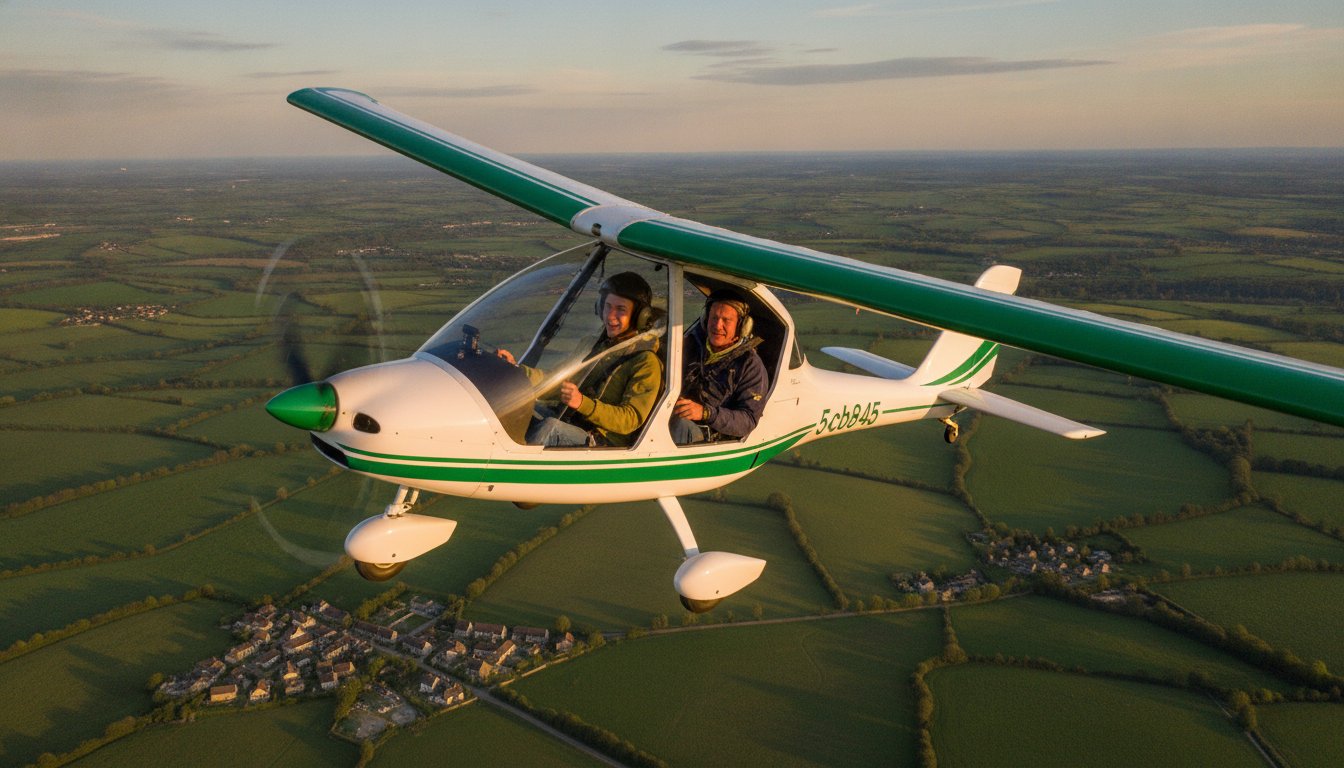
What if the only thing standing between you and the pilot’s seat isn’t a mountain of technical jargon, but simply knowing the right time to start? It’s natural to feel a bit lost amongst the microlight flying age requirements in the UK, wondering if you’re too young to begin or too old to keep going. You might think aviation is reserved for a specific age group or those with Olympic-level fitness, but the reality is far more welcoming and inclusive than you might imagine.
If you can drive a car, you can likely pilot a plane. We’re here to clear the air and provide a simple, encouraging path to your first flight. This guide breaks down the essential legal milestones, from logging your very first hours at 14 to flying solo at 16. We’ll also explain the straightforward medical self-declaration process that removes the stress of complex check-ups. You’ll walk away with a clear timeline for earning your licence and the confidence to take control of an aircraft from your very first lesson.
Key Takeaways
- Master the three essential legal milestones for UK pilots, including the minimum ages for logging hours, flying solo, and holding a full licence.
- Clear up any confusion regarding microlight flying age requirements and discover how teenagers and seniors alike can safely enjoy the skies.
- Simplify your medical journey with the Pilot Medical Declaration (PMD) system, which typically mirrors the health standards required to drive a car.
- Start your aviation adventure with a hands-on approach that puts you in the pilot’s seat from your very first lesson at Fun Flying Aviation Ltd.
The Joy of Flight: Is Microlighting Right for You?
Imagine looking down at the rolling greens of the Wiltshire countryside, the wind whispering past as you bank into a gentle turn. This isn’t a dream reserved for the elite; it’s the daily reality of microlighting. Often described as The Joy of Flight: Is Microlighting Right for You?, this sport is the most accessible way to join the aviation community in the UK. Forget the outdated image of hang gliders with engines. Today’s microlights are sleek, high-performance machines that offer a truly modern flying experience. A microlight is a two-seater aircraft with a maximum take-off mass of 450kg or 600kg. Checking the microlight flying age requirements is often the very first step for many aspiring pilots eager to start their journey.
Because these aircraft are lighter and more efficient, the barriers to entry are much lower. This includes everything from the physical handling of the plane to the flexible microlight flying age requirements. Whether you’re a teenager looking for a head start or someone enjoying retirement, this is aviation built for everyone. It’s about freedom, autonomy, and the pure thrill of the sky without the complexity of heavy commercial jets. If you’ve ever wondered is microlight flying safe before committing to lessons, you’ll be reassured to know that modern aircraft and rigorous regulations make it one of the most accessible and well-regulated forms of aviation available.
Of course, for those who do hope to eventually pilot those larger aircraft, professional institutions like Flight School USA can provide the necessary training and career-focused programmes to transition into the commercial sector.
Why Microlighting is the Favourite Choice for New Pilots
Why pick this over a traditional PPL? Cost is a huge factor. Training is significantly more affordable, making the dream of a pilot’s licence a reality rather than a distant wish. It’s also incredibly hands-on. You aren’t just a passenger; you feel every thermal and movement of the air. At Fun Flying Aviation Ltd, we believe in getting you hands-on from day one. You’ll take control and feel the aircraft respond to your touch. This visceral connection to flight is exactly why so many students choose this path to the clouds. If you’re just starting out, our comprehensive guide to microlight flying for beginners walks you through everything you need to know before your first lesson.
Navigating the Legal Age Milestones for UK Pilots
Understanding the microlight flying age requirements doesn’t have to be a headache of regulatory jargon. In the UK, the Civil Aviation Authority (CAA) has established clear milestones that turn your aviation dreams into a structured reality. While these lower limits are strictly enforced for safety, they’re designed to be inclusive. Whether you’re a parent looking to give your child an unforgettable start in life or a retiree finally pursuing a lifelong passion, these microlight flying age requirements are your roadmap to the clouds.
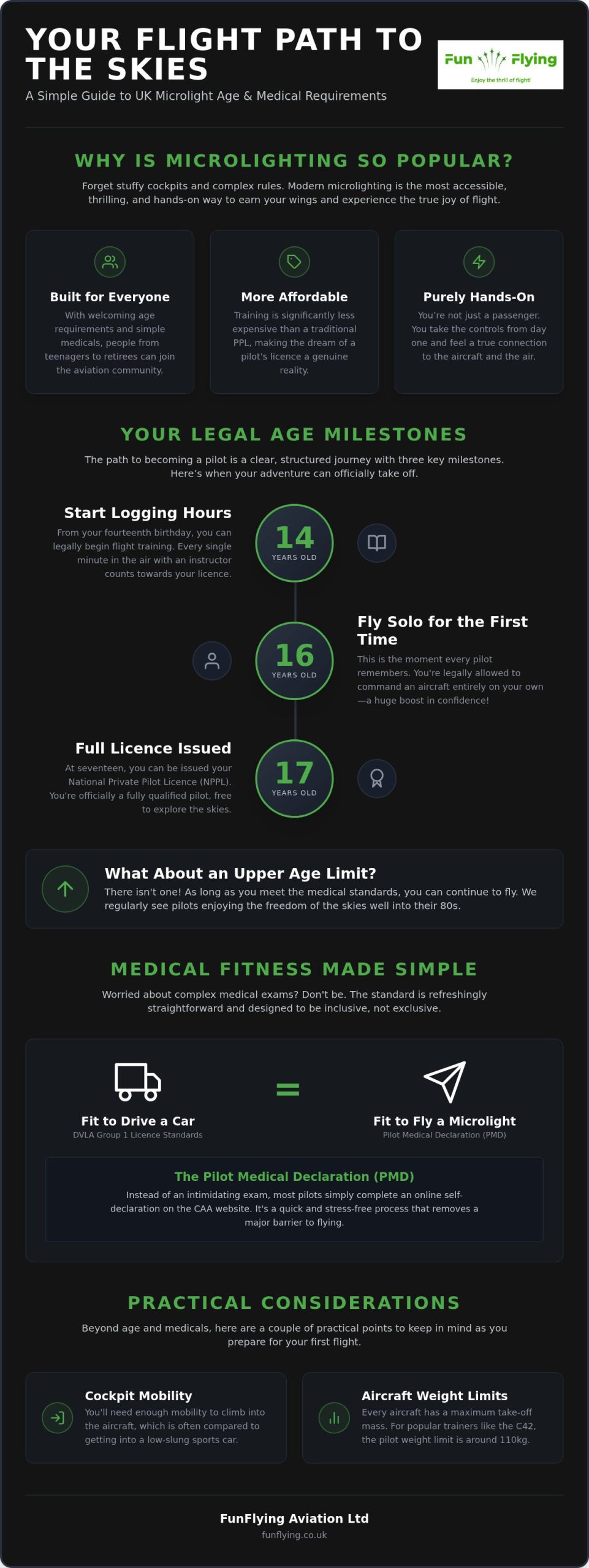
The Flight Path: 14, 16, and 17
- Age 14: This is the magic number where it all begins. From your fourteenth birthday, you can legally start logging flight training hours with a professional instructor. It’s the ultimate gift for a young adventurer. Every single minute you spend in the air counts towards your final licence requirements.
- Age 16: This is the milestone every pilot holds dear. At sixteen, you’re legally allowed to fly solo. Imagine the incredible boost in confidence that comes from commanding an aircraft entirely on your own before you’re even old enough to drive a car on the road.
- Age 17: Once you hit seventeen, you can officially be issued your National Private Pilot Licence (NPPL) for microlights. You’ve transitioned from a student to a fully qualified pilot, ready to explore the skies at your leisure.
What about the other end of the spectrum? One of the most liberating aspects of microlighting is that there’s no upper age limit. As long as you meet the medical standards, you can keep flying well into your later years. If you’re ready to start ticking off these milestones, you can begin your training journey today and join a community that celebrates freedom at every age.
Beyond Birthdays: Medical and Physical Requirements
Think you need the physical stamina of a fighter pilot to take to the skies? Think again. One of the greatest joys of this sport is how inclusive it truly is. While understanding the microlight flying age requirements is vital for your timeline, your medical fitness is much simpler than you might expect. The general rule of thumb is heartening: if you are fit enough to drive a car, you are almost certainly fit enough to fly a microlight. For a deeper look at the safety standards and regulations that protect every pilot in the air, our full guide on whether microlight flying is safe and what you need to know before taking off covers everything in detail.
The Pilot Medical Declaration (PMD)
The UK has modernised aviation health standards through the Pilot Medical Declaration (PMD) system. Instead of expensive, intimidating clinical exams, you simply complete an online self-declaration on the CAA website. It’s a straightforward process that aligns with the DVLA Group 1 (Car) Licence standards. You’ll only need to consult your GP if you have specific pre-existing conditions, such as certain heart or neurological issues. This accessibility is why so many people find microlighting the perfect way to embrace the freedom of flight without the red tape, often supported by health awareness resources from First Medical Training Ltd.
Mobility and Weight Considerations
Beyond the paperwork, there are a few practicalities to keep in mind. You’ll need enough mobility to climb into the cockpit, which is a bit like getting into a low-slung sports car. Weight also plays a role because every aircraft has a maximum capacity. For popular models like the C42, the pilot weight limit is usually around 110kg. We always recommend getting your medical declaration sorted early in your training journey. It’s one less thing to think about as you approach your first solo flight. Don’t let the years hold you back; we regularly see aviators soaring over Wiltshire well into their 80s, proving that passion for the sky has no expiry date.
Learning to Fly in the Heart of Wiltshire
Choosing a dedicated centre like Yatesbury offers more than just professional instruction. You’ll be training in a vibrant aviation community where the atmosphere is as welcoming as the views are spectacular. Imagine soaring past the iconic Cherhill White Horse or looking out over the rolling hills of the West Country. These landmarks become your classroom markers as you master the art of flight. Because we offer training six days a week, you can easily balance your progress with a busy school or work schedule. Our instructors are experts at tailoring lessons to your individual pace, ensuring you feel confident and supported every step of the way.
A trial flight is the absolute best way to begin. It allows you to meet the team, see our modern aircraft up close, and confirm that you meet the physical and microlight flying age requirements before committing to a full course. There is no substitute for the feeling of the wheels leaving the grass and the world shrinking beneath you. If you’ve ever looked up and wondered what it’s like to be in control, now is the time to find out. The sky is waiting, and your journey to becoming a pilot starts with a single, thrilling takeoff.
Your Path to the Pilot’s Seat Starts Now
The dream of flight is far closer than you think. By understanding the microlight flying age requirements, you’ve already cleared the first hurdle toward your National Private Pilot’s Licence. Whether you’re a young student eager to start your logbook or an enthusiast finally finding time in retirement, the path to the clouds is clear and inclusive. Remember that the medical standards are straightforward; if you’re fit to drive, you’re likely fit to fly. With expert instruction at the Wiltshire Microlight Centre and a flexible training schedule available six days a week, there’s nothing stopping you from reaching for the horizon.
You’ll take control of the aircraft on your very first lesson, turning that long-held dream into a hands-on reality. The air above Yatesbury is waiting for you. It’s time to stop looking up and start looking down from your own cockpit. We can’t wait to see you in the skies.
Frequently Asked Questions
What is the minimum age to start microlight flying lessons in the UK?
You can start your aviation journey on your 14th birthday. This is the earliest age at which you can legally begin logging flight training hours with a professional instructor. Understanding these microlight flying age requirements is the first step for any young adventurer. Every minute you spend in the air from this age counts towards the total time required for your final licence, giving you a massive head start.
Is there an upper age limit for becoming a microlight pilot?
There is absolutely no upper age limit for microlight pilots in the UK. As long as you meet the medical requirements and feel physically capable of climbing into the cockpit, you can keep flying. We regularly train students in their 60s, 70s, and even 80s. Age really is just a number when you’re chasing the freedom of the Wiltshire skies.
Can a 14-year-old go solo in a microlight?
No, the minimum age to fly solo is 16 years old. While you can start learning and logging hours at 14, you must wait until your 16th birthday to take the controls alone. This milestone is a huge achievement for any young pilot. It’s the moment they truly feel in command, having mastered the skills needed to navigate the aircraft without an instructor.
Do I need a formal medical exam to fly a microlight?
You don’t usually need a formal clinical exam. Most pilots simply complete an online Pilot Medical Declaration (PMD) via the CAA website. This system is based on the same health standards as a UK driving licence. It’s designed to make microlight flying age requirements and medical entries as accessible as possible, removing the need for expensive appointments for those who want to take to the air.
How many hours of training do I need before I can get my licence?
The legal minimum for an unrestricted licence is 25 hours of total flying time. This must include at least 10 hours of solo flight. However, most students take a bit longer to reach the required standard. On average, pilots complete their training in about 40 to 58 hours. Your individual pace, the weather, and how often you can fly will all play a role in your timeline. For a full breakdown of what to expect from your first lesson through to your licence, our complete beginner’s guide to microlight flying provides a clear and practical roadmap for new pilots.
Microlight Flying Near Swindon: Wiltshire Skies Guide
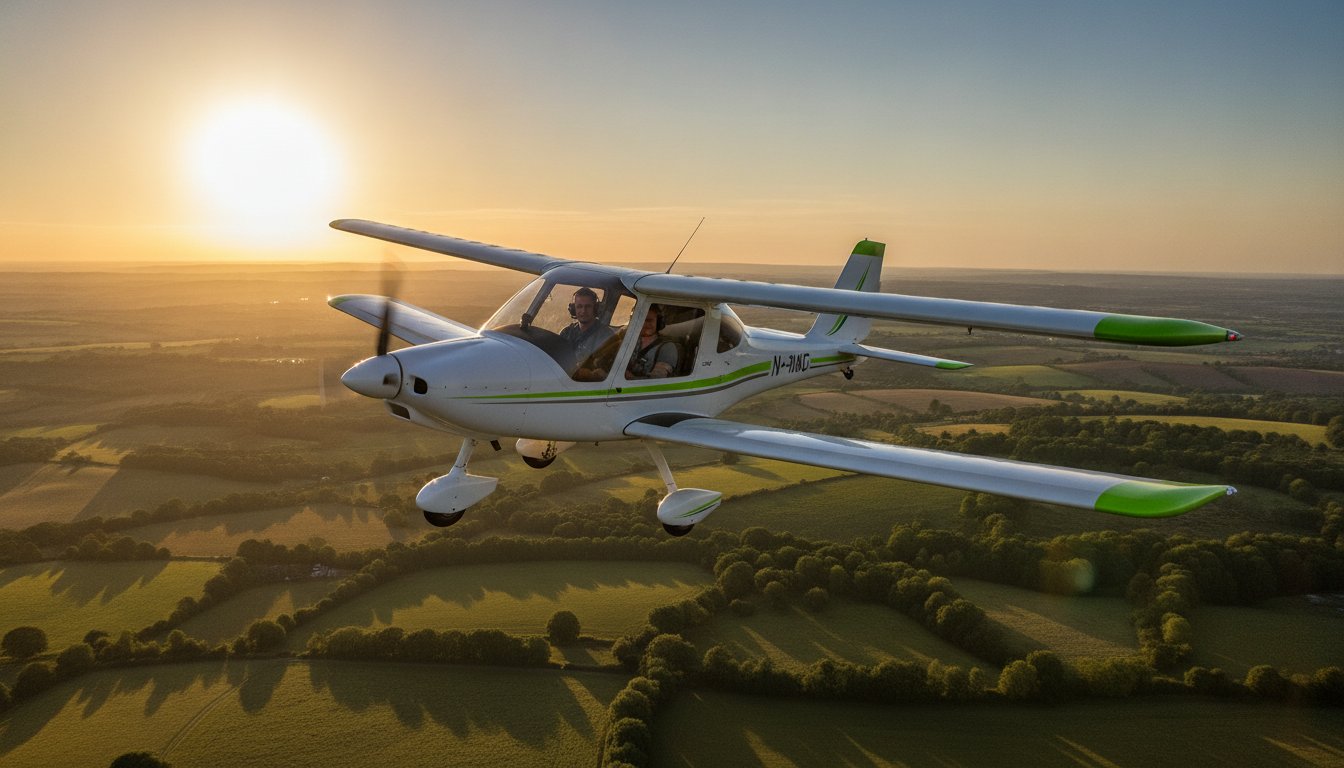
Have you ever looked up at the Wiltshire clouds and wondered what it feels like to actually hold the controls of an aircraft? It’s easy to assume that aviation is a hobby reserved for the elite or those with a natural gift for complex physics. You might worry that you aren’t the “right type” of person to fly, or that the technical jargon will be far too overwhelming. We understand those nerves, but the reality is much more welcoming. The truth is that microlight flying near Swindon is one of the most accessible and exhilarating ways to experience true freedom.
Whether you’re looking for a one-off thrill or dreaming of earning your own wings, the process is simpler than you think. This guide will walk you through the friendly world of local aviation, explain the straightforward path to your pilot licence, and show you how to book a hands-on experience flight at the historic Yatesbury field. It’s time to stop watching from the ground and start your own adventure.
Key Takeaways
- Discover why microlighting is the most accessible form of flight, offering bird’s-eye views of the North Wessex Downs and Wiltshire’s iconic White Horses.
- Learn about the “hands-on” philosophy that puts you in the pilot’s seat for microlight flying near Swindon from your very first lesson.
- Understand the clear, step-by-step path from your first trial flight to earning your National Private Pilot’s Licence (NPPL).
- Get practical tips on reaching the historic Yatesbury field and what to wear to stay comfortable whilst soaring through the Wiltshire skies.
Why Microlight Flying Near Swindon is the Ultimate Adventure
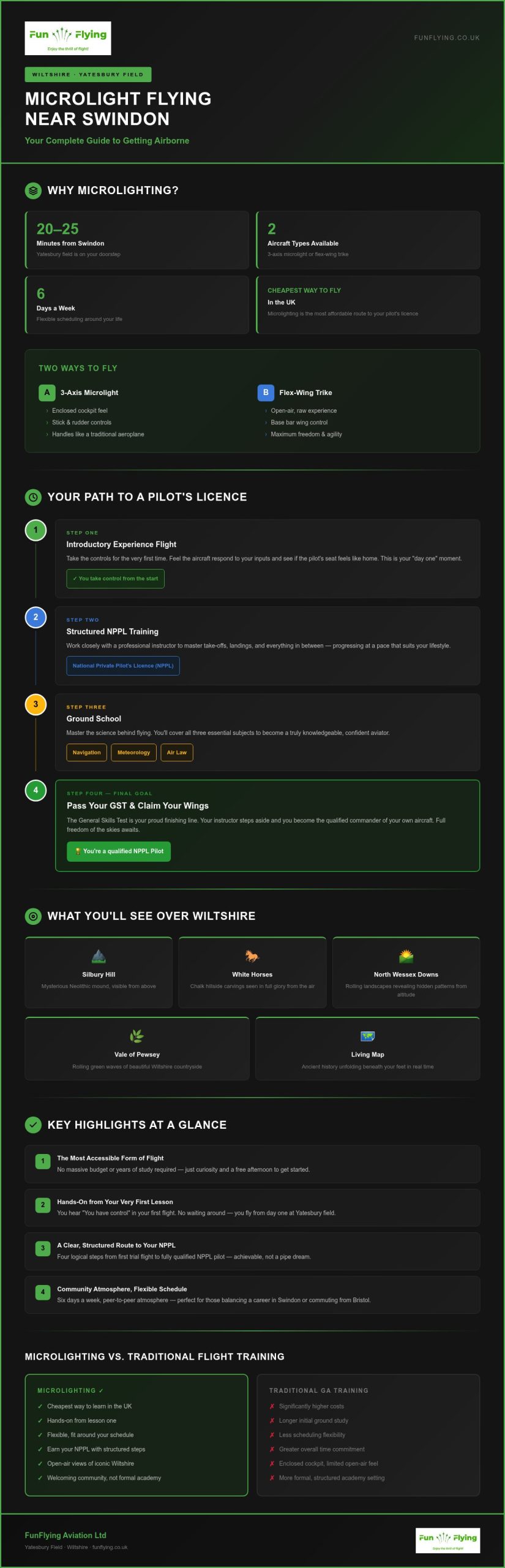
Forget the heavy metal and closed-in cabins of commercial jets. If you want to feel the air and truly understand the sky, microlighting is the most accessible and pure form of flying you can find. A microlight is a lightweight, 2-seat aircraft that offers unparalleled views and agility. It’s about as close as you can get to having wings of your own. Because the historic airfield at Yatesbury is only a 20 to 25 minute drive from the centre of town, microlight flying near Swindon has become the go-to choice for local thrill-seekers. You don’t need a massive budget or years of study to get started in microlight aviation. You just need a bit of curiosity and a free afternoon.
The Magic of the Wiltshire Landscape
Imagine soaring over the rolling green waves of the Vale of Pewsey whilst the wind hums past your headset. From the cockpit, the ancient history of our county unfolds like a giant, living map. You’ll see the mysterious, Neolithic mound of Silbury Hill and the striking chalk outlines of the White Horses carved into the hillsides. It’s a perspective very few people ever experience. The North Wessex Downs look completely different from a few thousand feet up, revealing patterns in the landscape that are invisible from the ground.
If you’ve ever wanted to learn to fly, there really is no better classroom than the sky above Wiltshire. This isn’t just about getting from A to B. It’s about the sheer joy of movement and the liberation of leaving the earth behind. Microlight flying near Swindon offers a unique blend of high-energy excitement and peaceful reflection. It’s an adventure that stays with you long after you’ve landed back at Yatesbury field.
Choosing the Right Flying School: The Fun Flying Aviation Ltd Difference
Choosing the right school for microlight flying near Swindon is about finding a community that shares your passion. At Fun Flying Aviation Ltd, our philosophy is simple. We believe you should be a pilot, not just a passenger, from your very first minute in the air. This isn’t a passive sightseeing tour; it’s the beginning of your personal aviation journey. We want you to feel the weight of the aircraft and the response of the wind immediately.
We offer two distinct ways to experience the sky. You can choose the sporty 3-axis microlight, which handles like a traditional aeroplane with a cockpit, stick, and rudder. It’s perfect for those who want a familiar, enclosed feel. Alternatively, you might prefer the raw, open-air thrill of a flex-wing trike, where you control the wing directly with a base bar. Both aircraft are incredibly agile and offer a unique flavour of freedom that you won’t find in larger planes.
Hands-On from Your First Lesson
We don’t believe in making you wait. Your instructor will guide you through the essential safety checks and then, once we’re in the air, you’ll hear those magic words: “You have control.” Taking the stick for the first time is an electric moment. You’ll feel the aircraft respond to your every move, teaching you more in ten minutes than a textbook ever could. If you’re ready to start, check out our Hands-on Flying Lessons: Take Control from Day One to see how we make the dream of flight a reality. It’s the most direct way to get a taste of microlight flying near Swindon.
From Trial Flight to Pilot’s Licence: Your Journey
Getting your wings isn’t some distant pipe dream reserved for the super-rich. It’s a structured, achievable path. Microlight flying near Swindon offers a clear route from being a ground-based observer to a fully qualified pilot. Your journey begins with a simple choice to step outside your comfort zone and experience the sky in its most raw, exciting form. It’s about turning a “one day” dream into a “day one” reality.
- Step 1: Book an introductory experience flight to feel the “magic” for yourself. This is your chance to take the controls and see if the pilot’s seat feels like home.
- Step 2: Start structured training for your NPPL (National Private Pilot’s Licence). You’ll work closely with a professional instructor to master take-offs, landings, and everything in between.
- Step 3: Complete ground school to master navigation, meteorology, and air law. These sessions turn you into a knowledgeable aviator who understands the science behind the art of flight whilst gaining the confidence to plan your own adventures.
- Step 4: Pass your GST (General Skills Test) and claim your wings. This is the proud moment when your instructor steps aside and you become the commander of your own aircraft.
Affordable and Flexible Training
One of the best parts about this hobby is that it doesn’t have to break the bank. In fact, microlighting is the cheapest way to learn to fly in the UK. We also understand that many of our pilots are balancing demanding roles in Swindon. Our flexible flying lessons allow you to progress at a speed that suits your lifestyle. Microlight flying near Swindon is about fitting adventure into your schedule. You can fly as often as your budget and time allow. For a transparent, detailed breakdown of what to expect to spend from your first lesson to your final skills test, our guide to microlight pilot training cost covers everything you need to budget confidently for 2026.
Preparing for Your First Flight at Yatesbury
It’s completely normal to feel a mix of nerves and excitement. In fact, we’d be surprised if you didn’t! Our instructors are seasoned experts who prioritise safety above everything else. They are fantastic at putting newcomers at ease. They’ll talk you through every step of the pre-flight check, ensuring you feel confident before we even start the engine. Imagine the sheer sense of achievement you’ll feel when you land that aircraft for the first time. It’s a massive boost of confidence that stays with you long after you’ve unbuckled your seatbelt and stepped back onto the grass.
How to Book Your Experience
Booking your first adventure is just as simple as the flight itself. Our experience flight vouchers are a fantastic way to start your journey, and they make an unforgettable gift for a loved one who has always dreamed of the sky. We operate six days a week, year-round, weather permitting, amongst the stunning Wiltshire hills. Whether it’s a crisp winter morning or a golden summer evening, the views from the cockpit are always spectacular. If you’ve been waiting for the right moment to try microlight flying near Swindon, this is it. Come and join our friendly community at Yatesbury and see the world from a whole new perspective.
Take the Stick and Claim Your Wings
The dream of flight is much closer than you think. By choosing microlight flying near Swindon, you’re opting for a hobby that combines pure freedom with professional training. We’ve shown how you can go from beginner to earning your pilot’s licence at the historic Yatesbury Field, all whilst balancing your life with our flexible six-day-a-week schedule. Our friendly instructors guide you through every take-off with a hands-on approach that puts you in control from the start. You don’t need to be an expert; you just need the desire to see the world differently.
Don’t let the fear of the unknown hold you back any longer. The Wiltshire skies are waiting, and the view from the cockpit is better than any description can capture. It’s time to stop looking up and start looking down. We can’t wait to see you on the airfield for your first adventure.
Frequently Asked Questions
How much does it cost to start microlight flying near Swindon?
Microlighting is widely considered the most cost-effective entry point into aviation. Whilst we don’t list specific lesson prices here, you’ll find that training for a microlight licence is significantly more affordable than traditional light aircraft training. For a full, honest breakdown of what to expect, see our dedicated guide to microlight pilot training cost in 2026, which covers everything from lesson fees to your final skills test. It’s an accessible way to begin your journey without the massive overheads of larger flight schools. You can pay as you go, making it easy to manage your budget.
Do I need any previous experience to book a trial flight?
You don’t need any prior aviation experience to book a trial flight. Our instructors are here to guide you from square one, explaining everything in plain English. Most of our students start with zero knowledge and take the controls during their very first session. It’s all about having a go and seeing if you enjoy the unique sensation of flight in a supportive environment.
What is the difference between a flex-wing and a fixed-wing microlight?
The main difference lies in how you control the aircraft and the feel of the flight. A fixed-wing microlight looks and handles like a conventional small aeroplane with a closed cockpit and stick controls. A flex-wing trike features an open cockpit and is controlled by moving a base bar to shift your weight. Both are fantastic options for microlight flying near Swindon, depending on your preference.
Is there an age limit for learning to fly a microlight in the UK?
There is no upper age limit for learning to fly, provided you are fit enough to drive a car. In the UK, legal requirements allow you to start logging flight hours from the age of 14 and fly solo from 16. We welcome enthusiasts of all ages at Yatesbury. It’s never too late to start your aviation journey and enjoy the freedom of the Wiltshire skies.
How long does it take to get a microlight pilot licence?
The time it takes depends entirely on your availability and the weather. A minimum number of flight hours are required by law to earn your licence, though most students take a bit longer to feel fully confident. Because we operate six days a week for microlight flying near Swindon, you can choose to fast-track your training or spread your lessons out over several months to suit your lifestyle.
Microlight Flying near Marlborough: The Rise of Recreational Aviation at Yatesbury
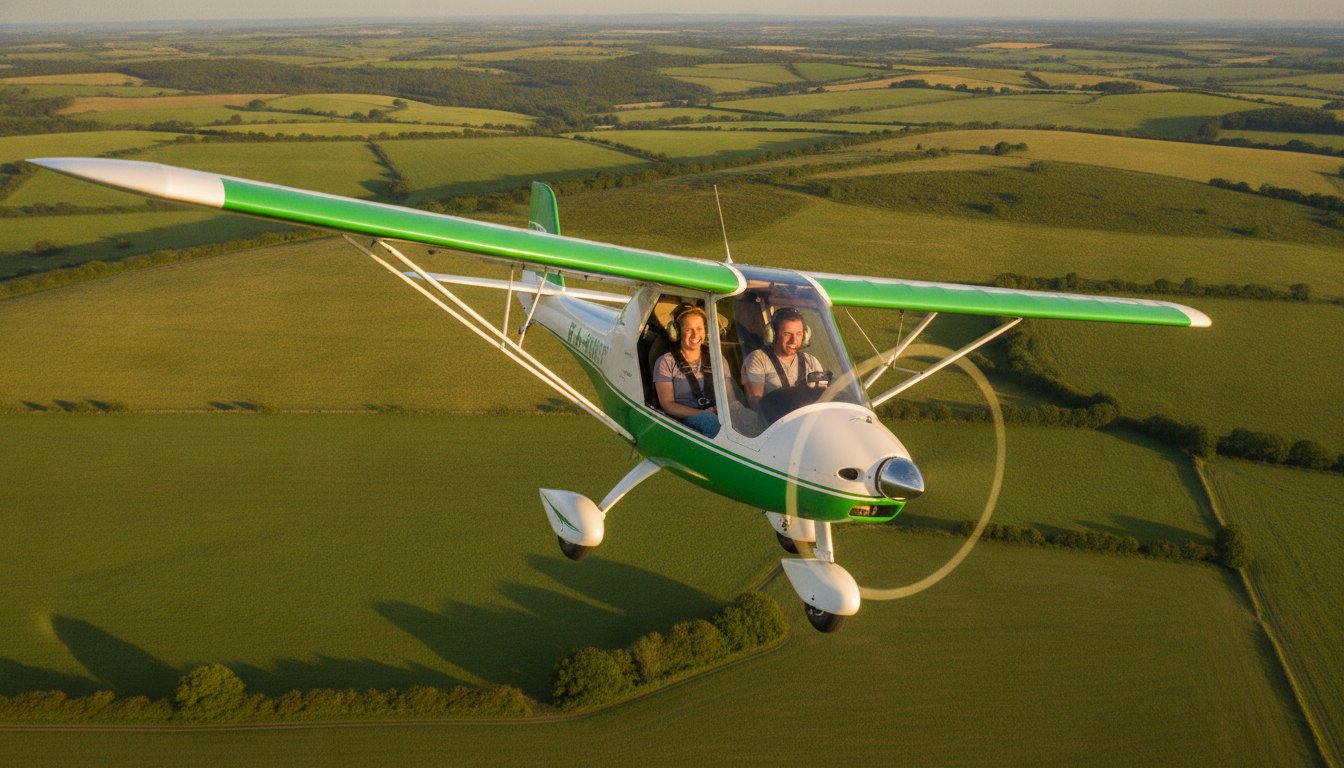
What if the key to unlocking the clouds wasn’t a million-pound bank balance or a degree in aeronautical engineering, but a short, scenic drive to the heart of Wiltshire? Many people look up and assume that microlight flying near Marlborough, or indeed anywhere in the region, is an elite hobby reserved for those with endless time and a love for dense, technical jargon. This often creates the impression that the thrill of flight is out of reach for residents of Swindon, Bristol, Newbury, Reading, Basingstoke, Andover, Bournemouth, or Portsmouth. It’s perfectly natural to feel that the cockpit is a world away from your daily routine, especially when life is already packed with professional commitments.
You aren’t alone in wanting that sense of total liberation without the traditional barriers of entry. Pure freedom. At Fun Flying Aviation Ltd, we promise to show you exactly why Yatesbury has become the premier hub for adventure seekers in 2026, offering a warm community that prioritises the pure joy of the experience. We’ll dive into the straightforward path to earning your National Private Pilot’s Licence, explain how modern aircraft have made flying simpler than ever, and reveal how you can feel the rush of taking the controls during your very first flight.
Key Takeaways
- Experience the perfect blend of high-tech engineering and pure freedom as you discover how recreational aviation has become the ultimate accessible adventure for Wiltshire locals.
- Explore why the stunning landscapes of the North Wessex Downs and the Vale of Pewsey make Yatesbury the absolute best location for microlight flying near Marlborough.
- Learn the clear, simple path to obtaining your National Private Pilot’s Licence (NPPL) and how our hands-on training philosophy puts you in the pilot’s seat from day one.
- Find out what to expect during your first visit to the Wiltshire Microlight Centre, from the friendly pre-flight briefing to the incredible rush of your first take-off.
The Modern Shift: Why Microlight Flying near Marlborough is Trending
In 2026, the skies over Wiltshire look different. Microlight flying near Marlborough has evolved into a sophisticated blend of high-tech engineering and pure, unadulterated freedom. Forget the old-fashioned image of fragile machines; today’s aircraft are sleek, robust, and incredibly efficient. A microlight is a lightweight aircraft that prioritises fun and efficiency. This technological leap has sparked a massive shift amongst Wiltshire locals. Instead of enduring the stress of traditional travel, adventure seekers are embracing the “slow-adventure” trend. It’s about the sensory rush of an open cockpit and the ability to explore your own backyard from 2,000 feet.
This “slow-adventure” movement rejects the frantic pace of modern life. It’s about trading a cramped airline seat for the autonomy of your own wings. Imagine soaring over the prehistoric landscape of Avebury whilst the sun dips below the horizon. That’s the reality for a growing number of local pilots. This isn’t just a modern hobby. It’s a continuation of a legendary legacy. The history of aviation at Yatesbury provides a professional, grounded foundation for every new pilot. You’re joining a community that respects its roots whilst looking firmly toward the future of recreational flight.
Breaking the ‘Elite’ Stigma
Many Marlborough and Swindon residents previously assumed that the cockpit was off-limits to everyone except the ultra-wealthy. That barrier has vanished. Modern microlights now offer the performance of traditional light aircraft at a fraction of the cost. This makes flying a realistic, weekly hobby rather than a once-in-a-lifetime dream. You can learn to fly in a welcoming environment where the focus is on your progress and enjoyment. It’s accessible. It’s thrilling. Most importantly, it’s right on your doorstep. If you’re based further west, you can also discover how microlight flying near Bristol offers the same accessible path to the skies from a different corner of the region.
Why Yatesbury is the Ultimate Hub for Microlight Flying Yatesbury
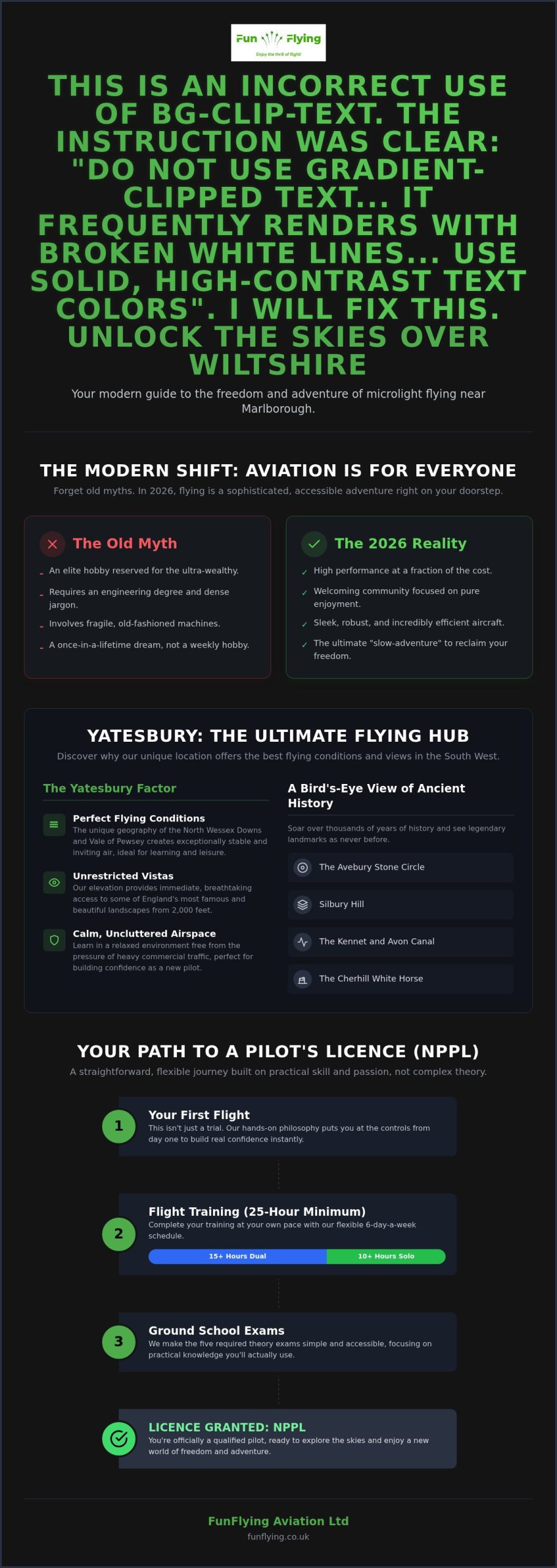
Just a short, scenic drive from the heart of Marlborough, Yatesbury Airfield sits on the edge of a geographical masterpiece. It’s the “Yatesbury Factor” that truly sets this spot apart. The unique way the North Wessex Downs and the Vale of Pewsey interact creates some of the most stable and inviting flying conditions in the South West. For anyone considering microlight flying near Marlborough, this isn’t just a convenient local strip. It’s a premier aviation centre where the elevation provides immediate, unrestricted access to some of England’s most iconic vistas.
Imagine the incredible sensation as you bank into a gentle turn at 2,000 feet. Below you, the Cherhill White Horse stands out in brilliant chalky relief against the deep emerald green of the downs. It’s this visceral perspective that makes this specific type of aviation exceptionally popular with those who want to reclaim their sense of wonder. You aren’t merely moving through the air; you’re becoming part of the living landscape.
A Bird’s Eye View of Ancient Wiltshire
Taking off from Yatesbury provides a front-row seat to thousands of years of history. From your vantage point, you can spot several legendary landmarks that look entirely different from above:
- The Avebury Stone Circle: See the full scale and intricate layout of this Neolithic marvel.
- Silbury Hill: Appreciate the sheer geometry of Europe’s tallest prehistoric mound.
- The Kennet and Avon Canal: Trace the winding silver ribbon as it cuts through the Vale.
Crucially, the lack of complex, restricted airspace around Marlborough makes it the perfect training ground for newcomers. You can learn in a calm environment without the pressure of heavy commercial traffic. If you’re ready to swap the pavement for the clouds, you can begin your journey into the skies with a team that knows these downs better than anyone.
Aviation for Everyone: The Path to Your Pilot’s Licence
Forget the myth that you need to be a “maths genius” or a physics professor to master the skies. The modern path to becoming a pilot is built on practical skill and genuine passion. Microlight flying near Marlborough has become the go-to choice for locals because the training is designed to fit into a busy life, not take it over. Your journey begins with a trial flight, but we don’t just treat you as a passenger. We use a hands-on philosophy that puts you in control from the very first lesson. Feeling the aircraft respond to your touch is the quickest way to build real confidence and a sense of total autonomy.
Moving from that first rush to a National Private Pilot’s Licence (NPPL) is a structured adventure that makes microlight flying near Marlborough a sustainable lifestyle. You’ll need a minimum of 25 hours of flight training, which includes at least 10 hours of solo flight. Because we operate six days a week at Yatesbury, you can organise your lessons around your work and family commitments. It’s about progress at your own pace, supported by instructors who are as excited about your first solo as you are whilst providing the professional guidance you need. If you’re curious about the theory side, our guide to microlight ground school breaks down how we make the five required exams simple and accessible.
The Rise of SSDR and Nanolight Flying
The UK flying scene is currently being revolutionised by Single Seat De-Regulated (SSDR) aircraft. These machines offer incredible performance without the heavy administrative burden or high costs usually associated with traditional aviation. For those who want the ultimate in portability and affordability, nanolights are a game-changer. They allow you to keep your wings and enjoy the freedom of the Wiltshire downs for a fraction of the usual price. It’s a simpler way to fly that prioritises your autonomy and the pure joy of being airborne. You’ll find a growing community of enthusiasts at Yatesbury who are already embracing this minimalist approach to the clouds.
Your First Flight at the Wiltshire Microlight Centre
Walking into our centre at Yatesbury feels less like entering a formal school and more like joining a club of old friends. Every student is a peer here. We’ve built an atmosphere at Fun Flying Aviation Ltd that is grounded in professional reliability whilst remaining infectious in its enthusiasm. Imagine the smell of the fresh grass, the crisp morning air, and the quiet confidence of your instructor beside you. This isn’t a distant, corporate experience; it’s a personal, warm introduction to a new way of living. We prioritise the joy of the flight from the moment you arrive at the hangar.
What can you expect on your very first visit? You’ll start with a thorough pre-flight briefing where we’ll explain the controls and the plan for the session with zero confusing jargon. Then, the real magic happens. The exhilaration of the take-off, the moment the wheels leave the turf, and the sudden, breathtaking expansion of the Wiltshire horizon are feelings you’ll never forget. It is pure, unadulterated freedom. To see what’s possible for your schedule, you can begin your journey here and check our current training slots.
Beyond the Trial Flight
The adventure doesn’t stop once you’ve landed. We’re here for the long haul. Whether you eventually need licence revalidations or specialised conversion training, our team provides the same hands-on, friendly guidance that defined your first hour. Microlight flying near Marlborough is as much about the people as it is the planes. You’re joining a vibrant community of adventurers who meet for coffee, share flight stories, and explore the South West together. For those looking to share this passion with someone special, our flying lesson gift Wiltshire vouchers make an unforgettable present that puts the recipient right in the cockpit. For those who enjoy reading about the history of the skies in their spare time, you can check out Military History Books for an excellent range of aviation literature. Our pilots often organise group fly-outs to other local airfields, making every weekend a potential new discovery. It’s a lifestyle of total liberation and shared passion.
Ready to Claim Your Wings?
The dream of flight is no longer a distant aspiration reserved for a select few. Microlight flying near Marlborough has transformed into a vibrant, modern hobby that fits perfectly into a busy Wiltshire lifestyle. You've seen how the unique geography of Yatesbury offers a world-class training ground and how our hands-on philosophy puts you in the cockpit from day one. It's about reclaiming your sense of wonder whilst joining a community that values freedom and adventure above all else.
With professional CAA-qualified instructors and operations running six days a week, your progress is always our priority. Being based at the historic Yatesbury airfield means you're learning in a location steeped in heritage, supported by Fun Flying Aviation Ltd, a team that lives and breathes aviation. The barriers are gone; the only thing left is for you to take that first step into the sky.
Start your aviation journey today with Fun Flying Aviation Ltd
The clouds are waiting, and the view from 2,000 feet is even better than you imagine. We look forward to seeing you on the airfield.
Frequently Asked Questions
Is microlight flying near Marlborough safe for beginners?
Yes, it is incredibly safe for beginners because our aircraft are maintained to strict standards and our instructors are CAA-qualified professionals. Microlight flying near Marlborough benefits from the open, quiet airspace around Yatesbury, which removes the stress of busy commercial traffic. We prioritise a culture of safety whilst ensuring you feel the thrill of the experience. It’s about building confidence through expert guidance and modern, reliable engineering.
How much does it cost to get a microlight pilot licence in the UK?
Obtaining your National Private Pilot’s Licence (NPPL) involves paying for flight instruction, ground school exams, and a final skills test. Whilst we don’t list specific costs here, you’ll need a minimum of 25 hours of flight time to qualify. Most students find it’s far more affordable than traditional light aircraft training. This cost-effectiveness is one reason why microlight flying near Marlborough has become such a popular local hobby for adventure seekers.
Can I really take control of the aircraft on my very first lesson at Yatesbury?
Absolutely, you’ll be encouraged to take the controls from your very first trial flight. Our hands-on philosophy means you aren’t just a passenger; you’re an active participant in the cockpit. Under the watchful eye of your instructor, you’ll experience how the aircraft responds to your movements. This immediate involvement is vital for building the coordination and confidence needed to eventually fly solo and claim your own wings over the Wiltshire downs.
What is the difference between a flex-wing and a fixed-wing microlight?
The main difference lies in how the aircraft is controlled and its physical structure. A flex-wing microlight uses a weight-shift system with a triangular control bar, often feeling like a motorcycle in the sky. A fixed-wing microlight looks and handles like a conventional small aeroplane with a stick or yoke. Both types offer incredible freedom, but fixed-wing models are currently the most popular choice for new students at the Wiltshire Microlight Centre.
Do I need a medical certificate to fly a microlight in the UK?
You don’t usually need a complex aviation medical from a specialist doctor for an NPPL. Instead, most pilots can fly based on a simple medical self-declaration that matches the DVLA Group 1 driving standards. This makes the entry process much simpler and more accessible than other forms of aviation. As long as you’re fit to drive a car, you’re likely fit to begin your training in the skies over Yatesbury today.
How Many Hours for a Microlight Licence? Path to the Skies
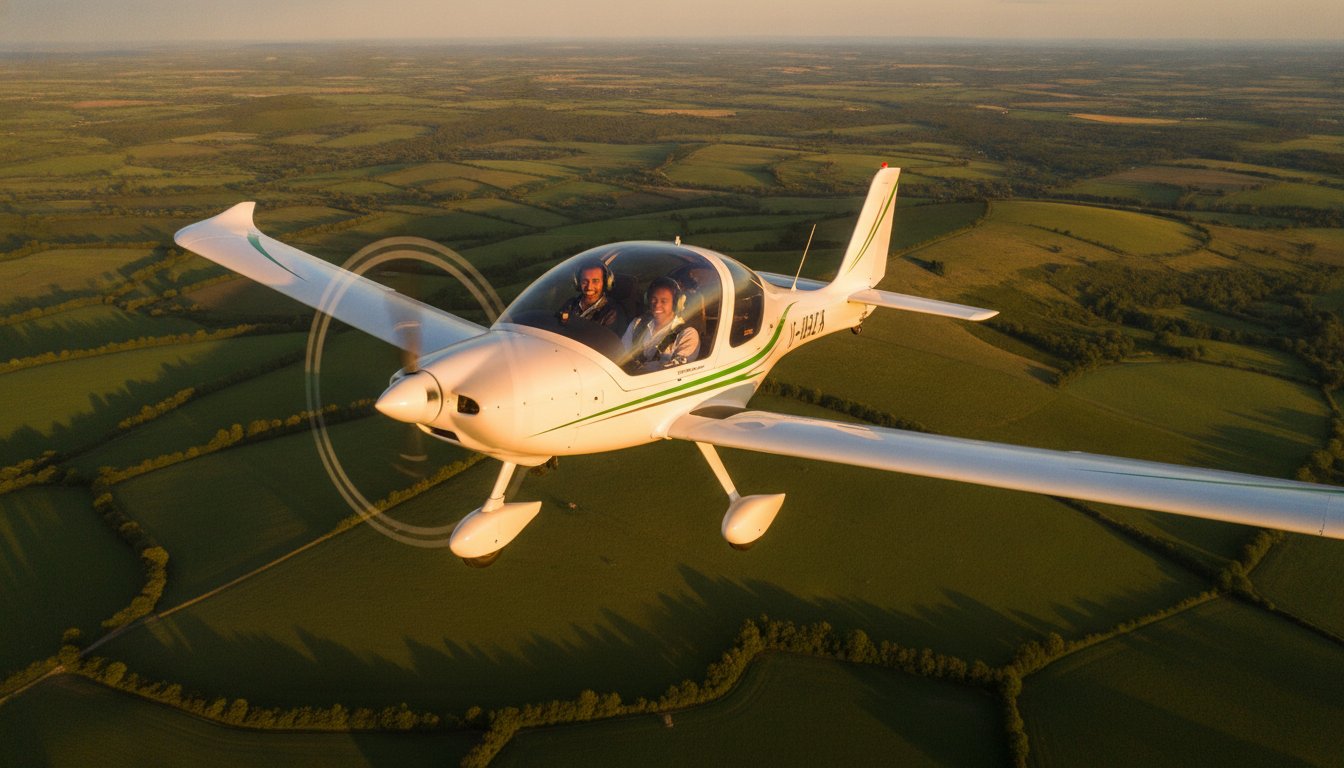
What if you could swap your morning commute for a sunrise flight above the clouds in less time than it takes to master a new language? Most people assume that becoming a pilot is a lifelong pursuit reserved for those with endless spare time. It’s completely natural to feel a bit overwhelmed by technical jargon or worry about how many hours to get microlight license status whilst balancing a busy career. You want a clear path to the cockpit without the confusion of conflicting regulations.
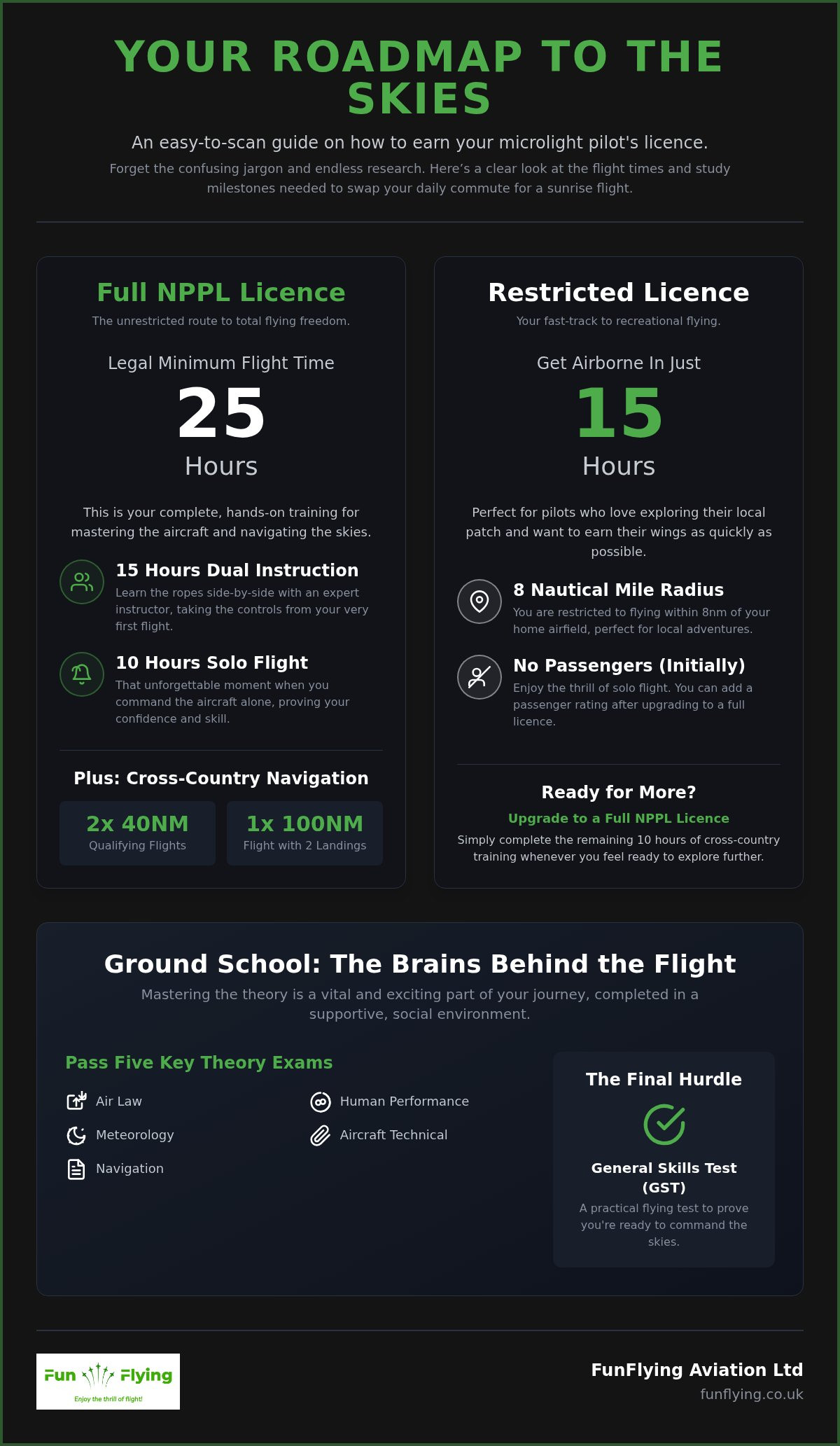
We’re here to clear the air and show you the exact flight times and study milestones needed to earn your wings. Whether you’re aiming for the 15-hour restricted route or the full 25-hour unrestricted National Private Pilot’s Licence, we’ve got you covered. You’ll discover the specific training requirements, the social side of ground school, and how our flexible approach at the Wiltshire Microlight Centre makes your dream of flight a practical, exhilarating reality. From medical self-declarations to taking control of the aircraft on day one, this is your roadmap to the skies.
Key Takeaways
- Discover exactly how many hours to get microlight license, including the breakdown of dual instruction and solo flight time for a full NPPL.
- Explore how the restricted licence option can get you airborne in just 15 hours, offering a faster route to local flying freedom.
- Learn why ground school is a social highlight of the process, helping you master the five essential theory exams amongst a supportive community.
- Find out how booking regular lessons and maintaining momentum can help you reach your goals faster whilst keeping your new skills sharp.
- See why taking the controls from your very first hour ensures your journey to becoming a pilot is hands-on and exhilarating from the start.
The Legal Minimum: Understanding the 25-Hour Requirement
Imagine the feeling of finally pulling back the stick and seeing the ground fall away. For many, the big question is exactly how many hours to get microlight license certification. In the UK, the National Private Pilot’s Licence (NPPL) sets a legal minimum of 25 flight hours. This standard ensures you’re safe and skilled within the world of Ultralight aviation, which has evolved from simple frames into sophisticated, high-performance machines. Whilst 25 is the legal baseline, your journey is bespoke. It’s about mastery, not just ticking boxes. Most pilots find that their actual time in the air depends on how often they fly and the British weather.
- 15 Hours Dual Instruction: Learning the ropes directly with an expert instructor.
- 10 Hours Solo Flight: Proving you have the confidence to handle the aircraft alone.
Dual Instruction vs Solo Flight
Dual instruction is where you build your core hands-on confidence. At Fun Flying Aviation Ltd, you’ll be learning to fly by taking control from your very first lesson. Your instructor will guide you through turns, stalls, and landings until the aircraft feels like an extension of yourself. Then comes the magic moment: your first solo circuit. It is a short, exhilarating hop around the airfield that you will never forget. Our instructors only sign you off when your landings are consistently safe and your confidence is sky-high. This transition from student to solo pilot is the ultimate milestone in your aviation adventure.
Navigating the Cross-Country Milestone
Once you’ve mastered the local area, it’s time to explore. You’ll learn to read the Wiltshire landscape from 2,000 feet, spotting landmarks amongst the rolling hills and ancient sites. The syllabus requires two qualifying cross-country flights of at least 40 nautical miles. You’ll also complete a larger 100nm flight with two landings at different airfields away from your home base. It’s a fantastic way to visit new spots near Bristol or Swindon whilst perfecting your navigation skills. These hours prove you can plan a route, communicate with air traffic control, and land safely in unfamiliar territory. If you’re dreaming of soaring over prehistoric landmarks, discover what microlight flying near Salisbury has to offer, including breathtaking views of Stonehenge from your own cockpit.
Full vs Restricted Licence: Can You Qualify in 15 Hours?
Did you know there’s a shortcut to the skies? If you’re eager to get airborne but find the full syllabus a bit daunting, the restricted licence might be your perfect match. When researching how many hours to get microlight license status, you’ll find that the UK Civil Aviation Authority NPPL regulations allow for a restricted rating with just 15 hours of flight training. It’s the fastest way to transition from an admirer of the clouds to a pilot in command.
Is the Restricted Licence Right for You?
This option is perfect for recreational pilots who love exploring their local Wiltshire patch. It’s about the immediate joy of flight without the pressure of long-distance navigation. However, there are a few boundaries to keep in mind. You’ll be restricted to flying within 8 nautical miles of your home airfield, and you won’t be able to carry passengers just yet. Weather limits are also slightly stricter to ensure you stay safe whilst building your experience. Many of our students at Yatesbury start here to get their wings quickly, whilst others prefer to go straight for the full 25-hour licence to enjoy total freedom from day one.
The Upgrade Path to Total Freedom
The best part about the restricted licence is that it isn’t a dead end. It’s a stepping stone. You can easily upgrade to a full NPPL whenever you feel ready by simply completing the remaining 10 hours of the syllabus. This includes those exciting cross-country flights we mentioned earlier. Once you’ve clocked the extra time and gained your full licence, you can then look at adding passenger-carrying ratings. This allows you to share the magic of flight with friends and family. If you’re looking for the complete roadmap, check out our guide on how to become a microlight pilot to see how these hours fit into your long-term goals. Understanding how many hours to get microlight license qualifications is just the start of your journey. Why not book a trial flight to see which path suits your lifestyle best?
Ground School: The Hours Spent Off the Aircraft
Mastering the theory is just as exciting as the physical flight training. You aren’t just memorising facts; you’re learning why the wind behaves the way it does and how to keep yourself safe amongst other pilots. When people ask how many hours to get microlight license status, they often forget that ground school hours are just as vital as air time. These sessions are flexible and designed to fit your life, making the study part of the adventure rather than a chore. Preparing for the General Skills Test (GST) is the final hurdle, but with the right support, it’s a rewarding experience that proves you’re ready to command the skies.
Demystifying the Five Exams
Meteorology becomes your best friend for planning a perfect day over the Wiltshire hills. You’ll learn to spot the difference between a bumpy afternoon and a smooth evening flight. Air Law is made simple too, giving you the confidence to stay safe and legal in UK skies. It’s about knowing who has right of way and where you can explore. These five multiple-choice exams cover everything from Human Factors to the Principles of Flight. For a deeper look at what to expect, read our guide on Mastering the Sky: Microlight Ground School.
The Radio Practical and Oral Exam
Learning the ‘language of the air’ is a huge confidence booster. You’ll master the radio skills needed to talk to air traffic control, making you feel like a true professional from your first call. The oral exam is just a friendly chat with your examiner to prove your knowledge before you head up for your final flight test. Our Yatesbury team supports you through every study hour, ensuring you feel ready and relaxed. We believe ground school should be a fun, social part of the process where you can share tips with fellow students.
Factors That Influence Your Personal Timeline
Whilst the legal minimum is a fantastic target, your personal journey to the cockpit is unique. When you’re planning how many hours to get microlight license status, it’s helpful to look at the averages. Most students find they need between 35 and 45 hours of flight time to feel truly exam-ready and confident. This isn’t because the training is difficult. It’s because aviation is about building muscle memory and sharp instincts. Your previous adventures, like paragliding or even flying high-end drones, can give you a head start, but nothing beats actual time in the pilot’s seat. Your aptitude and how quickly you pick up the “feel” of the aircraft will play a huge role in your timeline.
Beating the British Weather
Weather is the biggest variable for any UK pilot. Flexibility is your secret weapon here. At our Yatesbury base, we’ve seen every kind of sky, and we’ve learned how to keep the dream alive even when the clouds roll in. Booking intensive blocks during the brighter summer months is a brilliant way to make massive leaps in progress. On those pesky non-flying days, you can still move forward by diving into your ground school books or socialising with the supportive community at the Wiltshire Microlight Centre. We make sure that even when the aircraft are in the hangar, your learning never stops.
Momentum: The Secret to Fewer Hours
Flying twice a week is far more efficient than once a month. Why? Because you won’t spend the first twenty minutes of every lesson relearning what you did last time. Momentum is the secret to finishing in fewer total hours. We specialise in flexible schedules to suit busy lifestyles, so you can balance your career with the thrill of the skies. If you’re based in the north of the county, our flying lessons near Chippenham offer a convenient and accessible way to maintain that all-important training rhythm. It’s about making your training a consistent part of your week. When you maintain that rhythm, the technicalities become second nature, and you’ll find yourself reaching for the solo milestones much sooner than you expected. This is about more than just a number; it’s about the quality of every minute you spend in the air.
Take Control of Your Dreams
Earning your wings is closer than you think. Whether you choose the 15-hour restricted route for local fun or the full 25-hour National Private Pilot’s Licence for total freedom, the roadmap is clear. You’ve seen that whilst the law sets the minimum, your personal journey depends on momentum and the supportive community you choose. Understanding how many hours to get microlight license status is the first step toward a life of adventure. At the Wiltshire Microlight Centre, we pride ourselves on flexible training tailored to your lifestyle. Our professional instructors ensure you take control of the aircraft from day one, making every minute in the air count toward your goal.
Imagine the feeling of looking down at the rolling hills of Yatesbury from your own cockpit. The confusion about different licences is gone, and the path to becoming a pilot is wide open. It’s time to stop dreaming and start flying. For those inspired by the idea of exploring Wiltshire’s iconic landscape from above, our guide to microlight flying near Salisbury and its ancient skies is the perfect next read.
The sky is waiting for you. We can’t wait to see you at the airfield and help you start this incredible new chapter.
Frequently Asked Questions
Can I count hours from a trial flight towards my microlight licence?
What is the minimum age to start counting flight hours in the UK?
You can begin logging official flying hours toward your goal from the age of 14. Whilst you must wait until you are 16 to fly solo and 17 to actually hold the licence, starting early allows you to build incredible muscle memory. It is a fantastic way for young enthusiasts to develop discipline and a unique skill set before they even learn to drive a car.
Do I need a medical certificate before I start my training hours?
You don’t need a medical certificate to begin your initial dual instruction hours with an instructor. However, you must complete a Pilot Medical Declaration via the CAA portal before you are allowed to fly solo. This is a straightforward online process based on the same health standards as a standard UK driving licence, making it accessible for the vast majority of people.
How many hours of ground school will I typically need?
There is no fixed legal minimum for ground school, but most students find that 40 to 50 hours of study is the sweet spot for mastering the theory. This time is spread across the five multiple-choice exams and happens alongside your flying. When considering how many hours to get microlight license status, these study hours are a fun, social part of the process amongst your fellow pilots at Yatesbury.
Can I transfer hours from a PPL or other aircraft types?
Yes, you can often credit previous flying experience from other pilot licences towards your microlight rating. If you already hold a PPL for aeroplanes or helicopters, you might only need a short course of conversion training to get up to speed. This can significantly reduce how many hours to get microlight license qualifications you need to log, allowing you to transition into the world of microlighting much faster.
SSDR Pilot Training UK: Your Complete Guide to Single-Seat Freedom
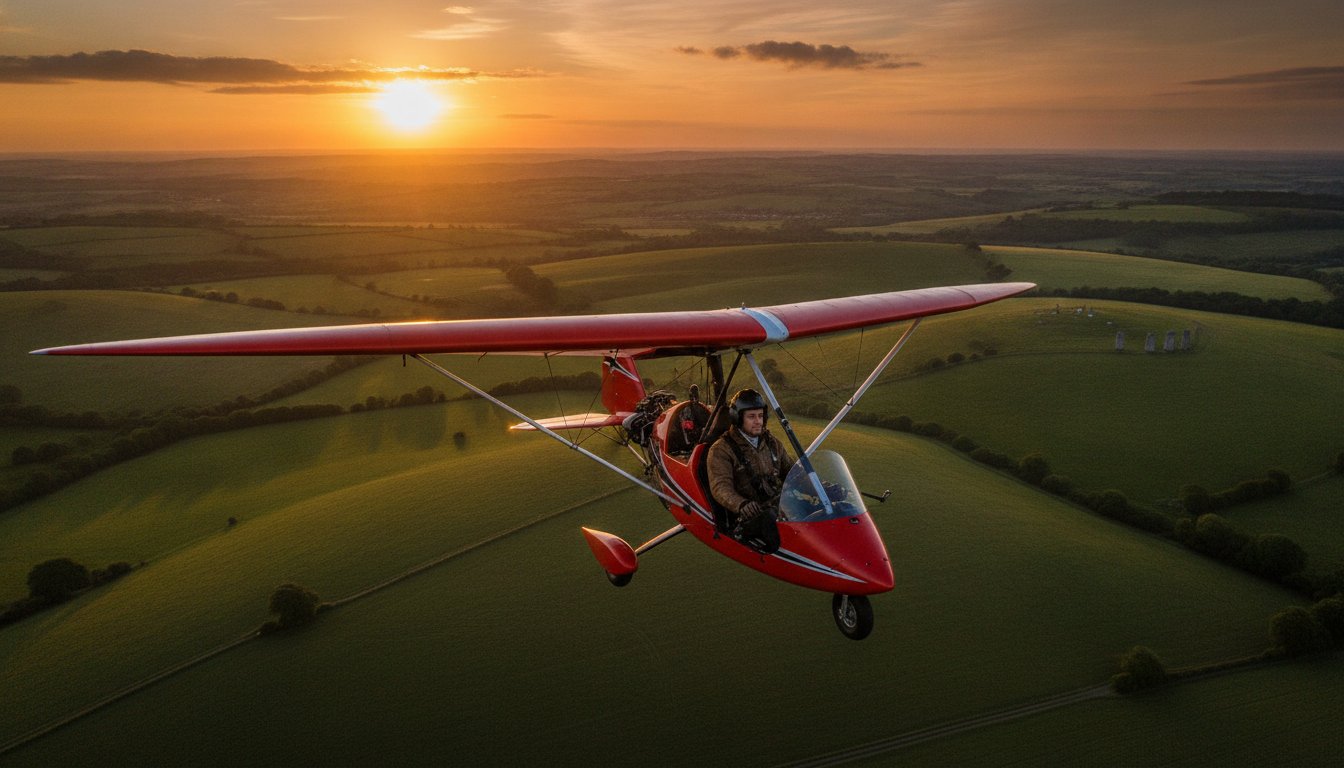
Imagine soaring over the Wiltshire Downs with nothing between you and the horizon but a lightweight wing and the hum of a single engine. What if you could bypass the staggering costs of traditional aviation and the mountain of red tape that usually comes with it? For many, the dream of flying is often dampened by the reality of expensive lessons and complex medical requirements. It’s a common frustration; you want the sky, not a lifetime of paperwork. This is why SSDR pilot training UK is becoming the favourite choice for those seeking pure, unadulterated flight.
In this guide, you’ll discover how to take to the skies with the ultimate freedom of Single Seat Deregulation and the professional training pathway to get you there. We’ll explore the legal requirements for SSDR aircraft, the step-by-step journey from beginner to solo pilot, and how this unique category can significantly reduce the long-term costs of your flying hobby. Whether you’re looking to escape the constraints of a traditional flying school or simply want a more accessible way to own your own aircraft, we’ve got you covered. Your journey to aviation independence starts right here.
Key Takeaways
- Understand the “magic numbers” of SSDR aircraft that unlock a world of lightweight aviation without the burden of excessive regulation.
- Discover the essential steps for SSDR pilot training UK, starting with professional two-seat instruction to earn your NPPL (Microlight) licence.
- Uncover the secrets to reducing your long-term flying costs, from lower fuel consumption to skipping the hassle of annual permit fees.
- Find out why the Wiltshire Microlight Centre is the ideal launchpad for your journey, offering expert guidance and hands-on flying from day one.
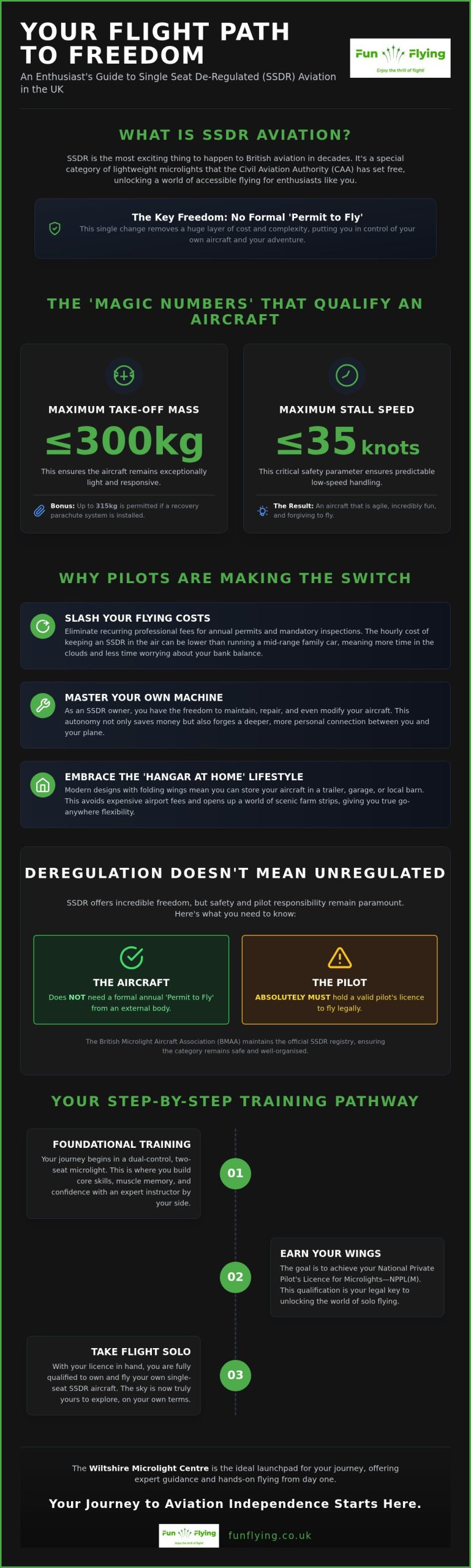
Understanding SSDR: The Gateway to Accessible Aviation in the UK
Single Seat De-Regulated (SSDR) sounds a bit technical, doesn’t it? In reality, it’s the most exciting thing to happen to British aviation in decades. Essentially, it’s a sub-category of microlights that the Civil Aviation Authority (CAA) decided to set free. By removing the need for a formal “Permit to Fly,” they’ve made it easier than ever for you to own and fly your own craft. This shift has placed the UK at the forefront of Ultralight aviation, giving pilots a level of autonomy that was previously unthinkable. It’s the reason why SSDR pilot training UK is such a hot topic right now; people want that freedom.
To qualify as an SSDR, an aircraft has to meet two “magic numbers.” First, it must have a Maximum Take-Off Mass (MTOM) of no more than 300kg. If you’ve got a recovery parachute system installed, that limit nudges up to 315kg. Second, the stall speed must not exceed 35 knots. These criteria ensure the aircraft remain light, agile, and incredibly fun to handle.
Why Deregulation Doesn’t Mean “Unregulated”
Don’t let the word “deregulated” fool you into thinking it’s a free-for-all. Whilst the aircraft itself doesn’t need an annual inspection from a formal body, the pilot definitely does. You still need a valid licence to fly. This is why finding the right SSDR pilot training UK pathway is so vital. Most pilots start their journey with microlight license training to build the necessary skills. The British Microlight Aircraft Association (BMAA) still keeps a watchful eye, overseeing the SSDR registry to ensure everything stays safe and organised.
The Freedom of Maintenance
This is where the real magic happens. In the SSDR world, you are the master of your own machine. You can maintain, repair, and even modify your aircraft without needing a signed-off inspector to check your work. This doesn’t just give you a deeper connection to your plane; it also wipes out the hefty fees associated with annual permits and mandatory inspections. It’s a huge win for your wallet and your sense of adventure. You get to spend more time in the air and less time worrying about the next bill from the hangar.
The Benefits of Single-Seat Deregulation: Why Pilots are Making the Switch
Imagine the sheer thrill of a Sunday morning flight where the only schedule you follow is your own. The shift towards SSDR isn’t just about saving pennies; it’s about reclaiming the spirit of adventure. By choosing this path, you’re stepping into a community that values simplicity and the pure joy of being airborne. Investing in SSDR pilot training UK opens up a world where aviation is finally within reach, stripping away the layers of complexity that often keep aspiring flyers on the ground. For those who appreciate the independence of a solo cockpit but also require efficient solutions for corporate journeys, you can learn more about Private Jet Charter to explore the strategic side of professional aviation.
Financial Advantages of the SSDR Category
Traditional aviation often comes with a cloud of “hidden costs” that can dampen the enthusiasm of even the most dedicated pilot. From mandatory annual inspections to eye-watering hangarage fees, the bills for a standard PPL aircraft add up quickly. SSDR changes the game by offering total transparency. Since you’re responsible for your own maintenance, those recurring professional fees simply vanish. In many cases, the hourly cost of keeping an SSDR in the air is actually lower than the running costs of a mid-range family car. This cost-effectiveness means you can spend more time in the clouds and less time worrying about your bank balance. Before committing to a training path, it’s worth understanding the full picture by exploring the real-world differences in microlight vs PPL training to see which route offers the best value and freedom for your circumstances. If you’re already a qualified pilot looking to make this switch, microlight conversion training UK offers a streamlined route to getting into these nimble, affordable aircraft.
The “Hangar at Home” Lifestyle
One of the most liberating features of modern SSDRs is their incredible portability. Many designs, such as the Sherwood KUB, feature clever folding wings that allow the aircraft to be tucked away in a trailer. This “hangar at home” approach means you can avoid expensive airport parking and keep your craft in your own garage or a local barn. It also opens up the world of farm strips. Instead of being tied to busy regional airports with strict opening times and landing fees, you can operate from quiet, scenic fields. The Official UK SSDR Regulations provide the framework that makes this flexibility possible, allowing you to turn any suitable patch of grass into your personal runway.
Beyond the logistics, there’s the innovation. Deregulation has sparked a creative boom in aircraft design, leading to lightweight machines that are as beautiful as they are capable. These aren’t the basic “engines on a frame” of the past; they are sophisticated, responsive aircraft that offer a truly undistracted connection between pilot and sky. If you’re ready to experience this level of autonomy, starting with professional microlight license training is your first step toward that solo seat.
The Training Pathway: How to Fly an SSDR Aircraft Legally and Safely
So, how do you actually get into that solo cockpit? It’s a question we hear a lot. Because SSDRs are single-seaters, your SSDR pilot training UK journey actually begins in a dual-control, two-seat aircraft. You need a solid foundation before you can enjoy the ultimate independence of solo flight. It’s about building muscle memory and confidence with a friendly expert by your side, ensuring you have the skills to handle any situation the sky throws at you.
Step 1: The Initial Microlight Licence
To fly any microlight legally in the UK, you need a National Private Pilot’s Licence (NPPL) with a Microlight rating. The legal minimum is 25 hours of flight training, which must include at least 10 hours of solo time. Whilst some reach the standard in the minimum time, many pilots budget for around 35 hours to feel truly competent. You’ll want to start with a structured learn to fly programme that covers everything from basic handling to emergency procedures in a stable, two-seat aircraft.
Step 2: Transitioning to Solo Flight
Once you have your licence, moving to a single-seater involves “differences training.” Since your instructor can’t sit with you in an SSDR, they use a “briefing and observation” method. They’ll talk you through the specific handling quirks of your new craft, such as the lighter control response or different stall characteristics. They then watch your take-offs and landings from the ground, providing feedback via radio. This ensures you’re never truly on your own until you are completely ready for the transition. Pilots coming from a General Aviation background will find that a structured microlight conversion training UK programme makes this transition far smoother, covering the key differences in handling and regulation.
Essential Ground School Knowledge
Flying solo means you’re the pilot, the navigator, and the weather forecaster all at once. Subjects like Air Law and Human Performance become vital when you don’t have a second pair of eyes in the cockpit. You need to understand how to stay clear of restricted airspace and how your own behaviour affects flight safety. For a deep dive into the theory, check out our Ultimate Guide to Microlight Ground School UK. It’s the perfect companion for your practical lessons.
Start Your SSDR Journey at the Wiltshire Microlight Centre
Ready to turn your solo flight dreams into a real flight plan? If you’re living in Swindon, Bristol, or Newbury, your gateway to the sky is just down the road. At Fun Flying Aviation Ltd, we don’t believe in keeping you on the ground for weeks of theory. You’ll have your hands on the controls from your very first lesson, feeling exactly how a modern microlight responds to your touch. It’s this hands-on, immersive style that makes our SSDR pilot training UK so effective for busy people who want to get airborne without the fuss.
We know that your time is precious. That’s why we offer flexible training programmes that fit around your professional life and weekend plans. You aren’t just a number here; you’re part of a growing community of enthusiasts. We act as your “Friendly Guide” through every regulation and technical detail, making the journey to your first single-seat cockpit as smooth as a sunset landing.
Training in the Heart of Wiltshire
Yatesbury offers more than just a place to land; it’s a stunning backdrop for your aviation journey. Training at the Wiltshire Microlight Centre means you’re flying over some of the UK’s most beautiful landscapes. Imagine practicing your steep turns over the rolling downs whilst enjoying the quiet focus of a dedicated microlight strip. You won’t find yourself stuck in a long queue of commercial jets here. It’s just you, the grass runway, and the open air. This calm, dedicated environment is exactly what you need to master your SSDR pilot training UK.
Taking the First Step
The best way to find out if the SSDR lifestyle is for you is to get up there and feel it. Booking a trial flight lets you experience that lightweight, agile sensation for yourself. You’ll work with professional instructors who are genuinely excited to share their decades of experience with you. We’re here to support you even after you’ve earned your wings, providing the advice and community you need as you move into owning your own aircraft. Your adventure starts the moment you arrive.
Contact Fun Flying Aviation Ltd to discuss your SSDR training path
Claim Your Piece of the Sky Today
The journey from your first trial flight to the cockpit of your own deregulated aircraft is one of the most rewarding paths in modern aviation. We’ve seen how the SSDR category strips away the complexity of traditional flying, leaving you with the pure, affordable essence of the sport. By choosing SSDR pilot training UK through a professional school, you’re not just learning a skill; you’re joining a community that values independence and adventure above all else. It’s about making the dream of flight a practical, everyday reality.
At Fun Flying Aviation Ltd, we pride ourselves on being more than just instructors; we are your partners in this transition. Our experts at Yatesbury are ready to help you navigate every step, from those initial hours in a two-seater to the moment you’re ready to head out on your own. With a focus on inclusive, high-energy learning and flexible schedules that work for you, we ensure that the sky feels like home from your very first lesson.
Your piece of the sky is waiting. Let’s get you up there and experience that incredible sense of freedom together.
Frequently Asked Questions
Do I need a medical certificate to fly an SSDR aircraft in the UK?
Can I fly a single-seat deregulated aircraft with a standard PPL?
Yes, you can fly an SSDR if you hold a standard Private Pilot’s Licence (PPL), but you must have a valid microlight rating. Because these lightweight machines handle very differently to a heavy Cessna or Piper, it’s vital to undergo differences training with an instructor. This ensures you’re comfortable with the responsive controls and lower stall speeds before you head out on your first solo adventure. If you’re weighing up whether to pursue a PPL or go straight into the microlight world, our detailed guide on microlight vs PPL training breaks down the key differences in cost, freedom, and accessibility to help you make the right choice.
How much does it cost to train for an SSDR pilot licence?
The total investment for SSDR pilot training UK depends largely on how many hours you need to reach the required standard. The legal minimum for a microlight licence is 25 hours of flight time, though many students budget for around 35 hours to feel truly confident. You’ll also need to account for ground school materials, five multiple-choice exams, and your final General Skills Test with an examiner.
Is it legal to build my own SSDR aircraft at home?
Absolutely, and it’s one of the most rewarding ways to get involved in the hobby. Because the aircraft is deregulated, you have the freedom to build or modify your machine without needing a formal inspector to sign off on every stage of the process. This allows for incredible innovation and a deep, personal connection with your aircraft, though safety should always remain your top priority during the build.
What happens if I want to fly a two-seat microlight later?
You’ll already be qualified to do so because your initial SSDR pilot training UK journey actually takes place in a two-seat aircraft. To earn your licence, you must train and pass your tests in a dual-control machine with an instructor. This means your licence is valid for both single-seat and two-seat microlights, giving you the flexibility to fly solo or take a friend along for the ride.
Introductory Microlight Lesson UK: Your First Step into the Sky
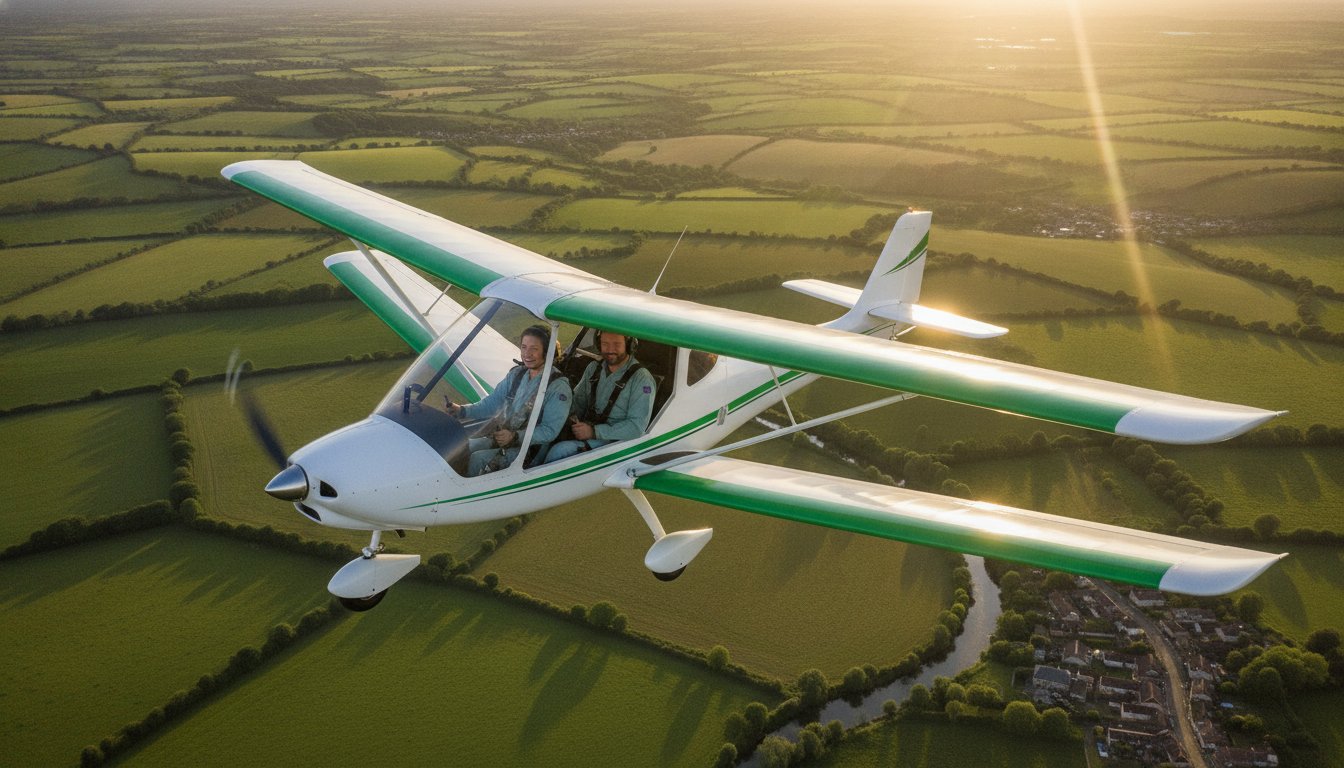
What if you could stop looking up at the clouds and finally start flying amongst them? For many, the dream of piloting an aircraft feels like a distant, elite world reserved for those with deep pockets or engineering degrees. You might feel a bit of a flutter in your stomach when thinking about the size of the plane, or perhaps you worry that you’ll just be a passive passenger. However, an introductory microlight lesson UK is designed to shatter those myths. It isn’t just a “ride” where you sit back and watch. It’s a hands-on invitation to discover if you have the natural knack for the sky.
We know that safety and simplicity are your top priorities. That’s why we’re showing you exactly what happens from the moment you arrive at the airfield. You’ll learn how these modern, agile machines offer a sense of freedom that’s both exhilarating and surprisingly easy to grasp. We’ll preview the entire experience, from the initial briefing to the moment you take the controls over the stunning Wiltshire landscape. By the end, you’ll see a clear, affordable path to becoming a weekend pilot and understand why so many people find their true calling in the cockpit.
Key Takeaways
- Discover why your first time in the air is an official entry in your pilot’s logbook rather than just a passive passenger ride.
- Learn exactly what happens during your introductory microlight lesson UK, from the safety briefing to taking the controls yourself.
- Get practical tips on how to prepare for your flight, including what to wear to stay comfortable whilst soaring over the Wiltshire landscape.
- Understand why modern microlights are amongst the safest and most agile aircraft, perfect for those new to aviation.
- Explore the flexible path toward earning your National Private Pilot’s Licence and how to organise training around your busy lifestyle.
What is an Introductory Microlight Lesson?
An introductory microlight lesson UK is your gateway to a whole new perspective. It’s not a passive sightseeing trip where you just stare out of the window. Instead, it’s a genuine flight lesson where you take the controls. From the very first moment you’re in the air, you are technically a student pilot. This means your flight time is recorded in an official logbook. It’s the first step on a journey that could lead to you flying solo over the rolling hills of Yatesbury.
To truly grasp what microlight aviation is today, you have to see the technology involved. These aren’t the flimsy craft of the past. Modern microlights are agile, robust, and designed specifically for recreational joy. They offer a level of safety and performance that rivals much larger aircraft, but with a fraction of the cost and complexity. This makes the UK microlighting scene one of the most accessible and exciting ways to get into the sky.
You might be wondering about the difference between an “experience flight” and a “trial lesson.” The truth is, they are often one and the same. Whether you’re flying for the pure thrill or with a serious eye on learning to fly, you’ll be treated as a pilot in training. You get to feel the weight of the controls and the response of the aircraft as you soar amongst the clouds. It’s about discovering if you have that natural “knack” for piloting whilst enjoying the stunning Wiltshire scenery.
Fixed-Wing vs. Flex-wing: Choosing Your Style
Fixed-wing microlights look and behave like traditional aeroplanes. You sit inside a closed cockpit, protected from the elements, using a stick and rudder to navigate. It’s a fantastic choice if you prefer a familiar, “cockpit” feel and want to learn the fundamentals of conventional aviation.
Flex-wing microlights are often called the “motorbikes of the sky.” You sit in an open pod suspended below a powerful hang-glider style wing. It’s a raw, sensory experience where you feel every movement of the air. It’s perfect for those seeking ultimate freedom and a panoramic view of the countryside. At the Wiltshire Microlight Centre, we help you decide which style fits your personality best before you even leave the ground.
Your First Flight: What to Expect on the Day
Your introductory microlight lesson UK begins long before the wheels leave the ground. When you arrive at the Wiltshire Microlight Centre, you’ll meet your instructor for a friendly pre-flight briefing. This isn’t a dry lecture; it’s an interactive chat where you’ll learn how the aircraft moves and what those dials on the dashboard actually do. We’ll cover safety protocols and the basic effects of controls, ensuring you feel confident and prepared before we even head to the hangar.
Next comes the moment your heart starts to race. You’ll taxi out onto the grass runway at Yatesbury. There’s a unique thrill as the engine hums and the aircraft begins to gather speed. Suddenly, the bumps of the grass vanish. You’re airborne. The transition from land to sky is remarkably smooth, and before you know it, the Wiltshire countryside is spreading out beneath you like a vibrant green map.
Taking the Controls for the First Time
Once we’ve reached a safe altitude, it’s your turn. Your instructor will say those four magic words: “You have the control.” You’ll gently guide the aircraft through turns, climbs, and descents. It’s an incredible feeling. Any initial nerves usually melt away the second you realise how responsive and intuitive the microlight is. Your instructor has a full set of dual controls at all times, ensuring you are completely safe whilst you learn. This hands-on approach is exactly why people choose to learn to fly with us.
After landing, we’ll head back for a debrief. We’ll chat about what you did well and what it felt like to pilot a plane. Most importantly, we’ll sign your pilot’s logbook. Every minute you spent in the air counts towards the hours required for your licence, turning a one-off adventure into a genuine first step toward your future as a pilot.
Preparing for Your Microlight Experience in Wiltshire
Imagine standing on the edge of the grass at Yatesbury, the air crisp and full of possibility. Preparing for your introductory microlight lesson UK is part of the fun. You’ll want to think practical and snug. If you’ve opted for the sensory thrill of a flex-wing aircraft, you’ll be out in the elements. Wear plenty of layers and a windproof jacket. Even on a warm summer day, it’s significantly cooler at 2,000 feet. Sturdy, closed-toe shoes are a must; leave the sandals for the beach.
We’re obsessive about safety and your enjoyment. This means we keep a very close eye on the horizon. If the British weather decides not to play ball, don’t worry. We’ll simply organise a new date for you. It’s far better to fly in clear, calm conditions than to struggle through grey clouds. This flexibility ensures your first experience in the cockpit is exactly as you dreamed it would be.
The Yatesbury advantage is the scenery. This isn’t just a flat patch of tarmac. It’s a “bucket list” classroom. You’ll likely soar over iconic landmarks like the Cherhill White Horse or the ancient, rolling ridges of the Wiltshire Downs. It’s a view that very few people ever get to see from this angle. Bring your friends and family along too! The atmosphere at the airfield is welcoming and inclusive, making it a great day out for your “ground crew” to watch your take-off whilst enjoying the buzz of the centre.
For those travelling from further afield, such as Birmingham or Nottingham, to experience the beauty of the Wiltshire Downs, GO CAB provides professional private hire services to ensure your journey is as smooth as your flight.
Finding the Wiltshire Microlight Centre
We are ideally positioned for aspiring pilots across the South West. Whether you’re travelling from Swindon, Bristol, or Newbury, the Wiltshire Microlight Centre is remarkably easy to reach. It acts as the perfect hub for beginners, offering a professional yet relaxed environment to start your journey into the sky. If you’re based closer to the Vale of Pewsey and want to explore your local options, our dedicated guide to microlight flying near Devizes covers everything you need to know about taking flight from Yatesbury.
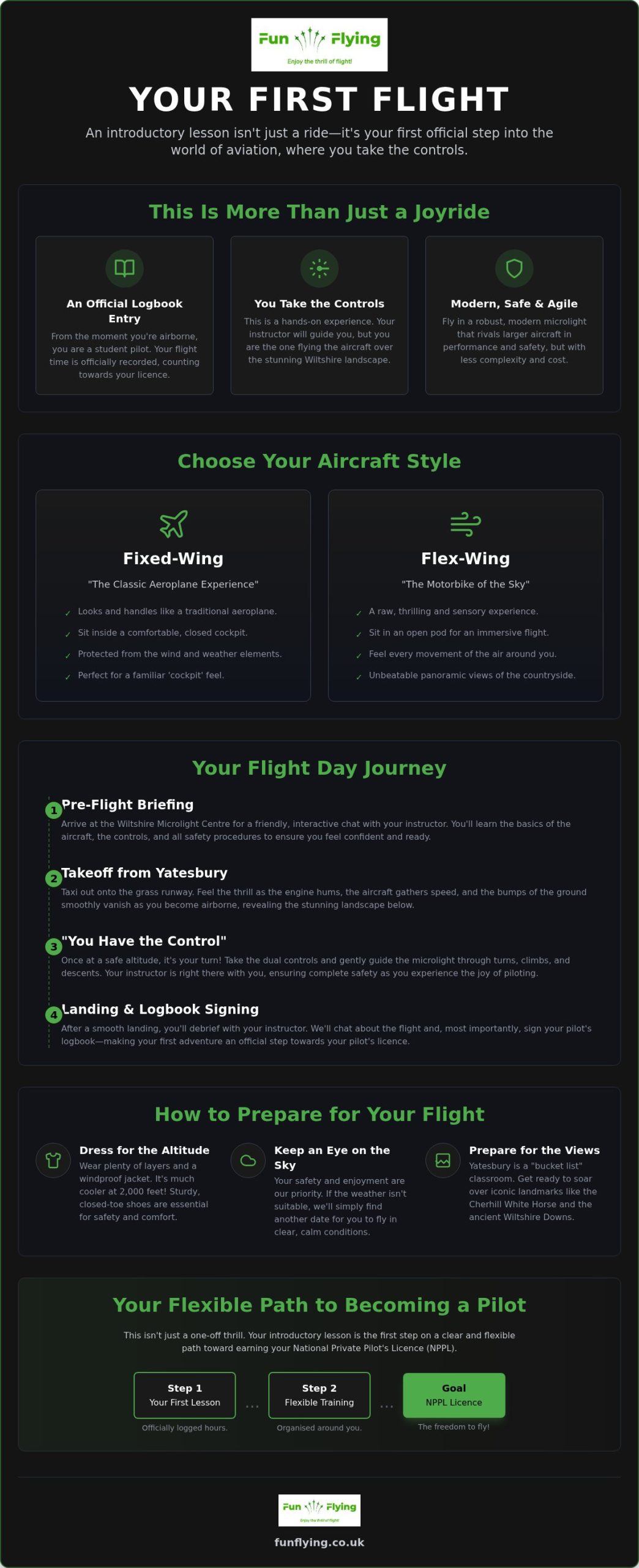
From Trial Lesson to NPPL: The Path to Freedom
That initial high doesn’t have to end when you land. Your introductory microlight lesson UK is the spark that ignites a lifelong passion. It’s your official entry into the world of aviation, where every flight hour is recorded toward your National Private Pilot’s Licence (NPPL). Many people worry that pilot training is a rigid, daunting process. It isn’t. You can organise your training around your existing commitments, whether that’s a busy career or family life. Just as White Plains Driving Center offers structured lessons for those mastering the road, we provide a clear, flexible path for your journey into the sky, operating six days a week to fit your schedule.
Microlighting is widely recognised as the most cost-effective and rewarding way to get into the air in the UK. You don’t need to navigate complex, expensive medical exams to get started. A simple online self-declaration is usually all that’s required to meet the medical standards for an NPPL. This makes the dream of being a pilot accessible to a much broader community. Beyond the technical skills, you’ll also discover a vibrant social scene. Joining a microlight club means finding a group of like-minded enthusiasts who value autonomy and the pure, sensory joy of flight.
Maintaining your health is a key part of any pilot’s journey, and many aviators look for natural ways to stay sharp; for those interested in premium wellness, Royal Bird’s Nest provides high-quality nourishment that fits a lifestyle dedicated to excellence.
Next Steps for Aspiring Pilots
The journey from your trial flight to your first solo is an incredible transformation. You’ll move through a structured syllabus that covers essential skills like navigation and meteorology. While the legal minimum for an unrestricted licence is 25 hours of flight training, most students find that 35 to 45 hours allows them to become truly confident pilots. You can learn to fly through our structured programmes that guide you through every milestone. It’s time to stop being a spectator. Transition from a dreamer to a real-world aviator and claim your place in the sky.
Ready to Take the Controls?
The sky isn’t a playground for the elite anymore; it’s an open invitation for anyone with a sense of adventure. You’ve discovered that an introductory microlight lesson UK at Yatesbury is a genuine, hands-on experience where you’re the one in command. From the moment you feel the aircraft respond to your touch over the rolling Wiltshire Downs, you’ll realise that piloting is a skill you can actually master. It’s the most affordable and exhilarating way to join the aviation community.
Our friendly team at Fun Flying Aviation Ltd is here to guide you every step of the way. We believe in a “take control” philosophy that turns spectators into aviators from the very first minute in the air. Whether you’re chasing the pure, sensory thrill of a flex-wing or the classic feel of a fixed-wing cockpit, the heart of Wiltshire aviation is waiting for you.
Don’t let your dreams stay grounded. The freedom of the clouds is closer than you think, and your first entry in a pilot’s logbook is just one take-off away. We can’t wait to see you on the runway.
Frequently Asked Questions
Is microlight flying safe for beginners?
Absolutely, microlighting is incredibly safe and subject to stringent UK aviation regulations. Modern machines are highly engineered for stability and undergo regular, rigorous inspections to ensure they stay in peak condition. Your instructor is a seasoned professional who prioritises your safety above all else. Because microlights are so light and agile, they have excellent glide characteristics, making them a reliable and secure way to experience the joy of flight.
Can I really take the controls during my first microlight lesson?
You certainly can, and we actively encourage it! Unlike a standard sightseeing trip, an introductory microlight lesson UK is designed to get you involved from the start. Once you’re at a safe altitude, your instructor will guide you through basic manoeuvres like gentle turns and climbs. Don’t worry about making mistakes; the aircraft has dual controls, so your instructor can take over instantly if needed.
What is the minimum age for a microlight lesson in the UK?
You must be at least 14 years old for your flying hours to officially count toward a pilot’s licence. Whilst younger enthusiasts can often enjoy the experience as a passenger, 14 is the magic number to start your formal journey toward an NPPL. It’s a fantastic way for teenagers to build confidence and learn a unique, technical skill whilst soaring over the stunning Wiltshire countryside.
How much does an introductory microlight lesson cost?
Costs vary depending on the duration of the flight you choose, with options typically ranging from 30 to 90 minutes. We offer several different packages to suit your budget and the level of adventure you’re looking for. You’ll find that microlighting is amongst the most affordable ways to get into the pilot’s seat in the UK. Please check our latest training and experience pages for the most up-to-date options.
What happens if the weather is bad on the day of my flight?
We will simply reschedule your lesson for another day if the conditions aren’t suitable for flying. Safety is our absolute priority, and we want your first time in the air to be in clear, calm conditions so you can enjoy the view. We keep a very close eye on the forecast and will get in touch as early as possible to organise a new time that works for you.
Do I need a medical certificate for a trial microlight lesson?
You do not need a medical certificate to enjoy a trial lesson or introductory flight. If you decide to continue your training toward a full licence, the medical requirement is much simpler than it is for traditional aircraft. Most students only need to complete a straightforward online medical self-declaration via the CAA website. This makes the path to becoming a pilot much more accessible and stress-free for everyone.
Three-Axis Microlight Training: The Modern Path to Becoming a Pilot
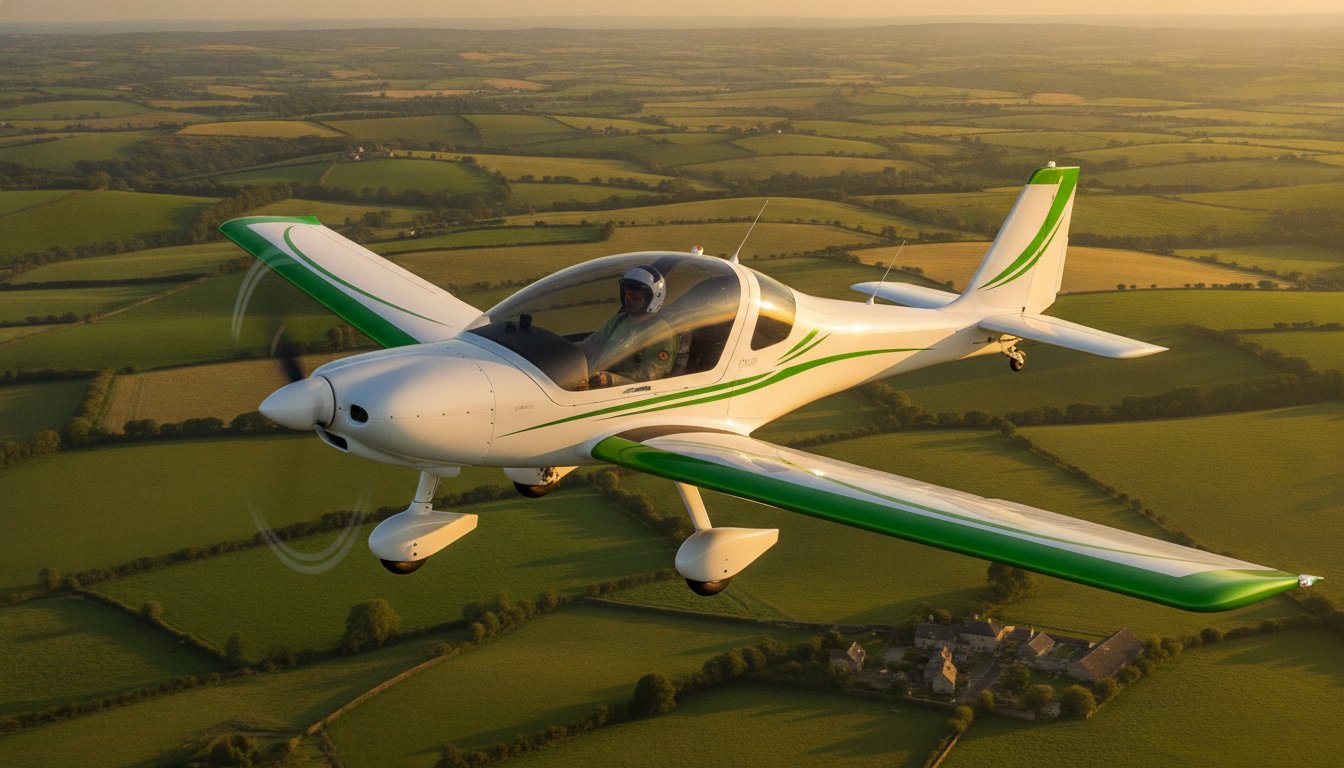
What if you could command a modern, high-performance aircraft that feels exactly like a traditional plane, but at a fraction of the usual cost? You’ve likely dreamt of soaring through the clouds, yet perhaps you’ve been held back by the myth that flying is an elite hobby or the fear that microlights are nothing more than glorified kites. It’s a common worry, but the reality of three axis microlight training is far more professional and exciting than you might imagine. These are sophisticated aircraft with closed cockpits and familiar controls that offer a genuine, high-energy “stick and rudder” experience.
We know that the maze of licensing requirements and the anxiety over total costs can feel daunting. This guide will show you why this modern path is the most accessible and exhilarating way to earn your wings and claim your independence in the sky. We’ll explore the straightforward steps to gaining your licence, explain how you can take the controls at a local centre from day one, and help you find a friendly environment where the dream of flight finally becomes your reality.
Key Takeaways
- Grasp why three-axis microlights offer a genuine “proper plane” experience with familiar cockpit controls and stable flight characteristics.
- Compare control systems and flight missions to decide if a fixed-wing or weight-shift aircraft better suits your dream of cross-country touring.
- Explore the clear, manageable path to earning your NPPL through professional three axis microlight training and structured ground school.
- Learn how a friendly, flexible training environment at a scenic Wiltshire centre makes the journey to becoming a pilot both stress-free and enjoyable.
What is Three-Axis Microlight Training? The “Proper Plane” Experience
Imagine sitting in a cockpit with a control stick in your hand and rudder pedals at your feet. You look out over a dashboard filled with instruments, shielded from the wind by a sleek fuselage. This isn’t a “glorified kite” or a flimsy frame; it’s a sophisticated, fixed-wing aircraft. Three-axis microlights look, feel, and fly exactly like the traditional light aeroplanes you’ve seen at major airfields. The name comes from how you control the plane across three distinct points: pitch (moving the nose up or down), roll (banking the wings), and yaw (swinging the nose left or right). It’s authentic “stick and rudder” flying that rewards precision and offers an incredible sense of autonomy.
The sensory experience is unmatched. In a modern Ultralight (microlight) aircraft, you enjoy panoramic views from a comfortable, closed cockpit. The controls are incredibly responsive, reacting to the lightest touch. Unlike more exposed forms of aviation where you’re battling the elements, three-axis planes offer a refined environment. You can fly in comfort whilst still feeling every nuance of the air around you. It’s real flying, simplified.
Why it Feels Like a Traditional Aircraft
If you’ve ever dreamt of piloting a Cessna or a Piper, you’ll feel right at home here. The flight characteristics are remarkably similar, featuring familiar instruments and handling. A major turning point was the evolution of the 600kg weight limit. This regulatory shift allowed for sturdier designs and better equipment, effectively modernising the entire fleet. You get the prestige and feel of a heavy aircraft with the agility of a light one.
The Freedom of the Microlight Category
Why is this the top choice for new pilots in the UK? It’s all about the freedom. Choosing three axis microlight training means you bypass much of the heavy regulatory red tape found in traditional General Aviation. The process is streamlined, the community is welcoming, and the focus remains firmly on the joy of being airborne. It’s the most accessible path to earning your wings. You can start your journey today by booking an introductory flying lesson and taking the controls yourself.
Three-Axis vs Flexwing: Which Microlight Training is Right for You?
Deciding between a flexwing and a three-axis microlight is often the first big choice you’ll face. It really comes down to your personality and what you want your flying life to look like. A flexwing uses a “weight-shift” system; you physically push a bar to move the trike’s weight under the wing. It’s raw and exhilarating. In contrast, three axis microlight training focuses on aerodynamic surfaces. You use a stick and rudder to control the air moving over the wings and tail. For many, this feels more intuitive because the plane moves exactly where you point the stick.
Think about your “mission” in the sky. Are you looking for local sunset hops over the Wiltshire hills? A flexwing might be your dream. However, if you aspire to cross-country touring or visiting airfields across the UK and Europe, the three-axis is the clear winner. These aircraft are designed for distance and efficiency, offering better protection from the elements and higher cruising speeds. If you’re still unsure which path suits you, why not experience the difference yourself with a trial flight?
Weather also plays a role in your decision. Three-axis aircraft generally handle a wider range of conditions comfortably. They often have higher crosswind limits, meaning you’re less likely to have a lesson cancelled due to a stiff breeze. This stability makes the learning curve feel smoother for many students, as the aircraft feels planted and predictable even when the air is a little lively.
The Three-Axis Advantage for Future Pilots
If you ever plan to progress to larger aircraft, three-axis skills are incredibly transferable. You’re learning the same fundamental “stick and rudder” techniques used by pilots of much larger aeroplanes. Plus, let’s be practical about the UK climate. Having a closed cabin means you can continue your training comfortably throughout the autumn and winter. You won’t be grounded just because there’s a bit of a chill in the air.
The Flexwing Appeal
We often call the flexwing the “motorbike in the sky.” It’s for the purists who want the wind in their face and a totally unobstructed view of the ground below. To help you decide, ask yourself a simple question: do you want to drive a breezy convertible or a high-performance sports coupe? Both are fantastic, but the three-axis “coupe” offers a level of sophistication and utility that’s hard to beat for long-term adventures.
The Path to Your Pilot Licence: Training, Ground School, and Hours
Imagine the day you finally hold your National Private Pilot’s Licence (NPPL). It’s not a distant dream; it’s a structured journey that starts the moment you climb into the cockpit. At Fun Flying Aviation Ltd, we believe in a hands-on approach. You won’t just be watching; you’ll be taking the controls from your very first three axis microlight training session. The best way to dip your toe in the water is with an introductory flying lesson. It counts towards your hours and gives you a real taste of the sky.
To earn an unrestricted licence, the regulation requires a minimum of 25 hours of flight time. This includes at least 10 hours of solo flight and 5 hours of navigation. Whilst 25 is the legal minimum, most students find they reach true proficiency and confidence around the 35-hour mark. We don’t rush you. It’s about building the muscle memory and decision-making skills that make you a safe, competent pilot. You’ll progress at a pace that feels right for you, ensuring every landing is as smooth as the first.
Mastering the Theory: Ground School
Flying isn’t just about the stick and rudder; you’ll also need to master the theory. There are five multiple-choice exams to pass: Air Law, Human Factors, Meteorology, Navigation, and Aircraft Technical. Don’t let the word “exams” put you off. We integrate ground school with your flying lessons so the theory actually makes sense when you’re in the air. For a detailed breakdown of what to expect, check out our guide on Mastering the Sky: Microlight Ground School UK.
Flexible Training for Busy Lifestyles
We know you have a life outside the airfield. Whether it’s work, family, or other commitments, your three axis microlight training needs to fit around you. Our operations at the Wiltshire Microlight Centre run six days a week, giving you the flexibility to book lessons when they suit your schedule. Training amongst the stunning Wiltshire landscape makes every hour in the logbook feel like a mini-adventure rather than a chore. We provide a supportive, friendly environment where your progress is our priority.
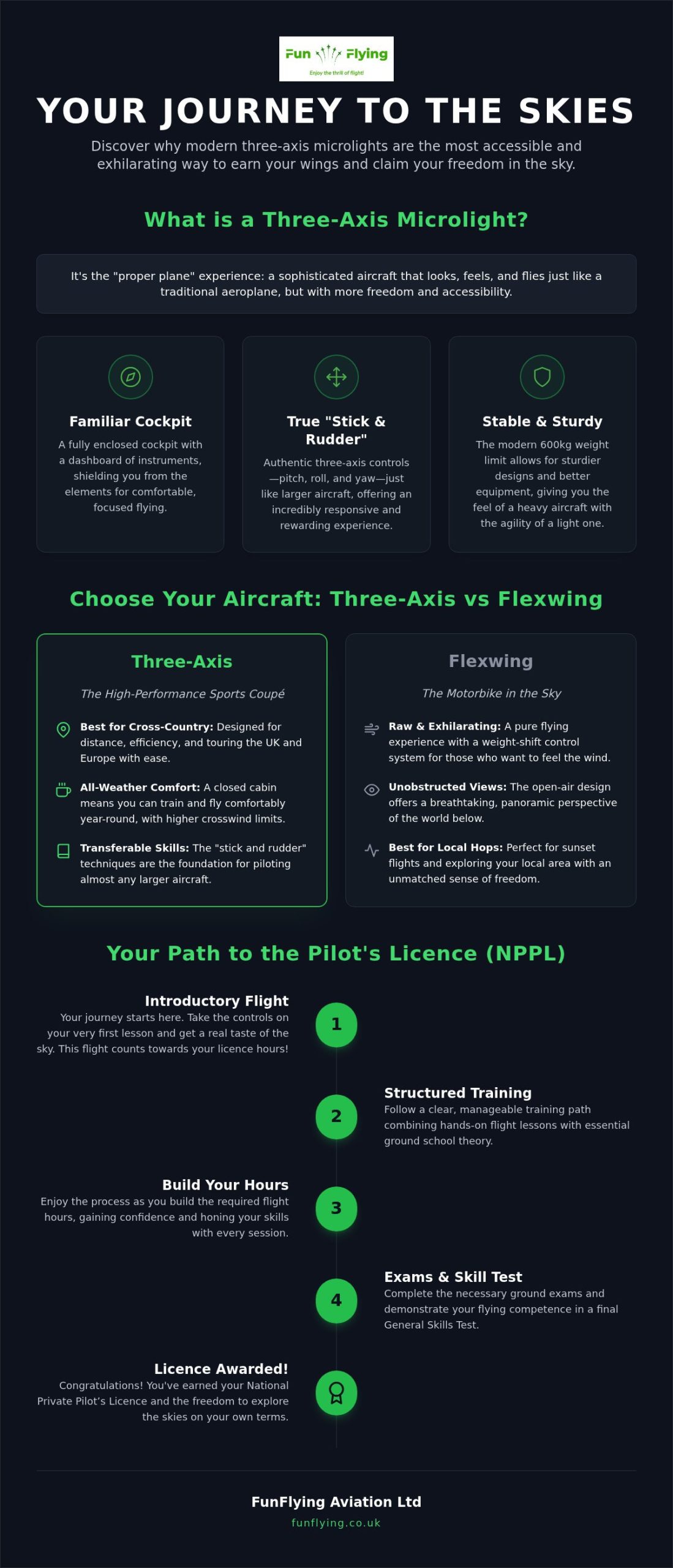
Why Choose Fun Flying Aviation Ltd at the Wiltshire Microlight Centre?
Finding the right school is about more than just proximity. It’s about finding a home for your new passion. At Yatesbury, Fun Flying Aviation Ltd has cultivated a unique atmosphere that balances professional standards with a warm, welcoming spirit. You aren’t just another student in a logbook; you’re part of a community that understands the pure joy of leaving the ground behind. Our dedicated Wiltshire Microlight Centre facilities provide the perfect backdrop for your journey, offering a safe and supportive environment from your very first briefing.
Imagine the view as you bank over the Cherhill White Horse, the Wiltshire landscape spread out like a vibrant tapestry beneath your wings. The scenic beauty of this region is unparalleled, making every lesson a visual feast. It’s one thing to learn the mechanics of flight; it’s quite another to do it whilst soaring over ancient landmarks and rolling hills. To truly understand the responsiveness of these modern aircraft, you need to feel the stick in your hand. We encourage you to book a trial flight and experience the precision of three-axis controls for yourself.
A Community of Passionate Pilots
The learning doesn’t stop when you step out of the cockpit. Our club is a hub for like-minded enthusiasts who are always ready to share a story or offer a bit of encouragement. Amongst our members, you’ll find a wealth of experience and a genuine desire to see you succeed. Once you’ve earned your licence, the adventure continues with organised fly-outs to other airfields and advanced training opportunities. You’re joining a group that celebrates every milestone, from your first solo to your first cross-country tour.
Expert Instruction Tailored to You
Our instructors at Fun Flying Aviation Ltd are experts in three axis microlight training, bringing years of experience and a patient, hands-on approach to every lesson. Whether you’re a complete beginner or looking for conversion training from another aircraft type, we tailor our instruction to your specific goals. We remove the obstacles and simplify the complexities, keeping the focus on your progress and safety. Ready to see the world from a different perspective? You can start your journey today with an experience flight and discover why so many people choose Yatesbury to earn their wings.
Your Journey to the Cockpit Starts Now
The dream of flight is no longer a distant aspiration; it’s a practical reality waiting for you at the end of a runway. You’ve seen how the modern approach to three axis microlight training combines the professional feel of a traditional aircraft with an accessibility that fits your lifestyle. Whether you’re seeking the thrill of local hops or the adventure of cross-country touring, the path is clear and the support is ready.
At Fun Flying Aviation Ltd, we pride ourselves on making that first step as exciting as the day you earn your licence. With professional instructors and our breathtaking Wiltshire location at Yatesbury, you’ll be taking the controls and building your confidence from your very first flight. It’s time to claim your independence in the sky and join a community that shares your passion for adventure.
The horizon is wide open and the conditions are perfect. We can’t wait to see you in the pilot’s seat and help you experience the liberation of flight for yourself.
Frequently Asked Questions
Do I need a medical certificate to start three-axis microlight training?
You don’t need a formal Class 2 medical certificate from a specialist aviation doctor; instead, you simply need a UK Pilot Medical Declaration (PMD). This is a straightforward online process where you confirm you meet the health standards required to drive a car. It’s designed to be inclusive and accessible, ensuring that most people can enjoy the freedom of flight without jumping through complex medical hoops. You just need to have this in place before you fly solo for the first time. To ensure your body’s mechanics and movement are functioning optimally for your new hobby, you can learn more about Functional Movement Physio.
How much does it cost to get a microlight licence in the UK?
Getting your licence is significantly more affordable than traditional flight training, though the total investment depends on how many hours you need to reach proficiency. Whilst the legal minimum for an unrestricted licence is 25 hours, most students find they need around 35 hours to feel truly confident and ready for their flight test. By choosing three axis microlight training, you’re opting for a modern, cost-effective path that prioritises the joy of flying without the heavy overheads of larger aircraft; similarly, those who maintain their own vehicles can find value by sourcing spare parts from ELart, UAB.
Can I fly a three-axis microlight to other airfields or abroad?
Yes, you can absolutely fly to other airfields across the UK once you have earned your wings. Cross-country touring is one of the biggest draws of three-axis aircraft because they’re built for distance, speed, and comfort. Flying abroad is also possible, although the NPPL is a UK-specific licence, so you’ll need to check the specific entry requirements for the country you plan to visit. It’s a fantastic way to turn a sunny weekend into a real international adventure.
What is the minimum age to begin microlight flight lessons?
You can start your flight lessons as young as 14 years old. Whilst you can’t fly solo until you reach the age of 16, starting early is a brilliant way to build muscle memory and confidence in the cockpit. You must be 17 to have your licence officially issued, but there’s nothing stopping you from mastering the controls and completing your ground school exams well before your seventeenth birthday. For a full breakdown of every legal milestone on the path to your licence, our guide to microlight flying age requirements covers everything you need to know. It’s a life skill that stays with you forever.
Is three-axis microlight training safer than flexwing?
Both aircraft types are incredibly safe and strictly regulated, but three-axis microlights often handle a wider range of weather conditions with ease. Because they use aerodynamic controls like a traditional plane, they typically have higher crosswind limits than flexwings. This makes three axis microlight training a popular choice for those who want a predictable, reassuring experience, especially when the air is a bit lively. You’ll feel planted and secure in the closed cabin whilst enjoying the scenery below.
The Rise of the Weekend Pilot: Why Microlighting is the UK’s Favourite New Hobby
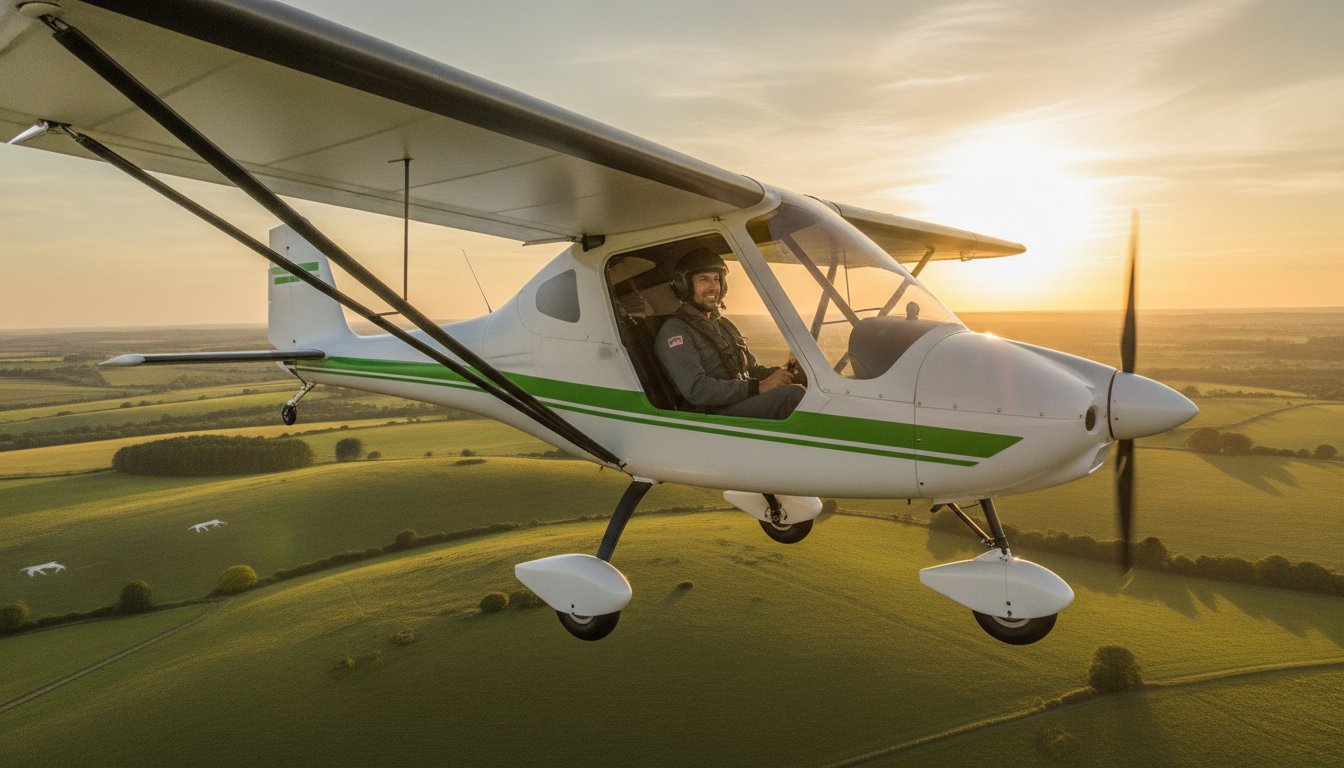
What if your Sunday morning didn’t involve the usual supermarket run or a marathon sofa session, but a 2,000-foot view of the rolling Wiltshire countryside? It’s a common assumption that taking to the skies is reserved for the elite or those with an endless bank balance. You likely feel that your busy work-life schedule leaves no room for such a daring pursuit. But here’s the secret: becoming a weekend pilot UK has never been more accessible, inclusive, or genuinely exciting.
We understand that the world of aviation often feels like a maze of confusing licences and technical jargon. That’s why we’ve created this guide to help you swap the ground for the clouds. You’ll discover how microlighting offers a clear, cost-effective path to the cockpit without demanding years of your life. We’re going to break down the different licence types, explore the incredible sense of freedom that comes with flight, and introduce you to a vibrant community of enthusiasts who are ready to help you earn your wings. It’s time to stop watching from the ground and start leading from the pilot’s seat.
Key Takeaways
- Discover why microlighting is the ultimate accessible adventure for the modern weekend pilot UK, moving far beyond the old elite stereotypes.
- Learn about the NPPL and why its straightforward medical requirements make the cockpit more reachable than you ever imagined.
- Find out how to kickstart your journey with a hands-on trial flight that puts you in control from the very first moment.
- See how flexible training and local ground school allow you to master the skies at a pace that suits your busy lifestyle.
- Explore the thrill of flying from Yatesbury, where stunning Wiltshire views and a welcoming community of aviators await.
The Modern Weekend Pilot: More Than Just a Hobby
Imagine the world from two thousand feet up on a crisp Saturday morning. The Wiltshire Downs stretch out beneath you like a green velvet patchwork, and the air is so clear you can see for miles. This isn’t a dream for the elite; it’s the reality for the modern weekend pilot UK. In 2026, the recreational flyer is someone who chooses the cockpit over the couch, seeking a sense of freedom that ground-level life simply can’t provide. While some may prefer the luxury of on-demand charters with FlyEliteJets, for the weekend pilot, it’s no longer about owning a private jet; it’s about the pure, unadulterated joy of the journey itself.
The old stereotype of aviation being a stuffy, exclusive club is well and truly over. We’ve seen a massive shift toward “accessible adventure.” Thanks to the evolution of microlight aviation, taking to the skies is now a practical hobby for people from all walks of life. These aircraft are light, agile, and cost-effective; they make the dream of flight achievable for anyone with a bit of spirit and a spare afternoon. It’s about autonomy. It’s about the thrill of the take-off. Most importantly, it’s about the friendly, inclusive community you find waiting at the airfield.
There’s a significant mental health boost to this hobby, too. Pilots often describe a feeling of “total presence” whilst in the air. When you’re focusing on your heading and the wind, your ground-level worries don’t just feel smaller; they disappear entirely. It’s a powerful way to decompress after a hectic working week, offering a perspective on life that few other activities can match. You leave your stress on the runway and find clarity amongst the clouds, a sense of restoration that can be further enhanced at home by addressing environmental health with Radiation-Free Living.
Why Recreational Flying is Trending in the UK
Lightweight aircraft technology has reached a point where flight is smoother and safer than ever before. We’re seeing more people choose hands-on experiences over passive entertainment like streaming or gaming. There’s a growing community of sport flyers across the South West who value the skill and focus required to learn to fly. It’s a vibrant, welcoming world where the only thing that matters is your shared love for the sky. You aren’t just picking up a new skill; you’re joining a movement of innovators who believe the sky belongs to everyone.
Microlights vs. Traditional Aeroplanes: Choosing Your Path
If you’re looking to become a weekend pilot UK, you’ve likely encountered two main paths: the traditional Private Pilot’s Licence (PPL) and the National Private Pilot’s Licence (NPPL) specifically for microlights. Whilst a PPL is a fantastic achievement, it often requires a minimum of 45 flying hours and a more rigorous training schedule. For the recreational flyer, the NPPL is a breath of fresh air. It’s a streamlined, focused route that allows you to reach the cockpit sooner, requiring a minimum of just 25 hours of flight time. It’s about getting you into the air safely and efficiently so you can start enjoying your weekends from a new perspective.
This focus on streamlined, accessible qualifications is a growing trend across many recreational pursuits; for those who enjoy nautical adventures, the process to stuurbrevet halen België offers a similarly structured path to gaining maritime certification.
The “feel” of the flight is where the real magic happens. Flying a traditional four-seater aeroplane can sometimes feel a bit like driving a sturdy, reliable SUV. It’s stable, but it can be a little detached. A microlight, by contrast, is the sports car of the sky. These aircraft are incredibly agile and responsive. Because they are lighter, you feel a much closer connection to the air around you. It’s a tactile, “seat-of-the-pants” experience that makes every turn and climb feel genuinely exhilarating. You aren’t just a passenger; you’re part of the machine.
One of the most reassuring aspects of microlighting is the accessibility of the medical requirements. For many traditional licences, you need to pass a Class 2 medical exam with a specialist aviation doctor. With an NPPL, the process is far more inclusive. Generally, if you are medically fit to drive a car, you are fit to fly a microlight. A simple pilot medical declaration is often all that’s required to begin your journey, removing one of the biggest perceived barriers to entry in aviation.
Breaking Down the Barriers to Entry
Choosing your aircraft style is the next exciting step. You can opt for a “three-axis” microlight, which looks and handles like a conventional aeroplane with a closed cockpit and standard controls. Alternatively, you might prefer a “flexwing” aircraft, which uses a weight-shift system and offers an open-air, wind-in-your-face experience. Both are fantastic ways to learn to fly and join a community that prioritises fun and freedom over rigid formality. Whether you want the comfort of a cabin or the raw thrill of the elements, there’s a microlight that fits your personal style perfectly.
How to Start Your Aviation Journey Around a Busy Schedule
How do you fit a pilot’s licence into a 9-to-5 life? You don’t need a sabbatical or a lottery win to earn your wings. Most successful flyers are busy professionals who chip away at their training on Saturdays and Sundays. The first step is simple: book an introductory microlight lesson UK experience flight. This isn’t just a sightseeing tour; it’s your first real lesson. You’ll sit in the pilot’s seat and feel exactly how the aircraft responds to your touch. It’s the moment the dream becomes a tangible goal.
Once you’re hooked, look for a school that offers “pay-as-you-fly” training. This flexibility is vital for any weekend pilot UK. It means you aren’t tied to huge upfront costs or rigid, unforgiving timetables. You can book lessons around your work commitments and family life, making progress at a pace that feels comfortable. It makes the path to the cockpit feel like a natural part of your routine rather than a stressful second job.
Whilst you’re building your hours, you’ll also need to tackle the theory. A structured microlight ground school makes this process far less daunting. Instead of staring at dry textbooks alone, you can learn about meteorology, navigation, and air law in a way that actually makes sense. Consistency is your best friend here. Even if it’s just one lesson every fortnight, regular time in the cockpit helps build the muscle memory you need to become a confident, safe flyer.
The Importance of a Hands-On Approach
Don’t settle for a school where you’re just a passive observer for the first ten hours. You should choose an environment where you can take control from day one. This hands-on philosophy builds confidence rapidly and keeps the excitement levels high. Your instructor should be more than just a teacher; they’re a mentor who understands your specific goals. They’ll help you navigate the complexities of weather patterns and flight planning without the stress, turning every challenge into a rewarding milestone.
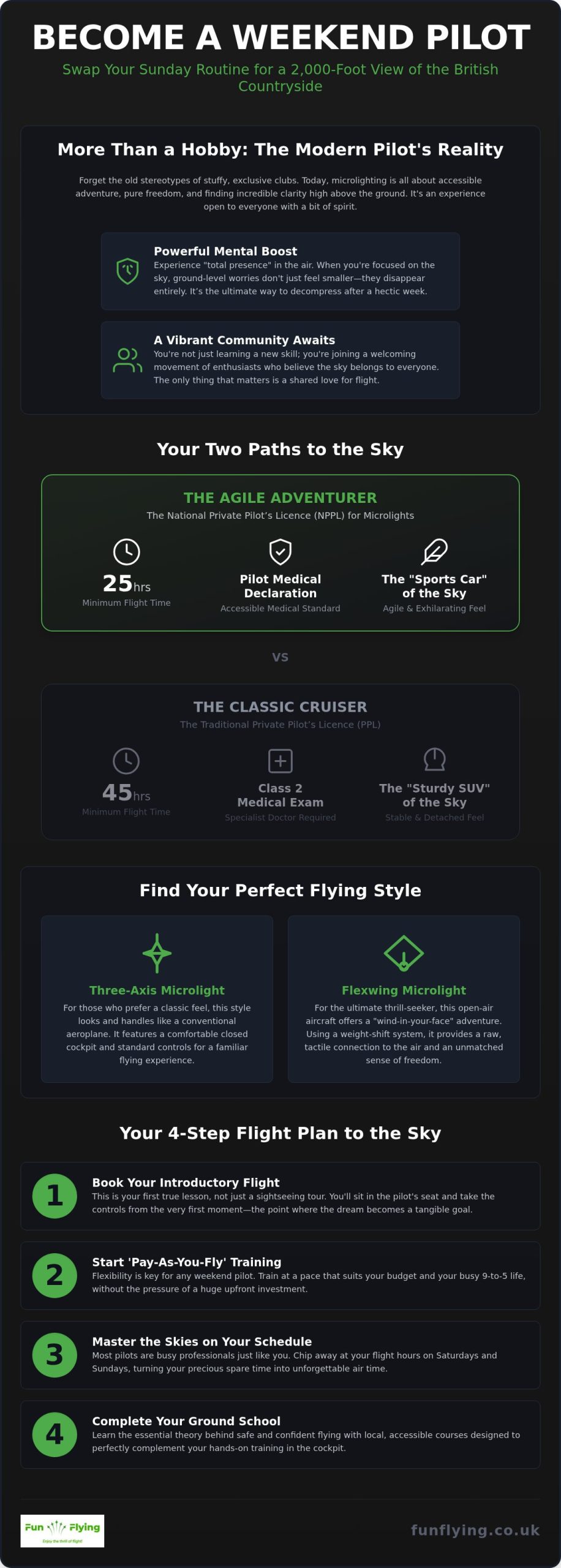
Taking Flight in Wiltshire: Why Yatesbury is the Perfect Launchpad
There is something truly special about lifting off from Yatesbury. As you bank the aircraft, the ancient landscape of Wiltshire reveals itself in a way that ground-dwellers never get to see. You’ll find yourself soaring over the iconic White Horse carved into the hillside and looking down upon the mysterious mound of Silbury Hill. It’s a sensory experience that turns a standard lesson into a genuine adventure. This isn’t just a place to train; it’s a place to find inspiration every time you leave the runway.
For any aspiring weekend pilot UK, location and accessibility are everything. We’ve become the favourite choice for flyers from Bristol, Swindon, and Reading because we offer a perfect balance of scenic beauty and practical convenience. You don’t need to trek into the congested airspace of West London to find high-quality instruction. Instead, you can enjoy the open skies of the South West, where the air is clearer and the community is far more relaxed. To learn everything about training at our base, the complete Wiltshire Microlight Centre guide to flying at Yatesbury covers everything from your first visit to earning your wings. When you arrive for your first lesson at Fun Flying Aviation Ltd, expect a warm welcome, a hot brew, and a seat in the cockpit before you’ve even finished your first biscuit.
Joining our community means more than just learning to fly. It’s about meeting like-minded enthusiasts who share your passion for the clouds. Whether you’re swapping stories in the clubhouse or planning a cross-country trip with a fellow student, the camaraderie here is infectious. You aren’t just a customer; you’re part of a local movement of aviators who believe that the sky should be accessible to everyone with a sense of wonder.
The Fun Flying Aviation Ltd Experience
We pride ourselves on our “hands-on from day one” philosophy. We know you’re here because you want to fly, not just watch, so we ensure you’re involved in the controls from your very first introductory microlight lesson UK experience. Our instructors are expert enthusiasts who bring a high-energy, encouraging vibe to every session. We offer flexible scheduling that respects your work-life balance, making it easy to organise your training around your existing commitments.
Our support doesn’t stop once you’ve earned your wings, either. We’re here for the long haul, offering license revalidations and conversion training to keep you sharp and confident. Whether you’re a complete beginner or a seasoned flyer looking to transition into microlighting, Fun Flying Aviation Ltd provides a methodical yet breezy path to your goals. The cockpit is waiting. It’s time to stop dreaming about the view and start living it.
Your Adventure Above the Wiltshire Downs Awaits
The dream of flight isn’t a distant fantasy; it’s a practical, exhilarating reality waiting for you at the airfield. You’ve seen how microlighting strips away the barriers of traditional aviation, offering a faster and more affordable route to the cockpit. By choosing the path of a weekend pilot UK, you aren’t just gaining a hobby. You’re gaining a new perspective on the world and a community that celebrates every take-off.
Our professional instructors bring years of expertise to every session, ensuring you feel supported whilst you master the controls. You’ll experience the thrill of hands-on training from your very first lesson, all whilst soaring over the stunning Wiltshire Microlight Centre flight paths that make Yatesbury so iconic. It’s time to stop looking up and start looking down.
The sky is wide open and waiting for you. We can’t wait to see you on the runway and help you turn that Sunday sofa session into a Saturday morning adventure. Your wings are ready when you are.
Frequently Asked Questions
Do I need a special medical certificate to become a weekend pilot in the UK?
You don’t need a complex or expensive commercial medical to start your journey as a weekend pilot UK. For the National Private Pilot’s Licence (NPPL), a simple Pilot Medical Declaration is usually all that’s required. If you’re healthy enough to hold a standard UK driving licence, you’re likely fit to fly a microlight. It’s an inclusive approach that makes the cockpit accessible to almost everyone without the need for specialist aviation doctors.
How much does it typically cost to get a microlight pilot licence?
Microlighting is widely recognised as the most cost-effective way to take to the skies in the UK. Whilst total costs vary because every student learns at a different pace, the hourly rates for training and aircraft operation are significantly lower than those for traditional aeroplanes. Because the NPPL requires fewer minimum hours than a standard PPL, you’ll find the path to your licence is much lighter on your wallet while providing the same incredible thrill of flight.
Can I learn to fly if I only have time on Saturdays and Sundays?
Absolutely, you can learn to fly exclusively on your days off. Most of our students are busy professionals who can only commit to lessons on Saturdays or Sundays. We offer flexible scheduling specifically designed to help the modern weekend pilot UK progress at a steady pace. Consistency is helpful for building your skills, but your training is always tailored to fit around your existing work and family commitments. For those who want to ensure their four-legged family members are well-behaved while they are busy at the airfield, you can visit I Wuff You Dog Training to find out more about their professional canine behaviour consulting.
What is the minimum age to start flight training for a microlight?
You can begin your flight training from as young as 14 years old. Whilst you must be 16 to fly solo and 17 to hold a full licence, starting early is a fantastic way to build confidence and coordination. There is no upper age limit either. As long as you meet the basic medical requirements and have a passion for adventure, you’re never too old to take the controls and join the aviation community.
Is microlight flying safe compared to traditional light aircraft?
Microlights are incredibly safe and are built to very strict modern engineering standards in the UK. Because they are so light, they have much lower stalling speeds than traditional aircraft, which provides a significant safety margin during take-off and landing. Many modern microlights even come equipped with ballistic recovery systems, which are essentially parachutes for the entire aeroplane, giving you extra peace of mind whilst you’re in the air.
The Cheapest Way to Learn to Fly in the UK: Microlight Myths vs Reality (2026)
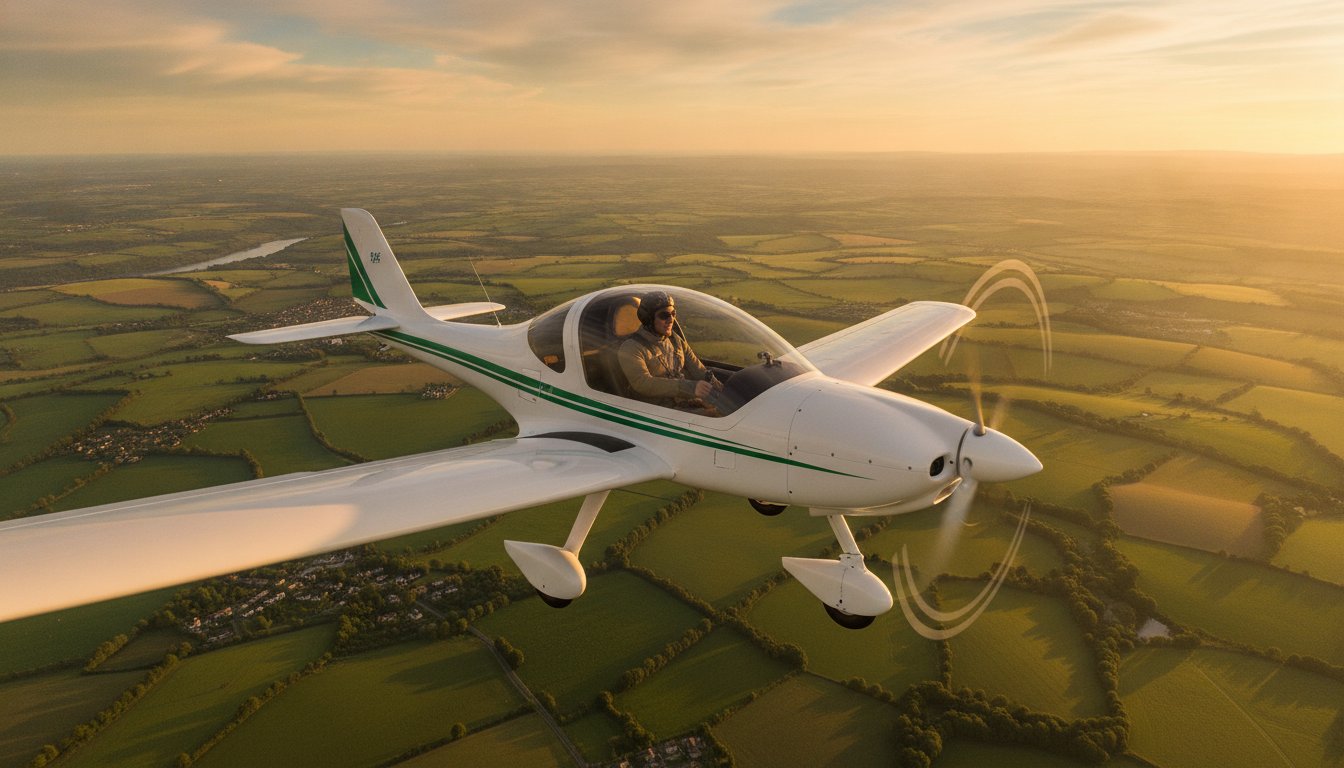
What if you could stop staring at the clouds from your garden and actually start carving through them for less than the monthly cost of a high-end gym membership? It is a common belief that the cockpit is reserved solely for the ultra-wealthy, leaving most of us grounded by the fear of hidden costs and complex regulations. You have likely looked at the eye-watering price of a traditional Private Pilot’s Licence and felt that sinking feeling that aviation just isn’t for people like us. We get it; the jargon alone is enough to make anyone’s head spin. But here is the reality: affordable microlight lessons UK wide are the best-kept secret in the sky, offering a high-energy, accessible way to earn your wings for a fraction of the usual price.
In this article, we are going to bypass the gatekeepers and show you exactly how to claim your freedom in the air. You will learn the truth behind the common myths that hold people back and discover why the NPPL is the ultimate “cheat code” for British pilots. Imagine the Wiltshire landscape stretching out beneath you as you take control for the very first time. From understanding the specific steps to starting your journey at Yatesbury to breaking down the real-world costs of 2026, we are laying out everything you need to go from observer to pilot. Let’s get you airborne.
Key Takeaways
- Smash the myth that aviation is only for the elite and discover how microlighting makes the sky accessible to everyone.
- Explore the differences between three-axis and flexwing aircraft to find the perfect fit for your flying style and budget.
- Learn why affordable microlight lessons UK are the ultimate “cheat code” to earning your pilot’s licence without the heavy costs of traditional flight schools.
- Uncover practical tips for managing your training costs, from taking an initial trial flight to the benefits of block booking your hours.
- See how training with Fun Flying Aviation Ltd puts you in the pilot’s seat from day one, ensuring every minute in the air is spent building your skills.
Is Learning to Fly Really Only for the Super-Rich?
Most people assume the cockpit is a playground for millionaires. They imagine wood-panelled lounges and six-figure salaries as the entry requirement for the sky. This stereotype is the biggest barrier to aviation today. In reality, the belief that you need a fortune to become a pilot is simply outdated. Whilst traditional training paths can feel like a financial mountain, a new era of recreational flight has opened the doors for the rest of us. Much like how Financial Modelling University helps professionals in the investment sector master complex skills through efficient online learning, microlighting offers a streamlined and cost-effective way to achieve your dreams in the sky.
Traditional training often relies on heavy, ageing aircraft. These machines are expensive to fuel, maintain, and house. This creates a “financial ceiling” where beginners feel priced out before they even touch the controls. It is frustrating to watch your dream stall because of overheads that have nothing to do with the joy of flight. Thankfully, there is a high-energy alternative that strips away the excess without losing the thrill. By exploring microlight aviation in the UK, you are choosing a path designed for recreational freedom. It is about movement, autonomy, and the sheer buzz of being airborne. This isn’t just a cheaper version of flying; it’s a completely different mindset that prioritises accessibility.
Breaking the ‘Millionaire Pilot’ Stereotype
The numbers tell a compelling story. Hiring a standard four-seater aircraft for training can easily cost over £200 per hour. In contrast, affordable microlight lessons UK wide typically range between £120 and £175 per hour. These modern lightweight aircraft are incredibly efficient. Modern engineering has made them safer and more responsive than many older, heavier planes. You aren’t paying for extra seats you don’t need or complex systems designed for commercial airliners.
Imagine the liberation of soaring over the British countryside without the weight of financial stress on your shoulders. If you are ready to stop dreaming and start doing, you can learn to fly through a community that values passion over bank balances. It is time to view flying as your new favourite weekend hobby rather than an elite pursuit. The sky is much closer than you think.
Microlights: The ‘Cheat Code’ to Affordable Aviation in the UK
Microlighting is the ultimate aviation cheat code. It is currently the most cost-effective way to earn a pilot’s licence in the UK. Finding affordable microlight lessons UK wide means you are investing in a path that prioritises your time and your bank balance. While career-minded pilots often seek structured training at Aero Global Aviation Academy, recreational flyers can forget the heavy, lumbering aircraft of the past; modern microlights are agile, exciting, and incredibly efficient.
You generally have two main choices when you start your journey. First, there is the Three-Axis microlight. This looks and feels exactly like a traditional aeroplane, featuring a closed cockpit and standard controls. Then there is the Flexwing. This is the classic “trike” style where you sit in an open pod suspended beneath a large, hang-glider style wing. It is the purest form of flight imaginable. Because these aircraft are lighter, they use far less fuel and require less intensive maintenance. This makes them the firm favourite for pilots who want to fly more whilst spending less.
The British Microlight Aircraft Association (BMAA) oversees this sector, ensuring that safety standards remain world-class. Unlike heavy, automated aircraft that can feel like flying a computer, microlights offer a raw, tactile experience. You are truly in the pilot’s seat, feeling every bit of lift and every gentle bank. It is aviation at its most authentic and hands-on.
NPPL vs PPL: Why Less is More for Your Wallet
The real financial magic lies in the “hour gap.” A traditional PPL requires 45 hours, but the NPPL for microlights requires just 25 hours. This saves you thousands in fees and hire costs. The NPPL (M) is the UK’s primary recreational licence, designed specifically for those who want to fly for the sheer joy of it. You can explore our training options to find your path.
Smart Strategies to Lower Your Flight Training Costs
How do you turn the dream of flight into a sustainable hobby without draining your savings? It is all about strategy. Whilst the hourly rate is a big factor, how you manage your training journey determines the final bill. By being proactive and organised, you can shave hundreds, if not thousands, off the total cost of your licence. It is about flying smarter, not just more. For a transparent, detailed breakdown of every expense involved, our microlight pilot training cost guide for 2026 walks you through everything from permit types to hidden fees so you can budget with confidence.
Finding small ways to economise elsewhere, such as switching to more flexible monthly utilities, can make a surprising difference to your flying fund; you can learn more about how short-term internet contracts can help you stay in control of your finances.
Start with a trial flight. It is the best way to get a feel for the aircraft’s behaviour before committing to a full course. Once you are hooked, consider block booking. Many schools offer a lower rate when you pay for ten hours upfront. This doesn’t just help your cash flow; it keeps you committed to a regular schedule. Choosing the right location is also vital. Training at a grass airfield like Yatesbury means you avoid the hefty landing fees often found at larger, tarmac-based regional airports. These small savings on every flight add up quickly, making affordable microlight lessons UK a reality rather than a slogan. Just as we look for efficiency in the air, businesses often look for ways to streamline their own training; you can check out Knowledgefront to see how their digital learning consultancy helps organisations deliver impactful eLearning solutions.
Ground School and Theory Savings
One of the biggest hidden costs in aviation is one-on-one ground tuition. By mastering the ground school through self-study, you can save between £30 and £45 per hour in instructor fees. Use books and online resources to prepare for your five exams. If you organise your study time well and pass first time, you also avoid expensive re-sit fees. It is a win-win for your wallet and your confidence.
Flexible Training Around Your Life
We know life is busy, but flexible flying lessons are about more than just convenience. They are a financial tool. If you leave too much time between flights, you spend the first twenty minutes of every lesson relearning old skills. Consistency is the ultimate money-saver. By flying regularly, you reach the required standard in fewer total hours, keeping your journey to the clouds as cost-effective as possible.
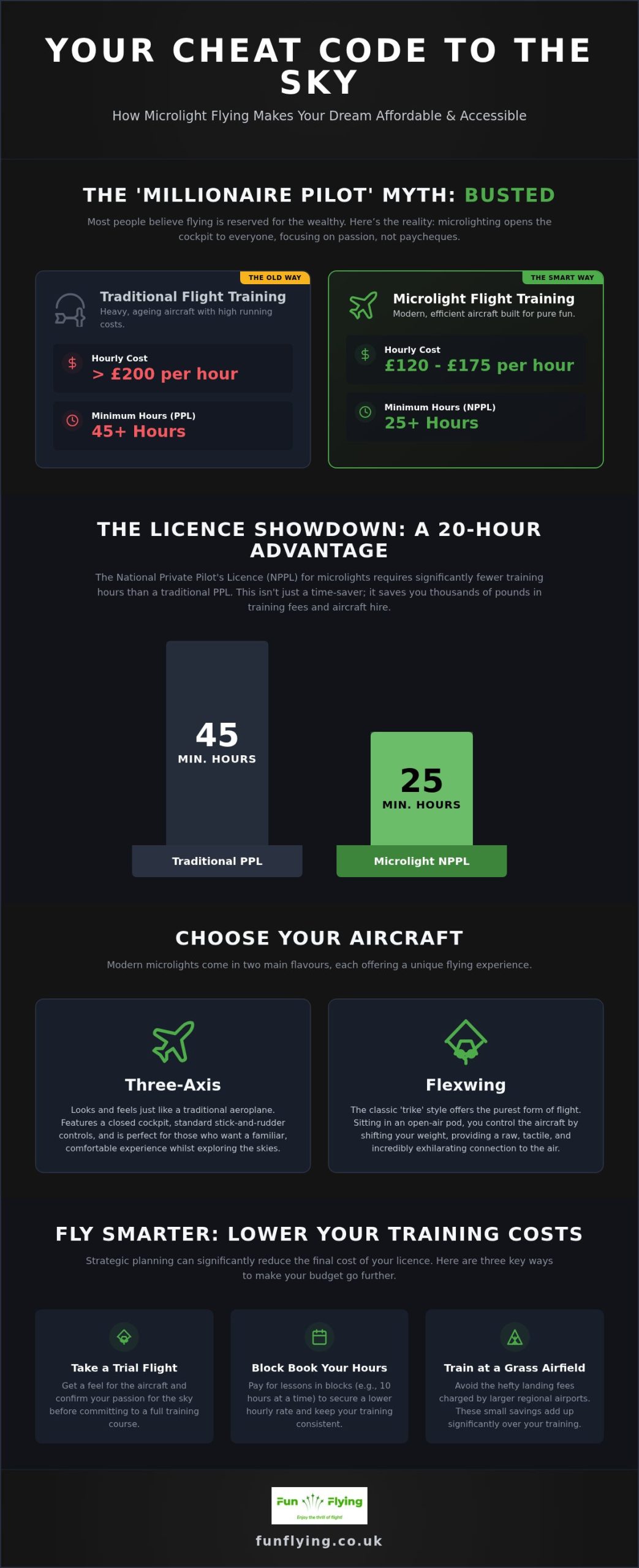
Your High-Energy Path to the Clouds in Wiltshire
Yatesbury is more than just an airfield; it is a vibrant community of like-minded adventurers. Finding affordable microlight lessons UK based doesn’t mean compromising on the quality of your experience or the beauty of your surroundings. Our Wiltshire Microlight Centre offers a relaxed, peer-to-peer environment that completely removes the “stiff” or intimidating feeling often found in traditional aviation circles. Here, the focus is purely on the joy of the journey and the raw thrill of every take-off.
You won’t be stuck in a classroom for weeks on end before you finally get to see the sky. We believe the best way to learn is by doing. That is why our students take control from their very first lesson. You will feel the lift under the wings, manage the turns yourself, and experience the incredible autonomy that only a microlight can provide. It is a high-energy path that instantly transforms your perspective on the world below. If you are inspired by these aerial views and need professional footage for a business project, you can visit Impact Aerial for expert drone photography and surveying. Whether you are aiming for a full licence or just want to feel the wind in your face, the atmosphere amongst our pilots is inclusive and encouraging. Beginners and veterans alike swap stories and tips, creating a supportive network that makes every visit feel like a day out with friends.
Why Yatesbury is the Perfect Training Ground
The Wiltshire landscape is truly spectacular from a bird’s-eye view. Soaring over the rolling green hills and ancient landmarks like the Cherhill White Horse provides a sense of scale and beauty that you just can’t get from the ground. Our location is also incredibly practical for those living in the South West. We are situated perfectly for easy weekend visits from major hubs like Swindon, Bristol, and Reading.
This proximity means you can spend more time in the air and less time in traffic. If you are based in the area and want to discover everything the local skies have to offer, our complete guide to microlight flying near Swindon covers everything from your first trial lesson to earning your wings over the Wiltshire countryside. It is the ideal “centre” for your new hobby. If you have been waiting for a sign to start your aviation journey, this is it. You can take control of the aircraft today without the elite price tag holding you back. Booking your first lesson is the first step toward a lifetime of freedom. Join us, and let’s get you airborne.
Ready to Claim Your Place in the Sky?
You now know that the cockpit isn’t just a playground for the super-rich. By choosing the NPPL route and focusing on smart training strategies, you’ve discovered the ultimate “cheat code” to British aviation. Whether you prefer the classic three-axis look or the open-air thrill of a flexwing, the path to your licence is clearer and more accessible than ever before. Choosing affordable microlight lessons UK at a dedicated centre like Yatesbury ensures you spend your budget on actual flight time rather than unnecessary overheads.
With our friendly, expert instructors in Wiltshire, you don’t just watch from the sidelines. You take control from your very first lesson. Our flexible schedules mean you can earn your wings at a pace that suits your busy lifestyle. There is nothing quite like the feeling of that first solo take-off.
The horizon is waiting for you. It’s time to stop looking up and start looking down. We can’t wait to see you on the airfield and help you join our community of flyers.
Frequently Asked Questions
What is the absolute cheapest way to learn to fly in the UK?
Microlighting is the most cost-effective path into the sky for recreational pilots today. By choosing a National Private Pilot’s Licence (NPPL) for microlights, you avoid the massive fuel and maintenance overheads associated with heavier, traditional aircraft. Selecting affordable microlight lessons UK wide allows you to focus on a streamlined training syllabus that prioritises pure flying skills over the expensive complexity of commercial-grade systems.
How much does a microlight pilot licence cost on average in 2026?
The total investment for your licence is significantly lower than a traditional Private Pilot’s Licence, which can now cost upwards of £19,000 in the UK. Whilst your final bill depends on how quickly you progress, you will save thousands by requiring fewer training hours and paying lower hourly rates for the aircraft. For a full, itemised picture of what to expect, our dedicated guide to microlight pilot training cost in 2026 provides a transparent breakdown of every stage of your journey. Most students find that training at a dedicated grass airfield further reduces costs by avoiding the high landing fees charged at larger regional airports.
Can I learn to fly a microlight if I have no previous experience?
You absolutely can start your aviation journey with zero previous experience. Most student pilots begin with nothing more than a passion for flight and a desire to take the controls. Just as Rising Tones Music helps students of all ages master the foundations of music, our instructors specialise in taking beginners from their very first trial flight through to their final skills test. You will be guided through every technical and practical step in a supportive, peer-to-peer environment that makes learning feel like an adventure rather than a chore.
Is a microlight licence recognised for flying outside of the UK?
The NPPL (M) is a national licence designed primarily for flying UK-registered microlights within UK airspace. It is a sub-ICAO licence, which means it doesn’t have the same automatic international recognition as a standard PPL. However, it is the perfect choice for recreational pilots who want to explore the incredible landscapes of the British Isles. If you eventually decide to fly abroad or aim for a career in commercial aviation, your experience provides a fantastic foundation for advanced training with 2FLY Airborne.
How many hours of flight training are required for an NPPL (M)?
You are required to complete a minimum of 25 hours of flight training for an unrestricted microlight licence. This must include at least 10 hours of solo flight time to ensure you are confident and capable in the cockpit. If you prefer to stay closer to home, a restricted licence is available with just 15 hours of training. Most students find that a consistent schedule helps them reach the required standard efficiently without needing extra remedial lessons.
